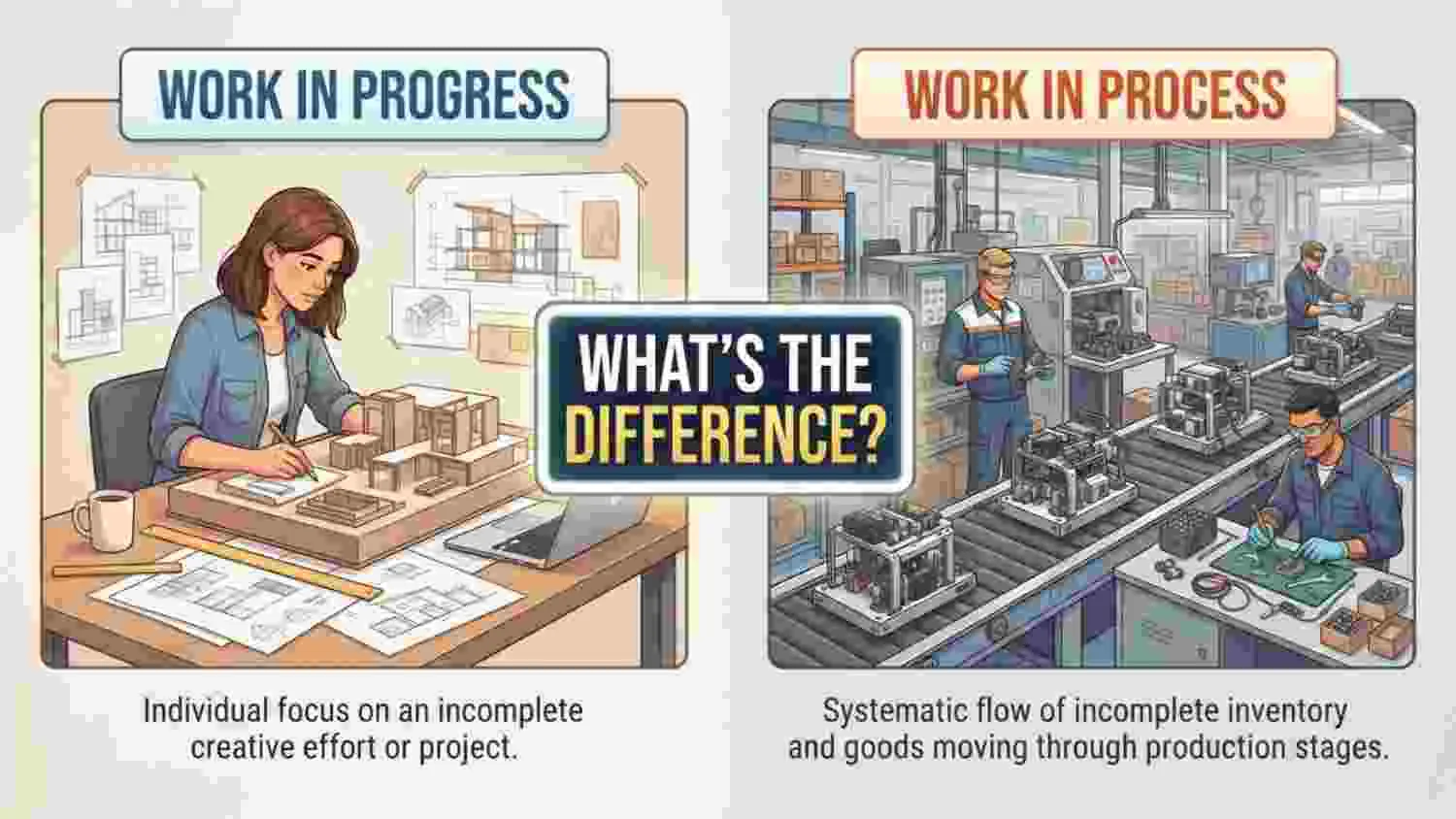
Choosing between work in progress vs work in process can be confusing because both phrases describe something that is not finished. In many cases, people even use them as synonyms.
For most everyday writing, work in progress is the better choice when you mean that a project, task, essay, design, or other piece of work is still being completed. Oxford defines work in progress as a project that is not yet finished and is still being developed.
Work in process also has a real meaning. It is especially common in manufacturing, accounting, and production. It can describe goods that have started production but are not yet finished.
This difference is useful when you write emails, reports, school work, business documents, or project updates. You will also see both phrases shortened to WIP, depending on the context.
Below, you will learn when to use each phrase, what they mean, how they differ, common mistakes, and simple examples.
Work in Progress vs Work in Process – Quick Answer
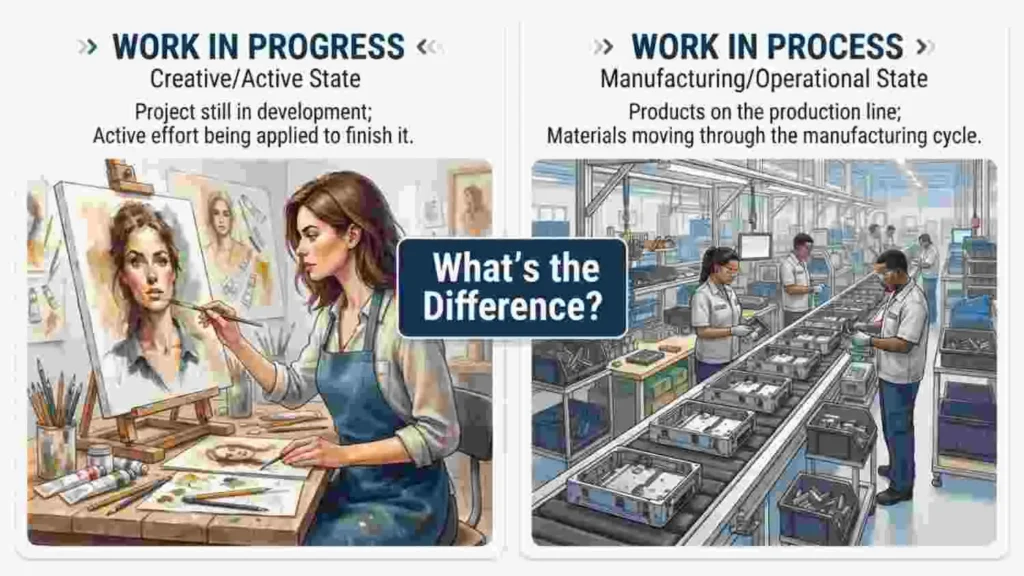
Work in process can have the same general meaning, but it is often used in manufacturing, production, and accounting for partially finished goods.
Simple rule
- Work in progress = an unfinished project, task, essay, idea, or piece of work.
- Work in process = unfinished work, especially goods or tasks moving through a production process.
For example:
My website is still a work in progress.
The factory has a large amount of work-in-process inventory.
If you are talking about a normal project or something you are still improving, work in progress is usually the clearest choice.
What Does Work in Progress Mean?
Work in progress means something has started but is not finished.
It can describe many kinds of work:
- A school essay
- A website
- A painting
- A building project
- A book
- A business plan
- A personal skill
- A software project
Oxford gives the example of an essay that is still a work in progress.
Examples
My new website is a work in progress.
The painting is still a work in progress.
This report is a work in progress.
The phrase can also describe something that is slowly improving.
My English is still a work in progress.
Here, the speaker means that their English is not perfect yet, but they are still working on it.
What Does Work in Process Mean?
Work in process means work that is currently going through a process but is not complete.
The phrase is especially common in manufacturing and accounting.
For example, a factory may start making a product. The product may have some parts added, but it is not ready to sell yet. That product can be called work in process or work-in-process inventory.
Example
The factory has 500 units of work in process.
The products have started production. They still need more work before they become finished goods.
In accounting, work in process can also refer to the costs tied to unfinished goods, including materials, labor, and factory costs.
Main Difference Between Work in Progress and Work in Process
The phrases overlap, but their common uses are different.
Work in Progress
Use work in progress when you mean:
- A project that is not finished
- Something being developed
- An unfinished piece of creative work
- A task that is still being done
- Something that is improving
Example:
My novel is a work in progress.
Work in Process
Use work in process when you mean:
- Goods being made
- Products that are partly finished
- Manufacturing work
- Production inventory
- Work moving through a production system
Example:
The company recorded its work in process at the end of the month.
There is some overlap. Business and accounting sources may use the two phrases in similar ways. AccountingCoach, for example, explains that its own use of work-in-process refers to unfinished manufacturer inventory.
Work in Progress vs Work in Process in Simple English
Think about the two words progress and process.
Progress focuses on moving toward completion.
The project is making progress.
Process focuses on the steps used to complete something.
The product is going through a process.
This gives you a useful memory trick:
Project → Work in progress
Production → Work in process
This is not an absolute grammar rule, but it is a helpful guide for everyday use.
Origin and History
The two phrases developed from common English words.
Progress comes from the idea of moving forward or moving toward a goal. In work in progress, the focus is on work that is moving toward completion.
Process refers to a series of actions or steps used to produce a result. In work in process, the focus can be on work moving through those steps.
Modern business and manufacturing language uses work in process as a term for unfinished goods. At the same time, work in progress has a broad everyday meaning for unfinished work.
Both phrases are also abbreviated as WIP in different contexts. Collins lists WIP as work in progress in British English and both work in process and work in progress in American English. )
British English vs American English
There is a usage difference worth knowing.
Work in progress is widely used in both British and American English for something unfinished.
Work in process is also used in American English, especially in business, manufacturing, and accounting.
Collins lists WIP as work in progress in British English. For American English, it lists both work in process and work in progress. )
However, this does not mean that British speakers never use work in process, or that Americans only use work in process. The meaning and field matter.
Examples
General English:
The project is a work in progress.
Manufacturing:
The company tracks its work in process inventory.
So, there is no simple rule that says one phrase belongs only to Britain and the other only to America.
Which One Should You Use?
For most general writing, choose work in progress.
It is a clear choice when you mean that something is unfinished.
Use Work in Progress For:
School:
My research paper is still a work in progress.
Work:
The new website is a work in progress.
Creative work:
This painting is a work in progress.
Personal growth:
Learning a new language is a work in progress.
Online posts:
Here is my latest drawing. Still a work in progress!
Use Work in Process For:
Use work in process when you are talking about production or unfinished goods.
The factory has $50,000 of work-in-process inventory.
It is also used in some project management and business settings. The Project Management Institute’s lexicon defines work in process as project tasks or activities that are in progress but not yet completed.
For Formal Writing
Use the phrase that matches the field.
If you are writing about a normal project, work in progress is a safe and natural choice.
If you are writing an accounting or manufacturing report, check the terms used by your company or industry. Work in process may be the preferred term.
Common Mistakes
Mistake 1: Using Work in Process for Every Project
Incorrect or less natural:
My essay is a work in process.
Better:
My essay is a work in progress.
Why?
For a normal unfinished essay, work in progress sounds more natural.
Mistake 2: Thinking Work in Process Is Always Wrong
Incorrect idea:
Work in process is not a real English phrase.
Correct:
Work in process is a valid phrase.
It is especially common in manufacturing, production, and accounting.
Mistake 3: Writing “Works in Progress” for One Project
Incorrect:
My book is a works in progress.
Correct:
My book is a work in progress.
Why?
Use the singular phrase when you are talking about one unfinished project.
Mistake 4: Confusing Progress With Process
Incorrect:
My painting is a work in process.
Better:
My painting is a work in progress.
Why?
For an unfinished creative project, work in progress is the usual phrase.
Mistake 5: Using the Wrong Form in Manufacturing
Less precise:
The factory has unfinished work.
Better:
The factory has work-in-process inventory.
Why?
The more specific term helps explain that the goods have entered production but are not finished.
Mistake 6: Treating WIP as Only One Phrase
Incorrect idea:
WIP always means work in progress.
Better:
WIP can mean work in progress or work in process, depending on the context.
Dictionary.com lists both meanings for the abbreviation WIP.
12 Everyday Examples
Here are simple examples of both phrases.
- My new book is a work in progress.
- The website is still a work in progress.
- Her painting remains a work in progress.
- Learning English is a work in progress for him.
- The report is a work in progress.
- Our office renovation is still a work in progress.
- The factory has several units of work in process.
- The accountant checked the work-in-process inventory.
- The unfinished products remain work in process.
- The factory tracks its work in process each month.
- The new design is still a work in progress.
- The production team moved the work in process to the next stage.
Real-Life Usage
In Conversations
People often use work in progress when talking about projects.
“How is your new house?”
“It is still a work in progress.”
This sounds natural and friendly.
In Emails
You may write:
The new website is still a work in progress, but we expect to finish the main pages soon.
For manufacturing:
Please review the attached work-in-process inventory report.
In School
A student can say:
My final paper is still a work in progress.
A teacher might use the phrase to describe a draft that needs more work.
At Work
A manager might say:
The new system is a work in progress.
An accountant may use:
work-in-process inventory
when discussing unfinished products.
On Social Media
Work in progress is common in posts about art, writing, photography, design, and other creative work.
New painting! Still a WIP.
Dictionary.com notes that WIP is commonly used online for unfinished artwork.
In Formal Writing
Both terms can appear in formal writing, but the field matters.
For a general project:
The research project remains a work in progress.
For manufacturing:
The company reported an increase in work-in-process inventory.
Related Search Questions
Is “work in progress” correct?
Yes. Work in progress is a standard phrase for something that has started but is not finished. It works well for projects, essays, artwork, websites, plans, and personal development. Oxford lists it as a noun meaning a project that is not yet finished and is still being developed.
Is “work in process” correct?
Yes. Work in process is a valid English phrase. It is often used in manufacturing and accounting for unfinished goods or inventory. It can also be used more broadly in some business and project settings.
Is work in progress the same as work in process?
They can have the same general meaning: work that is not finished. But they are not always used in the same way. Work in progress is common for general unfinished projects, while work in process is especially common for production and manufacturing.
Which is better: work in progress or work in process?
For a normal unfinished project, work in progress is usually the clearest choice. For manufacturing or inventory, work in process may be the better term. The right choice depends on the context.
Can I say “my project is a work in process”?
People may understand it, and the phrase exists in English. However, my project is a work in progress is the more natural choice for general writing.
What does WIP mean?
WIP commonly means work in progress or work in process. The exact meaning depends on the context. In a social media post about artwork, WIP usually means an unfinished work. In manufacturing, WIP may refer to unfinished production or inventory.
Should work in progress have hyphens?
As a noun phrase, work in progress is commonly written without hyphens.
When the phrase works as a compound adjective before another noun, work-in-progress may be used.
For example:
The project is a work in progress.
The company reviewed its work-in-progress inventory.
Style guides and dictionaries can vary, so follow the style used by your organization.
Usage and Search Trends
There is no reliable need to use made-up search volume or Google Trends numbers for this phrase. The useful search pattern is clear from dictionary and professional usage.
People generally search for the phrase because they want to know whether work in progress or work in process is correct.
The context gives the best answer:
- General unfinished work: work in progress
- Creative project: work in progress
- School project: work in progress
- Website or design: work in progress
- Manufacturing: work in process is common
- Inventory and accounting: work in process is common
- Project management: both terms can appear
There is also real overlap. Professional references note that the two terms can be used interchangeably in some settings.
Work in Progress vs Work in Process Comparison Table
| Term | Meaning | Common Usage | Example |
| Work in progress | Something started but not finished | General English, projects, creative work | My book is a work in progress. |
| Work in process | Work moving through a process and not yet complete | Manufacturing, production, accounting | The factory tracks work in process. |
| Work-in-progress | Hyphenated form used in some compound uses | Business and descriptive writing | Work-in-progress items need review. |
| Work-in-process | Hyphenated form used in some compound uses | Manufacturing and accounting | The report shows work-in-process inventory. |
| WIP | Short form for either phrase | Business, manufacturing, online posts | The drawing is still a WIP. |
FAQs
1. Which is correct, work in progress or work in process?
Both are correct English phrases. The best choice depends on the context. Work in progress is the usual choice for a general unfinished project or piece of work. Work in process is common in manufacturing, production, and accounting, especially when discussing unfinished goods or inventory.
2. Is “work in progress” more common in everyday English?
For general writing and conversation, work in progress is a very natural choice. People use it for projects, artwork, writing, websites, home improvements, and personal development. It tells the reader that something has started but still needs more work.
3. Does “work in process” mean unfinished work?
Yes. Work in process can mean unfinished work. In business and manufacturing, it often refers to goods that have entered production but have not become finished products. Some references also use the phrase more broadly for tasks that are still being completed.
4. What is a work-in-process inventory?
Work-in-process inventory is unfinished production. It includes goods that have started the manufacturing process but are not yet ready as finished products. Accounting systems track this inventory because materials, labor, and other production costs may already have been added to those goods.
5. Can “work in progress” describe a person?
Yes. It can describe a person in a figurative way when someone is still learning or improving. For example, someone might say, “I am a work in progress.” This means they are still growing or working on themselves.
6. Is WIP short for work in progress?
Yes, but not always. WIP can stand for work in progress and work in process. The meaning depends on the setting. In an art post, WIP usually means an unfinished work. In manufacturing, it may refer to work-in-process inventory.
7. Is “work in process” American English?
It is used in American English, especially in business, manufacturing, and accounting. But it is not limited to American English. Work in progress is also widely used in American English, and British English commonly uses it as well. The field and context matter more than a simple country rule.
Conclusion
The choice between work in progress vs work in process depends mainly on what you are talking about.
Use work in progress for a project, task, essay, painting, website, plan, or other work that has started but is not finished. It is the natural choice for most everyday situations.
Use work in process when you are talking about work moving through a process, especially in manufacturing, production, and accounting. It often refers to goods that have started production but are not yet finished.
Both phrases are correct, and they can overlap. Some professional sources use them as synonyms, while others make a clearer distinction based on the field.
The easiest rule is:
General project = work in progress
Production or unfinished inventory = work in process
You may also see both phrases shortened to WIP. The meaning of WIP depends on the context.
So, if you are writing, “My project is a work in progress” is usually the safest choice. If you are discussing unfinished products in a factory, “work in process” may be the more suitable term.

Emily Carter is an English grammar writer based in Portland, Oregon, with 7+ years of experience turning tricky grammar rules into simple, easy lessons.