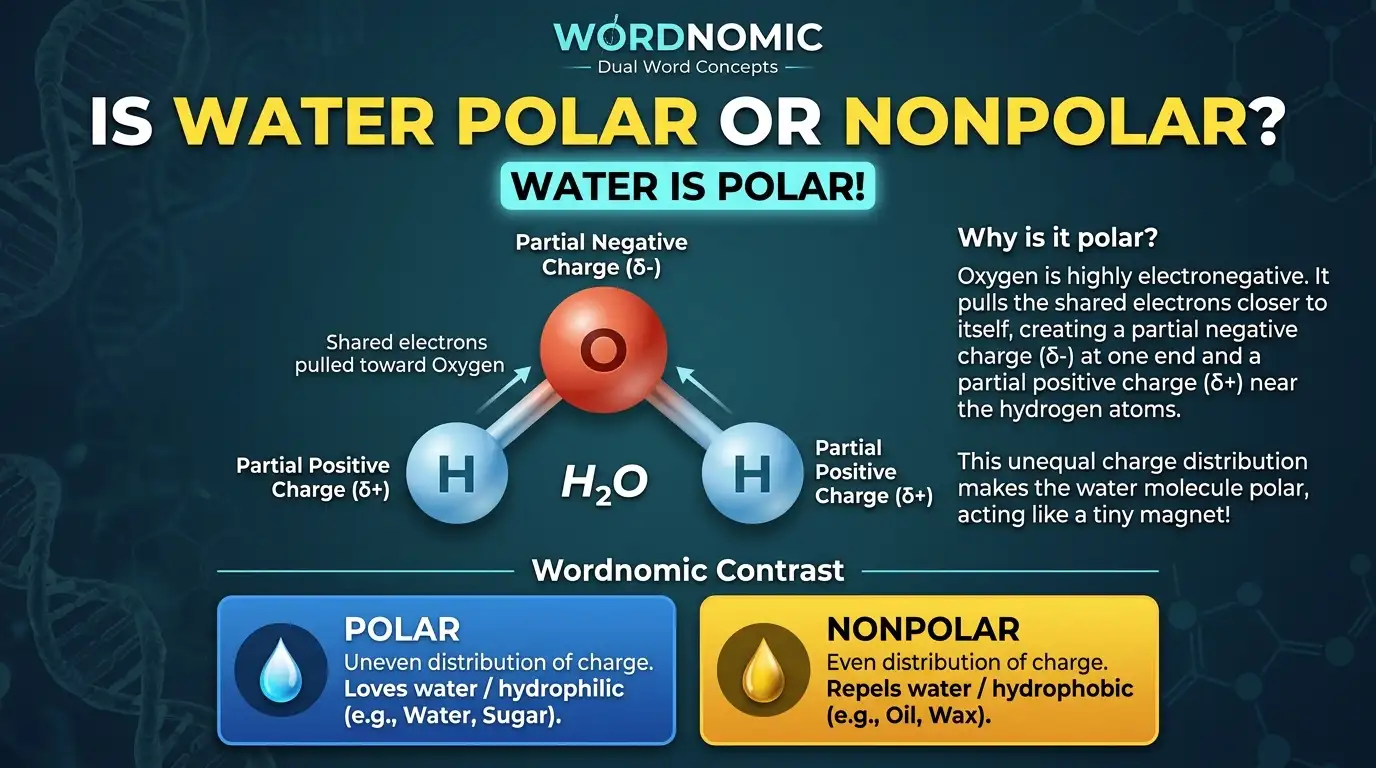
Water is polar, not nonpolar. Each water molecule (H₂O) has an uneven distribution of electrical charge. This happens because oxygen attracts the shared electrons more strongly than hydrogen does.
Water has two hydrogen atoms and one oxygen atom. Oxygen carries a slight negative charge, while the hydrogen atoms carry slight positive charges. These small charges make water a polar molecule.
Water’s polarity helps explain many of its special properties. For example, water can dissolve many substances, such as table salt and sugar. It also helps water molecules attract one another, which gives water a relatively high boiling point and strong surface tension.
In this article, you will learn why water is polar, how its molecular shape affects polarity, and how water differs from nonpolar molecules.
Is Water Polar or Nonpolar?
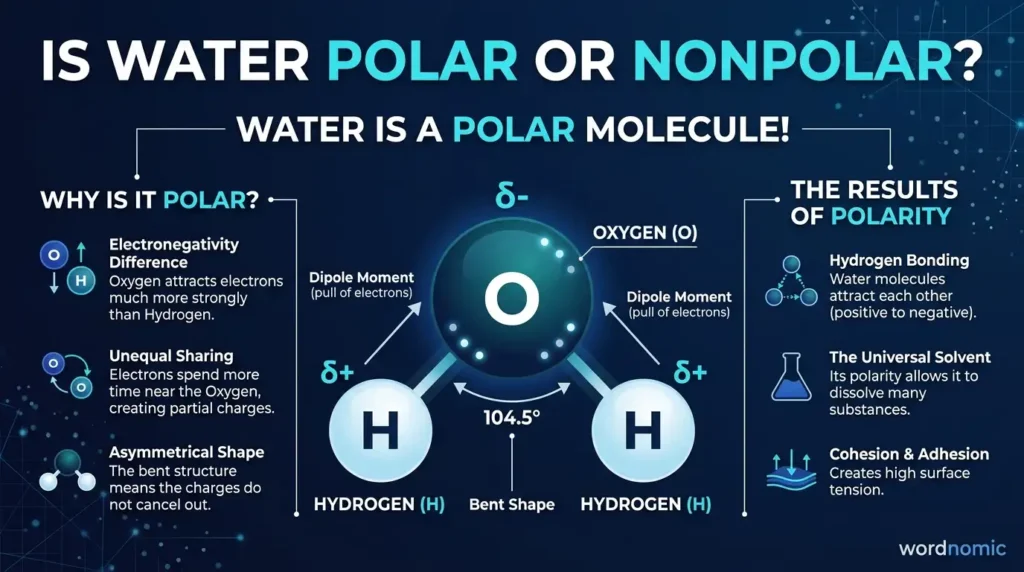
Water is a polar molecule because it has an uneven distribution of electrical charge.
Two main factors explain why water is polar:
- Electronegativity: Oxygen attracts shared electrons more strongly than hydrogen.
- Molecular shape: Water has a bent shape, so the electrical effects of its two O-H bonds do not cancel each other out.
As a result, the oxygen side of the molecule is slightly negative, and the hydrogen side is slightly positive. This creates a net dipole, which means water has an overall separation of electrical charge.
Why Is Water Polar?
Water’s polarity comes from its chemical bonds and its molecular shape. Both are important for understanding how the molecule behaves.
1. Oxygen Is More Electronegative Than Hydrogen
Electronegativity describes how strongly an atom attracts shared electrons in a chemical bond.
Oxygen is more electronegative than hydrogen. When oxygen bonds with hydrogen, it pulls the shared electrons closer to itself.
This creates an uneven sharing of electrons.
- Oxygen develops a partial negative charge (δ−).
- Each hydrogen develops a partial positive charge (δ+).
These are partial charges, not full electrical charges. The molecule remains electrically neutral overall.
2. Water Has a Bent Molecular Shape
A water molecule does not have a straight shape. Its two O-H bonds form a bent structure, with a bond angle of about 104.5 degrees.
Oxygen also has two lone pairs of electrons. These electron pairs help give water its bent shape.
Because of this shape, the two bond dipoles do not cancel each other out. Instead, they combine to create a net dipole pointing toward the oxygen side.
This is why water is polar.
Water’s Molecular Structure
Water has the chemical formula H₂O. Each molecule contains one oxygen atom bonded to two hydrogen atoms.
The basic structure looks like this:
H–O–H
However, this simple formula does not show the actual three-dimensional shape. Water is bent rather than linear.
The oxygen atom sits at the center, with the two hydrogen atoms forming an angle of approximately 104.5 degrees.
Oxygen attracts electrons more strongly, making its side partially negative. The hydrogen side is partially positive.
This arrangement creates the molecule’s overall polarity.
What Is the Difference Between Polar and Nonpolar Molecules?
Polar and nonpolar molecules differ in how their electrical charges are distributed.
| Property | Polar Molecules | Nonpolar Molecules |
| Charge distribution | Uneven | Even overall |
| Net dipole | Usually present | Absent |
| Electron sharing | May be unequal | May be equal, or bond effects cancel |
| Interaction with water | Often mix well with water | Often mix poorly with water |
| Examples | Water (H₂O), ammonia (NH₃) | Methane (CH₄), carbon dioxide (CO₂) |
One important point is that a molecule can contain polar bonds but still be nonpolar overall. Carbon dioxide (CO₂), for example, has polar C=O bonds, but its linear shape causes the bond dipoles to cancel.
Water has polar bonds and a bent shape, so its bond dipoles do not cancel.
How Does Water’s Polarity Affect Its Properties?
Water’s polarity explains several important properties that make it useful in nature and everyday life.
Water Dissolves Many Substances
Water is often called the universal solvent because it dissolves many different substances, although it cannot dissolve everything.
Its partial charges attract ions and other polar molecules. For example, water molecules surround sodium and chloride ions when table salt dissolves in water.
This helps separate the ions and spread them through the liquid.
Water can also dissolve polar substances such as sugar. However, nonpolar substances, such as oil, generally do not mix well with water.
Water Molecules Form Hydrogen Bonds
The partially positive hydrogen atoms of one water molecule can attract the partially negative oxygen atom of another.
These attractions are called hydrogen bonds.
Hydrogen bonding helps explain why water has a relatively high boiling point compared with similar small molecules. It also contributes to water’s surface tension and other physical properties.
Water Has High Surface Tension
Water molecules attract one another through intermolecular forces, including hydrogen bonding.
At the surface, these attractions create a strong resistance to increasing the liquid’s surface area. This property is called surface tension.
It helps explain why small insects can move across still water and why water forms rounded droplets on some surfaces.
Is Water More Polar Than Other Molecules?
Water is a strongly polar molecule, but polarity differs among molecules.
For example, methane (CH₄) is nonpolar because its symmetrical shape causes the bond dipoles to cancel. Ammonia (NH₃) is polar because its molecular shape produces a net dipole.
Water’s polarity is also linked to its strong hydrogen-bonding behavior. However, polarity and hydrogen bonding are not the same thing. Polarity describes the distribution of electrical charge, while hydrogen bonding is an attraction between suitable molecules or parts of molecules.
Frequently Asked Questions
Is H₂O polar or nonpolar?
H₂O is polar. Oxygen attracts shared electrons more strongly than hydrogen, and the molecule’s bent shape prevents its bond dipoles from canceling.
Why is water polar but carbon dioxide nonpolar?
Water has a bent shape, so its O-H bond dipoles do not cancel. Carbon dioxide has a linear shape, so its two C=O bond dipoles cancel each other out.
Does water have a positive or negative charge?
A water molecule has no overall electrical charge. Its oxygen side is partially negative, and its hydrogen side is partially positive.
Is ice polar?
Yes. The H₂O molecules in ice remain polar. When water freezes, the molecules arrange themselves into a solid structure, but each molecule retains its polar character.
Is water a polar covalent molecule?
Yes. Water contains polar covalent O-H bonds because oxygen and hydrogen share electrons unequally. The molecule as a whole is also polar.
Can polar and nonpolar substances mix?
Some can, but many do not mix well. Polar substances often mix with polar solvents, while nonpolar substances often mix with nonpolar solvents. This is commonly summarized as “like dissolves like,” although actual solubility depends on several factors.
Conclusion
Water is polar because oxygen attracts shared electrons more strongly than hydrogen, and the molecule has a bent shape. These two factors create an uneven distribution of electrical charge and give water a net dipole.
Water’s polarity helps it dissolve many substances, form hydrogen bonds, and display properties such as high surface tension. Understanding water’s polarity is an important first step in learning about chemical bonds, molecular geometry, and solubility.

Emily Carter is an English grammar writer based in Portland, Oregon, with 7+ years of experience turning tricky grammar rules into simple, easy lessons.