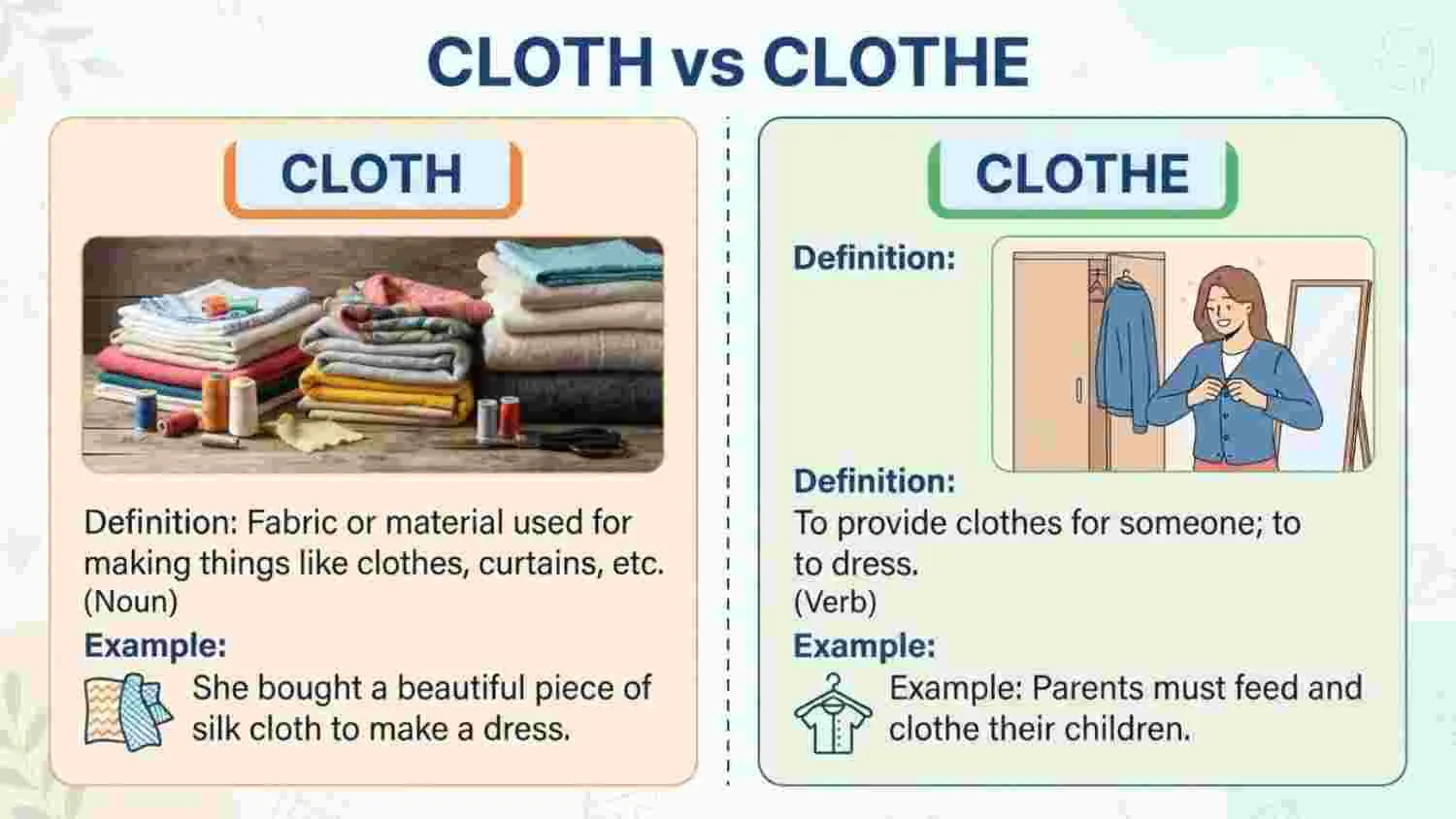
When you see cloth vs clothe, the two words can look almost the same. They also sound similar, which makes them easy to mix up. But they have different meanings and different jobs in a sentence.
Cloth is mainly a noun. It means a piece or type of fabric or material used to make clothes and other things.
Clothe is a verb. It means to dress someone or provide someone with clothes.
For example:
- This cloth is soft.
- Parents clothe their children.
The small e at the end changes the word from a thing into an action. This is why knowing the difference matters in school writing, work emails, and everyday English.
This guide explains the difference between cloth and clothe in simple English. You will learn their meanings, grammar, correct use, common mistakes, word history, examples, and easy ways to remember which word to use.
Cloth vs Clothe – Quick Answer

Cloth is a noun. It means fabric or material used to make things such as clothes.
Clothe is a verb. It means to dress someone or give someone clothes.
Simple rule:
- Cloth = material
- Clothe = dress someone
Examples:
I bought some cloth for a new shirt.
The charity helps clothe poor families.
So, cloth names a material, while clothe describes the act of dressing someone.
What Does Cloth Mean?
Cloth is a noun. It usually means a piece or type of fabric.
Cloth can be made from materials such as:
- Cotton
- Wool
- Silk
- Linen
- Polyester
For example:
The tailor chose a soft cloth for my shirt.
The word can also mean a small piece of fabric used for cleaning or other tasks.
Use a clean cloth to wipe the table.
Cloth as a Material
When you talk about fabric in general, cloth can describe the material used to make clothes.
This cloth is made from cotton.
She bought blue cloth for a dress.
Cloth as a Piece of Fabric
Cloth can also mean a piece of fabric.
Put a clean cloth over the bowl.
He used a cloth to clean his glasses.
What Does Clothe Mean?
Clothe is a verb. It means to dress someone or to provide someone with clothes.
For example:
The mother clothed her baby in warm clothes.
The group works to clothe people in need.
It can also be used in a more formal style.
The program helps clothe children during winter.
The verb clothe is less common in normal daily speech than dress. Most people would say:
We need to dress the child.
rather than:
We need to clothe the child.
However, clothe is correct, especially when the focus is on providing clothes.
Main Differences Between Cloth and Clothe
The biggest difference is their part of speech and meaning.
1. Cloth Is a Noun
A noun names a person, place, thing, or idea.
Cloth names a type of material or fabric.
I need more cloth for this project.
2. Clothe Is a Verb
A verb shows an action.
Clothe means to dress someone or provide them with clothes.
The charity helps clothe families.
3. Cloth Talks About Material
The cloth feels soft.
Here, cloth refers to fabric.
4. Clothe Talks About Dressing
They clothe their children in warm clothes.
Here, clothe describes the action of giving or putting clothes on someone.
Cloth vs Clothe: Easy Comparison
| Term | Meaning | Part of Speech | Example |
| Cloth | Fabric or material | Noun | The cloth is very soft. |
| Clothe | To dress or provide clothes | Verb | They clothe the children. |
A quick memory trick is:
Cloth = thing
Clothe = action
The extra e in clothe can help you remember that it is the verb.
Cloth, Clothes, and Clothe
These three words are often confused.
Cloth
Cloth means fabric or material.
The cloth is made of cotton.
Clothes
Clothes means the things people wear.
My clothes are in the closet.
Clothe
Clothe means to dress someone or provide clothes.
The charity helps clothe families.
So remember:
Cloth = fabric
Clothes = things you wear
Clothe = dress or provide clothes
A Simple Example
The store sells cloth.
I bought new clothes.
The charity helps clothe people.
This makes the difference much easier to see.
Origin and History of Cloth and Clothe
Cloth and clothe are old English words that are closely related.
Cloth comes from Old English clāþ, a word connected with fabric or material.
Clothe developed from the same word family and came to mean putting clothes on someone or supplying clothing.
The words have stayed related over time, but modern English gives them different roles.
Today:
- Cloth usually refers to fabric or material.
- Clothes refers to things people wear.
- Clothe means to dress or provide clothing.
Their shared history helps explain why they look so similar.
British English vs American English
There is no major British vs American spelling difference between cloth and clothe.
Both forms are standard in British English and American English.
| Word | British English | American English |
| Cloth | Cloth | Cloth |
| Clothe | Clothe | Clothe |
| Clothes | Clothes | Clothes |
The main difference is not regional spelling. It is meaning and grammar.
Both British and American speakers use cloth for fabric and clothe as a verb.
However, clothe can sound more formal than dress in everyday conversation.
Which One Should You Use?
Use cloth when you mean fabric or material.
I bought some cloth for a new shirt.
Use clothe when you mean to dress someone or provide clothing.
The charity helps clothe families.
For normal conversation, dress is often more natural than clothe.
She dressed the baby.
This does not mean clothe is wrong. It simply has a more formal or broad use.
For School Writing
Use the word that matches your meaning.
The cloth is made from wool.
The group works to clothe children in need.
For Business Writing
Both words can be correct.
We ordered the cloth for the new uniforms.
The program aims to clothe workers who need protective clothing.
For Everyday Writing
Cloth is common when talking about fabric or cleaning materials.
Clothe is less common. Dress is often the easier choice.
Common Mistakes With Cloth and Clothe
Mistake 1: Using Clothe for Fabric
Incorrect:
This clothe is very soft.
Correct:
This cloth is very soft.
Why?
You are talking about fabric, so you need the noun cloth.
Mistake 2: Using Cloth as a Verb
Incorrect:
The charity clothes poor families.
Correct:
The charity clothes poor families.
Why?
The verb is clothe. In the third-person singular, it becomes clothes.
Mistake 3: Confusing Cloth With Clothes
Incorrect:
I put my cloth on before school.
Correct:
I put my clothes on before school.
Why?
Clothes means the items you wear. Cloth means fabric.
Mistake 4: Using Clothe for One Piece of Fabric
Incorrect:
She bought a beautiful clothe.
Correct:
She bought a beautiful cloth.
Why?
A piece of fabric is cloth, not clothe.
Mistake 5: Using Cloth When You Mean Dress
Incorrect:
She cloth the baby every morning.
Correct:
She clothes the baby every morning.
Or, more naturally:
She dresses the baby every morning.
Why?
Clothe is the verb. Cloth cannot be used as this verb.
Mistake 6: Writing Clothe Instead of Clothes
Incorrect:
My clothe are dirty.
Correct:
My clothes are dirty.
Why?
The things you wear are called clothes.
12 Everyday Examples
Here are simple examples that show how the words work.
- The cloth is soft and light.
- She bought red cloth for the dress.
- Use a clean cloth to wipe the glass.
- This cloth is made from cotton.
- The charity helps clothe poor families.
- Warm clothes can clothe people during cold weather.
- The parents clothed the child in warm clothes.
- The program helps clothe children in winter.
- The tailor needs more cloth for the uniforms.
- My clothes are still wet.
- The shop sells many types of cloth.
- The group works to clothe people who need help.
Notice that cloth, clothes, and clothe all have related meanings, but they do different jobs.
Real-Life Usage
In Conversations
People often use cloth when talking about fabric or cleaning.
“What is this cloth made of?”
For dressing someone, people usually say dress rather than clothe.
“I need to dress the baby.”
In School
A student may write:
Cotton is a common type of cloth.
In a lesson about verbs, they may see:
The parents clothe their children.
In Emails
Cloth can appear in emails about clothing production or materials.
We need to order more cloth for the uniforms.
Clothe may appear in formal charity or program writing.
The project aims to clothe families during winter.
In Work
A clothing company may discuss:
the type of cloth used in a product.
A charity may say:
The program helps clothe people in need.
On Social Media
People are more likely to use cloth and clothes than clothe.
For example:
“This cloth feels amazing!”
“I love these clothes!”
The verb clothe sounds more formal in many casual posts.
Related Search Questions
Is cloth a correct word?
Yes. Cloth is a standard English word. It is a noun that usually means fabric or material. For example, “This cloth is made of cotton.”
Is clothe a correct word?
Yes. Clothe is a standard English verb. It means to dress someone or provide someone with clothing. For example, “The charity helps clothe families.”
What is the difference between cloth and clothes?
Cloth means fabric or material. Clothes means the things people wear. For example, “The cloth is soft” and “My clothes are clean.”
What is the difference between clothe and clothes?
Clothe is a verb meaning to dress or provide clothing. Clothes is a noun meaning things that people wear.
They clothe the children.
The children’s clothes are clean.
Is clothe the same as dress?
They have a similar meaning, but they are not always used in the same way. Dress is much more common in everyday English. Clothe often sounds more formal and can focus on providing someone with clothing.
Can cloth be used as a verb?
In standard modern English, cloth is mainly used as a noun. If you mean “dress someone,” use clothe or the more common verb dress.
Is cloth singular or plural?
Cloth is usually a mass noun when it means fabric, so we normally say “some cloth” rather than “cloths.” Cloths can be used when talking about separate pieces or types of cloth, especially cleaning cloths.
Usage and Search Trends
There is no need to use search-volume numbers to understand this word pair. The main reason people search for cloth vs clothe is the close spelling and the related meaning.
The most useful distinction is grammatical:
- Cloth = noun
- Clothe = verb
- Clothes = noun for things people wear
- Clothed = past form of clothe
In everyday English, cloth and clothes are more familiar words. Clothe is correct but can sound more formal than dress.
Cloth vs Clothe Comparison Table
| Feature | Cloth | Clothe |
| Part of speech | Noun | Verb |
| Main meaning | Fabric or material | To dress or provide clothing |
| Talks about | A thing/material | An action |
| Common use | Very common | Less common |
| Example | The cloth is blue. | They clothe the children. |
| Related word | Clothes | Clothed, clothing |
| British spelling | Cloth | Clothe |
| American spelling | Cloth | Clothe |
FAQs
1. What is the simple difference between cloth and clothe?
Cloth is a noun that means fabric or material. Clothe is a verb that means to dress someone or provide clothing. The words are related, but they cannot normally replace each other. Think of cloth as a thing and clothe as an action.
2. Is “clothe” a verb?
Yes. Clothe is a verb. It means to dress someone or give someone the clothes they need. Its forms include clothed and clothing. For example: “The charity helps clothe families.”
3. What is the plural of cloth?
The usual word for fabric remains cloth when it is used as a mass noun. However, cloths can mean separate pieces of cloth, especially cleaning cloths. For example: “The cleaner used several cloths.”
4. Are cloth and clothes the same?
No. Cloth means fabric or material. Clothes means items that people wear. For example, “The shirt is made from soft cloth” and “I washed my clothes.”
5. Is clothe used in everyday English?
Yes, but it is less common than dress in casual speech. A person might say “I need to dress the baby” rather than “I need to clothe the baby.” Clothe is still correct and often appears in formal, charity, or general writing.
6. What is the past tense of clothe?
The common past form is clothed. For example: “The parents clothed the child in warm clothes.” The word clothed can also work as a past participle.
7. How can I remember cloth vs clothe?
Use this simple rule: cloth = material, while clothe = dress. Also remember clothes = things you wear. If you can replace the word with “fabric,” choose cloth. If you can replace it with “dress,” choose clothe.
Conclusion
The difference between cloth and clothe is simple once you look at their jobs in a sentence.
Cloth is a noun. It means fabric or material. You can use it when talking about cotton, wool, silk, or a piece of fabric.
Clothe is a verb. It means to dress someone or provide someone with clothes. It is correct English, but dress is often more common in everyday speech.
Do not confuse either word with clothes. Clothes means the things people wear.
A simple way to remember all three is:
Cloth = fabric
Clothes = things you wear
Clothe = dress someone
There is no major British and American spelling difference here. The key difference is meaning and grammar. Once you learn which job each word does, choosing the right one becomes easy.
If you are talking about material, use cloth. If you are talking about dressing or providing clothing, use clothe.you mean shirts, pants, dresses, or other things people wear, use clothes.