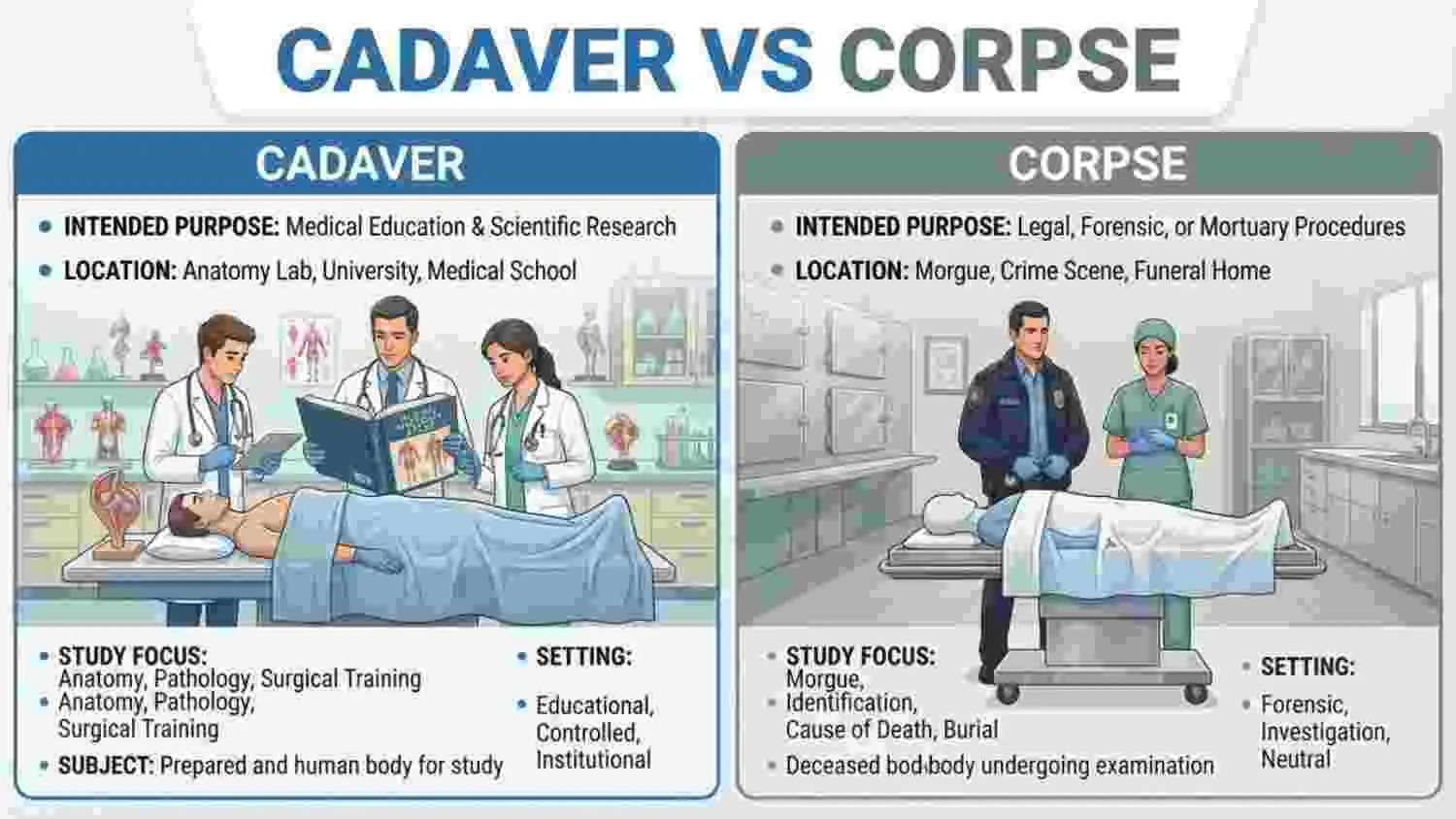
The words cadaver vs corpse both refer to a dead human body, so it is easy to think they mean exactly the same thing. In many sentences, they can be used in place of each other. However, there is a clear difference in tone and context.
A cadaver is a dead human body, but the word is especially common in medical, scientific, and anatomy settings. Medical students, researchers, and doctors may use the term when talking about human bodies used for study or dissection. Cambridge labels cadaver as a specialized medical term.
A corpse is a more general word for a dead body, usually a person. It is common in news reports, crime stories, books, and general descriptions of death.
So, the main difference is not that one word means “dead body” and the other means something else. Both can describe a dead human body. The key difference is how and where people use them.
This guide explains the meanings, history, tone, examples, common mistakes, and best use of each word.
Cadaver vs Corpse – Quick Answer

Cadaver and corpse both mean a dead human body.
The main difference is context:
- Cadaver = a more medical or scientific term for a dead human body.
- Corpse = a general term for a dead body, usually a person.
For example:
Medical students studied a cadaver in anatomy class.
Police found a corpse at the scene.
A cadaver often appears in medicine, anatomy, research, and dissection. A corpse is more common in general English, news, crime writing, and fiction. Cambridge lists cadaver as a specialized medical term and corpse as a general term for a dead body, usually a person.
What Does Cadaver Mean?
Cadaver is a noun that means a dead human body.
The word has a specialized medical use. Cambridge specifically defines it as a dead human body and notes that it can refer to one used by medical students for study.
For example:
The medical students examined a cadaver during anatomy class.
The surgeon studied the anatomy of the cadaver.
The researchers worked with donated cadavers.
The word is common in terms such as:
- Cadaver dissection
- Cadaveric anatomy
- Cadaver study
- Cadaver lab
- Cadaver donation
- Cadaveric specimen
Medical education has long used cadaver dissection to help students learn human anatomy. Research on anatomy education describes cadaveric dissection as a traditional method for studying the body’s structures.
Is Cadaver Only Used in Medicine?
No.
A cadaver can simply mean a dead human body. However, the word has a strong medical and scientific feel.
That is why this sounds natural:
The students studied a cadaver.
But this can sound more formal or technical:
The police discovered a cadaver.
In general news writing, body or corpse may be more natural, depending on the context.
What Does Corpse Mean?
Corpse is a noun meaning a dead body, usually of a person.
It is a general English word.
For example:
The police found the corpse in the building.
The story begins with the discovery of a corpse.
The corpse was taken to the morgue.
The word is common in:
- Crime reports
- Detective stories
- Horror stories
- News writing
- Historical writing
- General descriptions of death
Unlike cadaver, corpse does not strongly suggest medical study or anatomy.
Main Differences Between Cadaver and Corpse
The two words overlap in meaning, but their usual tone differs.
1. Cadaver Is More Medical
Cadaver is often used by medical professionals, anatomy teachers, and researchers.
Students learned human anatomy from a cadaver.
2. Corpse Is More General
Corpse can be used in many settings when talking about a dead person.
The detective examined the corpse.
3. Cadaver Can Suggest Study or Dissection
When people hear cadaver, they may think about anatomy, medical school, or dissection.
Cadaveric dissection remains part of anatomy education in many settings.
4. Corpse Can Sound More Dramatic
Corpse often appears in crime, horror, and fiction.
The detective found a corpse in the old house.
The word itself does not mean “horror.” The context creates that feeling.
5. Neither Word Means a Different Stage of Death
A common mistake is to think cadaver and corpse describe different stages after death.
They do not have a simple rule like that.
Both can refer to a dead human body. The main difference is usage and tone, not a fixed stage of decomposition.
Cadaver vs Corpse: Simple Difference
You can remember the difference this way:
Cadaver = medical or scientific dead body
Corpse = general dead body
This is only a usage guide, not a strict rule.
For example:
The anatomy students worked with a cadaver.
This sounds natural because the setting is medical.
The police discovered a corpse.
This sounds natural because the setting is a crime investigation.
Cadaver, Corpse, Body, and Carcass
These words are related, but they are not always interchangeable.
Cadaver
Usually refers to a dead human body, especially in medical or scientific contexts.
The students examined a cadaver.
Corpse
Usually refers to a dead human body in general English.
The detective found a corpse.
Body
Body is the broadest and often the most neutral word.
The family identified the body.
It can also refer to a living person’s body, so context matters.
Carcass
Carcass usually refers to the dead body of an animal, especially after slaughter or when discussing animals.
The fox found the animal carcass.
It is not normally the preferred word for a dead human body.
Origin and History of Cadaver
The word cadaver comes from Latin cadaver, meaning a dead body or corpse.
English later adopted the word as a term for a dead human body. Over time, it became strongly connected with medical and anatomical use.
Today, cadaver is especially common in medical education and scientific writing.
The connection between cadavers and anatomy is very old. Historical research on human dissection describes cadaver dissection as part of anatomy study for centuries, including early anatomical work in ancient Greece.
The word also gives us cadaveric, an adjective meaning related to a cadaver.
Examples:
cadaveric dissection
cadaveric tissue
Origin and History of Corpse
Corpse came into English through Old French cors, meaning body. It is related to the Latin word corpus, meaning body.
Over time, English developed corpse as a word specifically associated with a dead body.
Today, corpse is a normal general English word for a dead body, especially a human one. Cambridge lists it as meaning a dead body, usually of a person.
Unlike cadaver, it does not have a strong medical meaning.
British English vs American English
There is no major British-American spelling difference between cadaver and corpse.
Both forms are used in British and American English.
| Word | British English | American English |
| Cadaver | Cadaver | Cadaver |
| Corpse | Corpse | Corpse |
| Meaning | Dead human body | Dead human body |
The main difference is pronunciation.
Cadaver
British English:
/kəˈdæv.ə/
American English:
/kəˈdæv.ɚ/
Corpse
British English:
/kɔːps/
American English:
/kɔːrps/
Cambridge gives these pronunciation differences in its British and American entries.
The difference in usage is more important than the regional spelling.
Which One Should You Use?
Choose the word based on your context.
Use Cadaver When:
You are writing about:
- Medical school
- Human anatomy
- Dissection
- Medical research
- Surgical training
- Anatomy laboratories
- Donated bodies used for education
Example:
The students studied the cadaver in the anatomy lab.
Cadaveric dissection is used in medical and surgical education to help learners study real human anatomy.
Use Corpse When:
You are writing about:
- A crime
- A mystery
- A news event
- A fictional death
- A historical death
- A dead body in general
Example:
The detective found a corpse near the river.
Use Body When:
You want a more neutral or less technical word.
The police found the body.
In sensitive real-life situations, body can often sound less harsh than corpse.
Common Mistakes With Cadaver and Corpse
Mistake 1: Thinking Cadaver Means Animal Body
Incorrect:
The farmer examined the cow’s cadaver.
Better:
The farmer examined the cow’s carcass.
Why?
Cadaver normally refers to a dead human body. Carcass is commonly used for dead animals.
Mistake 2: Thinking Corpse Is Only a Medical Term
Incorrect idea:
Corpse is a medical word.
Correct idea:
Corpse is a general English word for a dead body, usually a person.
Example:
The detective discovered a corpse.
Mistake 3: Thinking Cadaver and Corpse Have Completely Different Meanings
Incorrect idea:
A cadaver and a corpse are two different things.
Better:
A cadaver and a corpse can both mean a dead human body.
Why?
The main difference is their usual context and tone.
Mistake 4: Using Cadaver in Every Situation
Less natural:
The newspaper reported that a cadaver was found.
More natural in many news contexts:
The newspaper reported that a body was found.
Why?
Cadaver can sound medical or technical. News reports often use body or corpse, depending on the story.
Mistake 5: Assuming Corpse Always Means a Decomposed Body
Incorrect idea:
Corpse means a badly decomposed body.
Correct:
Corpse simply means a dead body, usually a person. It does not require a particular level of decomposition.
Mistake 6: Using Carcass as a Direct Replacement for Cadaver
Incorrect:
The medical students studied a human carcass.
Better:
The medical students studied a human cadaver.
Why?
Carcass is normally used for animals, while cadaver is used for human bodies.
Everyday Example Sentences
Here are simple examples that show the difference.
- The medical students studied a cadaver.
- The anatomy class began with a lesson about the cadaver.
- Researchers examined the cadaver carefully.
- The surgeon attended a cadaver training course.
- The police found a corpse near the road.
- The detective examined the corpse.
- The story begins with the discovery of a corpse.
- The corpse was taken to the morgue.
- The doctor identified the body.
- The students learned anatomy through cadaveric dissection.
- The detective found the corpse inside the building.
- The university has a program for donated cadavers.
Real-Life Usage
In Medical School
Cadaver is the natural choice in anatomy education.
The students gathered around the cadaver during anatomy class.
Medical literature commonly uses terms such as cadaveric dissection and cadaver-based anatomy education.
In Medical Research
Researchers may use cadaver when discussing human bodies used for anatomical or surgical research.
The researchers studied the cadaveric specimens.
In Crime Writing
Corpse is common in detective stories.
The detective found a corpse in the abandoned house.
In News Writing
News writers often use body when reporting a death.
Depending on the story, corpse may also appear.
In School Writing
If you are writing about anatomy:
A cadaver can help students understand human anatomy.
If you are writing a crime story:
The detective discovered a corpse.
In Formal Writing
Medical writing usually favors cadaver when referring to a human body used for study.
General writing can use corpse, body, or another suitable term based on tone.
Related Search Questions
What is the difference between a cadaver and a corpse?
Both words can mean a dead human body. Cadaver is more specialized and is strongly linked with medicine, anatomy, and dissection. Corpse is a general word used for a dead body, especially in news, crime, history, and fiction.
Is a cadaver the same as a dead body?
Yes. Cadaver means a dead human body. The word often appears in medical or scientific settings, particularly when the body is being studied, dissected, or used for training.
Is a corpse the same as a cadaver?
They can refer to the same thing. Both can mean a dead human body. The difference is mainly in usage. Cadaver sounds more medical and technical, while corpse is more general.
Is cadaver a medical word?
Yes, cadaver has a specialized medical use. It is commonly used in anatomy, medical education, research, and dissection. Cambridge labels the word as medical and specialized.
Is corpse a rude word?
Corpse is not normally considered a swear word or an inherently rude word. However, it can sound blunt or unpleasant because it directly refers to a dead body. In sensitive situations, body may sound more neutral.
What is the difference between cadaver and carcass?
Cadaver usually refers to a dead human body. Carcass usually refers to the dead body of an animal, especially in farming, hunting, or food-related contexts. The words are not normally interchangeable.
What is a cadaver used for?
Cadavers can be used in anatomy education, medical training, and some forms of research. Cadaveric dissection allows students and trainees to study real human structures. Medical literature describes cadaver use in anatomy and surgical education.
Usage and Search Trends
There is no need to use unverified search-volume or Google Trends numbers for this word comparison.
The usage difference is clear from dictionary and medical sources.
Cadaver is strongly associated with:
- Anatomy
- Medical education
- Dissection
- Surgical training
- Research
- Donated human bodies
Corpse is more often associated with:
- General descriptions of death
- Crime
- News
- Fiction
- History
- Detective stories
Dictionaries also show that cadaver and corpse are synonyms in the broad sense. Cambridge lists each as a synonym or related term for the other.
So, if someone asks “cadaver or corpse, which is correct?”, the answer is that both are correct. Your choice should depend on the setting and tone.
Cadaver vs Corpse Comparison Table
| Term | Meaning | Common Usage | Example |
| Cadaver | Dead human body | Medicine, anatomy, research | Students studied a cadaver. |
| Corpse | Dead body, usually a person | General English, crime, news, fiction | Police found a corpse. |
| Body | Physical body or dead person | General and neutral use | The body was identified. |
| Carcass | Dead animal body | Animals, farming, hunting | The animal carcass was removed. |
| Cadaveric | Related to a cadaver | Medical and scientific writing | Cadaveric dissection is used in anatomy. |
FAQs
1. Is a cadaver a corpse?
Yes. A cadaver is a dead human body, so it can also be described as a corpse. The main difference is the setting. Cadaver is more specialized and often appears in medical or anatomy contexts, while corpse is a more general word.
2. Which word is more common, cadaver or corpse?
There is no single choice that is correct for every situation. Corpse is a general English word, while cadaver has a more specialized medical use. In anatomy and medical education, cadaver is especially common because the word fits that technical setting.
3. Can you call a dead animal a cadaver?
In normal modern English, cadaver is mainly used for a dead human body. For a dead animal, carcass is usually the more natural word. Some specialized contexts may use other terms, but carcass is the common general choice for animals.
4. Why do medical students use the word cadaver?
Medical students study human anatomy, and cadaver is a standard term for a human body used in anatomy education. Cadaveric dissection lets students see real body structures and their relationships. Medical education research continues to discuss cadaver-based anatomy and dissection as teaching methods.
5. Does corpse mean a decomposed body?
No. Corpse simply means a dead body, usually a human one. The word does not tell you how long the person has been dead or how much decomposition has happened. A corpse can be newly dead or in an advanced stage of decomposition.
6. Is “dead body” more polite than “corpse”?
In many everyday and sensitive situations, dead body or simply body can sound more neutral. Corpse is a normal dictionary word, but it can sound more direct. The best choice depends on the audience, subject, and tone of the writing.
7. What does cadaveric mean?
Cadaveric means related to a cadaver or dead human body. It is common in medical and scientific terms such as cadaveric dissection, cadaveric anatomy, and cadaveric tissue. For example: “The students took part in a cadaveric anatomy course.”
Conclusion
The difference between cadaver vs corpse is mainly about usage, context, and tone.
Both words can refer to a dead human body. A cadaver is the more specialized word. It is common in medicine, anatomy, research, dissection, and medical training. Medical students often study human anatomy using cadavers, which is why the term appears often in medical education.
A corpse is a more general word. It is common in crime stories, news reports, fiction, historical writing, and general descriptions of a dead person. Cambridge defines it as a dead body, usually of a person.
The easiest rule is:
Medical or anatomy setting = cadaver
General or crime setting = corpse
You can also use body when you want a more neutral word. For animals, carcass is usually the better choice.
Internal Linking Opportunities
| Anchor Text | Suggested Related Topic |
| Cadaver meaning | What does cadaver mean in medical English? |
| Corpse meaning | Corpse meaning, usage, and examples |
| Cadaver vs carcass | Difference between cadaver and carcass |
| Body vs corpse | Body vs corpse: meaning and tone |
| Medical terms for the human body | Common anatomy and medical vocabulary |
External Source Suggestions
- Cambridge Dictionary | Definitions, pronunciation, and usage for cadaver and corpse.
- Oxford English Dictionary | Word history and historical development of cadaver and corpse.
- National Library of Medicine / PMC | Research on cadaveric dissection and anatomy education.
- Anatomical Society | Academic material on cadaver use in anatomy education.
- Journal of Medical Education and Curricular Development / medical education research | Research on cadaveric anatomy and modern teaching methods.

Emily Carter is an English grammar writer based in Portland, Oregon, with 7+ years of experience turning tricky grammar rules into simple, easy lessons.