You’re writing a work email. You want to talk about a normal day at the office. You type “workday,” but then you stop. Should that be two words instead, “work day”? Both look fine at first glance. So which one is right?
Here’s the good news. This one is easy once you learn the small rule.
The Fast Answer
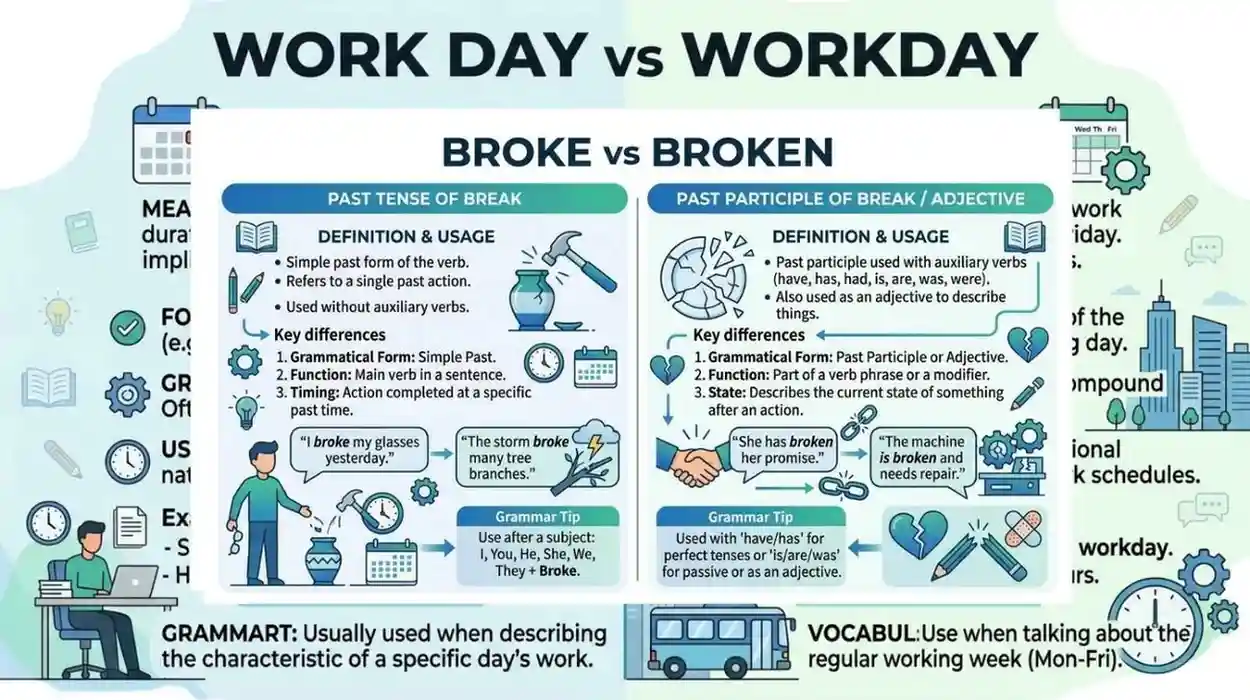
Workday is one word. It’s the most common and most accepted spelling.
Work day as two words is also seen, but it’s less common and less accepted in most writing.
- “Monday is always my busiest workday.” (main spelling)
- “Monday is always my busiest work day.” (also seen, but less common)
Both point to the same thing: a normal day spent working.
Why People Get Mixed Up
English has a lot of these small word pairs, where two words slowly grow together into one. Since both forms show up in daily writing, it’s easy to feel unsure which one is “right,” especially since neither one looks clearly wrong at first glance.
The mix-up also happens since other similar phrases stay as two words, like “work week” or “work hours.” Since those stay split, it feels natural to guess “work day” should split too, even though it usually doesn’t in most writing today.
Where This Word Came From
Long ago, “work” and “day” were always written as two separate words, simply placed next to each other, the same way you’d write “long day” or “hard day.” Over time, as the phrase got used more and more, especially in business and office settings, it slowly merged into one single word: “workday.”
This kind of merging happens a lot in English. Two words that get used together constantly often grow into one word over time, since it feels smoother and faster to write and read them as a single unit. “Weekend,” “notebook,” and “background” all went through this same kind of merge long before “workday” did.
A Simple Way to Remember
Try this trick: think of other common merged words tied to time and schedules, like “weekend” and “bedtime.” “Workday” fits that same pattern, joining two related words into one smooth word.
Easy rule: when in doubt, write “workday” as one word. It matches most style guides and most everyday writing today.
Side-by-Side Table
| Form | Correct? | Common Use |
| Workday | Yes, main spelling | Most style guides, everyday writing |
| Work day | Sometimes seen | Less common, more casual |
| Work week | Two words, standard | “I have a long work week ahead.” |
| Weekday | One word, similar pattern | “I only work on weekdays.” |
Which One Should You Use?
Writing something formal, like a business report or email? Use “workday” as one word. It’s the standard, expected spelling.
Writing something casual, like a text or quick note? “Workday” is still the safer choice, though “work day” won’t look completely out of place.
Not sure which one fits? Go with “workday” as one word. It matches how most writing guides and dictionaries list it today.
Common Mistakes People Make
Mistake 1: Wrong: Writing “work day” as two words in formal business writing.
Fix: Use “workday” as one word for a cleaner, more standard look in professional writing.
Mistake 2: Wrong: Assuming “work day” and “workday” are always interchangeable without checking a style guide.
Fix: Most style guides now prefer “workday” as one word, so it’s the safer default choice.
Mistake 3: Wrong: Splitting “workday” into two words while keeping similar words like “weekday” as one word.
Fix: Try to stay consistent. Since “weekday” is one word, treating “workday” the same way keeps your writing feeling steady and clear.
Mistake 4: Wrong: Assuming this rule never changes or has always been this way.
Fix: Language shifts over time. “Workday” is a great example of two words slowly merging into one as it became more common in daily use.
Everyday Examples
In a work email: “Please submit your report by the end of the workday tomorrow.”
In a casual conversation: “That was such a long workday, I’m exhausted.”
On social media: “Finally done with my workday, time to relax!”
In a company handbook: “Employees are expected to complete tasks within a standard eight-hour workday.”
Search Trends and Usage Data
People search “work day or workday” for a few clear reasons.
- Business writers: Many people search this while writing emails, reports, or company documents, wanting a clean, professional-looking result.
- Students and English learners: This word pair often comes up while learning how English merges common phrases into single words over time.
- Editors and careful writers: Some searches come from people simply double-checking a style guide before publishing something important.
“Workday” stays the more common, accepted form across nearly all types of writing, while “work day” still shows up here and there in more casual use.
Frequently Asked Questions
1. Is “work day” ever fully correct? It’s seen sometimes in casual writing, but “workday” remains the more standard, widely accepted spelling.
2. Does this rule apply the same way in British and American English? Yes, both regions generally prefer “workday” as one word in most modern writing.
3. Why do some related phrases, like “work week,” stay as two words? Not every phrase merges at the same speed. Some phrases, like “work week,” are still commonly written as two words, even though “workday” has already fully merged for most writers.
4. Is there a good way to remember this for good? Yes. Link “workday” to other merged time words, like “weekend” and “weekday.” If those feel natural as one word, “workday” should too.
5. Does spell-check flag “work day” as incorrect? Not always, since it’s still recognized in casual use, but many writing tools now suggest “workday” as the more standard choice.
6. Is this a fast-changing rule, or has it been settled for a long time? It shifted gradually over the past several decades, and today, “workday” as one word is widely seen as settled and standard in most style guides.
7. Should I always trust autocorrect to fix this for me? It’s smart to know the rule yourself, since not every autocorrect tool catches every case, especially in fast typing or casual apps.
The Bottom Line:
Work day or workday? “Workday” as one word is the standard, most accepted spelling, found in most style guides and everyday writing today. “Work day” as two words still shows up sometimes, but it’s less common and less expected in most writing.
When in doubt, go with “workday” as one word. It’s the safer, cleaner choice, and it matches how most writers and style guides handle it today.
At the end of the day, this is a small example of how English keeps changing, even in quiet, easy-to-miss ways. Two words that once stood apart slowly grew into one, simply because people used them together so often that splitting them apart started to feel unnecessary. The next time you write about a long, busy day at the office, you’ll know exactly how to spell it, clean, simple, and all in one word.

Emily Carter is an English grammar writer based in Portland, Oregon, with 7+ years of experience turning tricky grammar rules into simple, easy lessons.