Have you ever read a news story or a health report and seen the words “mortality” and “fatality” used close together? You may have asked yourself, “Are these the same thing?” This mix-up happens a lot, even to people who read a lot of news.
Both words talk about death, but they are used in different ways. One word looks at death from a wide view, like a big group of people. The other word looks at death from one single event or cause.
You will see these words in health news, weather reports, car crash reports, and studies about sickness. If you mix them up, you might get the wrong idea about how serious something is. That is why it helps to know the real difference.
In this guide, you will get a quick answer first. Then we will look at where these words came from, how they are used, and the common mix-ups people make. By the end, you will always know which word fits.
Mortality vs Fatality – Quick Answer
Here is the easy answer.
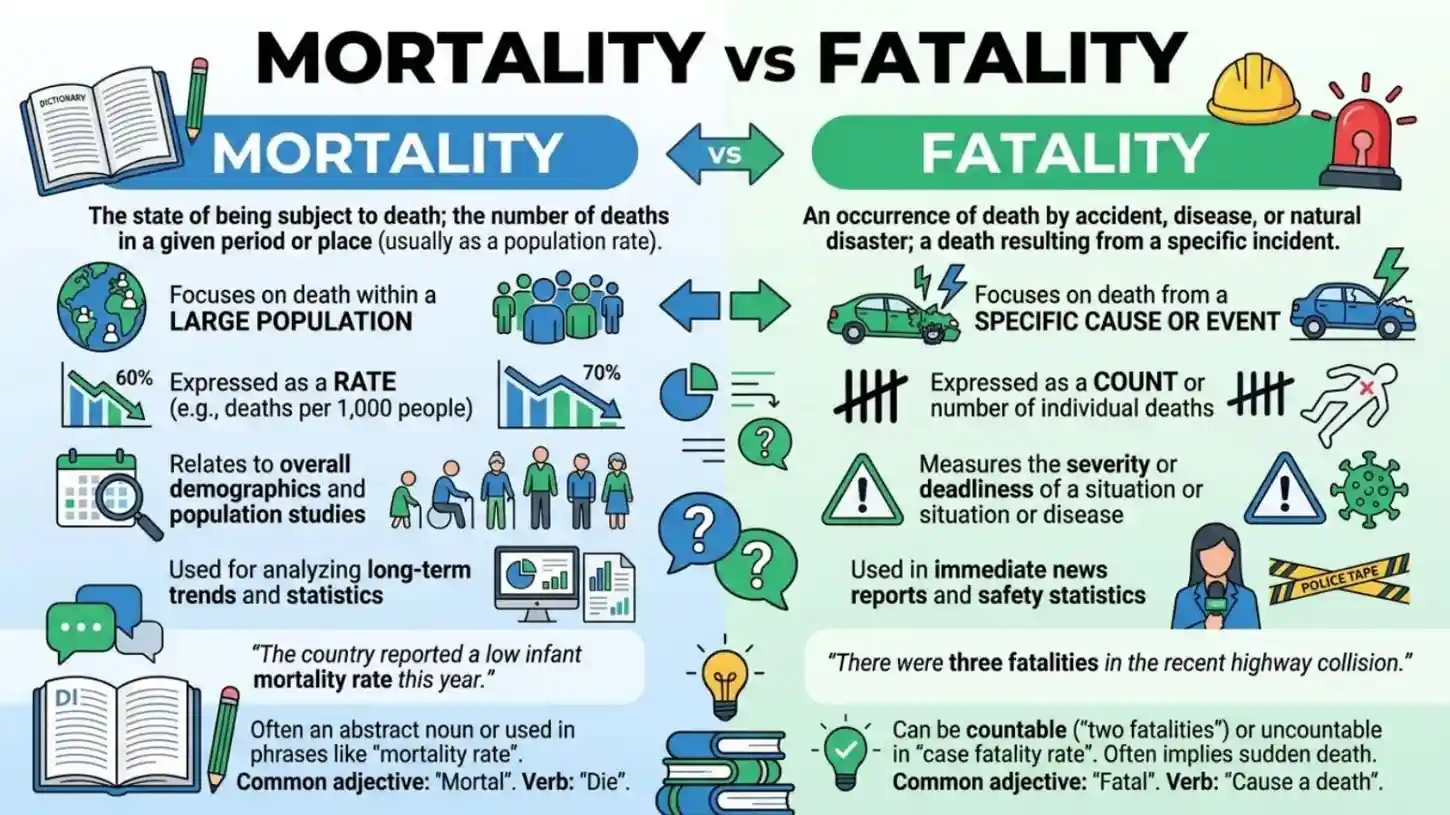
Mortality is a big-picture word. It talks about how many people die out of a large group, often shown as a rate or number over time.
Fatality is a smaller, more direct word. It talks about a death from one single event, like a crash, a storm, or an attack.
Example: “The mortality rate for this illness is 2 out of 100 people.” Example: “There was one fatality in the car crash last night.”
So use mortality when talking about death rates across a big group. Use fatality when talking about a death from one specific event.
Where the Words Mortality and Fatality Come From
Mortality comes from the Latin word “mortalis,” which means “able to die.” This word is linked to the idea that all living things will die one day. Over time, English speakers used “mortality” to talk about death rates in groups, like a whole city, country, or age group.
Fatality comes from the Latin word “fatalis,” which means “ordained by fate,” or something that was meant to happen. This word later came to mean a death that happens because of a specific event, like an accident or attack.
Both words trace back to old ideas about fate and death, but they took different paths. Mortality grew to describe big patterns and numbers. Fatality grew to describe single deaths tied to one clear cause.
British English vs American English Spelling
Good news here. “Mortality” and “fatality” are spelled the same way in both British English and American English. There is no spelling change between countries for these words.
However, how these words are used can shift slightly. In both the UK and the US, health reports often use “mortality rate” to talk about death numbers in a group. News reports in both countries use “fatality” to talk about deaths from one event, like a crash or storm.
| Word | British English | American English | Common Use |
| Mortality | Mortality | Mortality | Health data, death rates |
| Fatality | Fatality | Fatality | Crashes, storms, single deaths |
| Death rate | Death rate | Death rate | General news, reports |
Which One Should You Use?
Since both words are spelled the same everywhere, this is not about which country you live in. It is about what you are trying to say.
Use mortality when: You are talking about a group of people and how many of them died, often shown as a rate or percent, like “the mortality rate for flu this year.”
Use fatality when: You are talking about one clear event and how many people died in it, like “there were three fatalities in the plane crash.”
If you are writing a health report: Mortality is usually the better word, since health data often looks at large groups over time.
If you are writing about an accident or disaster: Fatality is usually the better word, since it points to a clear, single event.
Common Mistakes with Mortality and Fatality
Here are some mistakes people make, and how to fix them.
Mistake 1: “The fatality rate for this disease is going up.” Fix: “The mortality rate for this disease is going up.” (This talks about a group over time, so mortality fits better.)
Mistake 2: “There were two mortalities in the fire.” Fix: “There were two fatalities in the fire.” (This talks about one event, so fatality fits better.)
Mistake 3: Using the two words as if they always mean the exact same thing. Fix: Remember that mortality is about a group and a rate, while fatality is about one event and a death count.
Mistake 4: “The mortality happened during the crash.” Fix: “The fatality happened during the crash.” (Mortality is not usually used to describe a single death event this way.)
Mortality vs Fatality in Everyday Life
Let’s look at how these words show up in real life.
In news reports: “The fatality count from the storm has risen to five.” “Health officials tracked the mortality rate closely during the outbreak.”
In health reports: “The mortality rate for heart disease has dropped over the past ten years.” “This study looks at child mortality across several countries.”
On social media: “So sad to hear about the fatality on the highway this morning.” “New data shows mortality rates falling in older age groups. “
In formal writing: “The report includes a full breakdown of mortality by age and location.” “Officials confirmed the fatality was linked to the collapse of the bridge.”
These examples show that mortality often connects to numbers and patterns, while fatality often connects to a specific, single loss.
Mortality vs Fatality – What People Search Online
People search for “mortality vs fatality” a lot during health news events, like disease outbreaks, flu season, or new health studies. They want to understand what the numbers in the news actually mean.
Searches for “fatality” often spike after big events like car crashes, storms, plane crashes, or other sudden accidents that make the news.
People in every English-speaking country search for both words because health and accident news happen everywhere. They often search these terms because the words have similar meanings but people use them in different ways.
Mortality vs Fatality Comparison Table
| Feature | Mortality | Fatality |
| Meaning | Death rate across a group | A death from one event |
| Common Use | Health data, studies, reports | Crashes, storms, attacks |
| Word Origin | Latin “mortalis” (able to die) | Latin “fatalis” (fated) |
| Example | “Mortality rate rose 2% this year.” | “The crash caused one fatality.” |
| Focus | Groups, patterns, time | Single events, direct cause |
Frequently Asked Questions
1. What is the main difference between mortality and fatality? Mortality looks at death across a large group, often as a rate. Fatality looks at a death from one clear event.
2. Can fatality be used for more than one death? Yes. You can say “three fatalities” to talk about three deaths from the same event, like a crash or storm.
3. Is mortality rate the same as death rate? Yes.“Mortality rate” and “death rate” mean almost the same thing and often describe the same idea.
4. Where do these words come from? Both come from Latin. Mortality comes from a word meaning “able to die.” Fatality comes from a word meaning “fated” or “meant to happen.”
5. Is the spelling of these words different in the UK and the US?
No. Both words have the same spelling in British and American English.
6. Which word is used more in health news?
Health news uses mortality more often because it looks at death rates in groups over time, such as a country or age group.
7. Which word is used more in accident news?
News reports use fatality more often in accident news because it refers to a death caused by one clear event.
Conclusion:
Mortality and fatality both talk about death, but they are not the same. Mortality looks at the bigger picture, showing how many people die out of a group, often shown as a rate. Fatality points to a death from one clear event, like a crash, storm, or attack. Both words come from old Latin roots tied to the idea of death and fate, and both are spelled the same way in every English-speaking country.
The key thing to remember is simple: mortality is for groups and rates, and fatality is for single events and direct deaths.
Now that you understand the difference, you can read the news and health reports with more clarity. Whether you’re reading about a disease study or a car crash, you’ll know exactly which word fits and what it truly means. Keep this guide close, and you’ll never mix up mortality and fatality again.