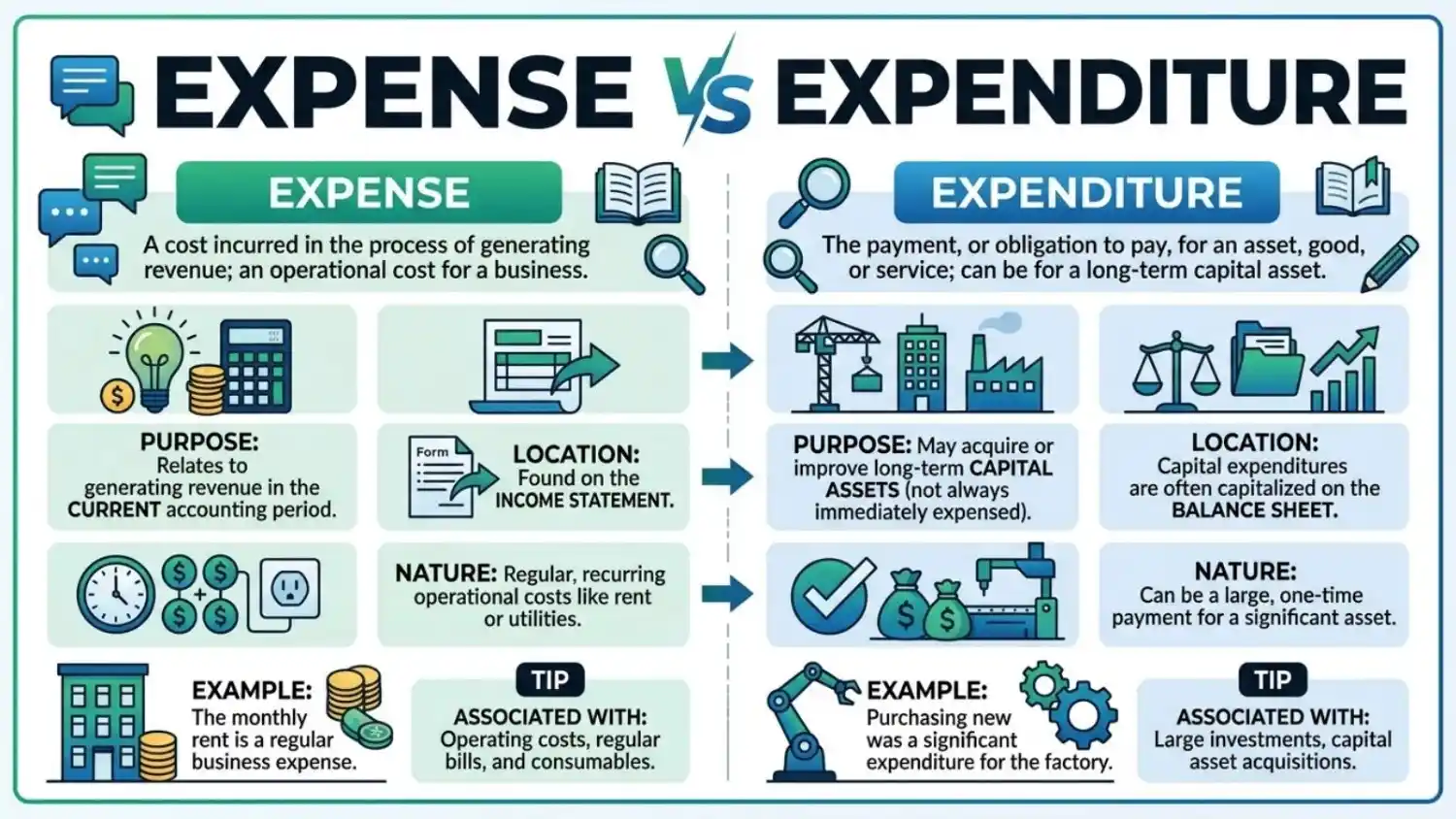
Have you ever read a money report or a business paper and seen the words “expense” and “expenditure” used side by side? You may have wondered, “Aren’t these the same thing?” This mix-up happens a lot, even to people who work with money every day.
Both words are about spending money, but they are used in different ways. One word talks about small, day-to-day costs. The other word talks about a bigger, wider way of spending money.
You will see these words in business reports, school lessons about money, government papers, and news about budgets. If you mix them up, your writing can sound off, especially in work or money talk. That is why it helps to know the real difference.
In this guide, you will get a quick answer first. Then we will look at where these words came from, how they are used, and the common mix-ups people make. By the end, you will always know which word fits.
Expense vs Expenditure – Quick Answer
Here is the easy answer.
Expense is a smaller, everyday word. It means money spent on one thing, like a bill, a meal, or a tool for work.
Expenditure is a bigger, wider word. It means the total amount of money spent over time, often by a business or a government.
Example: “My biggest expense this month was rent.” Example: “The city’s total expenditure on roads went up this year.”
So use expense when talking about one cost or a small list of costs. Use expenditure when talking about a big total, often over time or by a large group.
Where the Words Expense and Expenditure Come From
Expense comes from the Latin word “expensa,” which means “money paid out.” This word came into English hundreds of years ago and has always meant money spent on something, big or small.
Expenditure comes from the same root word, “expendere,” which means “to pay out” or “to spend.” Over time, English speakers added more letters to make a new word, “expenditure,” which grew to mean a bigger, more formal way of talking about spending, often used in business or government.
Both words share the same root idea of paying money out. But over hundreds of years, “expense” stayed simple and short for everyday use, while “expenditure” grew longer and became the word people use for big totals and formal reports.
British English vs American English Spelling
Good news here. “Expense” and “expenditure” are spelled the same way in both British English and American English. There is no spelling change between countries for these words.
However, how these words show up in daily life can be a little different. In both the UK and the US, “expense” is common in daily talk, like work expenses or travel expenses. “Expenditure” shows up more in business papers, school lessons, and government reports in both countries.
| Word | British English | American English | Common Use |
| Expense | Expense | Expense | Bills, work costs, daily spending |
| Expenditure | Expenditure | Expenditure | Business, government, big totals |
| Cost | Cost | Cost | General spending |
Which One Should You Use?
Since both words are spelled the same everywhere, this is not about which country you live in. It is about how big and how formal your topic is.
Use expense when: You are talking about one cost or a small group of costs, like a bill, a trip, or a work tool.
Use expenditure when: You are talking about a large total amount of money spent, often by a business, school, or government, over a period of time.
If you are writing a work report about your own spending: Expense usually fits better, since it’s more personal and specific.
If you are writing about a company’s or government’s full spending plan: Expenditure usually fits better, since it points to a big total.
Common Mistakes with Expense and Expenditure
Here are some mistakes people make, and how to fix them.
Mistake 1: “My monthly expenditure on coffee is $20.”
Fix: “My monthly expense on coffee is $20.” (This is a small, personal cost, so expense fits better.)
Mistake 2: “The government’s total expense for this year was $2 billion.”
Fix: “The government’s total expenditure for this year was $2 billion.” (This is a big total over time, so expenditure fits better.)
Mistake 3: Using both words as if they always mean the exact same thing.
Fix: Remember that expense is smaller and more personal, while expenditure is bigger and more formal.
Mistake 4: “Please list all your expenditures from this week’s lunch.”
Fix: “Please list all your expenses from this week’s lunch.” (Small, daily costs work better with the word expense.)
Expense vs Expenditure in Everyday Life
Let’s look at how these words show up in real life.
In work emails: “Please send your travel expense report by Friday.” “Our team’s total expenditure for this project has been shared in the report.”
In news reports: “Government expenditure on health care rose sharply this year.” “Many families are cutting back on daily expenses due to rising prices.”
On social media: “Coffee is my biggest expense, no regrets though. ” “New report shows public expenditure hit a record high this year. “
In formal writing: “All business expenses must be submitted with a receipt.” “The report breaks down total expenditure by department and month.”
These examples show that expense often connects to small, direct costs, while expenditure often connects to a bigger picture of total spending.
Expense vs Expenditure – What People Search Online
People search for “expense vs expenditure” a lot when they are learning about money for school, work, or business. Many people want a simple way to know when to use each word correctly in reports or writing.
Searches for “expenditure” often go up around tax season, budget season, or when governments share yearly spending reports. Searches for “expense” tend to stay steady all year, since people track personal or work costs all the time.
Both words are searched in every English-speaking country, since spending money and tracking costs happen everywhere. People search this topic mostly because the words sound close but are used in different-sized situations.
Expense vs Expenditure Comparison Table
| Feature | Expense | Expenditure |
| Meaning | Money spent on one thing | Total money spent over time |
| Common Use | Bills, work costs, daily life | Business, government, big totals |
| Word Origin | Latin “expensa” (money paid out) | Latin “expendere” (to pay out) |
| Example | “My biggest expense is rent.” | “Total expenditure rose this year.” |
| Focus | Small, specific costs | Large, wide totals |
Frequently Asked Questions
1. What is the main difference between expense and expenditure? Expense is a smaller word for one cost or a few costs. Expenditure is a bigger word for a total amount spent over time.
2. Can expense be used for big spending too? Yes, but it’s more common for smaller, direct costs. For big totals, expenditure is the better fit.
3. Is expenditure only used by governments and businesses? No, but it’s most common in those settings. You can still use it for personal spending, though expense is more common in daily talk.
4. Where do these words come from? Both come from Latin. Expense comes from a word meaning “money paid out.” Expenditure comes from a word meaning “to pay out,” with extra letters added over time.
5. Is the spelling of these words different in the UK and the US? No. Both words are spelled the same way in British English, American English, and all other English-speaking places.
6. Which word should I use in a work expense report? Use “expense.” Work reports about your own costs, like travel or meals, almost always use this word.
7. Which word fits better in a school lesson about a country’s budget? Use “expenditure.” This word fits big totals, like how much a government spends on health, roads, or schools.
Conclusion:
Expense and expenditure both talk about spending money, but they are not the same size of word. Expense points to one cost or a small group of costs, often used in daily life or work reports. Expenditure points to a bigger total, often used by businesses or governments to show how much was spent over time. Both words come from the same Latin root, but they grew apart over the years to fit different needs.
The key thing to remember is simple: expense is for small, direct costs, and expenditure is for big totals over time.
Now that you understand the difference, you can write and speak with more confidence. Whether you’re filing a work expense report or reading about government spending, you’ll know exactly which word fits. Keep this guide close, and you’ll never mix up expense and expenditure again.

Emily Carter is an English grammar writer based in Portland, Oregon, with 7+ years of experience turning tricky grammar rules into simple, easy lessons.