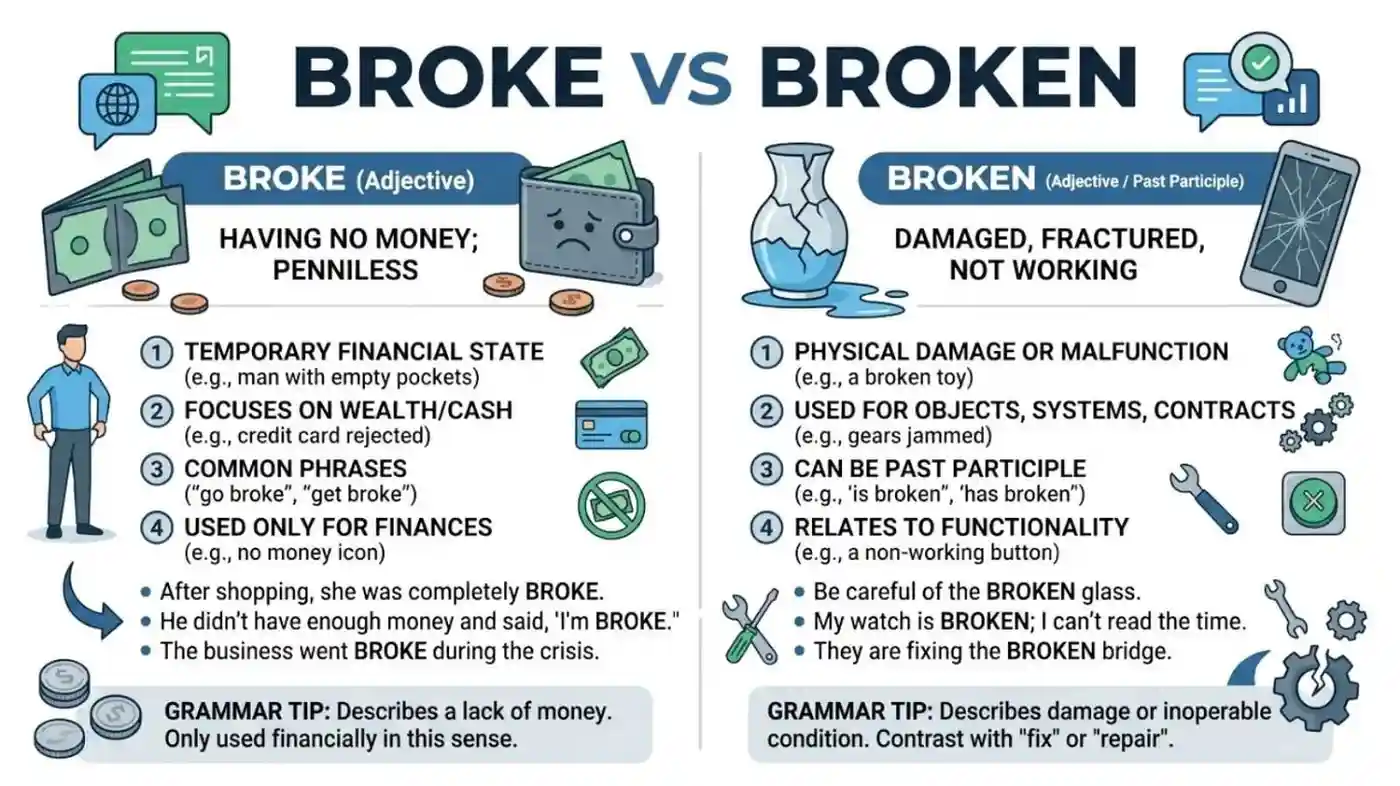
You dropped your phone, and now the screen won’t turn on. Do you say “I broke my phone” or “my phone is broken”? Both words feel right in a way, but only one of them fits each sentence. Let’s clear this up for good.
The Fast Answer
Broke is the simple past tense. Use it to talk about something that happened once, in the past, on its own.
Broken is the past form used with helper words like “is,” “was,” “has,” or “have.”
- “I broke my phone yesterday.” (something that happened)
- “My phone is broken.” (a state, paired with “is”)
Both words come from “break,” but they show up in different types of sentences.
Why People Mix These Up
“Break” is one of those tricky English words that doesn’t just add “-ed” to show the past. Instead, it changes shape in two different ways, and picking the right one depends on what’s happening in the rest of the sentence.
Since “broke” and “broken” both clearly connect to something being damaged, it’s easy to reach for either one without slowing down to check which spot in the sentence actually calls for which word.
Where This Word Came From
“Break” is a very old English word, and it belongs to a group of words that change their middle sound to show different tenses, instead of just adding “-ed” at the end. This same pattern shows up in words like “speak,” “spoke,” and “spoken,” or “wake,” “woke,” and “woken.”
Over hundreds of years, most English verbs shifted toward the simpler “-ed” pattern, like “walk” becoming “walked.” But a small group of older, common verbs held onto this three-part pattern instead. “Break” is one of them, which is why it still has three forms today: break, broke, and broken.
A Closer Look at Each Word
Broke stands alone in a sentence, describing something that happened at one point in the past. “She broke the vase.” “I broke my promise.” “They broke the record.” No helper word needed, it just works on its own.
Broken almost always needs a partner word standing right next to it, like “is,” “was,” “has,” or “have.” “The vase is broken.” “My promise was broken.” “They have broken the record.” In each case, broken pairs with another word to complete its meaning.
Side-by-Side Table
| Word | Type | Needs a Helper Word? | Example |
| Broke | Simple past tense | No | “He broke the window.” |
| Broken | Past participle | Yes | “The window is broken.” |
| Breaks | Present tense | No | “She breaks a sweat every workout.” |
| Breaking | Present action | Yes, usually with “is” or “was” | “The news is breaking right now.” |
A Simple Way to Remember
Try this trick: broke can stand alone, just like the word “walked” stands alone in “he walked to school.”
Broken always needs a buddy word beside it, kind of like how “eaten” always needs “has” or “is” nearby, as in “she has eaten” or “the food is eaten.”
Easy rule: no helper word nearby? Use “broke.” A helper word like “is,” “was,” “has,” or “have” sitting right there? Use “broken.”
A Quick Test You Can Use
Here’s a fast way to check yourself. Look at the word right before the one you’re about to use. If you see “is,” “was,” “has,” or “have,” go with “broken.” If there’s nothing like that sitting there, go with “broke.”
For example: “The lamp ___ broke or broken?” If the sentence reads “The lamp broke,” no helper word needed, that’s correct. If it reads “The lamp is ___,” you need “broken” to complete it: “The lamp is broken.”
Common Mistakes People Make
Mistake 1: Wrong: “The phone is broke.”
Fix: “The phone is broken.” (After “is,” you always need “broken,” not “broke.”)
Mistake 2: Wrong: “I have broke my arm before.”
Fix: “I have broken my arm before.” (After “have,” you need “broken,” not “broke.”)
Mistake 3: Wrong: “Yesterday, I broken my favorite mug.”
Fix: “Yesterday, I broke my favorite mug.” (No helper word here, so “broke” is correct.)
Mistake 4: Wrong: Mixing up “broke” and “broken” without checking for a nearby helper word first.
Fix: Always glance at the word right before it. That one quick check almost always gives you the right answer.
Everyday Examples
In a text message: “I broke my headphones this morning, so annoying.”
In a customer service chat: “My laptop screen is broken and I need help getting it fixed.”
On social media: “Just broke my personal best at the gym today!
In a work email: “The printer has been broken since yesterday, can someone take a look?”
Search Trends and Usage Data
People search “broke or broken” for a few clear reasons.
- Students and English learners: Many people search this while learning irregular verbs, since “break” doesn’t follow the simple “-ed” pattern most verbs use.
- Fast writers and texters: Some searches come from people who paused mid-sentence, unsure which form fit the moment.
- Writers and editors: Careful writers sometimes double check this pair to avoid a small, easy-to-miss grammar slip in their writing.
Both words stay in steady, everyday use, since talking about broken things comes up constantly in daily life.
Other Verbs That Follow the Same Pattern
“Break” isn’t alone in this. A handful of common English verbs follow this same three-part pattern, which makes learning one of them a big help for understanding the rest.
| Base Form | Simple Past | Past Participle |
| Break | Broke | Broken |
| Speak | Spoke | Spoken |
| Wake | Woke | Woken |
| Choose | Chose | Chosen |
Once you notice this pattern, “broke” and “broken” start to feel a lot less random, and a lot more like part of a small, familiar family of English words.
Frequently Asked Questions
1. Is “broke” ever correct after “has” or “have”? No. After “has” or “have,” you always need “broken,” never “broke.”
2. Can “broken” stand alone in a sentence without a helper word? It can work as a describing word on its own, like “a broken heart” or “a broken promise,” but as part of an action, it almost always needs a helper word like “is” or “has.”
3. Is “broke” also slang for having no money? Yes, that’s a separate, informal meaning. “I’m broke” can mean someone doesn’t have much money, completely different from anything being physically damaged.
4. Does this rule work the same in British and American English? Yes. Both regions follow the exact same rule for “broke” and “broken,” with no difference at all.
5. Why does English have three forms for a verb like this instead of just adding “-ed”? This comes from very old English patterns, where certain common verbs changed their middle sound to show different tenses, rather than adding a simple ending.
6. Is there a shortcut to remember which one needs a helper word? Yes. Broken almost always needs a buddy word like “is,” “was,” “has,” or “have” standing right next to it. Broke works fine completely on its own.
7. Can I say “it’s broke” instead of “it’s broken” casually? You’ll hear this in very casual speech sometimes, but “it’s broken” is the correct, standard form in careful or formal writing.
The Bottom Line:
Broke or broken? Both words come from “break,” but they play different roles in a sentence. Broke stands on its own, describing something that happened once, in the past. Broken needs a helper word like “is,” “was,” “has,” or “have” standing right beside it to complete its meaning.
Next time you’re not sure which one fits, just check what’s sitting right before the word. No helper word there? Go with “broke.” A helper word like “is” or “has” nearby? Go with “broken.” That one quick glance will guide you to the right word almost every single time.
This might feel like a small detail, but getting it right makes your writing sound clean and natural, whether you’re texting a friend, sending a work email, or filling out a customer service form. Once this small rule clicks, it tends to stick for good, and you’ll stop second-guessing yourself the next time something breaks, or gets broken, in your day.