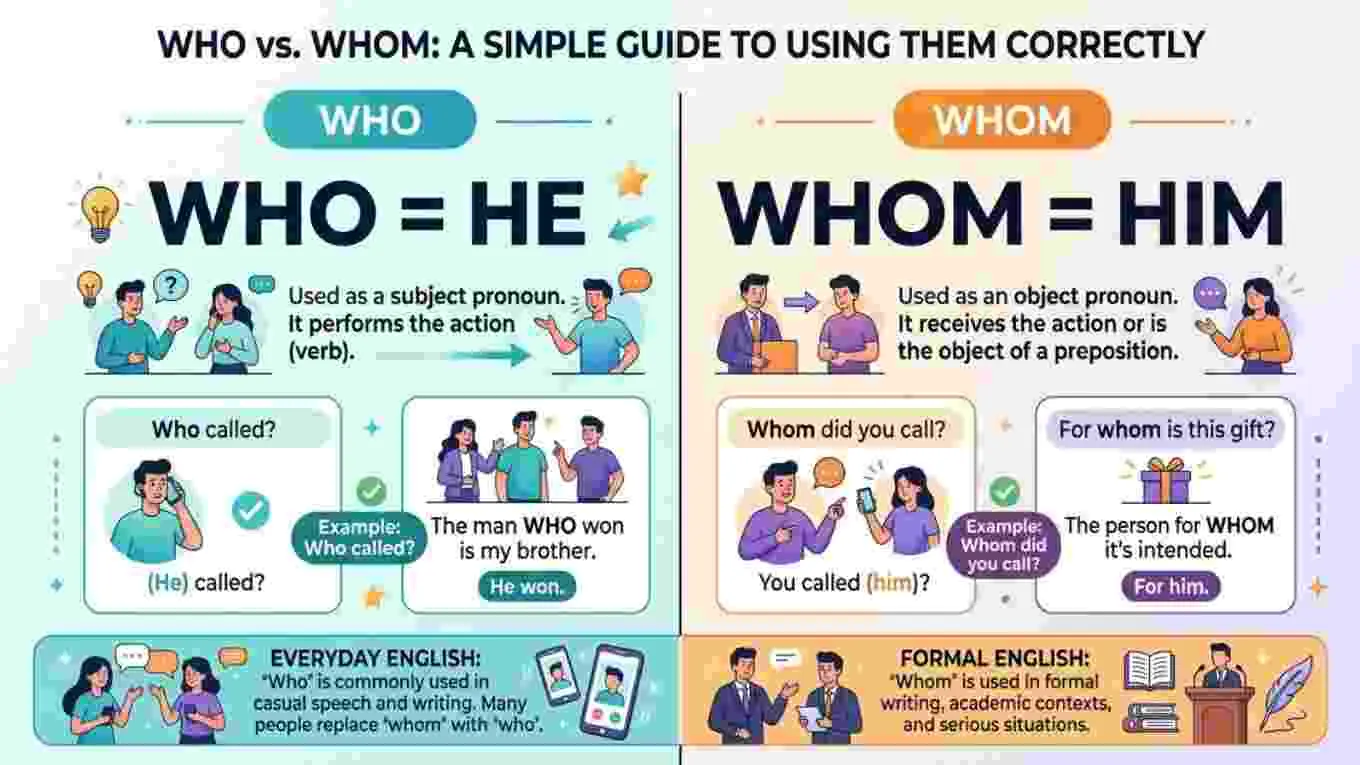
Choosing between who or whom can be hard, even for people who speak English well. Both words refer to people, and in everyday speech they can sound almost the same. The main difference comes from their job in a sentence.
Who usually acts as the subject, or the person doing the action. Whom traditionally acts as the object, or the person receiving the action. For example, in “Who called you?”, who does the calling. In “Whom did you call?”, whom receives the action of calling.
However, modern English has become more relaxed. In normal conversation, many people use who where older grammar rules would use whom. Cambridge notes that whom is more common in formal writing and is not used very often in everyday speech.The easiest way to choose is to use the he/him test. If he fits, use who. If him fits, use whom.
Who or Whom – Quick Answer
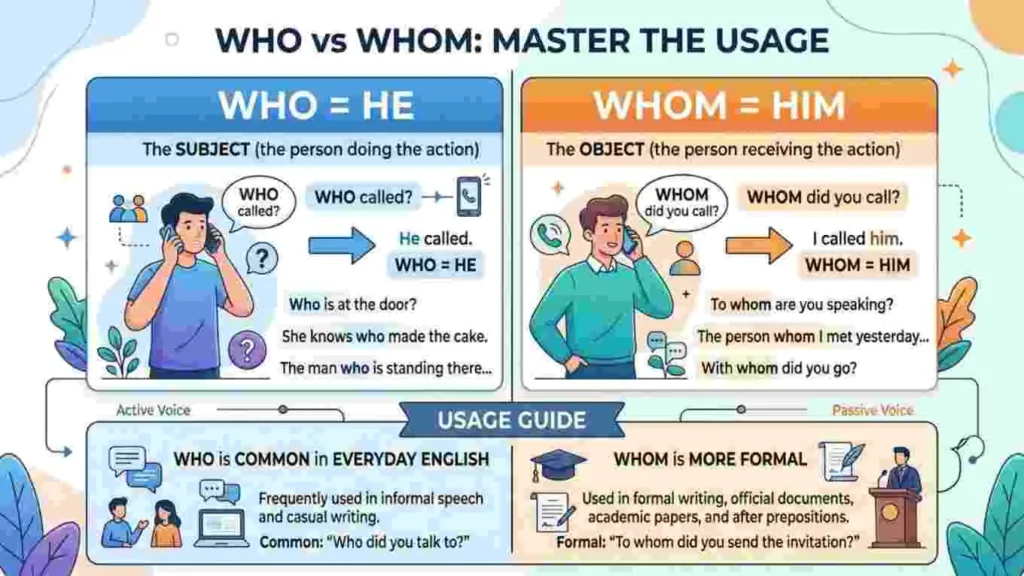
Use who when the person is doing the action.
Use whom when the person is receiving the action, especially in formal writing.
Simple examples
Who called you?
→ He called you.
→ Use who.
Whom did you call?
→ You called him.
→ Use whom.
A quick rule is:
- Who = he
- Whom = him
You can also remember:
Who does the action. Whom receives the action.
In everyday English, who often replaces whom, especially in speech. In formal writing, whom still has a clear place, especially after a preposition such as to, for, with, or from.
What Does “Who” Mean?
Who is a pronoun used when we ask about or refer to a person or people.
It often acts as the subject of a verb.
Examples
- Who called me?
- Who broke the window?
- Who wants coffee?
- Who lives here?
- Who wrote this book?
In each sentence, who does the action.
For example:
Who opened the door?
The answer could be:
Sarah opened the door.
Sarah is doing the action, so who is correct.
Cambridge also notes that who can be used as either the subject or object in modern English, especially in less formal use.
What Does “Whom” Mean?
Whom is the object form of who.
It traditionally refers to the person who receives the action of a verb or follows a preposition.
For example:
Whom did you invite?
The person receiving the action is the person you invited.
The answer could be:
I invited him.
Because him fits, whom fits.
Cambridge describes whom as the object form of who and says it is mainly used in formal styles and writing.
Who vs Whom: The Main Difference
The easiest way to understand the difference is to look at the role of the person in the sentence.
Who = Subject
The subject does the action.
Who helped you?
John helped me.
John does the action, so use who.
Whom = Object
The object receives the action.
Whom did you help?
I helped John.
John receives the action, so traditional grammar uses whom.
| Word | Grammar Role | Simple Meaning | Example |
| who | Subject | The person doing the action | Who called? |
| whom | Object | The person receiving the action | Whom did you call? |
The Easy He or Him Test
The he/him test is one of the easiest ways to decide between who and whom.
Replace the word with he or him.
- If he sounds right, use who.
- If him sounds right, use whom.
Example 1
Who called?
Answer:
He called.
“He” works, so use who.
Example 2
Whom did you meet?
Answer:
I met him.
“Him” works, so use whom.
Example 3
Who is coming with us?
Answer:
He is coming with us.
Use who.
Example 4
Whom are you waiting for?
Answer:
I am waiting for him.
Use whom in formal grammar.
Quick Memory Trick
Think:
Who = he
Whom = him
This trick works because who and he are subject forms, while whom and him are object forms.
Who or Whom in Questions
Questions often cause the most confusion.
When Who Is Correct
Use who when the person does the action.
Who ate the cake?
Who sent the email?
Whos opened the door?
Who won the game?
In each case, the unknown person performs the action.
When Whom Is Correct
Use whom when the person receives the action.
Whom did you invite?
Whom did she call?
The answers would use him or her.
For example:
Whom did you call?
I called him.
Cambridge gives the same basic distinction between subject and object use. Who or Whom After a Preposition
Whom is especially common after a preposition in formal writing.
Common prepositions include:
- to
- for
- with
- from
- by
- about
- of
Examples
To whom did you speak?
With whom are you going?
For whom is this gift?
From whom did you receive the letter?
In everyday speech, people often move the preposition to the end and use who:
Who did you speak to?
Who are you going with?
Both styles can be found in English, but the first style sounds more formal. Cambridge specifically notes that whom is common with prepositions and is more formal.
Who or Whom in Relative Clauses
You can also use who and whom in relative clauses.
Who as the Subject
The woman who called me is my teacher.
The woman did the calling.
So who is correct.
Whom as the Object
The woman whom I called is my teacher.
I did the calling.
The woman received the action.
So traditional formal grammar uses whom.
However, everyday English often uses who:
The woman who I called is my teacher.
This form is very common.
Cambridge notes that who can act as either the subject or object in relative clauses, while whom is mainly used for objects in formal styles or writing.
Who or Whom: Main Differences
Here is the difference at a glance:
| Situation | Traditional Choice | Example |
| Person does the action | who | Who called? |
| Person receives the action | whom | Whom did you call? |
| After a preposition | whom | To whom did you speak? |
| Informal conversation | Often who | Who did you speak to? |
| Formal writing | whom for object | The person whom I met |
| Relative clause subject | who | The man who helped me |
| Relative clause object | whom in formal style | The man whom I helped |
Who or Whom: Common Mistakes
1. Using “whom” for the person doing the action
Incorrect:
Whom called you?
Correct:
Who called you?
Why?
The person called you, so that person does the action.
Who called you?
2. Using “who” in a formal object question
Less formal:
Who did you invite?
Formal:
Whom did you invite?
Why?
You invited the person, so the person receives the action.
In everyday speech, who did you invite? is very common and natural.
3. Confusing “to whom” and “to who”
Formal:
To whom did you send the letter?
Less formal:
Who did you send the letter to?
Why?
After the preposition to, formal English uses whom.
4. Using “whom” after a subject verb
Incorrect:
Whom is coming to dinner?
Correct:
Who is coming to dinner?
Why?
The person is doing the action of coming.
5. Using “who” in a formal phrase with “of”
Less formal:
The students, who many of you know, joined us.
Formal:
The students, many of whom you know, joined us.
Why?
Here whom follows the preposition of.
6. Choosing by sound alone
Problem:
Who and whom can sound very similar in speech.
Better approach:
Use the he/him test.
If he works, choose who.
If him works, choose whom.
7. Thinking “whom” is always better
Incorrect idea:
“Whom is always more correct.”
Better rule:
Use whom when it fits the object role, especially in formal writing. In everyday English, who is often normal even when traditional grammar would use whom.
10 Everyday Examples of Who and Whom
- Who called you last night?
- Who wrote this message?
- Whom did you invite to the party?
- Who wants some tea?
- Whom should I contact about the problem?
- The teacher who helped me was kind.
- The student whom I helped passed the test.
- Who is waiting outside?
- To whom should I send the report?
- Who did you speak to yesterday?
Notice that some sentences use whom because they follow formal grammar, while everyday English often uses who instead.
Who or Whom in Real-Life Writing
In Conversation
Most people prefer who in normal conversation.
You might hear:
Who did you talk to?
This sounds natural and common.
A more formal version is:
Whom did you talk to?
In Emails
Both forms can work.
Casual:
Who should I contact?
Formal:
Whom should I contact regarding this matter?
For a simple work email, who is often clear and natural.
In School
Teachers may expect traditional grammar in some assignments.
For formal writing:
Whom did the teacher choose?
But who did the teacher choose? is also widely used in modern English.
At Work
Formal letters may use whom, especially after a preposition.
To whom it may concern
This is a well-known formal phrase.
On Social Media
People almost always favor the simpler who.
Who are you going with?
Using whom in casual posts can sound very formal.
In Formal Writing
Whom can be useful when you want to follow traditional grammar rules.
Example:
The candidate whom we interviewed had strong skills.
Is “Who Did You Talk To?” Correct?
Yes.
Who did you talk to? is a common and natural English question.
Traditional formal grammar may prefer:
To whom did you talk?
The second sentence sounds much more formal.
Cambridge notes that English speakers commonly use who in questions such as “Who did you talk to?” while whom is more formal.
So, you do not need to force whom into every sentence.
Is “Whom Did You Talk To?” Correct?
Yes.
Whom did you talk to? is grammatically acceptable in traditional formal grammar.
However, the placement of to can make the sentence feel less formal than:
To whom did you talk?
In everyday English, the most natural choice is often:
Who did you talk to?
Who or Whom in British and American English
There is no simple rule that says one country uses who and the other uses whom.
Both British and American English use both forms.
The main difference is often formality and style, not country.
Who is very common in everyday speech in both varieties.
Whom is more common in formal writing and formal expressions in both varieties. Cambridge describes whom as more common in writing than speaking.
Examples
British English:
Who did you see?
American English:
Who did you see?
Both are natural.
Formal English:
Whom did you see?
The meaning stays the same.
Which One Should You Use?
The best choice depends on the sentence and the level of formality.
Everyday Conversation
Use who in most cases.
Who did you meet?
Who are you talking to?
This sounds natural.
Formal Writing
Use whom when the person is the object, especially after a preposition.
To whom did you send the email?
The person whom I contacted replied.
Academic Writing
Both forms can appear. Use whom when it fits a formal sentence, but do not use it just to make your writing sound more advanced.
Business Writing
Choose based on the tone.
Simple:
Who should I contact?
More formal:
Whom should I contact?
Both are understood.
Social Media
Who is usually the better choice because it sounds natural and friendly.
A Fast 3-Step Test for Who or Whom
When you are unsure, use these steps.
Step 1: Find the action
Look for the main verb.
Example:
Who did you invite?
The action is invite.
Step 2: Ask who did the action
You invited someone.
The person did not perform the action.
Step 3: Try “he” or “him”
You invited him.
“Him” works.
So formal grammar gives:
Whom did you invite?
Another Example
Who called you?
Try:
He called you.
“He” works.
So:
Who called you?
Related Search Questions
What is the difference between who and whom?
Who is traditionally used for the subject, the person doing the action. Whom is used for the object, the person receiving the action. A simple test is to replace the word with he or him. If he works, use who. If him works, use whom.
Is it “who” or “whom” after “to”?
In formal English, use whom after to when referring to a person.
Example:
To whom did you speak?
In everyday English, people commonly say:
Who did you speak to?
Both are widely understood, but the first is more formal.
Is “who did you call” correct?
Yes. Who did you call? is very common in modern English. Traditional grammar would use whom because the person receives the action: Whom did you call? In everyday speech, however, who is widely used in this position.
Is “whom” still used?
Yes. Whom still appears in formal writing, especially after prepositions and in formal phrases. Examples include to whom, for whom, with whom, and of whom. It is much less common in everyday conversation.
Can “who” be used instead of “whom”?
Yes, especially in informal and everyday English. Modern English often uses who where traditional grammar would use whom. For example, Who did you talk to? is very common. In formal writing, whom may be preferred when it is the object
Is “whom” more correct than “who”?
Not always. The traditional grammar rule gives who the subject role and whom the object role. But modern English often uses who for both roles. The best choice depends on grammar, context, and formality.
Usage and Search Trends
The search intent for who or whom is mainly informational. People usually want to know which word fits a sentence and whether whom is still used in modern English.
Common search variations include:
- who or whom
- who vs whom
- who or whom grammar
- difference between who and whom
- when to use who or whom
- who or whom examples
- who vs whom examples
- who did you talk to or whom
- who should I contact or whom
- who or whom after to
- how to use who and whom
- is whom still used
Exact search volume or keyword difficulty should not be stated without current keyword data. What is clear from major grammar references is that whom remains a formal object form, while who is very common in modern speech and can also appear as an object.
Who or Whom Comparison Table
| Word | Role | Best Use | Example |
| who | Subject | Person doing an action | Who called you? |
| who | Object in common modern English | Everyday speech and writing | Who did you call? |
| whom | Object | Formal writing | Whom did you call? |
| whom | After a preposition | Formal style | To whom did you speak? |
| who | Relative pronoun | Person doing an action | The man who helped me |
| whom | Relative pronoun | Person receiving an action in formal style | The man whom I helped |
FAQs
What is the easiest way to remember who and whom?
Use the he/him test. If you can replace the word with he, use who. If you can replace it with him, use whom. For example, “Who called?” becomes “He called,” so who is correct. “Whom did you call?” becomes “I called him,” so whom fits.
Is “whom” outdated?
No. Whom is still used, especially in formal writing. It is also common after prepositions in formal phrases such as to whom, for whom, and with whom. However, everyday speakers often use who instead, so whom can sound more formal.
Should I use who or whom in an email?
For a normal email, who is often the easiest and most natural choice. For a very formal email, whom may fit when it acts as an object. Example, “Who should I contact?” sounds natural, while “To whom should I address this letter?” has a more formal tone.
Is “whom” only used for people?
Yes, whom refers to people in standard modern usage. It acts as the object form of who. For things, English normally uses words such as which or that, depending on the sentence.
Is “who” a subject or object?
Who can be either a subject or an object in modern English. For example, Who called? uses who as the subject. Who did you meet? uses who as the object. Traditional formal grammar may prefer whom in the second sentence.
What is the difference between “who” and “whom” in a relative clause?
Use who when the person does the action: The man who called me. In formal grammar, use whom when the person receives the action: The man whom I called. In everyday English, who is also very common in the second pattern.
Is “to whom it may concern” correct?
Yes. To whom it may concern is a traditional formal phrase used when the exact reader is not known. The word whom follows the preposition to and acts as its object. The phrase has a formal tone and is often used in letters and official documents.
Conclusion
The difference between who or whom is mainly about the person’s role in a sentence.
Use who when the person does the action:
Who called you?
Use whom when the person receives the action, especially in formal writing:
Whom did you call?
The easiest way to check is the he/him test. If you can answer with he, choose who. If you can answer with him, traditional grammar calls for whom.
However, modern English gives you more freedom than older grammar rules. People often use who instead of whom in everyday speech and informal writing. For example, Who did you talk to? is a normal and widely used question.
You should still know whom, especially if you write formal letters, academic work, official documents, or sentences with formal preposition patterns such as to whom and for whom.
The simple rule to remember is:
Who = he. Whom = him.
Once you learn that small test, choosing between the two becomes much easier

Emily Carter is an English grammar writer based in Portland, Oregon, with 7+ years of experience turning tricky grammar rules into simple, easy lessons.