When you look at food labels, you may see the words saturated and unsaturated. You may also hear people talk about saturated and unsaturated fats. But what do these words really mean?
The answer can feel confusing because both types are fats, yet they have different structures and are found in different foods. People often search for saturated or unsaturated to learn which type they are eating, how they differ, and what the terms mean.
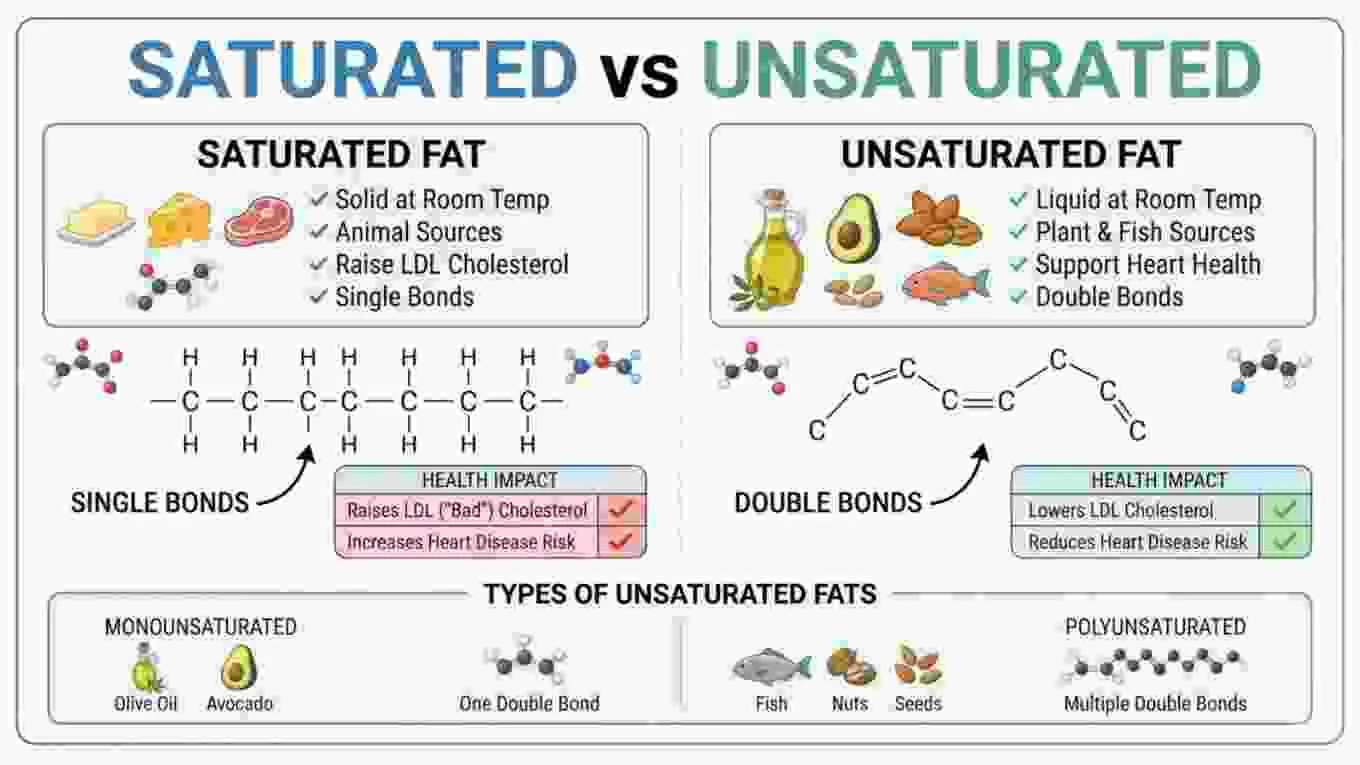
In simple words, saturated fats have no double bonds between their carbon atoms. Unsaturated fats have one or more double bonds. This small change in their structure affects how they act and where they are found.
You will often find saturated fat in foods such as butter, cheese, and fatty meat. Unsaturated fat often comes from foods such as olive oil, nuts, seeds, and fish.
This guide explains the difference in simple words. You will also learn about monounsaturated and polyunsaturated fats, food examples, common mistakes, and how these terms work in chemistry.
Saturated or Unsaturated – Quick Answer
Saturated and unsaturated describe the structure of a fat or a chemical compound.
For fats:
- Saturated fat has no carbon-carbon double bonds.
- Unsaturated fat has one or more carbon-carbon double bonds.
- Monounsaturated fat has one double bond.
- Polyunsaturated fat has two or more double bonds.
A simple way to remember it is:
Saturated = no double bonds
Unsaturated = one or more double bonds
For example:
- Butter contains a lot of saturated fat.
- Olive oil contains a lot of unsaturated fat.
- Nuts and seeds contain many unsaturated fats.
- Fatty fish contains unsaturated fats, including omega-3 fats.
The words can also describe hydrocarbons in chemistry. In that case, a saturated compound has only single bonds between carbon atoms, while an unsaturated compound has at least one double or triple bond.
What Does Saturated Mean?
The word saturated means that something is filled or complete.
In fat chemistry, a saturated fat has carbon atoms joined by single bonds. The carbon chain has the maximum number of hydrogen atoms that this structure can hold.
This gives saturated fats their name.
Many saturated fats are solid at room temperature. Butter and some animal fats are common examples. However, the solid or liquid state does not define whether a fat is saturated.
The chemical structure does.
Examples of foods with saturated fat
Saturated fat can occur naturally in many foods, including:
- Butter
- Ghee
- Cheese
- Cream
- Whole milk
- Fatty cuts of meat
- Sausages
- Some baked foods
- Coconut oil
- Palm oil
Different foods contain different amounts of saturated fat.
What Does Unsaturated Mean?
An unsaturated fat contains one or more carbon-carbon double bonds.
These double bonds change the shape of the fat molecule. They also change some of its physical properties.
Many unsaturated fats remain liquid at room temperature. Common examples include olive oil and many other plant oils.
Unsaturated fats have two main groups:
Monounsaturated Fat
A monounsaturated fat has one carbon-carbon double bond.
Common food sources include:
- Olive oil
- Avocados
- Peanuts
- Almonds
- Some seeds
Polyunsaturated Fat
A polyunsaturated fat has two or more carbon-carbon double bonds.
Food sources include:
- Fatty fish
- Walnuts
- Sunflower seeds
- Soybean oil
- Some other plant oils
Omega-3 and omega-6 fats are types of polyunsaturated fats.
Saturated vs Unsaturated: Main Difference
The main difference comes down to the chemical structure.
Saturated fat has no carbon-carbon double bonds. Unsaturated fat has at least one carbon-carbon double bond.
This difference can affect the shape and physical behavior of the fat.
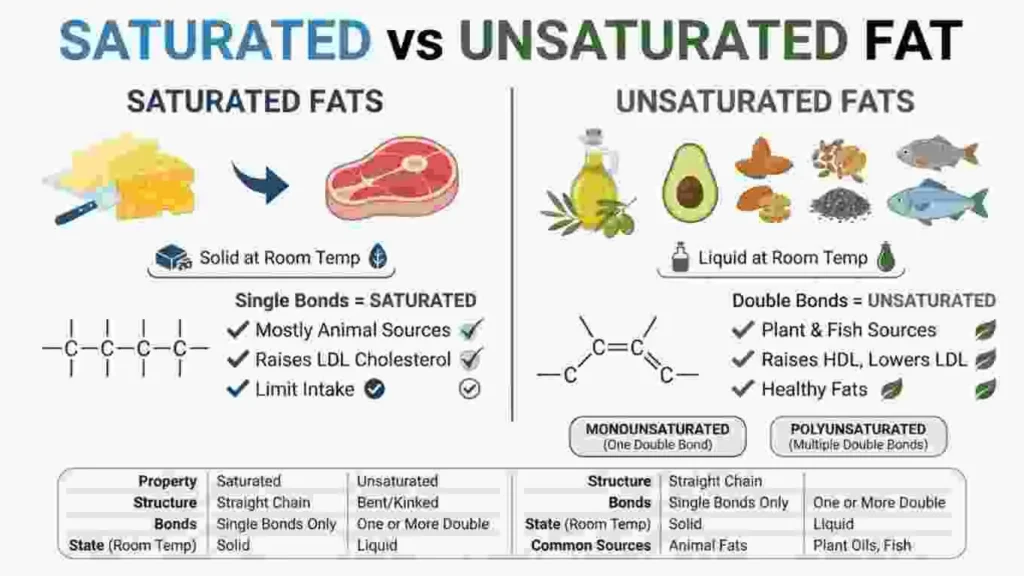
Saturated fats often have straighter chains. Unsaturated fats can have bends in their chains, depending on the type and structure of the double bond.
This helps explain why many saturated fats are solid while many unsaturated fats are liquid at room temperature.
But remember, this is a general pattern. It is not a rule that every saturated fat must be solid or every unsaturated fat must be liquid.
Saturated and Unsaturated Fats in Food
Both saturated and unsaturated fats occur in food.
The type of fat depends on the fatty acids that make up the food.
Foods that often contain saturated fat
Examples include:
- Butter
- Cheese
- Cream
- Fatty meat
- Ghee
- Coconut oil
- Palm oil
Foods that often contain unsaturated fat
Examples include:
- Olive oil
- Avocado
- Nuts
- Seeds
- Peanuts
- Vegetable oils
- Fatty fish
Some foods contain both types.
For example, a food may contain saturated, monounsaturated, and polyunsaturated fats at the same time. Food labels can help you see the amounts.
Are Saturated and Unsaturated Fats the Same?
No.
Both are types of fat, but their chemical structures differ.
The key difference is the number of carbon-carbon double bonds.
Saturated fat:
No carbon-carbon double bonds.
Unsaturated fat:
One or more carbon-carbon double bonds.
Unsaturated fat can then be divided into monounsaturated and polyunsaturated fat.
So the basic order is:
Fat → Saturated or Unsaturated
And:
Unsaturated → Monounsaturated or Polyunsaturated
Why Are Some Fats Called Unsaturated?
The word unsaturated relates to the number of hydrogen atoms attached to the carbon chain.
A saturated fat has a full set of hydrogen atoms for its carbon chain structure. An unsaturated fat has one or more carbon-carbon double bonds, so it has fewer hydrogen atoms than the matching saturated structure.
The double bond is the key feature.
This is why chemistry uses the words saturated and unsaturated for many compounds, not only fats.
Saturated vs Unsaturated in Chemistry
In chemistry, these words have a wider meaning.
A saturated hydrocarbon has only single bonds between carbon atoms.
An unsaturated hydrocarbon has at least one double or triple bond between carbon atoms.
For example:
- Alkanes are saturated hydrocarbons.
- Alkenes are unsaturated hydrocarbons because they contain carbon-carbon double bonds.
- Alkynes are unsaturated hydrocarbons because they contain carbon-carbon triple bonds.
Simple chemistry example
Ethane: C₂H₆
It has a single bond between its two carbon atoms.
Ethene: C₂H₄
It has a double bond between its two carbon atoms.
So ethane is saturated, while ethene is unsaturated.
This chemistry meaning is different from simply asking which food contains a healthier type of fat.
Main Differences Between Saturated and Unsaturated
Here are the key differences:
- Saturated fats have no carbon-carbon double bonds.
- Unsaturated fats have one or more carbon-carbon double bonds.
- Monounsaturated fats have one double bond.
- Polyunsaturated fats have two or more double bonds.
- Many saturated fats are solid at room temperature.
- Many unsaturated fats are liquid at room temperature.
- Both types can occur naturally in foods.
The chemical structure is the most important difference.
Origin and History of the Terms
The words saturated and unsaturated come from the idea of being filled or not fully filled with hydrogen.
Chemists use these terms to describe the bonds in organic compounds.
The idea becomes easier when you look at carbon atoms. Carbon can form several bonds with other atoms. A carbon chain with only single carbon-carbon bonds can hold more hydrogen than a similar chain that contains double or triple bonds.
That led to the terms saturated and unsaturated.
Scientists later used these terms widely when describing fats and fatty acids.
Today, you may see them in chemistry books, food labels, nutrition guides, and health information.
British English vs American English
There is no important British vs American spelling difference for these terms.
Both British English and American English use:
- Saturated
- Unsaturated
- Saturated fat
- Unsaturated fat
- Monounsaturated fat
- Polyunsaturated fat
The meaning also stays the same.
For example:
Olive oil contains mostly unsaturated fat.
This sentence has the same meaning in British and American English.
Which One Should You Use?
If you are writing about food or nutrition, use saturated fat or unsaturated fat based on the type of fat you mean.
If you are writing about chemistry, use saturated and unsaturated based on the bonds in the compound.
Use “saturated” when:
- A fat has no carbon-carbon double bonds.
- A hydrocarbon has only single carbon-carbon bonds.
- You are talking about a saturated compound.
Use “unsaturated” when:
- A fat has one or more carbon-carbon double bonds.
- A hydrocarbon has a double or triple bond.
- You are talking about an unsaturated compound.
You should not use the two words as if they mean the same thing.
Common Mistakes
1. Mistake: Thinking all solid fats are saturated
Incorrect idea:
“All solid fats are saturated.”
Correct idea:
Many saturated fats are solid at room temperature, but physical form alone does not define the fat.
Example:
The chemical structure tells you whether a fat is saturated.
2. Mistake: Thinking all liquid fats are unsaturated
Incorrect idea:
“If a fat is liquid, it must be unsaturated.”
Correct idea:
Many unsaturated fats are liquid, but you need to look at the fat’s chemical structure to classify it.
3. Mistake: Thinking unsaturated means no fat
Incorrect idea:
“Unsaturated fat is not really fat.”
Correct idea:
Unsaturated fat is still fat. The word describes its chemical structure.
4. Mistake: Confusing monounsaturated and polyunsaturated
Incorrect idea:
“Both words mean exactly the same thing.”
Correct idea:
Monounsaturated means one double bond. Polyunsaturated means two or more double bonds.
5. Mistake: Thinking saturated means unhealthy by definition
Incorrect idea:
“The word saturated means a food is bad.”
Correct idea:
Saturated describes chemical structure. Nutrition advice depends on the type and amount of fat in the diet.
6. Mistake: Thinking unsaturated always means one double bond
Incorrect idea:
“Every unsaturated fat has one double bond.”
Correct idea:
Unsaturated fats can have one or more double bonds.
7. Mistake: Using the terms only for food
Incorrect idea:
“Saturated and unsaturated only describe fats.”
Correct idea:
Chemists also use these terms for hydrocarbons and other compounds.
Everyday Examples
Here are simple examples that show how these terms work:
- Butter contains a significant amount of saturated fat.
- Olive oil contains a high amount of unsaturated fat.
- Avocados contain mostly unsaturated fats.
- Some fatty fish contain polyunsaturated fats.
- A monounsaturated fat has one double bond.
- A polyunsaturated fat has more than one double bond.
- Saturated hydrocarbons contain only single carbon-carbon bonds.
- Unsaturated hydrocarbons contain double or triple bonds.
- Food labels can show the amount of saturated fat in a food.
- The word unsaturated does not mean that a food contains no fat.
- Nuts contain several types of fat, including unsaturated fats.
- Ethene is an example of an unsaturated hydrocarbon.
Real-Life Usage
In conversations
Someone may ask:
“Is olive oil saturated or unsaturated?”
A simple answer is:
“Olive oil is mostly unsaturated fat.”
In school
A science teacher may ask:
“What is the difference between saturated and unsaturated compounds?”
A good answer is:
“Saturated compounds have only single carbon-carbon bonds, while unsaturated compounds have double or triple bonds.”
In food labels
You may see:
- Total fat
- Saturated fat
- Trans fat
- Unsaturated fat
These terms help describe the types of fat in food.
In work or formal writing
You may write:
“The sample contains a mixture of saturated and unsaturated fatty acids.”
This wording fits science and lab writing.
On social media
People often use these terms when talking about food, cooking, fitness, or nutrition.
For example:
“I use olive oil because it contains mostly unsaturated fats.”
The exact nutrition advice someone needs can depend on their full diet and health needs.
Related Search Questions
What is the difference between saturated and unsaturated?
Saturated fats have no carbon-carbon double bonds. Unsaturated fats have one or more carbon-carbon double bonds. Unsaturated fats include monounsaturated and polyunsaturated fats.
Is olive oil saturated or unsaturated?
Olive oil contains mostly unsaturated fat, especially monounsaturated fat. It also contains smaller amounts of saturated and polyunsaturated fats.
Is butter saturated or unsaturated?
Butter contains a large amount of saturated fat. It also contains smaller amounts of unsaturated fats.
What is a saturated fat?
A saturated fat is a fat whose fatty acids contain no carbon-carbon double bonds. Many foods contain saturated fat, including butter, cheese, and fatty meat.
What is an unsaturated fat?
An unsaturated fat contains one or more carbon-carbon double bonds. It can be monounsaturated or polyunsaturated.
What does monounsaturated mean?
Monounsaturated means that a fatty acid contains one carbon-carbon double bond. Olive oil, avocados, peanuts, and some nuts contain monounsaturated fats.
What does polyunsaturated mean?
Polyunsaturated means that a fatty acid contains two or more carbon-carbon double bonds. Omega-3 and omega-6 fatty acids are examples of polyunsaturated fats.
Usage and Search Trends
The phrase saturated or unsaturated can have more than one search meaning.
People may use it when they want to understand:
- Saturated vs unsaturated fats
- Saturated and unsaturated fatty acids
- Saturated vs unsaturated hydrocarbons
- Saturated vs unsaturated compounds
- Food sources of saturated fat
- Food sources of unsaturated fat
- Monounsaturated vs polyunsaturated fat
- The difference between saturated and unsaturated
The meaning often depends on the words around the search.
For example, a search about food usually points toward fats and nutrition. A search about alkanes and alkenes usually points toward chemistry.
Exact search volume and Google Trends numbers can change over time. This article does not use made-up numbers.
Saturated vs Unsaturated Comparison Table
| Term | Meaning | Main Feature | Example |
| Saturated fat | A fat with no carbon-carbon double bonds | No double bonds | Butter |
| Unsaturated fat | A fat with one or more carbon-carbon double bonds | One or more double bonds | Olive oil |
| Monounsaturated fat | Unsaturated fat with one double bond | One double bond | Olive oil |
| Polyunsaturated fat | Unsaturated fat with two or more double bonds | Two or more double bonds | Fatty fish |
| Saturated hydrocarbon | Hydrocarbon with only single carbon-carbon bonds | Single bonds only | Ethane |
| Unsaturated hydrocarbon | Hydrocarbon with double or triple bonds | Double or triple bond | Ethene |
FAQs
1. Is saturated or unsaturated better for cooking?
The answer depends on the food, cooking method, and the type of fat. Different oils have different fatty acid profiles and cooking properties. The words saturated and unsaturated describe structure, so they do not by themselves tell you everything about how an oil should be used.
2. Is olive oil saturated or unsaturated?
Olive oil is mostly unsaturated fat, with monounsaturated fat making up a large part of its fat content. It also contains some polyunsaturated and saturated fat. So calling olive oil simply “fat-free” or “saturated” would be incorrect.
3. Is coconut oil saturated or unsaturated?
Coconut oil is high in saturated fat. It also contains a smaller amount of unsaturated fat. The exact amount can vary by product, so the nutrition label gives the most useful information for a specific product.
4. Are nuts saturated or unsaturated?
Many nuts contain more unsaturated fat than saturated fat. Almonds, peanuts, walnuts, and other nuts can contain different amounts and types of fat. Their full nutrition profile includes more than just fat, so the whole food matters too.
5. What is the easiest way to remember saturated and unsaturated?
Think about the word “saturated” as full. In basic fat chemistry, saturated fatty acids have no carbon-carbon double bonds. Unsaturated fatty acids have one or more double bonds. Remembering “no double bonds = saturated” makes the difference easy to recall.
6. Are saturated and unsaturated hydrocarbons different from fats?
Yes. The same basic idea about carbon bonds applies, but the compounds are different. In hydrocarbons, saturated compounds have only single carbon-carbon bonds. Unsaturated hydrocarbons have at least one double or triple bond.
7. What are the two main types of unsaturated fat?
The two main types are monounsaturated and polyunsaturated fats. Monounsaturated fats have one carbon-carbon double bond. Polyunsaturated fats have two or more. Omega-3 and omega-6 fats are examples of polyunsaturated fats.
Conclusion
The difference between saturated or unsaturated becomes simple when you look at the chemical structure.
A saturated fat has no carbon-carbon double bonds in its fatty acids. An unsaturated fat has one or more carbon-carbon double bonds. Unsaturated fats can be monounsaturated, with one double bond, or polyunsaturated, with two or more.
You can find saturated fat in foods such as butter, cheese, and fatty meat. You can find many unsaturated fats in foods such as olive oil, avocados, nuts, seeds, and fish. Some foods contain both types.
These words also have a wider meaning in chemistry. Saturated hydrocarbons contain only single carbon-carbon bonds. Unsaturated hydrocarbons contain at least one double or triple bond.
So, when you see saturated vs unsaturated, first check the context. If the topic is food, it usually means types of fat. If the topic is chemistry, it may refer to the bonds in a compound.
The key rule is easy to remember:
No carbon-carbon double bonds = saturated.
One or more carbon-carbon double bonds = unsaturated.