Have you ever written “time flys” and then stopped to ask if it looks right? You are not alone. Many English learners get confused by time flies or time flys because the word “fly” changes when we use it with “time.”
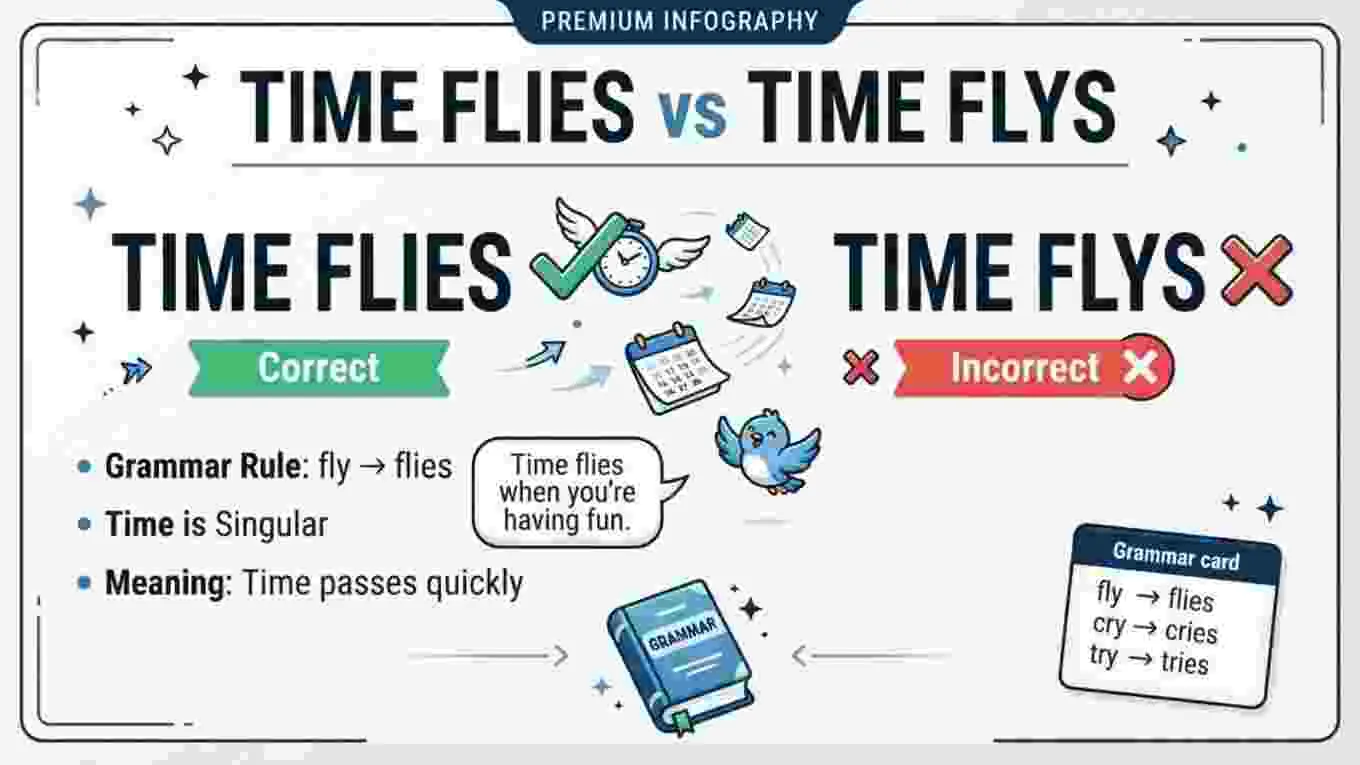
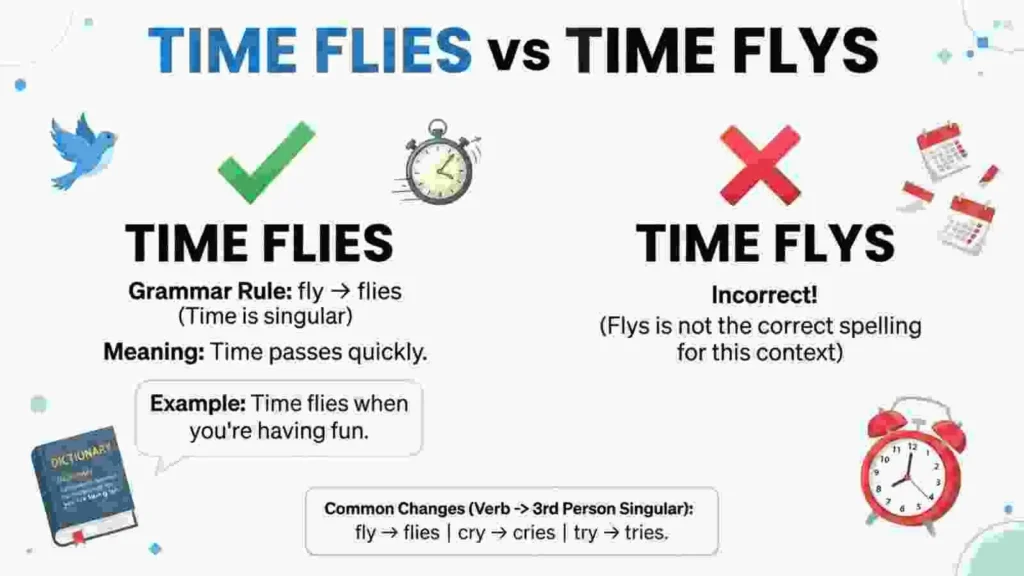
The correct phrase is “time flies.” The spelling “time flys” is incorrect in standard English.
The phrase time flies means that time seems to pass very quickly. People often say it when they feel surprised by how fast days, weeks, months, or years have passed.
For example, you might say, “Time flies when you are having fun.” You could also say, “I cannot believe my son is ten. Time flies!”
The main rule is simple. When fly becomes a verb with a singular subject such as “time,” we change y to ies. So fly becomes flies.
This guide explains why time flies is correct, what the phrase means, how to use it, common mistakes, and where the famous expression comes from.
Time Flies or Time Flys – Quick Answer
“Time flies” is correct.
The correct phrase is:
Time flies.
It means that time passes very quickly.
Why is “flies” correct?
The subject is time, which is singular.
The verb is fly.
When a verb ends in consonant + y, we usually change y to ies when we use it with he, she, it, or another singular subject.
So:
- fly → flies
- cry → cries
- try → tries
- study → studies
Because time is singular:
Time flies.
Not:
Time flys.
What Does “Time Flies” Mean?
Time flies means that time seems to pass very fast.
People often use the phrase when they look back and feel surprised by how quickly something happened.
For example:
Time flies when you are having fun.
This means that fun can make you feel as if time passes very quickly.
You can also use it when talking about age:
My daughter is already five years old. Time flies!
The speaker feels surprised that five years have passed so quickly.
Simple meaning
Time flies = Time passes quickly.
The phrase does not mean that time can literally fly like a bird.
It is a common expression that describes how fast time seems to pass.
Why Is It “Time Flies” and Not “Time Flys”?
The answer comes from a basic English spelling rule.
The verb fly ends in y.
When a verb ends in a consonant followed by y, we normally change the y to ies for a singular third-person subject.
For example:
| Base Verb | Singular Form |
| fly | flies |
| cry | cries |
| try | tries |
| carry | carries |
| hurry | hurries |
| study | studies |
The word time works like a singular subject.
So:
Time flies.
The spelling flys does not follow this standard English rule.
The Grammar Behind “Time Flies”
The sentence “Time flies” has two main parts:
- Time = subject
- flies = verb
The base verb is fly.
Because “time” acts as a singular subject, the verb takes the -s form. Since fly ends in consonant + y, its spelling changes from fly to flies.
Compare these sentences:
Birds fly.
Here, birds is plural, so we use fly.
A bird flies.
Here, a bird is singular, so we use flies.
The same rule applies to time:
Time flies.
More examples
- The bird flies.
- My dog cries.
- She tries again.
- He studies every night.
- Time flies.
This is why “time flies” is grammatically correct.
Time Flies: Main Differences
There is no real meaning difference between the two forms because “time flys” is not the standard spelling.
| Phrase | Correct? | Meaning | Example |
| Time flies | Yes | Time passes quickly | Time flies when we have fun. |
| Time flys | No | Intended to mean the same thing | Incorrect spelling |
| Time fly | No in this sentence | Base verb form | Time flies so quickly. |
The key point is simple:
Use “time flies.”
When Should You Use “Fly”?
The word fly is the base form of the verb.
We use it in several situations.
After “to”
I want to fly home.
With plural subjects
Birds fly south in winter.
After modal verbs
Time can fly when you are busy.
We may fly tomorrow.
Notice that fly stays in its base form after words such as can, may, and will.
When Should You Use “Flies”?
Use flies when fly acts as a present-tense verb with a singular third-person subject.
Examples:
The bird flies over the lake.
My brother flies to London often.
Time flies when we are busy.
The subject does not have to be a person. A thing or idea can also take flies when it acts as a singular subject.
Origin and History of “Time Flies”
The idea behind time flies is very old.
The expression connects the passing of time with the idea of something moving quickly through the air.
A famous Latin phrase, tempus fugit, means “time flees” or “time flies.” The idea later became common in English expressions about how quickly life and time pass.
The English phrase “time flies” became a common way to express this idea.
You may also see the longer saying:
Time flies when you’re having fun.
This phrase means that enjoyable activities can seem to pass very quickly.
The exact history of the modern phrase has more detail, but the main idea is clear: people have used the image of fast-moving time for many centuries.
British English vs American English
There is no British vs American spelling difference here.
Both British English and American English use:
Time flies.
The meaning is also the same.
Examples:
British English:
Time flies when you’re having fun.
American English:
Time flies when you’re having fun.
The pronunciation is also essentially the same in both forms.
So you do not need to choose between a British and American version.
Which One Should You Use?
Use “time flies” in everyday, formal, academic, and online writing when you want to say that time passes quickly.
Everyday writing
Time flies! I cannot believe it has been a year.
Formal writing
You can use the phrase in a suitable formal context, but a more direct phrase such as “time passes quickly” may sound more formal.
Academic writing
In academic writing, choose the wording that fits your subject. “Time flies” is an informal expression, so “time passes quickly” may work better in a formal paper.
Business writing
For a friendly email, you might write:
Time flies! It has already been six months since we started the project.
For a very formal message, use simpler direct wording.
Social media
Time flies works very naturally on social media.
Time flies. My little brother is graduating already!
Common Mistakes
1. Writing “time flys”
Incorrect:
Time flys so fast.
Correct:
Time flies so fast.
Why?
The subject “time” is singular, and fly changes to flies.
2. Writing “time fly”
Incorrect:
Time fly when you have fun.
Correct:
Time flies when you have fun.
Why?
“Time” is singular, so the present-tense verb needs the singular form flies.
3. Writing “time flie”
Incorrect:
Time flie quickly.
Correct:
Time flies quickly.
Why?
The correct spelling is flies, not “flie.”
4. Using “flies” with a plural subject
Incorrect:
Birds flies across the sky.
Correct:
Birds fly across the sky.
Why?
“Birds” is plural, so use the base form fly.
5. Confusing “fly” and “flies”
Incorrect:
A bird fly over my house.
Correct:
A bird flies over my house.
Why?
“A bird” is singular, so the verb becomes flies.
6. Writing “time flies” when you mean a literal flight
The phrase time flies has a special meaning.
If you want to talk about an actual object or animal flying, use the normal meaning of fly.
The plane flies over the city.
Here, “flies” describes actual movement through the air.
Everyday Examples
Here are natural examples using time flies:
- Time flies when you are having fun.
- I cannot believe it is Friday already. Time flies!
- Time flies when I spend the day with my family.
- My baby is one year old already. Time flies.
- It feels like yesterday, but time flies.
- Time flies when you are busy at work.
- We have been friends for ten years. Time flies!
- Summer is almost over. Time flies so quickly.
- Time flies when you enjoy what you do.
- I still remember my first day at school. Time flies.
- The holidays ended before I knew it. Time flies.
- You will be surprised by how fast time flies.
Real-Life Usage
In conversations
Someone may say:
“You have been here for five years?”
You can reply:
“Yes! Time flies.”
This shows surprise about how quickly the years passed.
In emails
A friendly work email might say:
Time flies! It has already been six months since we started working together.
At school
A student might say:
Time flies when we are enjoying our school trip.
At work
A worker may say:
I cannot believe the workday is almost over. Time flies!
On social media
People often use the phrase when sharing old photos:
Five years ago today! Time flies.
In formal writing
If the writing needs a formal tone, you can replace time flies with:
- Time passes quickly.
- Time passes very fast.
- The years pass quickly.
Related Search Questions
Is “time flies” correct?
Yes. “Time flies” is the correct phrase. It means that time passes quickly. The subject “time” is singular, so the verb changes from fly to flies.
Is “time flys” correct?
No. “Time flys” is not the standard spelling. The correct form is “time flies.” The change from fly to flies follows the common spelling rule for verbs ending in consonant + y.
What does “time flies” mean?
“Time flies” means that time seems to pass very quickly. People often use it when they feel surprised by how quickly days, months, or years have passed.
Why does fly become flies?
The verb fly ends in consonant + y. When it takes the third-person singular form, the y changes to ies. Therefore, fly becomes flies, just like try becomes tries.
Is “time flies when you’re having fun” correct?
Yes. “Time flies when you’re having fun” is a common English expression. It means that enjoyable activities can seem to make time pass very quickly.
Can I say “time fly”?
Not in the normal sentence “Time fly.” Because “time” is singular, the correct present-tense form is “time flies.” However, fly can appear after words such as “will,” “can,” or “may,” as in “Time can fly.”
Is “time flies” British or American?
It is used in both British English and American English. There is no spelling difference between the two forms. Both use “time flies” and understand the phrase in the same way.
Usage and Search Trends
People who search for time flies or time flys are usually looking for a spelling or grammar answer.
Common search needs include:
- time flies or time flys
- is time flies correct
- is time flys correct
- time flies meaning
- why is it time flies
- time flies when you’re having fun
- time flies grammar
- fly or flies
- how to use flies in a sentence
The search intent is mainly informational. The user usually wants to know which spelling is correct and why.
Exact search volume, keyword difficulty, and Google Trends numbers can change over time. No exact figures are included here without verified data.
Time Flies vs Time Flys Comparison Table
| Form | Correct? | Meaning | Best Use |
| Time flies | Yes | Time passes quickly | Standard English |
| Time flys | No | Intended to mean time passes quickly | Avoid |
| Time fly | No for this sentence | Base verb | Use only in structures that need the base form |
| Time can fly | Yes | Time can seem to pass quickly | After “can” |
| Time will fly | Yes | Time will seem to pass quickly | After “will” |
FAQs
1. What is the correct spelling, time flies or time flys?
The correct spelling is time flies. The word “time” is a singular subject, so the verb “fly” takes its singular form. Because “fly” ends in consonant + y, the y changes to ies. Therefore, flies is correct, while flys is not standard English.
2. What does “time flies” mean in simple words?
Time flies means that time passes quickly. You might say this when a day, year, holiday, or event seems to end sooner than expected. For example, if you have not seen a friend for ten years, you might say, “Time flies!”
3. Why do we say “time flies” instead of “time fly”?
The subject “time” is singular. In the simple present tense, a singular third-person subject normally takes a verb ending in -s. Since “fly” ends with consonant + y, it changes to flies.
4. Can “flies” be a noun?
Yes. Flies can also be the plural of the noun fly, meaning the small flying insects. For example, “There are flies near the window.” In “time flies,” however, “flies” is a verb, not a noun.
5. Is “time flies when you’re having fun” a common phrase?
Yes. It is a very common English expression. People use it to say that enjoyable activities seem to pass quickly. You might hear it in conversations, see it in social media posts, or use it when talking about a fun trip or event.
6. What is the difference between “fly” and “flies”?
Fly is the base form, while flies is used with a singular third-person subject in the simple present. For example, “Birds fly,” but “A bird flies.” The same rule gives us “Time flies.”
7. Can I use “time flies” in formal writing?
You can, but it depends on the type of writing. The phrase is common and natural, but it has a somewhat conversational tone. In a formal report or academic paper, “time passes quickly” may sound more direct and neutral.
Conclusion
When choosing between time flies or time flys, the correct phrase is “time flies.”
The phrase means that time seems to pass very quickly. People often use it when they feel surprised by how fast days, months, or years have passed.
The spelling flies follows a basic English grammar rule. The subject time is singular, so the verb fly needs its singular form. Because “fly” ends in consonant + y, we change the y to ies. That gives us flies.
For example:
Time flies when you’re having fun.
The form “time flys” is not standard English and should not be used in normal writing.
There is also no British or American spelling difference here. Both forms of English use time flies.
Remember the simple rule:
fly → flies
So when you want to say that time passes quickly, write:
Time flies.
This small spelling rule can help you avoid a very common mistake in English writing.

Emily Carter is an English grammar writer based in Portland, Oregon, with 7+ years of experience turning tricky grammar rules into simple, easy lessons.