Jibe or jive can be confusing because the two words look and sound very similar. You may see both words in books, news stories, conversations, or online posts. But they do not always mean the same thing.
The good news is that both jibe and jive are correct English words. The right choice depends on what you want to say.
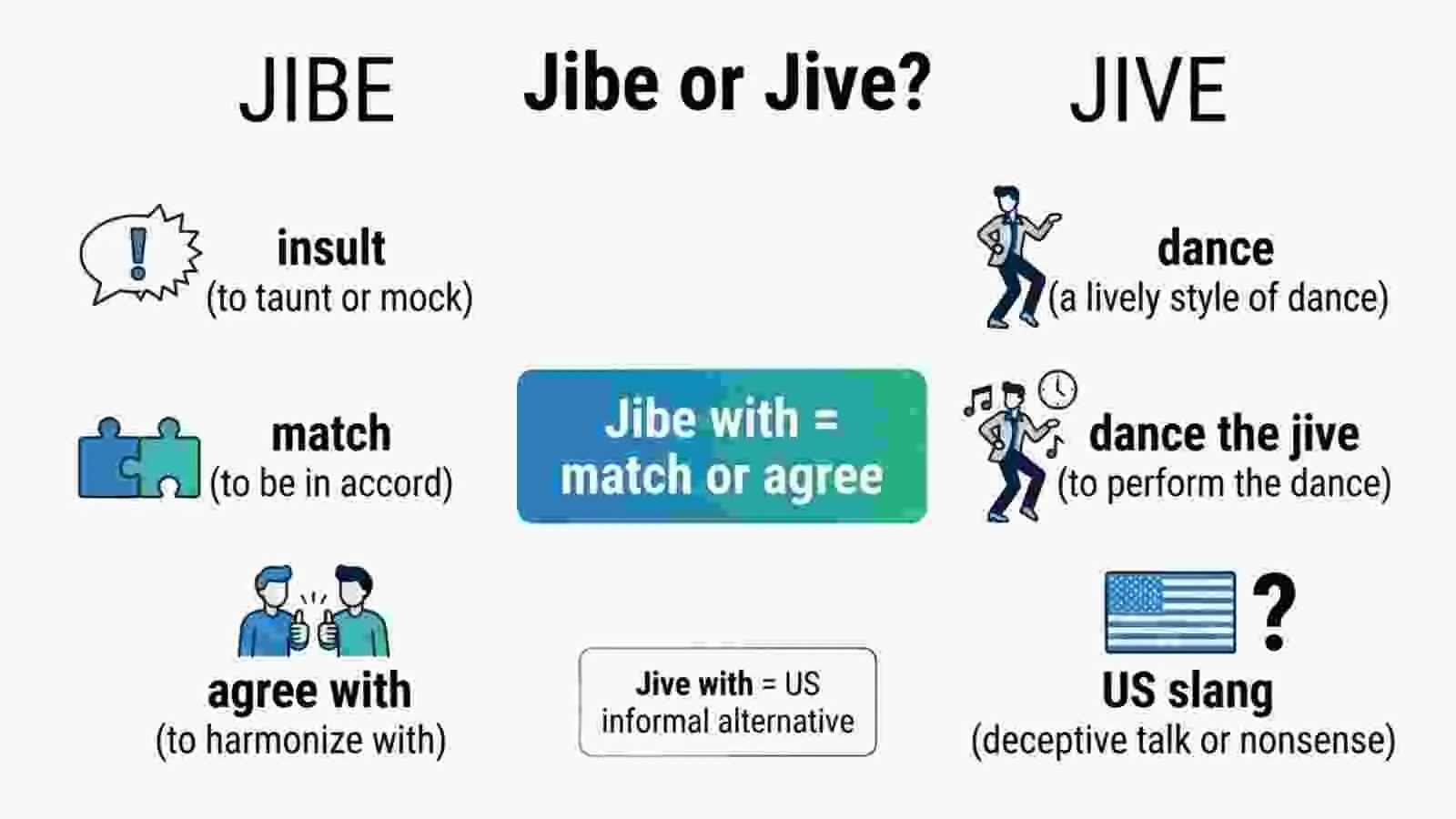
Jibe has several uses. As a noun or verb, it can mean an insulting remark or an act of making fun of someone. The phrase jibe with can also mean to match or agree with something.
Jive has different meanings. It can refer to a fast dance, or it can describe dishonest or meaningless talk in US slang. As a verb, jive can also mean to dance or to try to trick someone.
The confusion becomes greater because jibe with and jive with can both be used for the idea of things matching, although jive with is marked as US informal by Cambridge.
This guide explains the difference in simple English and shows you exactly when to use each word.
Jibe or Jive – Quick Answer
Jibe and jive are both correct words, but they have different meanings.
It can mean:
- an insulting remark
- to make an insulting remark
- to match or agree with something when used in jibe with
Example:
His story does not jibe with the facts.
Here, jibe with means match or agree with.
Jive
Jive can mean:
- a fast dance
- to dance
- dishonest or meaningless talk
- to try to trick someone, in US slang
Example:
They learned how to jive at the dance class.
Cambridge lists these meanings for jive.
Simple rule
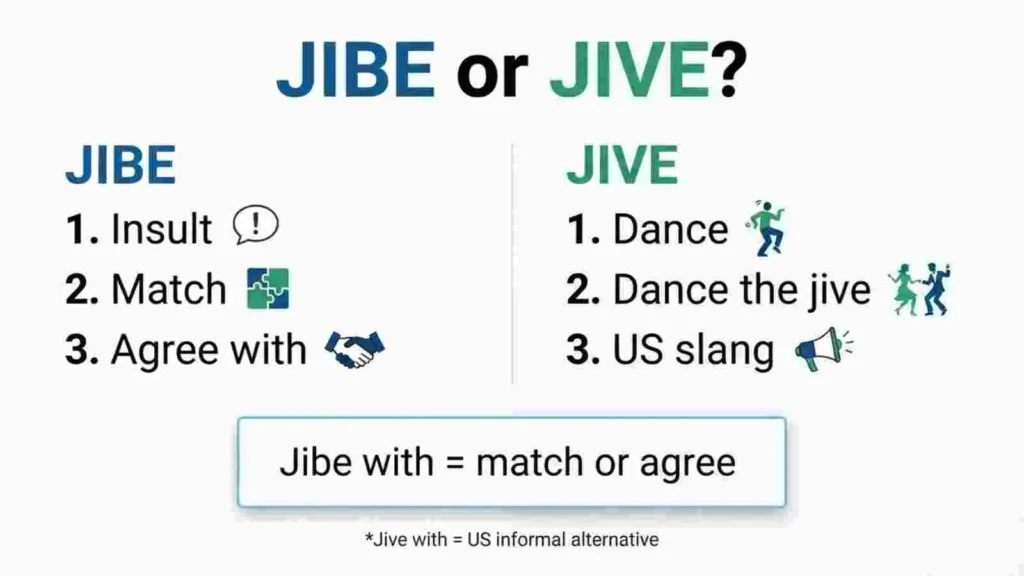
Jibe = match, agree, or insult
Jive = dance or dishonest talk
There is one exception to remember:
Jive with can also mean match or agree, especially in informal US English.
What Does Jibe Mean?
Jibe has more than one meaning.
One meaning is an insulting remark. For example:
She made a jibe about his old car.
Here, jibe means a remark meant to make someone look foolish.
As a verb, jibe can mean to make an insulting remark:
He jibed at her new haircut.
Cambridge lists this meaning for both British and American English.
Jibe With
The phrase jibe with has a different meaning.
It means that something matches, agrees with, or fits with something else.
For example:
His story does not jibe with the evidence.
This means his story does not match the evidence.
Cambridge also notes jibe with as a phrasal verb meaning that one statement or opinion is similar to and matches another.
What Does Jive Mean?
Jive has several different meanings.
One common meaning relates to dance.
They learned the jive.
The jive is a fast dance that became popular with young people in the 1940s and 1950s.
As a verb, jive means to dance the jive:
The couple jived across the dance floor.
Jive as Slang
In US slang, jive can also mean talk that has no real meaning or is dishonest.
For example:
Don’t believe his jive.
Cambridge lists this use as US slang.
The verb jive can also mean trying to make someone believe something that is not true:
Stop jiving me and tell me what happened.
This use is also marked as US slang.
Jibe vs Jive: Main Differences
The easiest way to understand these words is to look at their main meanings.
Jibe
Use jibe when you mean:
- An insulting comment.
- To make an insulting comment.
- To match or agree with something in the phrase jibe with.
Jive
Use jive when you mean:
- A type of fast dance.
- To dance.
- Dishonest or meaningless talk in US slang.
- To try to deceive someone in US slang.
- Jive with, in informal US English, can mean to match or agree.
Origin and History
The words jibe and jive have different histories.
Jibe is connected with the older word gibe, which means an insulting remark or taunt. Cambridge lists gibe as another form of the noun jibe.
Jive developed with meanings linked to dance and slang. Its modern use includes the name of a fast dance and US slang for dishonest or meaningless talk.
Over time, the two words became easy to confuse because they have the same pronunciation in common English use.
That does not mean they have the same meaning.
British English vs American English
Both jibe and jive are used in British and American English.
The biggest difference is not the spelling of the words. It is how certain meanings are used.
Jibe can mean an insulting remark in both varieties of English. The phrase jibe with can mean match or agree.
Jive refers to the dance in both varieties. Its slang meaning for dishonest or meaningless talk is marked as US slang by Cambridge.
Cambridge also notes jive with as a US informal form of jibe with.
So, you should not assume that jive is always a spelling mistake for jibe.
Which One Should You Use?
Choose the word based on your meaning.
Use Jibe for an Insult
His comment was a cheap jibe.
Here, jibe means an insulting remark.
Use Jibe With for Match or Agree
Her story does not jibe with the facts.
Here, jibe with means match or agree.
Use Jive for the Dance
They performed the jive at the competition.
Here, jive means the dance.
Use Jive for US Slang
That’s just jive.
Here, jive can refer to dishonest or meaningless talk.
For Formal Writing
When you mean match or agree, jibe with is a clear choice.
You can also use simpler words such as:
- agree with
- match
- fit with
- be consistent with
For example:
Her report agrees with the data.
This is very clear and easy to understand.
Common Mistakes
1. Using Jive for Match
Less standard in formal writing:
His story jives with the evidence.
Clearer:
His story jibes with the evidence.
In US informal English, jive with can also mean match or agree, but jibe with is the direct dictionary form for this meaning.
2. Using Jibe for the Dance
Incorrect:
They learned the jibe.
Correct:
They learned the jive.
Why?
The name of the dance is jive.
3. Using Jive for an Insult
Incorrect:
He made a jive at her.
Correct:
He made a jibe at her.
Why?
An insulting remark is a jibe.
4. Confusing Jibe With Jive
Incorrect:
The two reports do not jive.
Better for formal writing:
The two reports do not jibe.
The phrase jibe with means to match or agree.
5. Using Jibe When You Mean Dance
Incorrect:
They jibe every Friday night.
Correct:
They jive every Friday night.
Why?
As a verb, jive means to dance the jive.
6. Thinking Jive Is Always Wrong
Incorrect idea:
Jive is always a misspelling of jibe.
Correct idea:
Jive is a real English word with its own meanings.
It can refer to a dance, dancing, and certain US slang uses.
Everyday Examples
Here are simple examples showing the difference.
Examples With Jibe
- His story does not jibe with the facts.
- Her report jibes with the earlier report.
- The two accounts do not jibe.
- He made a jibe about my old phone.
- She ignored the rude jibe.
- His comment sounded like a cheap jibe.
Examples With Jive
- They learned the jive at dance school.
- The couple jived all night.
- She loves watching the jive.
- He tried to jive his way out of the question.
- Don’t listen to that jive.
- The dancers performed the jive on stage.
Real-Life Usage
In Conversation
You might hear:
That doesn’t jibe with what you told me.
This means:
That does not match what you told me.
You may also hear jive with in informal US speech:
That doesn’t jive with what I heard.
Cambridge lists this use as US informal.
In Emails
A business email might say:
The numbers in your report do not jibe with our records.
This means the numbers do not match the records.
At School
A student might write:
The answer does not jibe with the information in the book.
For very simple writing, does not match may be easier.
At Work
You may see:
The results do not jibe with the earlier data.
This means the new results do not agree with the earlier data.
In Social Media
You may see jive in casual posts about music or dance:
She can really jive!
You may also see jive in US slang.
In Formal Writing
Jibe with can work in formal writing, but agree with or match may be clearer for many readers.
Related Search Questions
Does Jibe Mean Agree?
Yes, when used in the phrase jibe with, it can mean that something matches or agrees with something else.
His story does not jibe with the evidence.
It does not mean that the person has the same opinion in every case. It means the two things fit or match.
Does Jive Mean Agree?
Jive with can mean to match or agree in US informal English.
For example:
That explanation doesn’t jive with the facts.
However, jibe with is the more direct standard form for this meaning in dictionary usage. Cambridge lists jive with as a US informal alternative.
Is Jibe the Same as Gibe?
They can refer to the same type of insulting remark.
Cambridge lists gibe as another form of the noun jibe.
Is Jive a Real Word?
Yes. Jive is a real English word.
It can mean a fast dance, to dance that dance, or certain types of dishonest or meaningless talk in US slang.
What Does Jibe With Mean?
Jibe with means to match, agree with, or fit with something.
Her explanation does not jibe with the evidence.
The phrase is useful when comparing two facts, stories, ideas, or pieces of information.
Usage and Search Trends
There is no reliable fixed search number that should be used here without a specific current keyword-data source. Search volume and keyword rankings can change over time.
The word pair remains useful because jibe and jive have several meanings, while jibe with and jive with can overlap in informal US use.
Common search questions include:
- jibe or jive
- jibe vs jive
- jibe or jive which is correct
- does it jibe or jive
- jibe with or jive with
- jibe meaning
- jive meaning
- jibe with meaning
- jive with meaning
- is jive a word
For searchers, the most useful distinction is simple: jibe is linked to insulting remarks and matching, while jive is linked to dance and slang.
Comparison Table
| Term | Meaning | Usage | Example |
| jibe | An insulting remark | Noun | He made a jibe about my car. |
| jibe | Make an insulting remark | Verb | She jibed at his idea. |
| jibe with | Match or agree | Phrase | The story does not jibe with the facts. |
| jive | A fast dance | Noun | They learned the jive. |
| jive | Dance the jive | Verb | They jived all night. |
| jive | Dishonest or meaningless talk | US slang | Don’t believe that jive. |
| jive with | Match or agree | US informal | The story doesn’t jive with the facts. |
The meanings above follow dictionary usage from Cambridge.
FAQs
1. Is it jibe or jive?
Both jibe and jive are correct words. They have different meanings. Jibe can mean an insult or, in jibe with, to match or agree. Jive can mean a dance, to dance, or certain US slang uses. The correct spelling depends on the meaning you want.
2. Should I say jibe with or jive with?
Use jibe with when you mean that something matches or agrees with something else. Jive with can also carry this meaning in US informal English. If you want a clear choice for formal writing, jibe with is a good option.
3. What does jibe mean?
Jibe can mean an insulting remark. As a verb, it can mean making an insulting remark. In the phrase jibe with, it means to match or agree with something. These meanings are different, so the sentence helps show which meaning the writer intends.
4. What does jive mean?
Jive has several meanings. It can mean a fast dance or the act of doing that dance. In US slang, it can also mean dishonest or meaningless talk. As a verb, it can mean trying to make someone believe something untrue.
5. Is jive a spelling mistake for jibe?
No. Jive is a real word. It has its own meanings, especially the dance and certain slang uses. However, if you mean that two stories or facts match, jibe with is the standard form to choose in careful writing.
6. What is the difference between jibe and gibe?
Jibe and gibe can both refer to an insulting remark. Cambridge lists gibe as another form of the noun jibe. This is separate from jive, which has meanings connected with dance and slang.
7. Does jibe mean make fun of someone?
It can. As a noun, a jibe is an insulting remark meant to make someone look foolish. As a verb, jibe can mean making such remarks. For example, “He made a jibe about her clothes” describes an insulting comment.
Conclusion
When choosing jibe or jive, first think about the meaning.
Use jibe for an insulting remark or an insulting comment. You can also use jibe with when you mean that something matches or agrees with something else.
For example:
Her story does not jibe with the facts.
Use jive for the fast dance or the act of dancing it. The word also has some US slang meanings related to dishonest or meaningless talk.
There is one point that can cause extra confusion. Jive with can also mean match or agree in US informal English. So, you may see both jibe with and jive with in real writing.
The easiest rule is:
Jibe = insult or match
Jive = dance or slang
If you are writing something formal and mean “match” or “agree,” jibe with is a clear choice. When you mean the dance, always use jive.