To or too is a common English word confusion. The two words look and sound similar, but they have different jobs in a sentence. Using the wrong one can change the meaning of your sentence or make your writing look incorrect.
So, should you write to or too?
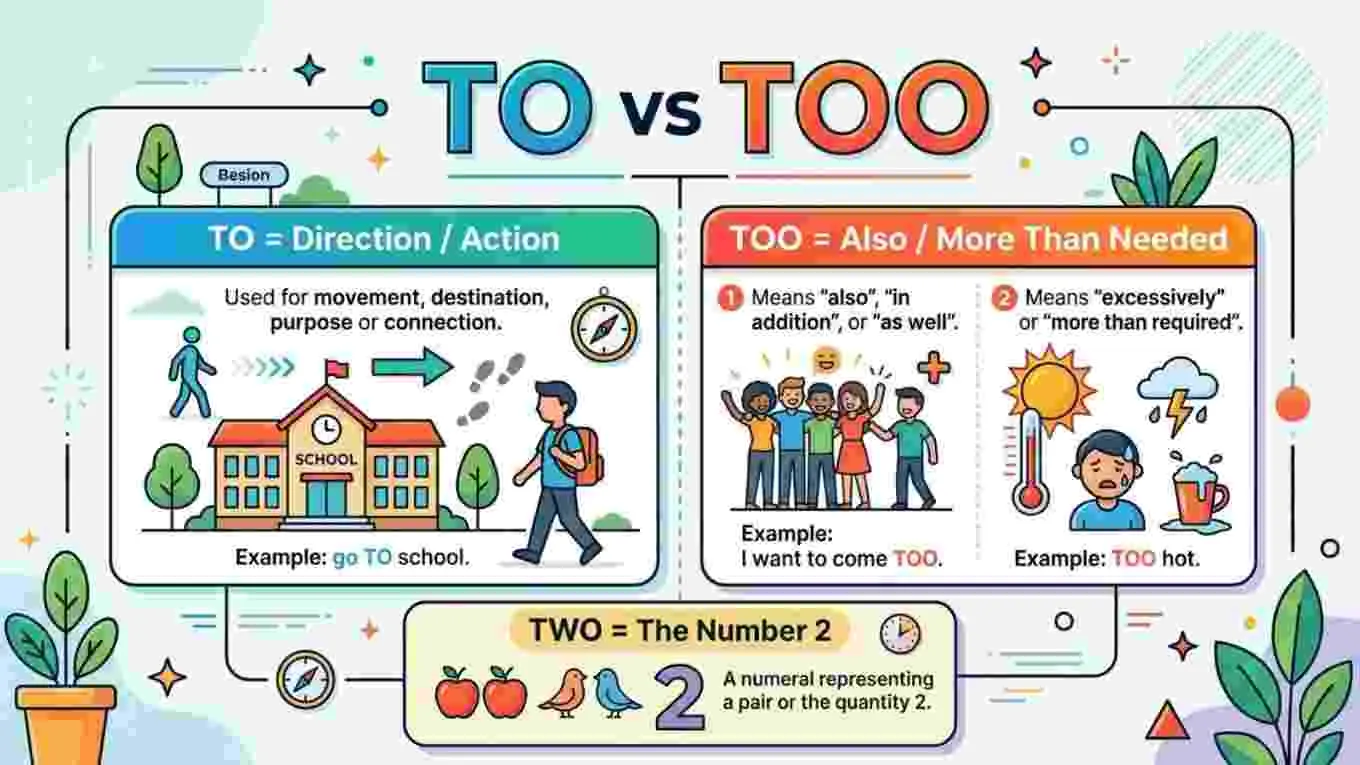
The answer depends on what you want to say. To is most often used before a verb or to show direction, a person, or a place. For example, “I want to eat” and “She went to school.” Too usually means “also” or “more than needed.” For example, “I want to go too” or “The bag is too heavy.”
People often search for to or too because both words sound the same in many sentences. This makes them easy to mix up when writing.
The good news is that the difference is simple. Once you learn what each word does, you can choose the right one with ease.
To or Too – Quick Answer
To and too have different meanings.
- To usually shows direction, a person, a place, or comes before a verb.
- Too usually means also or more than needed.
Examples
I am going to school.
Here, to shows direction.
I want to eat too.
Here, too means “also.”
The coffee is too hot.
Here, too means “more than is wanted or needed.”
A simple trick is:
If you can replace the word with also, use too.
For example:
I want to come too.
→ I want to come also.
That works, so too is correct.
What Does “To” Mean?
To is one of the most common words in English. It has several uses.
1. To Show Direction
Use to when someone or something moves toward a place or person.
Examples:
- I went to school.
- She walked to the store.
- We drove to Lahore.
- He ran to his mother.
Here, to shows where someone or something is going.
2. Before a Verb
Use to before the basic form of many verbs.
Examples:
- I want to sleep.
- She likes to read.
- We need to leave.
- He plans to study.
This form is called the to-infinitive.
3. To Show a Person Receiving Something
Use to when something moves or is given to someone.
Examples:
- Give the book to Ali.
- I sent an email to my teacher.
- She gave the keys to her brother.
4. To Show a Range
To can connect two numbers, times, or points.
Examples:
- 10 to 20
- Monday to Friday
- 9 a.m. to 5 p.m.
What Does “Too” Mean?
Too has two main meanings.
1. Too Means “Also”
Use too when you want to say also or as well.
Examples:
- I like pizza too.
- She is coming too.
- He wants one too.
- I am tired too.
In these examples, you can often replace too with also.
I like pizza too.
I also like pizza.
Both sentences have almost the same meaning.
2. Too Means “More Than Needed”
Use too when something is more than is wanted, needed, or safe.
Examples:
- The water is too hot.
- This box is too heavy.
- You are driving too fast.
- The shirt is too small.
Here, too does not mean “also.” It means more than needed or wanted.
To vs Too: Main Differences
The main difference is their meaning and use.
To often connects a person, place, thing, or verb to another part of the sentence.
Too usually adds the meaning of also or more than needed.
| Word | Main Meaning | Common Use | Example |
| to | Direction or link | Before a verb, place, or person | I went to school. |
| too | Also | Adds another person or thing | I want to go too. |
| too | More than needed | Before an adjective or adverb | It is too cold. |
To or Too: Easy Memory Trick
Here is a simple way to remember the difference.
Remember “too” has an extra O
Too has two O’s.
You can remember:
too = also
too = more
For example:
I want ice cream too.
You can think:
I want ice cream also.
Another example:
It is too cold.
Think:
It is more cold than I want.
Remember “to” for movement or action
Use to in sentences like:
- go to school
- walk to work
- want to eat
- need to sleep
To or Too: Common Mistakes
Mistake 1: Using “too” before a verb
Incorrect:
I want too go home.
Correct:
I want to go home.
Why?
Use to before the basic form of a verb.
Mistake 2: Using “to” when you mean “also”
Incorrect:
I want to come to.
Correct:
I want to come too.
Why?
Here, too means “also.”
Mistake 3: Confusing “too much” and “to much”
Incorrect:
I ate to much food.
Correct:
I ate too much food.
Why?
Too much means more than needed or wanted.
Mistake 4: Confusing “too many” and “to many”
Incorrect:
There are to many people here.
Correct:
There are too many people here.
Why?
Use too many when the number is more than needed.
Mistake 5: Writing “to” instead of “too” at the end
Incorrect:
Can I come to?
Correct:
Can I come too?
Why?
The speaker means “Can I also come?”
Mistake 6: Writing “too” before an infinitive
Incorrect:
She wants too learn English.
Correct:
She wants to learn English.
Why?
Use to before the verb learn.
Mistake 7: Confusing “to” with “too” in a direction phrase
Incorrect:
We went too the park.
Correct:
We went to the park.
Why?
The word shows the place where we went, so to is correct.
10 Everyday Examples of To and Too
- I need to finish my homework.
- She went to the market.
- I want some water too.
- The soup is too hot.
- He likes to play football.
- Are you coming too?
- We walked to the bus stop.
- This bag is too heavy.
- They want to buy a new car.
- I would like to join too.
Notice how to connects ideas or shows direction, while too adds “also” or shows that something is more than needed.
How to Use To in a Sentence
You will often see to in these patterns:
To + Verb
- to eat
- to sleep
- to work
- to read
- to study
- to play
Examples:
I want to study.
She needs to work.
To + Place
- to school
- to work
- to London
- to the store
Example:
He went to work.
To + Person
Example:
I spoke to my friend.
How to Use Too in a Sentence
Too = Also
I like tea too.
She wants to come too.
He is a student too.
Too = More Than Needed
The room is too small.
The test was too hard.
The music is too loud.
Too Much
Use too much with things that you usually cannot count one by one.
Examples:
- too much water
- too much money
- too much time
- too much sugar
There is too much sugar in this tea.
Too Many
Use too many with things you can count.
Examples:
- too many books
- too many people
- too many cars
- too many questions
There are too many cars on this road.
Real-Life Usage of To or Too
In Conversations
People use both words all the time when speaking.
“Are you going to the party?”
“Yes. Do you want to come too?”
Here, to shows movement toward the party, while too means “also.”
In Emails
You may write:
I would like to speak to you.
Or:
Please send the report to me too.
At School
Students often use to before verbs:
I need to finish my homework.
They may also use too when adding information:
I have a test tomorrow too.
At Work
You may see:
Please send the file to the manager.
Or:
The file is too large to send by email.
On Social Media
Short posts often use too to mean “also”:
I love this song too!
In Formal Writing
Both words are normal in formal English.
For example:
The results are too limited to support the claim.
Or:
The report was sent to the research team.
Is “Too” Always at the End of a Sentence?
No. Too often appears at the end of a sentence when it means “also,” but it can appear in other places too.
For example:
She too wanted to join.
This means:
She also wanted to join.
When too means “more than needed,” it usually comes before an adjective or adverb.
Examples:
- too difficult
- too expensive
- too quickly
- too late
The bag is too expensive.
Is “To” Always Followed by a Verb?
No.
You often see to before a verb:
I want to sleep.
But to can also come before a noun or pronoun.
Examples:
- go to school
- give it to her
- talk to me
- travel to Pakistan
So, do not assume that to must always come before a verb.
To, Too, and Two
There is one more word that sounds like to and too:
two
These three words sound alike in many forms of English, but they have different meanings.
| Word | Meaning | Example |
| to | Direction, link, or before a verb | I want to go. |
| too | Also or more than needed | I want to go too. |
| two | The number 2 | I have two books. |
Easy Trick
Two is easy to remember because it contains the word idea of two things.
Example:
I have two pens.
But:
I want to buy a pen too.
Here, too means “also.”
To or Too in British and American English
There is no major British English vs American English difference between to and too.
Both forms are standard in British English and American English.
For example, people in both forms of English write:
I want to go too.
The meaning and basic grammar stay the same.
The main issue is not regional spelling. It is choosing the word that fits the sentence.
Which One Should You Use?
Use to when you show:
- Direction
- A person receiving something
- A place
- A link between words
- An action after certain verbs
Examples:
Go to school.
Give it to me.
I want to sleep.
Use too when you mean:
- Also
- More than needed
- More than wanted
- More than is suitable
Examples:
I want to go too.
The food is too hot.
A Quick Test
Ask yourself:
Can I replace the word with “also”?
If yes, use too.
I want to come too.
→ I want to come also. ✓
If the answer is no, check whether to fits the sentence.
I want to go to school.
“Also” does not work here, so to is correct.
Related Search Questions
What is the difference between to and too?
To usually shows direction or comes before a verb. Too usually means “also” or “more than needed.” For example, “I want to go to school” uses to, while “I want to go too” uses too.
Is it “to much” or “too much”?
The correct phrase is too much when you mean more than needed or wanted.
Example:
I have too much work.
Use to in phrases such as “go to work,” not “too work.”
Is it “to many” or “too many”?
The correct phrase is too many when you mean a number that is more than needed.
Example:
There are too many people here.
Is “too” the same as “also”?
Often, yes. When too means “also,” you can usually replace it with also.
Example:
I like coffee too.
This has nearly the same meaning as:
I also like coffee.
Is “to” always used before a verb?
No. To often comes before a verb, as in “to read,” but it can also show direction or a relationship with a person or place.
Examples include:
go to school
talk to me
Can “too” come at the beginning of a sentence?
Yes, although this use is less common. When too means “also,” it can appear in different places.
Example:
Too much noise can make it hard to study.
Here, too means “more than is wanted or needed.”
Usage and Search Trends
The search intent for to or too is mainly informational. People usually want to understand the difference, check a sentence, or learn which word they should use.
Common searches include:
- to or too
- too or to
- to vs too
- difference between to and too
- when to use to or too
- how to use to and too
- to and too examples
- is it to or too
- to much or too much
- to many or too many
- what is the difference between to and too
These searches show a clear need for simple grammar help. Exact search volume, traffic, or Google Trends numbers should not be stated without current data from a reliable keyword or search-data source.
To or Too Comparison Table
| Word | Type | Meaning | Example |
| to | Preposition / infinitive marker | Direction, link, or action | I want to learn. |
| too | Adverb | Also | I want to learn too. |
| too | Adverb | More than needed | It is too hard. |
| two | Number | 2 | I have two books. |
FAQs
Is it “I want to” or “I want too”?
The correct phrase is “I want to” when another verb follows it.
Example:
I want to eat.
Use too when you mean “also”:
I want to eat too.
The two words can appear in the same sentence, but they have different jobs.
Is it “me too” or “me to”?
The correct phrase is “me too” when you mean “I also agree” or “the same for me.”
Example:
“I love this movie.”
“Me too!”
“Me to” does not have this meaning.
Is it “nice to” or “nice too”?
The correct phrase is “nice to” when to comes before a verb or shows a link.
Example:
It is nice to meet you.
Use too if you mean “also” or “more than needed.”
Why do to and too sound the same?
In many English accents, to and too have the same or very similar pronunciation in normal speech. This makes them easy to confuse when writing. Their meanings and grammar roles are different, even when they sound alike.
Is “I like it too” correct?
Yes. In “I like it too,” the word too means also. The sentence means that you like it in addition to someone else.
You can also write:
I also like it.
Both sentences are correct.
Is “too” a preposition?
No. Too is normally an adverb. It can mean also or more than needed.
To, on the other hand, commonly works as a preposition and can also appear before a verb in the infinitive form.
How can I remember to and too?
Remember that too has an extra o. Think of too as meaning also or more. Use to for direction, such as “go to school,” or before a verb, such as “to eat.”
Conclusion
The difference between to or too becomes easy once you learn what each word does.
Use to when you talk about direction, a person, a place, or an action. For example, you can go to school, talk to a friend, or want to eat.
Use too when you mean also or more than needed. For example, “I want to come too” means “I also want to come.” In “The bag is too heavy,” too means that the bag is heavier than you want or need.
You can use one simple test when you are unsure. Try replacing the word with also. If the sentence still makes sense, too may be the right choice.
Also remember two, which means the number 2.
The three words sound alike in many English accents, but their meanings are different. Once you understand these simple patterns, you can use to, too, and two with much more confidence in school, work, emails, conversations, and everyday writing.

Welcome to the official author page of Clara Wordsmith, grammar writer at Wordnomic. Clara specializes in explaining confusing English words, grammar rules, spelling differences, and vocabulary topics with clear examples and beginner-friendly explanations.