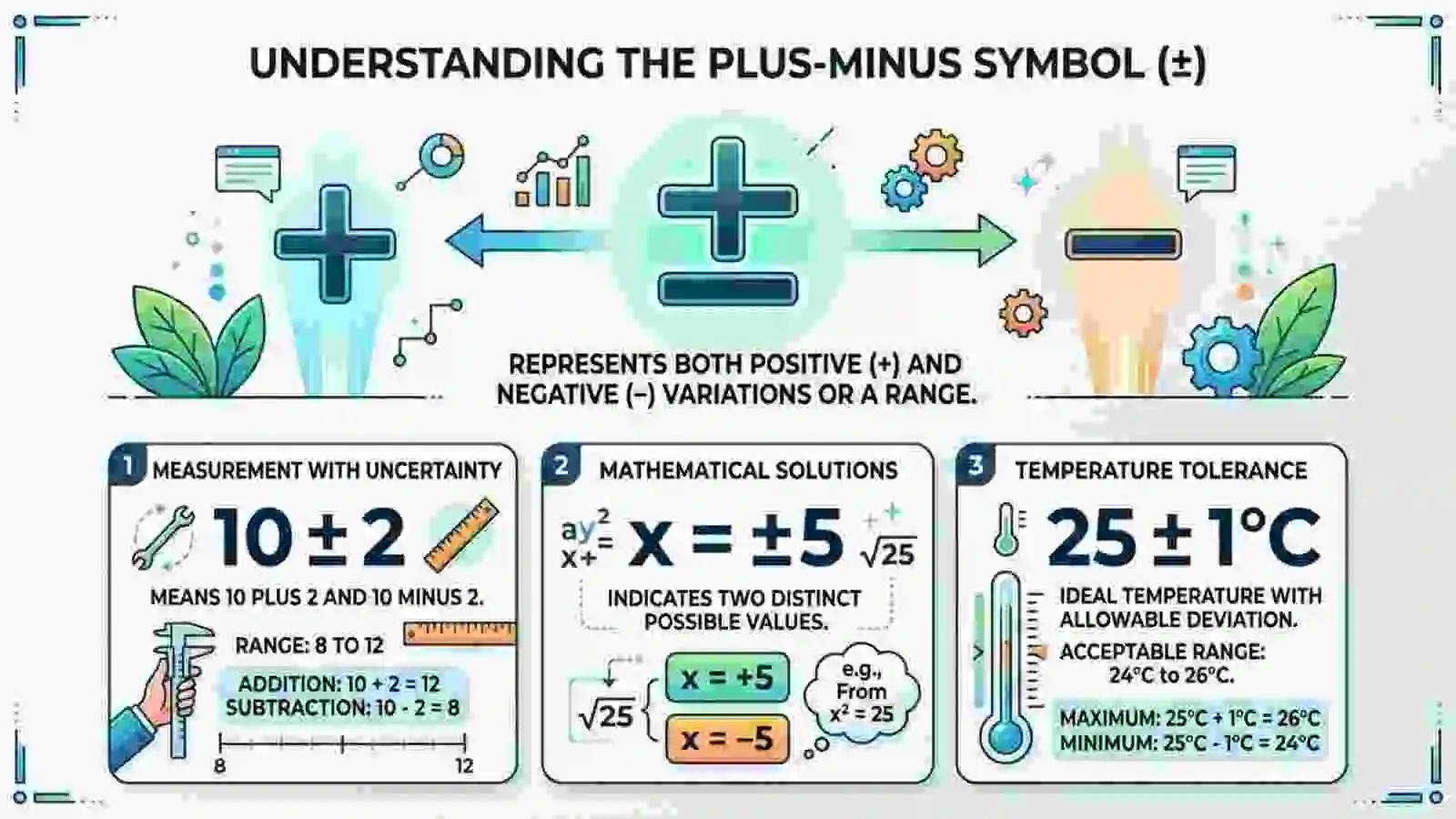
The plus or minus symbol is a small sign with an important role in math, science, medicine, and daily life. It looks like this: ±. You may have seen it next to a number and wondered what it means or how to type it.
People often search for the plus or minus symbol when they need to copy it, type it on a keyboard, use it in a math problem, or understand what it means. The symbol can show that a number may go up or down by a certain amount. It can also show two possible answers in mathematics.
For example, 10 ± 2 means that the value can be 2 more or 2 less than 10. In a simple setting, that gives a range from 8 to 12.
The symbol is also common in science and measurements. A result such as 25 ± 1°C shows a measured value of 25 degrees with an uncertainty of 1 degree.
This guide explains the meaning, history, uses, typing methods, common mistakes, and examples of ±.
Plus or Minus Symbol – Quick Answer
The plus or minus symbol is ±.
It combines two signs:
- + means plus.
- − means minus.
- ± means plus or minus.
Simple example
10 ± 2
This can mean:
- 10 + 2 = 12
- 10 − 2 = 8
So the value may be 8 or 12, depending on the context.
In measurements, ± often shows a possible amount of error or uncertainty.
Example:
50 ± 3 cm
This means the measurement is 50 cm, with a possible difference of 3 cm.
What Does the Plus or Minus Symbol Mean?
The ± symbol has more than one use.
1. It can show two possible values
In algebra, you may see:
x = ±5
This means:
x = 5 or x = −5
Both values can work.
2. It can show a range
A measurement such as:
100 ± 5
can describe values from 95 to 105 when the symbol shows a fixed range.
3. It can show uncertainty
Scientists and researchers often use ± with measurements.
For example:
20.5 ± 0.2 g
This tells the reader that the reported value is 20.5 grams, with an uncertainty of 0.2 grams.
The exact meaning depends on the field and the way the result was measured.
Plus vs Minus vs Plus or Minus
These three symbols are related but not the same.
| Symbol | Name | Meaning | Example |
| + | Plus sign | Addition or positive value | 5 + 3 = 8 |
| − | Minus sign | Subtraction or negative value | 5 − 3 = 2 |
| ± | Plus or minus sign | Two possible signs or a range | 10 ± 2 |
The plus sign adds.
The minus sign subtracts or can show a negative number.
The plus or minus sign combines both ideas.
The Origin and History of the Plus or Minus Symbol
The plus sign (+) and minus sign (−) became common in European mathematics several centuries ago.
The plus sign likely developed from an early form of the letter t or from writing used to show addition. The minus sign also developed from marks used to show subtraction or a lack of something.
The combined plus or minus symbol (±) came later as a short way to write both signs together.
It became useful in mathematics because some equations have two possible answers.
For example:
x² = 9
has two solutions:
x = +3 or x = −3
The symbol lets us write this more quickly:
x = ±3
Today, the symbol appears in mathematics, physics, chemistry, engineering, statistics, medicine, and measurement reports.
British English vs American English
There is no meaningful British or American spelling difference for the plus or minus symbol.
The symbol is normally written as:
±
People in both British and American English use it in the same general way.
| Feature | British English | American English |
| Plus sign | + | + |
| Minus sign | − | − |
| Plus or minus | ± | ± |
| Name | plus or minus sign | plus or minus sign |
| Basic meaning | Same | Same |
The symbol itself does not change based on the English variety.
Some style guides may use different spacing around mathematical signs, but that does not change the meaning of ±.
Which Plus or Minus Form Should You Use?
For normal mathematical writing, use the standard symbol:
±
In school work
Use ± when your teacher or textbook expects mathematical symbols.
Example:
x = ±4
In academic writing
Use ± when reporting a mathematical result or measurement. Explain what the value means if the reader may not know.
Example:
The average value was 15 ± 2 units.
In science
The symbol often appears with measurements and uncertainty.
Example:
25.0 ± 0.5 mL
In business writing
You may use ± when giving an estimated range.
Example:
Delivery time: ±2 days
However, write the meaning clearly when precision matters.
Online writing
You can copy and paste:
±
If the symbol does not work in a system, write:
plus or minus
How to Type the Plus or Minus Symbol
Many people search for the plus or minus symbol because they want to type ±.
Copy and paste
The easiest way is to copy this:
±
Windows
On many Windows systems, you can type ± with an Alt code:
Alt + 0177
Use the number pad if your keyboard supports it.
Microsoft Word
In Microsoft Word, you can insert the symbol through the symbol menu.
You can also use:
00B1
and then press Alt + X in Word.
This changes the code into ±.
Mac
On many Mac keyboards, use:
Option + Shift + =
This produces:
±
Keyboard layouts can vary, so the shortcut may differ on some systems.
HTML
For a web page, you can use:
±
This displays:
±
You can also use the Unicode character U+00B1.
Common Mistakes With the Plus or Minus Symbol
1. Using only the plus sign
Incorrect: 10 + 2 when you mean two possible values.
Correct: 10 ± 2
The two symbols have different meanings.
2. Using ± for every range
Incorrect idea: Every range should use ±.
Better: Use ± only when it correctly describes the value.
For example:
10 ± 2
can show a central value with a difference of 2.
But if you simply mean that something happens between 10 and 12, write:
10 to 12
3. Forgetting the negative value
If:
x = ±5
then the answers are:
x = 5 and x = −5
Do not treat ±5 as only +5.
4. Confusing ± with −
± means plus or minus.
− means minus.
They are not the same symbol.
5. Using the symbol without explaining uncertainty
A result such as:
20 ± 1
may not tell readers exactly what the 1 represents.
In scientific writing, explain whether it is a measurement uncertainty, error range, standard deviation, or another quantity.
6. Using a hyphen instead of a minus sign
A hyphen – is not the same mathematical character as the minus sign −.
They may look similar, but they serve different purposes.
Plus or Minus Symbol in Everyday Examples
The symbol appears in many fields.
Mathematics
x = ±6
This means:
x = 6 or x = −6.
Science
The mass was 12.4 ± 0.2 g.
Here, the symbol gives information about the reported measurement.
Chemistry
A lab result may include a value with an uncertainty:
5.0 ± 0.1 mL
Medicine
Medical studies may report measurements with a value followed by ±, depending on the type of result being reported.
The exact meaning should be explained by the study or report.
Engineering
Engineers may use the symbol when giving a tolerance or allowed difference.
50 ± 1 mm
This can indicate an acceptable range from 49 mm to 51 mm when used as a tolerance.
Weather
You may sometimes see a temperature or estimate written with ±.
For example:
20 ± 2°C
This suggests a possible difference of 2°C, but the exact meaning depends on the source.
10 Natural Examples of the Plus or Minus Symbol
- x = ±7.
- 10 ± 3 = a value that may differ by 3.
- The result was 25 ± 1 cm.
- The sample weighed 8.5 ± 0.2 g.
- The machine allows a tolerance of 50 ± 1 mm.
- The test result was reported as 12.0 ± 0.5 units.
- The equation gives x = ±4.
- The reading was 30 ± 2°C.
- The measured length was 15.2 ± 0.1 cm.
- Copy the ± symbol into your document.
Real-Life Uses of the Plus or Minus Symbol
In school
Students use ± in algebra and other math problems.
Example:
x = ±8
In emails
A technical email may say:
“The measurement is 40 ± 2 mm.”
For general readers, it may be clearer to write the range or explain the symbol.
At work
Engineers, scientists, technicians, and other workers may use ± in reports and specifications.
On social media
People may use the symbol to show an estimated difference:
“It takes ±10 minutes.”
However, this use can be unclear. Writing about 10 minutes or 10 minutes, give or take may be easier to understand.
In formal writing
Use the symbol when it has a clear technical meaning. If the audience may not understand it, explain it.
How Is ± Used in Mathematics?
One important use appears when solving equations.
Consider:
x² = 25
Both 5 and −5 give 25 when squared.
So:
x = ±5
This means:
x = 5 or x = −5
Important rule
Do not add ± to every square root automatically.
For example:
√25 = 5
The principal square root is 5, not ±5.
But when solving:
x² = 25
the solutions are:
x = ±5
This difference matters in math.
Is Plus or Minus the Same as Approximately?
No.
The symbol ± does not simply mean approximately.
For example:
20 ± 2
gives a central value and a difference of 2.
The symbol ≈ means approximately equal to.
Example:
π ≈ 3.14
So these symbols have different jobs.
| Symbol | Meaning | Example |
| ± | Plus or minus | 20 ± 2 |
| ≈ | Approximately equal to | π ≈ 3.14 |
| = | Equal to | 2 + 2 = 4 |
| − | Minus | 8 − 3 = 5 |
| + | Plus | 8 + 3 = 11 |
Related Search Questions
What is the plus or minus symbol?
The plus or minus symbol is ±. It combines the plus sign and minus sign. In math, it can show two possible values. In science and measurement, it can show a central value together with an amount of uncertainty or variation.
What does ± mean in math?
In math, ± often means that both the positive and negative versions are possible. For example, x = ±4 means x = 4 or x = −4.
What is the difference between + and ±?
The + sign normally means addition or a positive value. The ± sign means plus or minus. For example, 5 + 2 = 7, while 5 ± 2 can represent 5 plus or minus 2.
What is the difference between ± and ≈?
± means plus or minus. ≈ means approximately equal to. For example, 10 ± 2 describes a value with a difference of 2, while 10.1 ≈ 10 says that two values are close.
How do I type ± on a keyboard?
You can copy and paste ± directly. On Windows, many systems support Alt + 0177. In Microsoft Word, type 00B1 and press Alt + X. On Mac, many keyboard layouts use Option + Shift + =.
Usage and Search Trends
People search for the plus or minus symbol for several practical reasons.
Common search needs include:
- Copying the symbol
- Learning what ± means
- Typing ± on Windows
- Typing ± on Mac
- Using ± in Word
- Using ± in Excel
- Understanding ± in math
- Understanding ± in science
- Finding the Unicode value
- Learning the difference between ± and ≈
The search intent is mainly informational and practical. Many users want a quick answer and a symbol they can copy.
Exact search volume and Google Trends numbers can change over time. No specific traffic or search-volume number should be given without current verified data.
Plus or Minus Symbol Comparison Table
| Symbol | Name | Main use | Example |
| + | Plus sign | Addition | 4 + 2 = 6 |
| − | Minus sign | Subtraction | 4 − 2 = 2 |
| ± | Plus or minus | Two signs or uncertainty | 10 ± 2 |
| ≈ | Approximately equal | Approximate value | π ≈ 3.14 |
| = | Equal sign | Shows equality | 2 + 2 = 4 |
| ∓ | Minus or plus | Paired with ± in some math work | ±a and ∓b |
FAQs About the Plus or Minus Symbol
1. What is the plus or minus symbol?
The plus or minus symbol is ±. It combines the plus and minus signs. In mathematics, it can show two possible values. In science, it can show a reported value together with an uncertainty or allowed difference.
2. How do I copy the plus or minus symbol?
You can copy this symbol directly: ±. Paste it into a document, email, website, spreadsheet, or message. If you use it often, you can also create a keyboard shortcut or text replacement on your device.
3. What is the Unicode for ±?
The Unicode code point for the plus or minus symbol is U+00B1. In HTML, you can also use ± to display the symbol on a web page.
4. What does ± mean in a measurement?
In a measurement, ± often shows an uncertainty, error, tolerance, or possible variation. The exact meaning depends on the measurement method and context. For example, 10.0 ± 0.2 g reports a central value of 10.0 grams with an associated amount of 0.2 grams.
5. Is ± the same as approximately?
No. ± and ≈ have different meanings. The plus or minus symbol gives a positive and negative difference around a value. The approximately equal sign shows that one value is close to another.
6. Does ± mean both plus and minus?
In many math expressions, yes. For example, x = ±3 means x = 3 or x = −3. However, the exact meaning can depend on the mathematical expression and context.
7. How do I type ± in Microsoft Word?
You can use the Insert Symbol feature in Word. Another common method is to type 00B1 and press Alt + X. Word then changes the code into ±.
Conclusion
The plus or minus symbol, written as ±, is a useful mathematical and technical symbol. It combines the plus sign and minus sign into one character. You may see it in equations, measurements, science reports, engineering documents, and other technical writing.
In mathematics, ± can show two possible values. For example, x = ±5 means that x can equal 5 or −5. In measurements, the symbol often shows an amount of uncertainty, variation, or tolerance. The exact meaning depends on the context.
The symbol is the same in British and American English. There is no different spelling or form for either variety of English. You can also copy ± directly or type it with common keyboard shortcuts.
Do not confuse ± with +, −, or ≈. Each symbol has its own meaning. Also, do not use ± when you simply want to say “about.”
For quick use, remember this simple rule: + means plus, − means minus, and ± means plus or minus. When you see ±, always check the context to understand exactly what the number means.

Emily Carter is an English grammar writer based in Portland, Oregon, with 7+ years of experience turning tricky grammar rules into simple, easy lessons.