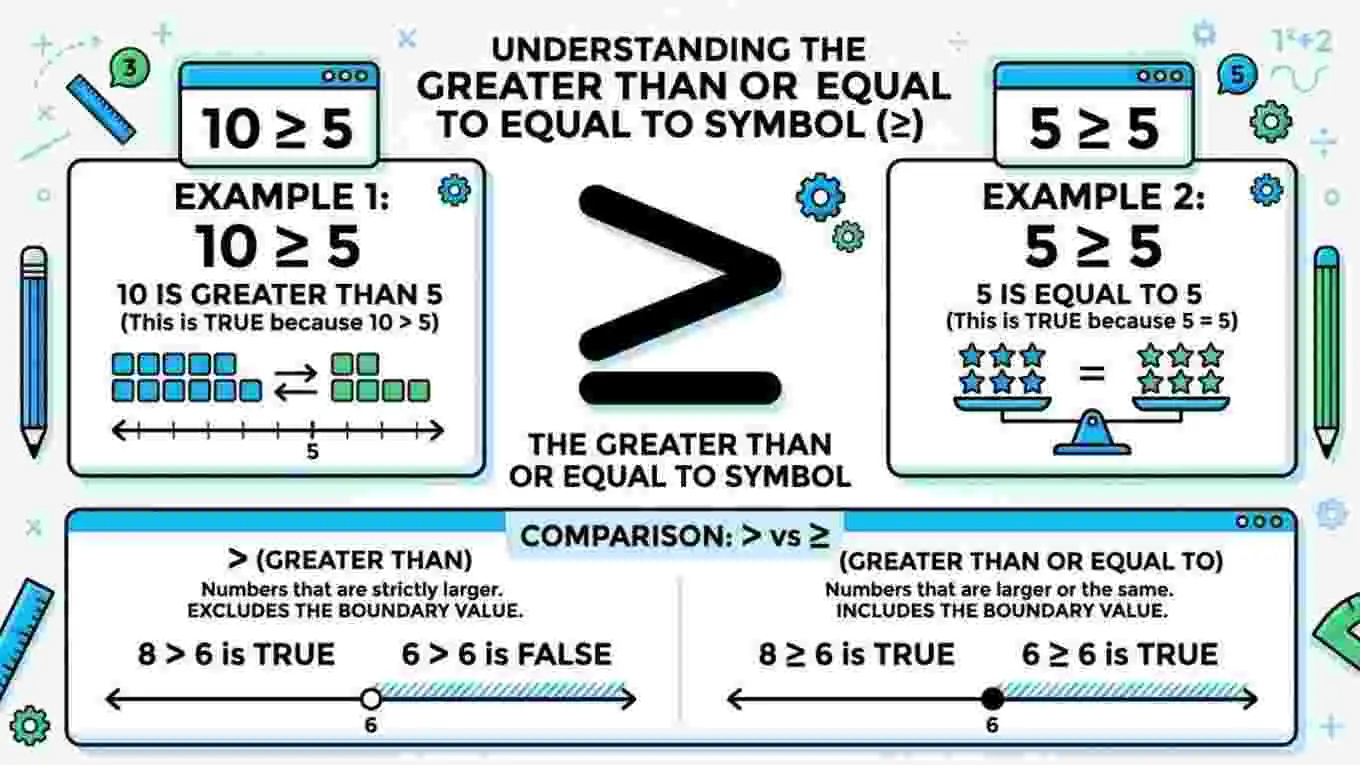
When you see ≥ in a math problem, you may wonder what the symbol means or how to type it. The greater than or equal to symbol means that one number or value is greater than another value or exactly equal to it.
For example, x ≥ 5 means that x can be 5 or any number greater than 5. So, 5, 6, 10, and 100 all meet the rule.
This symbol is common in math, algebra, statistics, science, computer work, and school assignments. People also search for it when they need to know the difference between ≥, >, and =, or when they want to type the symbol on a keyboard.
The symbol may look simple, but its two parts have a clear meaning. The > part means “greater than,” while the = part means “or equal to.”
Below, you will learn what ≥ means, how to read it, how to use it, how it differs from other inequality symbols, and how to type it on different devices.
Greater Than or Equal To Symbol – Quick Answer
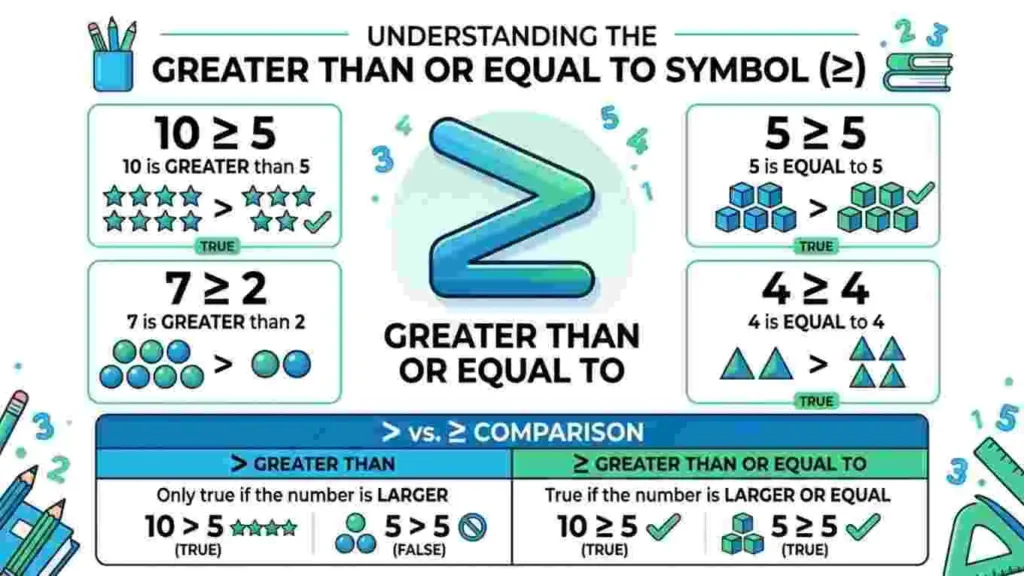
The greater than or equal to symbol is ≥.
It means greater than or equal to.
For example:
x ≥ 10
This means:
x is 10 or greater.
So these values work:
- 10
- 11
- 12
- 20
- 100
But 9 does not work.
The symbol ≥ combines two ideas:
- > means greater than
- = means equal to
The line under the greater-than sign shows that the two values can also be equal. The Unicode Standard names ≥ “GREATER-THAN OR EQUAL TO” and assigns it the code point U+2265.
What Does the ≥ Symbol Mean?
The symbol ≥ tells us that the value on the left is greater than or equal to the value on the right.
For example:
8 ≥ 5
This is true because 8 is greater than 5.
Now look at:
5 ≥ 5
This is also true because both numbers are equal.
But:
4 ≥ 5
is false because 4 is not greater than 5 and it is not equal to 5.
A simple way to remember it is:
≥ means bigger than or the same as.
In algebra, you may see:
x ≥ 7
This means that x can be 7 or any number greater than 7.
OpenStax gives the same meaning for a ≥ b: “a is greater than or equal to b.”
Main Difference Between > and ≥
The biggest difference is whether equality is allowed.
Greater Than: >
The symbol > means only “greater than.”
Example:
8 > 5
This is true.
But:
5 > 5
is false.
Greater Than or Equal To: ≥
The symbol ≥ means “greater than or equal to.”
Example:
8 ≥ 5
is true.
Also:
5 ≥ 5
is true.
The equal part makes the difference.
| Symbol | Meaning | Is equality allowed? |
| > | Greater than | No |
| ≥ | Greater than or equal to | Yes |
| < | Less than | No |
| ≤ | Less than or equal to | Yes |
| = | Equal to | Yes, only equal |
How to Read the Greater Than or Equal To Symbol
You can read ≥ as:
- greater than or equal to
- greater than or equal to
- at least
- no less than
- a minimum of
For example:
x ≥ 20
can be read as:
- “x is greater than or equal to 20.”
- “x is at least 20.”
- “x is no less than 20.”
These phrases can all express the same basic idea. OpenStax lists “at least,” “minimum,” and “no less than” as common phrases that translate to ≥. (OpenStax)
Example
If a teacher says:
You need at least 70 points to pass.
You can write:
Score ≥ 70
This means a score of 70 or higher meets the rule.
How to Remember ≥
A simple trick can help.
Look at:
≥
The wide opening faces the larger value.
The short horizontal line underneath means equal is also allowed.
So:
10 ≥ 5
means 10 is greater than 5.
And:
5 ≥ 5
means the values are equal, so the statement is still true.
Another easy memory trick is:
≥ = greater than + equal to
The top part gives you greater than.
The bottom line adds equal to.
Examples of the Greater Than or Equal To Symbol
Here are some simple examples:
- 10 ≥ 5
Ten is greater than or equal to five. - 5 ≥ 5
Five is equal to five. - 12 ≥ 10
Twelve is greater than ten. - x ≥ 8
x can be 8 or any number above 8. - y ≥ 100
y must be 100 or more. - Age ≥ 18
The age must be 18 or older. - Score ≥ 50
The score must be 50 or higher. - n ≥ 1
n must be 1 or greater. - Temperature ≥ 30°C
The temperature is 30°C or higher. - Speed ≥ 60 km/h
The speed is 60 km/h or more.
Greater Than or Equal To in Word Problems
Many math questions do not show the symbol directly. Instead, they use words.
You need to turn those words into a mathematical statement.
For example:
“You must be at least 18 years old.”
This becomes:
Age ≥ 18
Another example:
“The box must weigh no less than 20 kg.”
This becomes:
Weight ≥ 20 kg
Common phrases that often mean ≥ include:
- at least
- no less than
- minimum
- 10 or more
- greater than or equal to
- 10 or higher
- 10 and above
The phrase “at least 10” does not mean more than 10 only. It includes 10 itself. (OpenStax)
Main Differences Between Inequality Symbols
The four main inequality symbols can look confusing at first.
| Symbol | Name | Simple Meaning | Example |
| > | Greater than | More than | 8 > 5 |
| ≥ | Greater than or equal to | More than or the same as | 8 ≥ 5 |
| < | Less than | Fewer than | 5 < 8 |
| ≤ | Less than or equal to | Fewer than or the same as | 5 ≤ 8 |
The key point is the horizontal line.
> means greater than.
≥ means greater than or equal to.
Likewise:
< means less than.
≤ means less than or equal to.
Origin and History of the Symbol
The greater-than and less-than signs are old mathematical comparison symbols. Modern mathematical writing uses them to compare values.
The symbol ≥ combines the greater-than sign with an equal line. Unicode lists ≥ as GREATER-THAN OR EQUAL TO, with the code point U+2265.
Unicode also lists related symbols, such as:
- > Greater-Than Sign
- < Less-Than Sign
- ≥ Greater-Than or Equal To
- ≤ Less-Than or Equal To
- ≠ Not Equal To
This helps computers, websites, documents, and other digital systems store and display these symbols correctly. (Unicode)
British English vs American English
There is no meaningful British English vs American English difference for the mathematical symbol ≥.
People in both British and American English use:
≥
The spoken phrase also remains the same:
greater than or equal to
For example:
x ≥ 10
can be read as:
“x is greater than or equal to 10.”
Math notation does not change based on whether you are writing British or American English.
Which One Should You Use?
Use ≥ when you want to say that a value can be greater than or exactly equal to another value.
Use it in:
- School math
- Algebra
- Geometry
- Statistics
- Science
- Research
- Technical writing
- Equations
- Inequalities
- Data rules
Use > when equality is not allowed
If a rule says:
“The score must be greater than 50.”
Write:
Score > 50
A score of exactly 50 does not qualify.
Use ≥ when equality is allowed
If a rule says:
“The score must be 50 or higher.”
Write:
Score ≥ 50
A score of exactly 50 qualifies.
Common Mistakes
1. Using > when you need ≥
Incorrect:
Score > 50
Correct:
Score ≥ 50
If 50 is allowed, you need the equal line.
2. Thinking ≥ means only greater than
Incorrect idea:
“≥ 10 means more than 10.”
Correct idea:
“≥ 10 means 10 or more.”
The value can equal 10.
3. Forgetting the equal line
Incorrect:
x > 18
Correct:
x ≥ 18
Use ≥ when 18 itself is allowed.
4. Confusing ≥ with ≤
Incorrect:
x ≤ 10 when you mean 10 or more.
Correct:
x ≥ 10
Remember:
≥ = greater
≤ = less
5. Writing ≥ for “greater than” only
Incorrect:
“The number is greater than 5, including only values above 5: x ≥ 5.”
Correct:
x > 5
If 5 is not allowed, do not use the equal line.
6. Reading ≥ as “greater and equal”
A clearer reading is:
“greater than or equal to.”
You can also say:
“at least.”
10 Everyday Examples
Here are natural examples using the symbol:
- Students need a score ≥ 60 to pass.
- The minimum age is 18, so age ≥ 18.
- The package weight must be ≥ 2 kg.
- Choose a value where x ≥ 5.
- The temperature must be ≥ 25°C.
- The final score was ≥ 90.
- The speed should stay ≥ 40 km/h.
- The order must contain ≥ 10 items.
- The number of workers must be ≥ 4.
- The value of n must be ≥ 1.
Real-Life Usage of ≥
The greater than or equal to symbol does not appear only in math class. People use it in many areas where they need to set a minimum value.
In School
A teacher may write:
Score ≥ 70
This means students need 70 or more points.
In Science
A science worksheet may use:
Temperature ≥ 100°C
This means the temperature is 100°C or higher.
In Statistics
Researchers use inequality symbols when they describe values, limits, or hypotheses. For example, a statement may use ≥ when a value can equal the stated number as well as exceed it.
At Work
A company may set a rule such as:
Experience ≥ 2 years
This means two years of experience or more.
In Online Forms
A website may say:
Password length ≥ 8 characters
This means the password needs at least eight characters.
In Computer Code
Many programming languages use combinations such as:
>=
to represent the same basic idea as ≥.
The exact coding syntax depends on the programming language, but the meaning is usually “greater than or equal to.”
Related Search Questions
What is the greater than or equal to symbol?
The greater than or equal to symbol is ≥. It means that the value on the left is greater than or equal to the value on the right.
For example:
10 ≥ 10
is true because both values are equal.
What does ≥ mean in math?
≥ means “greater than or equal to.” It allows two possibilities: the left value can be greater than the right value, or both values can be equal.
For example, x ≥ 5 means x can be 5 or any number greater than 5.
What is the difference between > and ≥?
> means greater than only. ≥ means greater than or equal to. Therefore, 5 > 5 is false, but 5 ≥ 5 is true.
Does ≥ include the number itself?
Yes. The equal line means the number itself is included.
For example:
x ≥ 10
includes 10, 11, 12, and every larger value.
What does “at least” mean in math?
“At least” means the value is greater than or equal to a given number.
For example:
at least 20 = ≥ 20
So 20 is included.
What is the opposite of ≥?
The opposite inequality is < when you reverse the relation in the usual logical sense.
For example:
x ≥ 5
means x is 5 or greater.
The values that do not meet this condition are:
x < 5
Usage and Search Trends
This topic has clear informational search intent. People usually search for the symbol because they want to understand it, copy it, type it, or use it correctly in a math problem.
Common search variations include:
- greater than or equal to symbol
- greater than or equal symbol
- greater than or equal sign
- greater than equal symbol
- greater than or equal to sign
- ≥ symbol
- what does ≥ mean
- how to type greater than or equal to
- greater than or equal to symbol on keyboard
- greater than or equal to symbol in math
- greater than or equal to symbol meaning
Exact search volume or Google Trends numbers should not be added without current, reliable data. The meaning of the symbol itself is well established in mathematical references. Unicode identifies ≥ as U+2265, while OpenStax and Wolfram MathWorld use it for “greater than or equal to.”
Greater Than or Equal To Symbol Comparison Table
| Symbol | Name | Meaning | Example |
| > | Greater than | More than | 9 > 4 |
| ≥ | Greater than or equal to | More than or the same as | 9 ≥ 4 |
| < | Less than | Less than | 4 < 9 |
| ≤ | Less than or equal to | Less than or the same as | 4 ≤ 9 |
| = | Equal to | Same value | 9 = 9 |
| ≠ | Not equal to | Different values | 9 ≠ 4 |
How to Type the Greater Than or Equal To Symbol
The symbol ≥ can be copied directly:
≥
On many devices and apps, you may also be able to insert it through a symbol or special-character menu.
For digital work, another common form is:
>=
This two-character form often appears in programming and other technical systems.
The Unicode code point for ≥ is:
U+2265
If you simply need the symbol for a document, equation, message, or website, you can copy it from here:
≥
FAQs
What is the symbol for greater than or equal to?
The symbol is ≥. It means “greater than or equal to.” For example, x ≥ 10 means that x can be 10 or any value greater than 10.
What does ≥ mean on a calculator?
On a calculator or math tool, ≥ means that the value on one side is greater than or equal to the value on the other side. Some basic calculators may not have a dedicated key for it.
Is ≥ the same as >?
No. > means only greater than, while ≥ allows the two values to be equal. For example, 5 is not greater than 5, so 5 > 5 is false. But 5 ≥ 5 is true.
What does “at least 10” mean?
“At least 10” means 10 or more. In math, you can write it as x ≥ 10. The number 10 counts because the greater-than-or-equal-to symbol includes equality.
What is the Unicode for ≥?
The Unicode code point for the standard greater-than-or-equal-to symbol ≥ is U+2265. Unicode gives the character the official name “GREATER-THAN OR EQUAL TO.”Can I use >= instead of ≥?
In many computer programs, >= represents greater than or equal to. In normal math writing, however, ≥ is the standard single symbol. The correct choice depends on the system or software you are using.
What is the difference between ≥ and ≤?
≥ means greater than or equal to. ≤ means less than or equal to. For example, x ≥ 5 means 5 or more, while x ≤ 5 means 5 or less.
Conclusion
The greater than or equal to symbol is ≥. It means that one value is greater than or equal to another value.
For example:
x ≥ 10
means that x can be 10 or any number greater than 10.
The symbol combines >, which means greater than, with =, which allows the two values to be equal. This small difference matters. If a rule allows the exact number, use ≥. If the number must be higher and cannot be equal, use >.
You will often see ≥ in algebra, statistics, science, school work, technical writing, and computer-related tasks. Common phrases such as “at least,” “no less than,” “minimum,” and “or more” can also express the same idea.
There is no British or American spelling difference for this mathematical symbol. The standard Unicode character is ≥, with code point U+2265. The easiest way to remember it is simple: ≥ means greater than or equal to, or “at least.”

Emily Carter is an English grammar writer based in Portland, Oregon, with 7+ years of experience turning tricky grammar rules into simple, easy lessons.










