You are writing a sentence. You want to say that something was measured on a scale. Or maybe you want to say that a decision had more importance on one side. You stop and think. Should you write “weighed” or “weighted”? Both words come from the word “weight.” Both look almost the same. So which one is right?
This question comes up more than you would think. Students get confused when writing science reports. Business writers pause when talking about data. Teachers stop when grading papers. Even people who have spoken English their whole lives sometimes look twice before picking one of these words.
The confusion is real because both words are correct. But they do not mean the same thing. They do different jobs in a sentence. Using the wrong one can make your writing confusing, even if your reader can guess what you meant.
In this guide, you will get a fast, clear answer first. Then you will learn where each word came from, how they work in real sentences, and which one fits your writing best. By the end, you will always know which word to pick without any doubt.
Weighed vs Weighted Quick Answer
Both words are real and correct. But they mean different things.
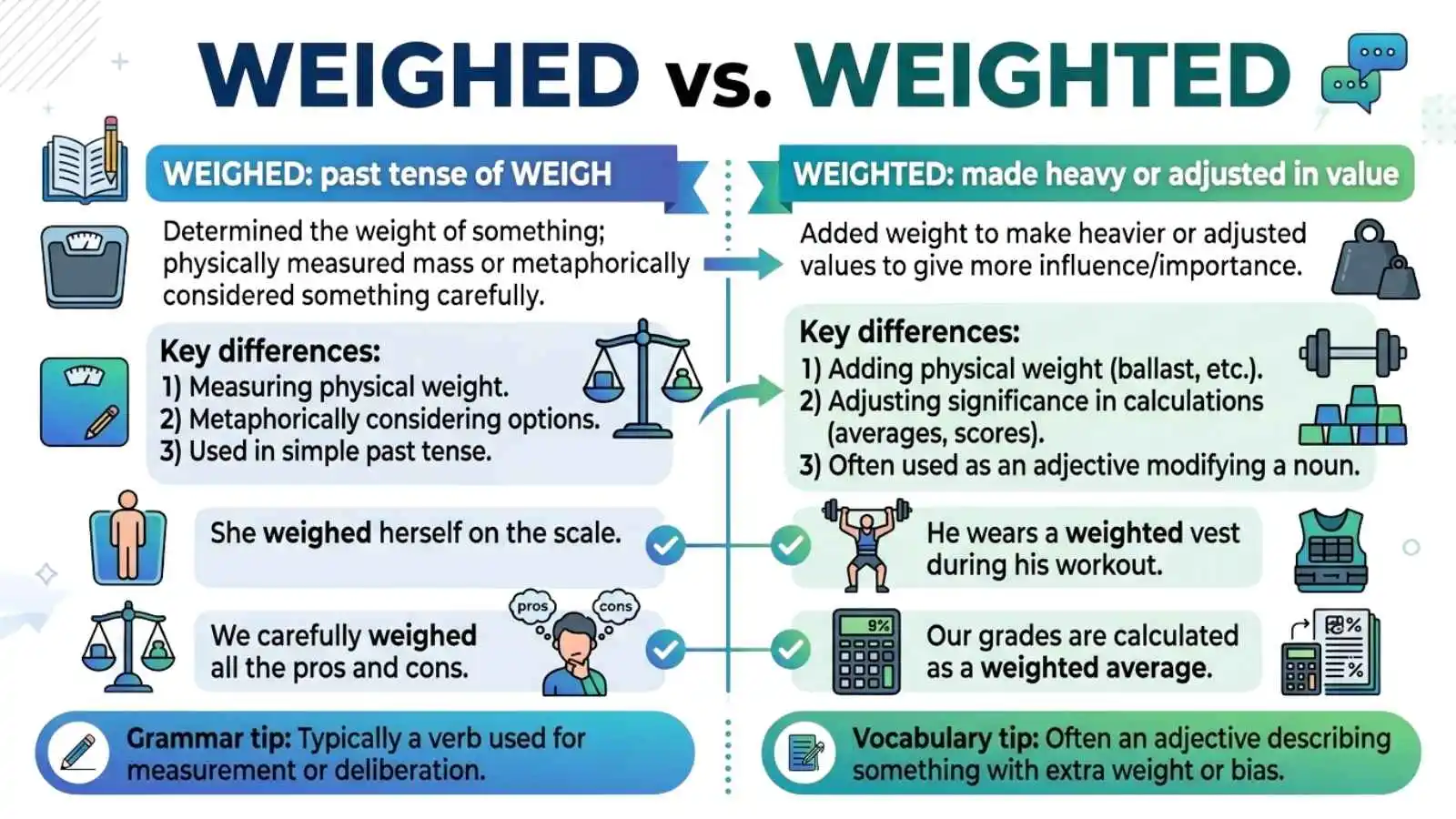
Weighed is the past tense of the verb “weigh.” It means that someone or something was measured to find its weight. It also means that someone thought carefully about something.
Weighted is an adjective. It means something has been given extra importance, extra value, or extra load. It describes something that leans more toward one side.
Quick examples:
- She weighed the apples before putting them in the bag.
- He weighed his options before making the final choice.
- The test uses a weighted score, so some questions count more than others.
- The blanket is a weighted blanket that helps people sleep better.
Simple rule: If you are talking about the action of measuring or thinking carefully, use “weighed.” If you are describing something that has extra importance or extra load added to it, use “weighted.”
The Origin of Weighed and Weighted
Both words come from the same root. Knowing this history makes it easy to understand why they are so close but still different.
The word “weigh” comes from an Old English word called “wegan.” This old word meant to carry, to move, or to measure the heaviness of something. Long ago, people used scales to measure things like food, gold, and grain. They would “weigh” these items to find out how heavy they were.
Over time, the word “weigh” also grew to mean thinking carefully about something. If you weigh your choices, you are putting each one on a mental scale and thinking about which one is heavier or more important.
“Weighed” is simply the past tense of “weigh.” It means the action of weighing already happened.
“Weighted” grew from the same root but took a different path. It became an adjective, a describing word. When something is “weighted,” it means extra importance or extra mass has been added to one side. Think of a weighted scale that tips to one side. Or think of a weighted average in math, where some numbers count more than others.
Because both words come from the same root, they look and sound very similar. This is exactly why people mix them up so often.
British English vs American English Spelling
This is not a British vs American spelling issue. Both countries spell these words the exact same way. There is no British version of “weighed” and no American version of “weighted.”
Both words are used in the United States, the United Kingdom, Canada, Australia, and everywhere else. The spelling stays the same no matter where you are in the world.
The real difference is not about location. It is about meaning and grammar. “Weighed” is a verb. “Weighted” is an adjective. This difference stays the same in every country.
| Feature | Weighed | Weighted |
| British English spelling | weighed | weighted |
| American English spelling | weighed | weighted |
| Part of speech | Verb (past tense) | Adjective |
| Meaning | Measured weight or thought carefully | Given extra importance or load |
| Used in science | Yes | Yes |
| Used in math | Rarely | Yes (weighted average) |
| Used in daily talk | Yes | Yes |
Which Word Should You Use?
Since spelling is the same everywhere, the only question is: what do you mean?
Use “weighed” when:
- You are talking about measuring something on a scale.
- You are talking about thinking carefully about choices or options.
- You need the past tense of the verb “to weigh.”
Examples:
- The nurse weighed the baby at the clinic.
- He weighed the risks before signing the contract.
Use “weighted” when:
- You are describing something that has extra importance or extra load added to it.
- You are talking about a score, average, or system where some parts count more than others.
- You are describing something that leans more to one side.
Examples:
- The grading system uses a weighted average.
- She sleeps with a weighted blanket every night.
For all audiences US, UK, global: The rule stays the same. Verb action = weighed. Describing word with extra importance = weighted.
Common Mistakes with Weighed and Weighted
Here are the most common errors people make, with easy corrections.
Mistakes
1: Using “weighted” when talking about measuring something. Wrong: “She weighted herself every morning.” Right: “She weighed herself every morning.”
2: Using “weighed” when describing a scoring system. Wrong: “The exam uses a weighed scoring system.” Right: “The exam uses a weighted scoring system.”
3: Writing “weighed down” when “weighted down” might fit better. Both phrases exist, but they mean slightly different things. “Weighed down” means feeling heavy with worry or burden. “Weighted down” means physically held down by extra weight. Example: “She felt weighed down by stress.” (emotional) Example: “The tent was weighted down by sandbags.” (physical)
4: Forgetting that “weighted” is only an adjective. Wrong: “He weighted the box on the scale.” (This does not work) Right: “He weighed the box on the scale.”
5: Thinking “weighted” means the same as “heavy.” “Weighted” does not just mean heavy. It means something has had extra importance or extra load added on purpose.
Quick writing tip: Ask yourself this before you write. Am I describing an action that happened? Use “weighed.” Am I describing how something is set up or designed with extra importance? Use “weighted.”
Weighed and Weighted in Everyday Examples
Let us look at how each word appears in real writing.
email: “I have carefully weighed all the options and I believe Option B is the best choice.”
news headline: “Scientists Use Weighted Data to Predict Storm Paths More Accurately”
social media post: “Finally weighed myself after a month of healthy eating. Down 4 pounds!”
formal report: “The committee weighed each proposal against the project goals before making a final decision.”
Using “weighted” in formal writing: “The company uses a weighted scoring system to rank job applicants fairly.”
Use “weighted” in daily life: “My doctor recommended a weighted vest to help with my posture.”
Using “weighed” in daily life: “He weighed the tomatoes and found they were just over one kilogram.”
Notice the clear pattern. “Weighed” always shows up when an action happened. “Weighted” always shows up when something is described as having extra importance or extra load built into it.
Weighed vs Weighted Google Trends and Usage Data
When we look at search data, both words get strong search numbers. But they are searched for very different reasons.
“Weighed” is searched often in everyday topics. People search “weighed myself,” “weighed my options,” “weighed in” in sports news, and “I weighed” in health and fitness content. This word shows up across the United States, the United Kingdom, India, Australia, and Canada.
“Weighted” is searched heavily in education and math topics. People search “weighted average,” “weighted GPA,” “weighted blanket,” and “weighted score.” These searches are especially strong in countries with competitive school systems, like the United States, India, and South Korea.
Searches for “weighed vs weighted” come mostly from students writing reports, business writers working on data documents, and teachers creating grading systems. They want to know the right word before they publish or submit their work.
| Word | Common Searches | Where Popular | Context |
| Weighed | “weighed myself,” “weighed options” | Global | Health, fitness, decisions |
| Weighted | “weighted average,” “weighted GPA,” “weighted blanket” | US, India, global | Education, math, health |
| Weigh | “how to weigh,” “weigh in” | Global | General, sports, health |
Did You Know?
The phrase “weigh in” is used in boxing and other sports. Before a fight, fighters step on a scale to show they are in the right weight group. This is called “the weigh-in.” The noun “weigh-in” comes from the verb “weigh.” It has nothing to do with “weighted.” This is another example of how “weigh” and “weight” show up in many surprising places in everyday English.
Memory Trick
Here is an easy way to always pick the right word.
Think of the letter “D” at the end of both words. Both “weighed” and “weighted” end in “d.” But “weighted” has an extra “t” before the “d.”
That extra “T” in “weighted” stands for “Tips the scale.” When something is weighted, it tips the scale to one side. It has extra importance added to it.
“Weighed” has no extra “t.” It is just the simple past action of weighing something. No extra anything.
Say this to yourself: “WeighTed Tips the scale. Weighed just measures it.”
Once this picture sticks, you will never mix them up again.
Parts of Speech
Understanding the grammar of each word makes everything clearer.
“Weighed” is a verb.
A verb is an action word. “Weighed” is the past tense of “weigh.” It shows an action that already happened.
| Form | Word | Example |
| Present (I, you, we) | Weigh | I weigh the bags every trip. |
| Present (he, she, it) | Weighs | She weighs herself each Monday. |
| Past tense | Weighed | He weighed the fruit at the market. |
| Future tense | Will weigh | I will weigh the options tomorrow. |
| Continuous | Weighing | She is weighing the pros and cons now. |
“Weighted” is an adjective.
An adjective is a describing word. “Weighted” describes a noun by telling us it has extra importance or extra load added to it.
| Use | Example |
| Describing a score | It is a weighted score. |
| Describing an average | The weighted average favors recent results. |
| Describing an object | He wore a weighted vest at the gym. |
| Describing a system | They use a weighted ranking system. |
| Describing a blanket | A weighted blanket can reduce anxiety. |
Practice Exercise
Fill in the blank with the right word: weighed or weighted.
- The coach ________ the players before the competition began.
- The school uses a ________ grading system where finals count more.
- She ________ her decision for a long time before saying yes.
- The ________ blanket helped him feel calm during the storm.
- He ________ the parcel and found it was three kilograms.
- Our report uses a ________ average to calculate the final score.
- She ________ the baby at the clinic and noted the results.
- The survey uses ________ responses to give more value to expert opinions.
Answer Key:
- weighed past tense verb, action of measuring weight
- weighted adjective describing the grading system
- weighed past tense verb, thinking carefully about a decision
- weighted adjective describing the blanket with extra load
- weighed past tense verb, action of measuring the parcel
- weighted adjective describing how the average is calculated
- weighed past tense verb, action of measuring the baby
- weighted adjective describing how the responses are set up
How did you do? 8 out of 8 Perfect! You have fully understood both words. 5 to 7 Good work! Read the parts of the speech section one more time. Below 5 No problem. Go back through the examples slowly and try again.
Frequently Asked Questions
1. Are “weighed” and “weighted” the same word? No. They come from the same root but they are different words with different jobs. “Weighed” is a verb (action word). “Weighted” is an adjective (describing word). Using the wrong one changes the meaning of your sentence.
2. Can I say “she weighted herself every morning”? No. This is wrong. The correct sentence is “she weighed herself every morning.” You use a scale to weigh yourself. “Weighted” does not describe this action.
3. What is a “weighted average”? A weighted average is a type of average where some numbers count more than others. For example, in school, your final exam might count 50 percent while homework counts 20 percent. This is a weighted average.
4. Is there a British or American difference in spelling? No. Both words are spelled the same way in British and American English. The difference is only about meaning and grammar, not location.
5. What does “weighed down” mean? “Weighed down” means feeling heavy with worry, sadness, or too many responsibilities. For example, “She felt weighed down by all her deadlines.” It can also describe something physically heavy.
6. Can “weighted” describe a person? Not usually. “Weighted” describes systems, objects, scores, or things that have been designed with extra importance on one side. It does not usually describe a person directly.
7. What is the noun form of “weigh”? The noun form is “weight.” For example, “The weight of the bag was five kilograms.” The related noun for events is “weigh-in,” as used in sports.
Conclusion:
“Weighed” and “weighted” come from the same root, but they work very differently in a sentence. “Weighed” is a verb. It tells you that an action of measuring or careful thinking already happened. “Weighted” is an adjective. It tells you that something has been set up with extra importance or extra load added to one side.
Both words are correct. Neither one is a mistake on its own. The mistake only happens when you use one in place of the other. If you are describing an action that took place, use “weighed.” If you are describing how something is designed or set up, use “weighted.”
There is no British or American spelling difference here. The rule stays the same everywhere in the world. Whether you are writing a school paper, a business report, a news article, or a casual message, the same simple rule applies every time.
Remember the easy trick: “WeighTed Tips the scale. Weighed just measures it.” Keep that in mind and you will always pick the right word with full confidence.

Emily Carter is an English grammar writer based in Portland, Oregon, with 7+ years of experience turning tricky grammar rules into simple, easy lessons.