You are reading a post online. Someone says something funny but means it seriously. Your friend says, “That is so ironic.” But wait. Is it really ironic? Or is it unironic? And what does unironic even mean?
These two words confuse a lot of people. Not because they are hard to spell. But because people are not always sure what each one means. “Ironic” is used so much in daily talk that people often use it for the wrong situations. And “unironic” is a newer word that many people have never even heard of before.
Writers, students, and social media users all search for “ironic vs unironic” because they want to understand the difference. They want to use these words correctly in posts, essays, and everyday conversations without sounding confused or wrong.
In this guide, you will get a clear answer right away. Then you will learn where each word came from, what each one really means, and how to use them in real sentences. You will also find a practice exercise and a memory trick. By the end, you will feel fully confident using both words the right way.
Ironic vs Unironic Quick Answer
Both words are real and both are used in modern English. But they mean opposite things.
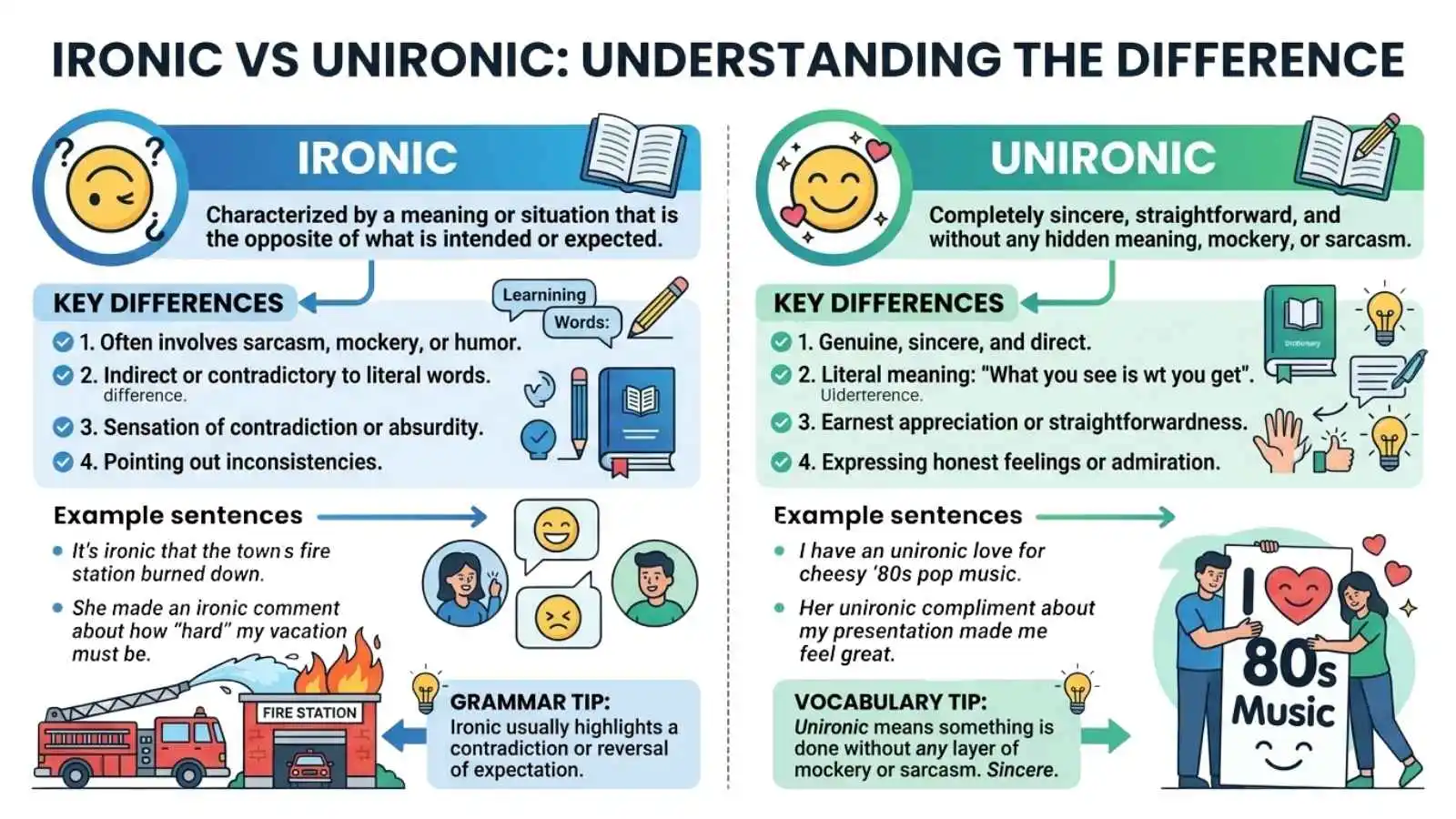
Ironic means something is the opposite of what you expect. It can also mean saying one thing but meaning another, often in a funny or clever way.
Unironic means something is completely genuine and serious. When someone does or says something unironically, they truly mean it with no joke or hidden twist behind it.
Quick examples:
- It is ironic that the fire station burned down.
- She ironically thanked him for making her day worse.
- He unironically loves wearing socks with sandals. He thinks it looks great.
- The song became an unironic hit after people started genuinely liking it.
Simple rule: Ironic means there is a twist, a joke, or the opposite of what was expected. Unironic means there is no twist at all. The person truly means it.
The Origin of Ironic and Unironic
Let us look at where each word came from. This helps explain why they mean such different things even though they look so similar.
“Ironic” comes from the word “irony.” Irony is a very old idea. It comes from the ancient Greek word “eironeia,” which meant a kind of speech where someone pretends to be less smart than they are in order to make a point. Greek writers and thinkers used irony as a tool. They said the opposite of what they meant to make people think harder.
From Greek, the idea of irony moved into Latin and then into French. By the time it entered English in the 1500s, “irony” meant saying the opposite of what you mean, or when something happens in a way that is the complete opposite of what was expected.
The adjective form, “ironic,” came along soon after. It described anything that had the quality of irony. A situation, a comment, or an event could be ironic.
“Unironic” is a much newer word. It was built simply by adding the prefix “un” to “ironic.” The prefix “un” means “not.” So “unironic” means “not ironic” , genuine, real, without any hidden meaning or twist.
“Unironic” became popular in the late twentieth and early twenty-first century, especially online. As internet culture grew, people started using irony as a form of humor all the time. They would say things they did not mean in a joking way. When they wanted to show that they actually meant something for real, they started saying “unironically.” It became a way to cut through the jokes and say, “No seriously, I actually mean this.”
British English vs American English
This is not a spelling issue between British and American English. Both countries spell “ironic” and “unironic” the exact same way. There is no British version or American version of either word.
However, there is a small cultural difference in how these words are used. American internet culture, especially social media, brought “unironic” into very common use. Young American writers and social media users use “unironically” very often in posts and comments.
British English speakers use both words too, but “unironic” is slightly more common in American online spaces. In formal writing, both British and American writers use “ironic” regularly. “Unironic” appears more in casual and informal writing on both sides.
| Feature | Ironic | Unironic |
| British English spelling | ironic | unironic |
| American English spelling | ironic | unironic |
| Formal writing | Very common | Rare |
| Casual and online writing | Very common | Common |
| How long it has existed | Hundreds of years | Decades |
| Meaning | Twist, opposite of expected | Genuine, truly meant |
Which Word Should You Use?
The choice between these two words depends on what you are trying to say, not where you live.
Use “ironic” when:
- Something happens in the opposite way you would expect.
- Someone says something but means the opposite in a clever or funny way.
- A situation has a surprising twist that feels like the universe is making a point.
Use “unironic” when:
- You want to make clear that you truly and genuinely mean something.
- You are saying or doing something without any joke or sarcasm behind it.
- You want to separate your real feeling from a joke or cultural trend.
For British readers: Both words work. Use “ironic” in formal writing. Use “unironic” in casual writing when needed.
For American readers: Both words are common. “Unironic” and “unironically” are especially popular in online and social media writing.
For global readers: “Ironic” is understood everywhere. “Unironic” is understood too but is more of a modern, informal word. Use it freely in casual writing but be careful in formal or academic writing.
Common Mistakes with Ironic and Unironic
Here are the most common errors people make with these words.
Mistake 1: Using “ironic” to mean “coincidental.” Wrong: “It is so ironic that we both wore the same shirt today.” Better: “It is such a coincidence that we both wore the same shirt today.” Note: Wearing the same shirt is a coincidence, not irony. Irony requires a meaningful twist or opposite outcome.
Mistake 2: Using “ironic” when you mean “sarcastic.” Sarcasm and irony are related but not the same. Sarcasm is mean or mocking. Irony is more about contrast and expectation. Wrong: “Oh great, another Monday,” she said ironically. Better: “Oh great, another Monday,” she said sarcastically.
Mistake 3: Forgetting that “unironic” exists and using long phrases instead. Wordy: “He actually genuinely truly loves that old movie without any sense of humor about it.” Cleaner: “He unironically loves that old movie.”
Mistake 4: Using “unironic” in formal writing. “Unironic” is a casual word. In academic papers or professional reports, use clearer phrases like “genuinely,” “sincerely,” or “without irony.”
Mistake 5: Saying something is ironic when it is just bad luck. Bad luck is not an irony. If your coffee spills on a bad morning, that is bad luck. If a coffee shop owner who hates coffee has to drink it every day for a study, that is ironic.
Ironic and Unironic in Everyday Examples
Let us see how each word appears in real writing situations.
email: “It is somewhat ironic that our meeting about saving time ended up running an hour over schedule.”
news headline: “In an Ironic Twist, the Award for Best Safety Record Goes to a Company Under Investigation”
social media post: “I unironically think this ten-year-old song is still the best track of the decade. No joke.
In a formal essay: “The author uses ironic dialogue to highlight the gap between what the character believes and what the reader knows.”
In daily conversation: “She unironically asked for more homework because she loves learning.”
Another casual example: “He was the city’s top dentist and unironically had the worst teeth on the block now that is ironic.”
Notice how “ironic” appears in formal and everyday settings. “Unironic” fits best in casual writing where someone wants to make clear they are being fully serious.
Ironic vs Unironic Google Trends and Usage Data
Search data shows that “ironic” is searched far more often than “unironic” around the world. This makes sense because “ironic” is an older word that appears in literature, news, film, and education. It has been part of English for hundreds of years.
“Unironic” is searched much less, but the searches have been growing steadily since the 2010s. Most searches for “unironic” come from younger users on social media platforms who want to understand the word before using it in posts or comments.
The phrase “ironically” is also searched often, especially in the United States, the United Kingdom, India, and Australia. It is used in news writing, social media, and entertainment content.
Searches for “ironic vs unironic” mostly come from students writing about language, writers checking their word choice, and social media users learning new vocabulary.
| Word | How Often Used | Where Popular | Common Context |
| Ironic | Very often | Global | Literature, news, daily talk |
| Ironically | Very often | Global | News, social media, essays |
| Unironic | Growing fast | US, global online | Social media, casual writing |
| Unironically | Growing fast | US, global online | Posts, comments, captions |
Did You Know?
The word “irony” has been misused so often that it became a joke in itself. In 1996, the singer Alanis Morissette released a famous song called “Ironic.” But language experts pointed out that most of the situations in the song were not actually ironic. They were just unfortunate. Rain on a wedding day is bad luck, not irony. This sparked a worldwide conversation about what irony really means. People still debate it today. The song is now considered a great example of how even smart, creative people can misuse the word “ironic.”
Memory Trick
Here is a simple way to remember the difference between these two words.
Think of “ironic” as a road with a U-turn. When something is ironic, it goes in the opposite direction of where you expected it to go. There is always a turn, a twist, or a reversal.
Think of “unironic” as a straight road. No turns, twists or jokes. Just going straight ahead in one direction. When someone does something unironically, they mean it directly and fully with no hidden curve.
Say this to yourself: “Ironic = a U-turn. Unironic = a straight road.”
Once you picture these two roads in your head, the difference becomes very clear.
Parts of Speech
Understanding how each word works in a sentence helps you use them correctly.
“Ironic” is an adjective. It describes a noun or situation that has a twist or an opposite outcome.
| Form | Word | Example |
| Adjective | Ironic | That is an ironic outcome. |
| Adverb | Ironically | She ironically ended up loving the job she hated. |
| Noun | Irony | The irony was not lost on anyone in the room. |
“Unironic” is also an adjective. It describes something that is genuine, real, and without any twist or joke.
| Form | Word | Example |
| Adjective | Unironic | He has an unironic love for that old show. |
| Adverb | Unironically | She unironically thinks this is the best film ever made. |
Practice Exercise
Read each sentence. Decide if the word in bold is used correctly. Write “correct” or “incorrect” and explain your choice.
- “It is so ironic that we both showed up at the same restaurant at the same time.”
- “The health minister who smoked every day was an ironic figure in the anti-smoking campaign.”
- “She unironically cried at the end of the cartoon movie. She really found it emotional.”
- “He ironically said thank you when his boss gave him extra work on a Friday afternoon.”
- “It was ironic that the swimming instructor did not know how to swim.”
- “I unironically think pineapple belongs on pizza. It is my genuine opinion.”
- “It is so ironic that my phone died on the day I needed it most.”
- “The comedian unironically told the crowd he was not funny. He was being completely serious.”
Answer Key:
- Incorrect This is a coincidence, not irony. Use “coincidental” instead.
- Correct: The health minister promoting anti-smoking while smoking is a true ironic situation.
- Correct “Unironically” shows she genuinely felt emotional. No joke involved.
- Correct Saying “thank you” for extra work sarcastically is ironic speech.
- Correct: A swimming instructor who cannot swim is a classic ironic twist.
- Correct “Unironically” makes clear this is a real, genuine opinion, not a joke.
- Incorrect A phone dying when needed most is bad timing, not irony.
- Correct “Unironically” shows the comedian was being fully serious and genuine.
How did you do? 8 out of 8 Excellent! You fully understand both words. 5 to 7 Good work! Read the common mistakes section one more time. Below 5 No problem. Read the quick answer and examples again slowly.
Frequently Asked Questions
1. Is “unironic” a real word? Yes. “Unironic” is a real word. It is informal and more common in casual and online writing. It means genuine, serious, and without any twist or joke.
2. What is the most common mistake people make with “ironic”? The most common mistake is using “ironic” when something is just a coincidence or bad luck. Irony requires a meaningful twist or opposite outcome, not just an unfortunate event.
3. Can I use “unironically” in a school essay? It is better to avoid it in formal essays. Use words like “genuinely,” “sincerely,” or “without irony” instead. “Unironically” fits casual and informal writing better.
4. Is there a British or American spelling difference? No. Both words are spelled the same in British and American English. There is no regional spelling difference.
5. What is the difference between irony and sarcasm? Irony is when something happens in the opposite way you expected. Sarcasm is when you say the opposite of what you mean in a mocking or hurtful way. Sarcasm is a type of irony, but not all irony is sarcasm.
6. Why has “unironically” become so popular online? Internet and social media culture made irony and jokes so common that people needed a word to say, “No, I actually mean this for real.” “Unironically” fills that gap perfectly in online conversations.
7. Can something be both ironic and unironic? Not at the same time. If something is ironic, there is a twist or contrast. If something is unironic, there is no twist at all. They describe opposite situations.
Conclusion:
“Ironic” and “unironic” are opposites, and that is the key to understanding them. “Ironic” describes a situation where the outcome is the opposite of what was expected, or where someone says the opposite of what they mean. It has been part of English for hundreds of years and shows up in literature, news, and everyday talk.
“Unironic” is newer. It became popular through internet and social media culture as a way to say, “I am being completely genuine here. No joke. No twist.” It works best in casual and informal writing.
The most common mistake with “ironic” is using it for coincidences or bad luck. Remember that irony needs a meaningful twist or contrast to be real irony. A flat tire is bad luck. A tire shop owner getting a flat tire on the day he runs out of spare tires is ironic.
There is no British or American spelling difference. Both words are spelled and used the same way everywhere. Use “ironic” in any kind of writing. Save “unironic” for casual and online contexts where you want to make clear you are being fully genuine.











