You are writing a sentence. You want to say a website is not safe. Or maybe you want to say a person feels nervous and not sure of themselves. You stop and think. Should you write “insecure” or “unsecure”?
Both words look very close. Both start with a part that means “not.” So which one do you pick?
A lot of people search for this question every day. Tech writers search it when writing about websites. Teachers search it when talking about feelings. Even good writers pause before picking one of these words.
The good news is simple. Both words are real. But they are used in very different places. One is used for feelings and general safety. The other is used mostly for computers and the internet. Using the wrong one can make your writing sound odd.
In this guide, you will get a fast answer first. Then you will learn where each word came from, how to use each one, and which one fits your writing. By the end, you will always know which word to pick.
Insecure vs Unsecure Quick Answer
Both words are real. But they work in different places.
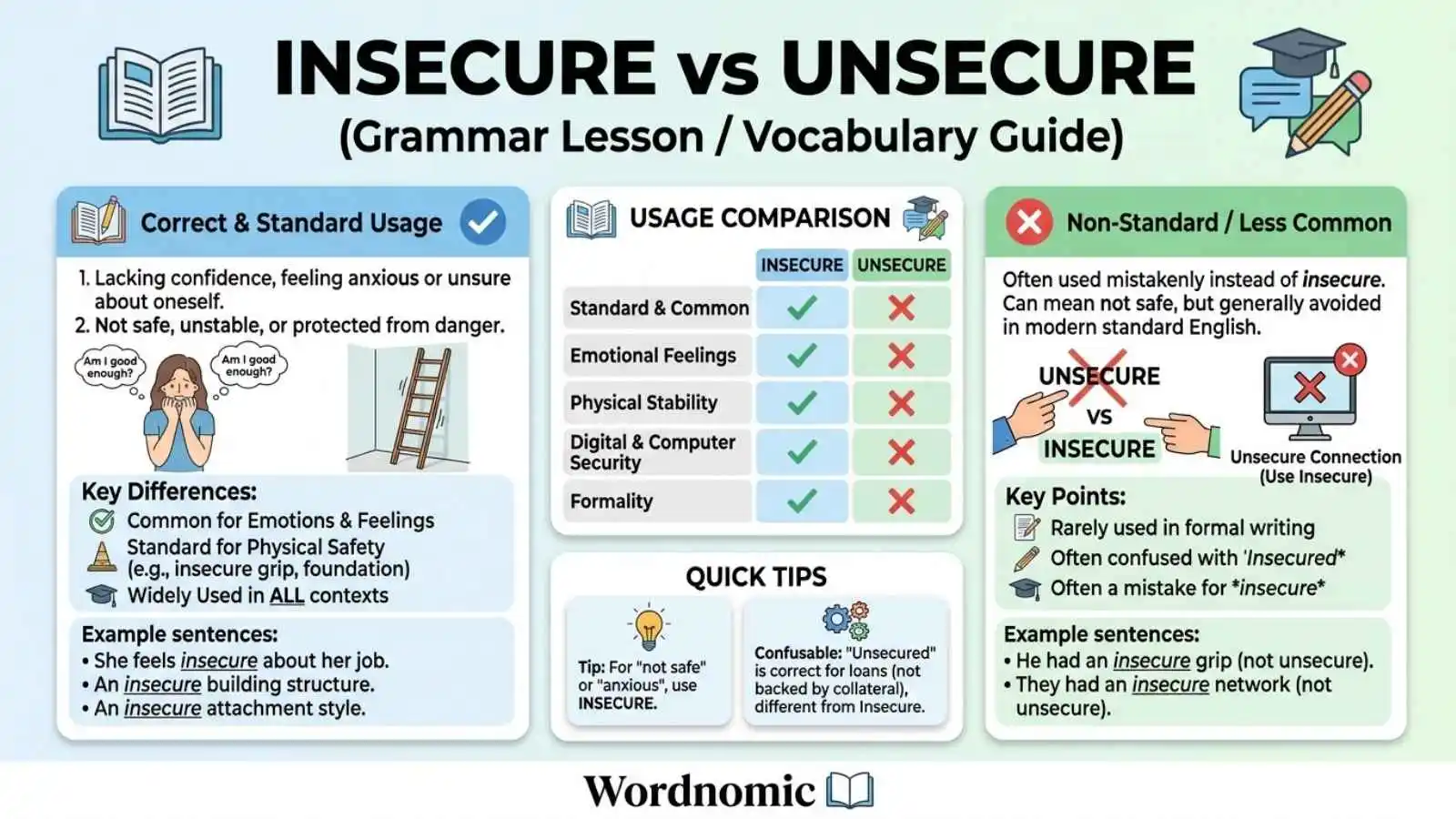
Insecure means not safe, not steady, or not feeling sure of yourself. This word is used for feelings, people, buildings, and general safety. It is the more common word that everyone uses every day.
Unsecure is mostly used for computers and the internet. It describes a website or connection that is not protected.
Quick examples:
- She felt insecure about speaking in front of the class.
- The old bridge is insecure and may fall down.
- The website uses an unsecure connection. Your data may not be safe.
- He used an unsecure Wi-Fi at the cafe.
Easy rule: For feelings and general safety, use “insecure.” For computers and internet topics, use “unsecure.”
The Origin of Insecure and Unsecure
Let us look at where each word came from.
“Insecure” is the older word. It comes from two old Latin parts. The first part, “in,” means “not.” The second part, “securus,” meant “safe” or “free from worry.” Put them together and you get “not safe” or “not free from worry.”
This word has been in English since the 1600s. Over many years, it grew to describe both things and feelings. A building can be insecure if it is not strong. A person can feel insecure if they do not feel sure of themselves.
“Unsecure” is a much newer word. Someone simply took the word “secure” and added “un” at the front. “Un” also means “not.” So “unsecure” means “not secure.”
But “unsecure” did not grow through hundreds of years of use like “insecure” did. It became common when computers and the internet became part of daily life. Tech writers needed a short word to describe websites and connections that were not protected. “Unsecure” fit that job well.
This is why “insecure” feels like a normal everyday word. And “unsecure” feels more like a word you see on a computer screen.
British English vs American English Spelling
This is not a British vs American spelling issue. Both countries spell these words the same way. There is no UK version or US version of either word.
The only small difference is where each word shows up more often. American tech companies use “unsecure” a lot in their guides and warnings. British tech writers use it too. But in everyday writing, both countries use “insecure” much more than “unsecure.”
| Feature | Insecure | Unsecure |
| Spelling in the UK | insecure | unsecure |
| Spelling in the US | insecure | unsecure |
| Used for feelings | Yes | No |
| Used for buildings | Yes | Rarely |
| Used for websites | Sometimes | Yes, very often |
| Used in daily talk | Yes | Rarely |
| Used in tech writing | Sometimes | Yes, very often |
Which Word Should You Use?
The answer depends on what you are writing about. Not where you live.
Use “insecure” when:
- You talk about how a person feels inside.
- You talk about a place or thing that is not strong or not safe.
- You write for any type of reader in any situation.
Use “unsecure” when:
- You write about websites, the internet, or computer networks.
- You describe a connection or system that has no protection.
- You write for tech or computer topics.
For US readers: Use “insecure” for feelings. Use “unsecure” for tech topics.
For UK readers: Same rule. “Insecure” for daily life. “Unsecure” for tech writing.
For readers all over the world: “Insecure” is known by everyone. “Unsecure” is known in tech topics.
Not sure which to pick? Always go with “insecure.” It works in more places and more people know it.
Common Mistakes with Insecure and Unsecure
Here are common wrong uses of each word, with easy fixes.
Mistake 1: Using “unsecure” for a person’s feelings. Wrong: “She felt unsecure at the party.” Right: “She felt insecure at the party.”
Mistake 2: Forgetting that “insecure” also works for buildings and places, not just feelings. Wrong: “The old wall is unsecure.” Right: “The old wall is insecure.”
Mistake 3: Thinking “unsecure” is a wrong word. “Unsecure” is real. It just belongs in tech writing. Do not be afraid to use it there.
Mistake 4: Using “insecure” in tech writing when “unsecure” is the right fit. In computer and internet writing, “unsecure” is the better, more fitting word.
Mistake 5: Mixing up “unsecure” and “unsecured.” “Unsecured” (with a “d” at the end) is used in money topics. Like an unsecured loan, which is a loan with nothing backing it up. “Unsecure” (no “d”) is the tech word for a website or connection with no protection.
Easy tip: Ask yourself one question before you write. Am I writing about feelings or safety? Use “insecure.” Am I writing about a website or computer? Use “unsecure.”
Insecure and Unsecure in Everyday Examples
Let us look at how each word fits in real writing.
email: “She said she felt insecure about joining the new team on her first day.”
news headline: “City Finds Insecure Railings on Five Old Bridges After Heavy Rain”
social media post: “Taking breaks from social media has helped me feel less insecure about how I look. 💙”
work report (tech topic): “The check found that six of the ten servers were using unsecure connections.”
browser warning: “Warning: This site uses an unsecure connection. Your details may not be safe.”
In daily talk: “He gets insecure when his work is checked in front of other people.”
In tech writing: “Do not send private details over an unsecure network. Use a VPN instead.”
You can see the clear pattern here. “Insecure” covers feelings, people, and safety. “Unsecure” shows up in tech warnings and computer topics.
Insecure vs Unsecure Google Trends and Usage Data
Search data shows that “insecure” is searched much more often than “unsecure” all over the world. This makes sense because “insecure” covers a much bigger range of topics, from mental health and feelings to physical safety and risk.
“Unsecure” gets steady searches too, but mostly in tech topics. People search “unsecure connection,” “unsecure website,” and “unsecure network” when they see browser warnings or read IT guides.
Searches for “insecure vs unsecure” mostly come from writers and students who want to pick the right word before they send or publish something.
| Word | How Often Used | Where Searched | Common Use |
| Insecure | Very often | All over the world | Feelings, safety, daily life |
| Unsecure | Often in tech | US, India, UK | Websites, networks, IT |
| Unsecured | Often in money topics | All over the world | Loans, payments |
Did You Know?
Your web browser already uses the word “unsecure” every single day. When you open a website that does not have HTTPS, your browser shows a small warning. It says “Not Secure.” This is the browser telling you the site is unsecure. Most people see this message and never think about the word behind it. Now you know exactly what it means and why that word is used there.
Memory Trick
Here is a very easy way to remember which word to use.
Think of the letter “I” in “insecure.” The “I” stands for “I feel.” When you say “I feel,” you are talking about your feelings. So “insecure” is the word for feelings and personal safety.
Think of the letter “U” in “unsecure.” The “U” stands for “URL.” A URL is the address of a website. Websites and tech use “unsecure.”
Say this in your head: “Insecure = I feel. Unsecure = URL.”
Once this is in your head, picking the right word takes just one second.
Parts of Speech
Knowing how each word works in a sentence helps you use it right.
“Insecure” is a describing word (adjective). It tells us more about a person, place, or thing.
| Word | Example |
| Insecure | She felt insecure at the new job. |
| Insecurely | The shelf was insecurely fixed to the wall. |
| Insecurity | His insecurity made it hard to take feedback. |
| Insecurities | Everyone has small insecurities from time to time. |
“Unsecure” is also a describing word (adjective). It tells us that a connection or system has no protection.
| Word | Example |
| Unsecure | Avoid using an unsecure connection. |
| Unsecured | The loan was unsecured and very risky. |
Practice Exercise
Fill in the blank with the right word: insecure or unsecure.
- She always felt ________ when she compared herself to others online.
- The IT team found three ________ servers during the safety check.
- The old rope bridge is ________ and should not be used.
- Never send your bank details over an ________ Wi-Fi connection.
- He grew up feeling ________ because other kids left him out a lot.
- The browser showed a warning that the website was ________.
- The fence around the yard is ________ and keeps falling over.
- The company lost data because of an ________ network.
Answer Key:
- insecure feeling about herself
- unsecure tech topic, servers with no protection
- insecure a structure that is not safe or strong
- unsecure tech topic, Wi-Fi with no protection
- insecure a feeling from childhood
- unsecure tech topic, browser warning about a site
- insecure a physical thing that is not steady
- unsecure tech topic, a network with no protection
How did you do? 8 out of 8 Great job! You know both words very well. 5 to 7 Good! Read the quick answer one more time. Below 5 No problem. Go through the examples slowly and try again.
Frequently Asked Questions
1. Is “unsecure” a real word? Yes. It is a real word. they used in tech and computer writing. It means a connection or website has no protection.
2. Can I use “insecure” for a website? You can, and it is not wrong. But in tech writing, “unsecure” is the better and more common word to use.
3. What is the difference between “unsecure” and “unsecured”? “Unsecure” means a website or connection has no protection. “Unsecured” is used in money topics, like a loan with nothing backing it up.
4. Is there a British or American spelling difference? No. Both words are spelled the same way in both countries.
5. Can a person be described as “unsecure”? No. For people and feelings, always use “insecure.” “Unsecure” is only for tech topics.
6. What is the noun form of “insecure”? The noun is “insecurity.” The plural is “insecurities.” For example, “She worked hard to get past her insecurities.”
7. Which word should I use in a school essay about feelings? Always use “insecure” in essays about feelings or mental health. “Unsecure” only fits in tech writing.
Conclusion:
“Insecure” and “unsecure” both mean “not secure.” But they work in very different places.
“Insecure” is the older and bigger word. It covers feelings, how people see themselves, and the safety of places and things. It has been part of English for a very long time. You can use it in any type of writing, formal or casual, anywhere in the world.
“Unsecure” is newer. It belongs in computer and internet writing. You will see it in tech guides, IT reports, and browser warnings. It describes websites and connections that have no protection.
There is no British or American spelling difference. The same rules work everywhere. When you are not sure which to pick, go with “insecure.” It works in more places and more people know it.
Remember the easy trick: Insecure = I feel. Unsecure = URL. Keep that in your head and you will always pick the right word.

Emily Carter is an English grammar writer based in Portland, Oregon, with 7+ years of experience turning tricky grammar rules into simple, easy lessons.










