You are writing a message. they want to say that someone worked very hard. You type “affort.” Then you stop. Something looks wrong. Should it be “effort” instead? You say the word in your head. Both spellings sound almost the same. So which one is right?
This small spelling question comes up more than you think. Students type it fast and get it wrong. People learning English as a second language often mix up the first letter. Even people who have spoken English for years sometimes pause before writing this word.
The reason is simple. The word “effort” does not sound the way it looks. The “e” at the start makes a short sound that some people hear as “a.” So they write “affort” without even realizing it is wrong.
But only one of these words is real. The other one does not exist in any English dictionary in the world.
In this guide, you will get the answer fast. Then you will learn where the word came from, why people make this mistake, and how to always get it right. You will also see real examples, a practice exercise, and easy tips. By the end, this word will never trip you up again.
Effort vs Affort Quick Answer
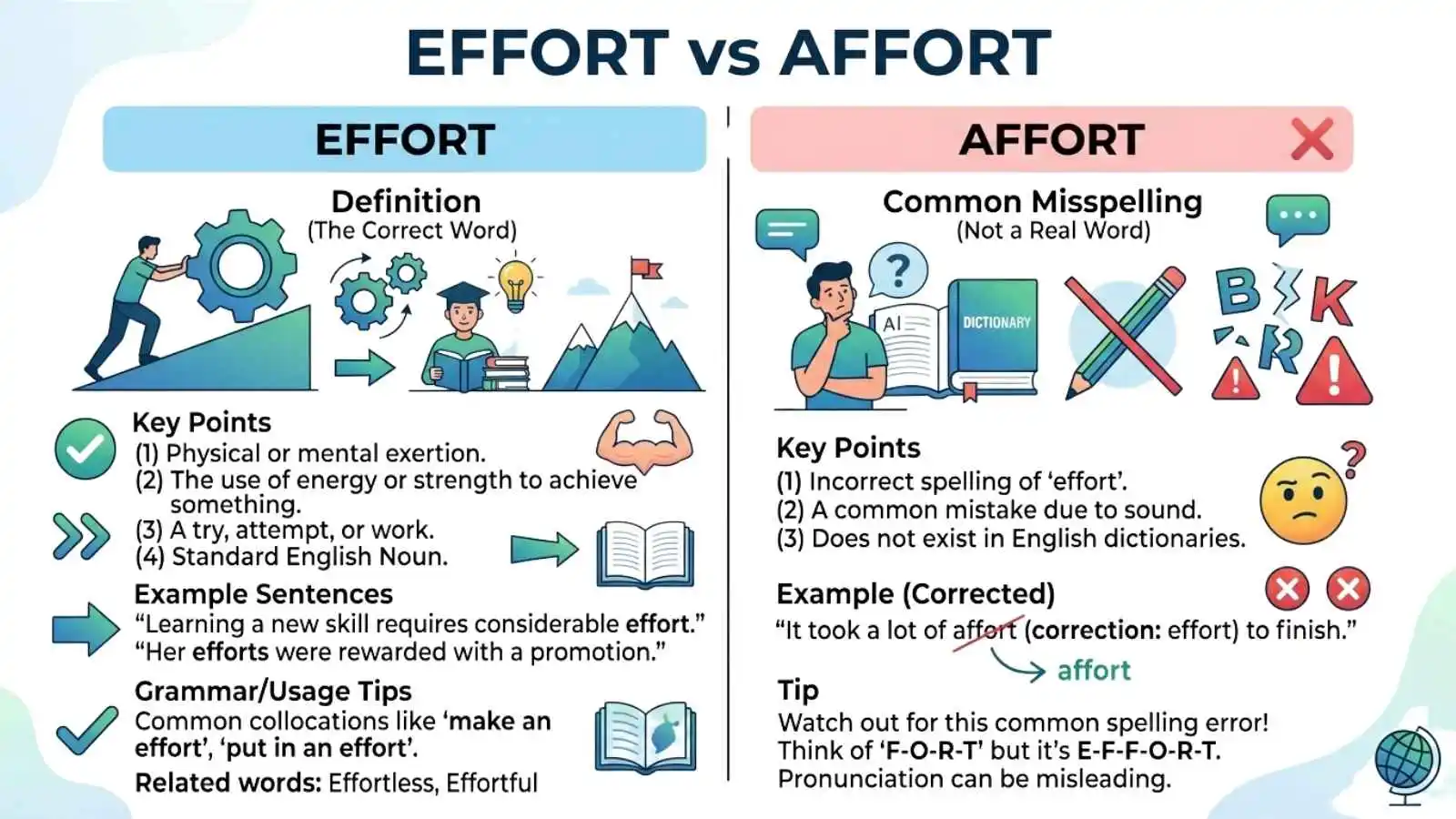
The correct spelling is “effort.”
“Affort” is not a real word. It does not exist in English dictionaries. It is a common spelling mistake that many people make without knowing it.
Quick examples using the right word:
- It takes a lot of effort to learn a new skill.
- She put in great effort to finish the project on time.
- Good results always come from hard effort.
- His effort in the game was noticed by everyone.
If you are ever unsure, remember this: the word starts with “ef” not “af”. There is no such word as “affort” in English.
The Origin of Effort
Let us look at where this word came from. Knowing its history makes it much easier to remember the correct spelling.
The word “effort” comes from the French word “effort” yes, the exact same spelling. The French word meant “a strong push” or “a great use of strength.” Before that, it came from an even older Latin phrase: “ex fortis”, which meant “out of strength” or “from strength.”
The prefix “ex” in Latin meant “out of” or “from.” The word “fortis” meant “strong.” So “effort” literally means something that comes out of your strength. When you make an effort, you are pushing strength out of yourself to get something done.
This word came into English from French a very long time ago, in the 1400s. English writers started using it to describe the energy and work a person puts into doing something. Over hundreds of years, the spelling stayed the same: e-f-f-o-r-t.
The word “affort” was never part of this history. It was never a French word. They was never a Latin word. It simply does not exist. People create it by accident when they write the “a” sound they think they hear at the start of the word.
Why Do People Write “Affort” by Mistake?
This is a fair question. Why do so many people write “affort” when it is not even a real word?
There are a few simple reasons.
First, the sound of the word. When you say “effort” out loud, the “e” at the start makes a very short, soft sound. In many accents, this soft sound is hard to tell apart from a short “a” sound. So people hear “affort” and write what they hear.
Second, English learners. People who learn English as a second language sometimes write words the way they sound in their first language. In many languages, the “a” vowel is more common than the “e” vowel in that position. So “affort” feels more natural to them at first.
Third, fast typing. When people type quickly on phones or laptops, fingers slip. The “a” key sits right next to the “s” key and not far from where “e” should be. A small slip can create “affort” without the writer even noticing.
Fourth, no spell-check warning. Sometimes spell-check does not catch “affort” right away, especially in older software. This lets the mistake slip through.
Now that you know why it happens, you can watch out for it.
British English vs American English
This is not a British vs American spelling issue at all. Both British English and American English spell this word the exact same way: “effort.”
There is no British version of “effort.” There is no American version of “effort.” The word stays the same everywhere in the world.
| Word | British English | American English | Correct? |
| Effort | Yes | Yes | Yes |
| Affort | No | No | No |
| Efforts (plural) | Yes | Yes | Yes |
| Effortless | Yes | Yes | Yes |
| Effortlessly | Yes | Yes | Yes |
As the table shows, every form of this word stays exactly the same across all English-speaking countries. If you write “affort” anywhere in the world, it will be wrong everywhere in the world.
Which Spelling Should You Use?
The answer is simple. There is only one correct spelling, and it works everywhere.
you live in the United States: Use “effort.”
they live in the United Kingdom: Use “effort.”
you live in Canada, Australia, India, or Pakistan: Use “effort.”
you write for a global audience: Use “effort.”
There is no situation, no country, and no context where “affort” is correct. It is always a mistake. Always choose “effort” every single time you write this word.
Common Mistakes with Effort
Here are the most common errors people make with this word, along with easy fixes.
Mistake 1: Spelling it as “affort.” Wrong: “She made a great affort to finish on time.” Right: “She made a great effort to finish on time.”
Mistake 2: Spelling it as “efffort” with three f’s. Wrong: “It was a huge efffort to climb that hill.” Right: “It was a huge effort to climb that hill.”
Mistake 3: Writing “effor” and forgetting the final “t.” Wrong: “Good effor is always noticed.” Right: “Good effort is always noticed.”
Mistake 4: Using “effort” as a verb. Wrong: “I will effort to do better next time.” Right: “I will make an effort to do better next time.” Note: “Effort” is a noun, not a verb. You cannot use it as an action word on its own.
Mistake 5: Writing “affords” when you mean “efforts.” Wrong: “His affords were not enough.” Right: “His efforts were not enough.”
Quick writing tip: Before you finish any piece of writing, search for the word “affort” in your document. If it appears, change it to “effort” right away.
Effort in Everyday Examples
Let us see how this word looks in real writing situations.
In an email: “Thank you for all your effort in putting this report together. It really shows.”
In a news headline: “City Workers Praised for Their Effort During the Flood Clean-Up”
In a social media post: “Three months of effort and I finally finished my first painting. Never give up!
formal report: “The team’s effort during the final quarter led to a 20 percent rise in results.”
School essay: “With steady effort, any student can improve their grades over time.”
In daily conversation: “That meal took so much effort to cook, but it was worth every minute.”
Notice how “effort” fits smoothly into every type of writing. It is a simple, powerful word that works in casual messages, serious reports, and everything in between.
Effort vs Affort Google Trends and Usage Data
When we look at search data, “effort” is searched millions of times every month across the world. It is one of the most commonly used nouns in the English language.
“Affort” also shows up in searches, but only because people are checking their spelling. Most of these searches come from people who typed “affort” and then felt unsure. They go online to confirm whether it is correct. The answer they always find is the same: it is not.
Countries like the United States, India, the United Kingdom, the Philippines, Pakistan, and Nigeria all show high search numbers for “effort.” This makes sense because the word is used in education, business, health, sports, and everyday life all around the world.
| Word | Correct? | Search Volume | Common Use |
| Effort | Yes | Very High | School, work, sports, daily life |
| Affort | No | Low (checking spelling) | Misspelling only |
| Efforts (plural) | Yes | High | Reports, news, business |
| Effortless | Yes | Moderate | Describing ease |
Did You Know?
The word “effort” has a cousin word you may know: “fort.” A fort is a strong building used for protection. Both “effort” and “fort” come from the same Latin word “fortis,” meaning strong. So when you make an effort, you are using your inner strength, just like a fort uses its strong walls. This connection can help you remember that “effort” starts with “e” from “ex” (meaning “out of”) and not with “a.”
Memory Trick
Here is an easy way to remember the correct spelling of “effort” every single time.
Think of the word in two parts: EF + FORT.
A FORT is a strong place. When you make an EFFORT, you are building a fort of strength inside yourself.
Say this to yourself: “EFFORT = EF + FORT. Use your inner FORT to make an EFFORT.”
You can also remember it this way. The word starts with “EF” like the start of the word “EFFective.” Effort makes you effective. Both words start with “ef,” not “af.”
Once you see this connection, the spelling will stick in your mind for good.
Parts of Speech
Understanding how “effort” works in a sentence helps you use it correctly every time.
Effort is a noun.
A noun is a naming word. It names a thing, feeling, or idea. “Effort” names the energy or work someone puts into doing something.
Here is how “effort” and its related words work:
| Word | Part of Speech | Example |
| Effort | Noun (singular) | She put in a lot of effort. |
| Efforts | Noun (plural) | Their efforts paid off in the end. |
| Effortless | Adjective | He made it look effortless. |
| Effortlessly | Adverb | She ran effortlessly across the field. |
Important rule: “Effort” is a noun only. You cannot use it as a verb on its own. You need to pair it with action words like “make,” “put in,” “show,” or “require.”
Correct ways to use “effort” with verbs:
- “Make an effort” I will make an effort to arrive on time.
- “Put in effort” She put in a lot of effort this week.
- “Show effort” His work shows real effort.
- “Require effort” Good results require effort.
- “Take effort” Learning a language takes effort.
Practice Exercise
Try these questions. Fill in the blank with the right word: effort or efforts.
- She made a huge ________ to arrive at the meeting on time.
- The team’s ________ over six months finally led to a great result.
- It takes real ________ to learn how to play the guitar well.
- All her ________ went into making the event a success.
- Without ________, even the smartest person will not grow.
- The manager praised the ________ of every worker on the project.
- Good ________ today will bring good results tomorrow.
- Despite their ________, the team could not finish before the deadline.
Answer Key:
- effort singular, one big push
- efforts plural, many actions over time
- effort singular, general idea of trying
- efforts plural, many actions she took
- effort singular, general concept
- efforts plural, the work of multiple workers
- effort singular, general advice
- efforts plural, the actions of the whole team
How did you do? 8 out of 8 Fantastic! You have fully mastered this word. 5 to 7 Great work! Read the parts of the speech section one more time. Below 5 No problem. Go back through the examples and try again.
Frequently Asked Questions
1. Is “affort” a real word in English? No. “Affort” does not exist in any English dictionary. It is a very common spelling mistake. The only correct spelling is “effort.”
2. Why do people write “affort” instead of “effort”? The short “e” sound at the start of “effort” can sound like a short “a” in some accents. This makes people write what they hear instead of the correct spelling.
3. Is “effort” spelled differently in British and American English? No. Both British and American English use the same spelling: “effort.” There is no regional difference for this word.
4. Can “effort” be used as a verb? No. “Effort” is a noun only. To use it correctly, pair it with a verb. Say “make an effort,” “put in effort,” or “show effort.”
5. What is the plural form of “effort”? The plural form is “efforts.” For example: “Their efforts over many months finally paid off.”
6. What does “effortless” mean? “Effortless” means something is done without any difficulty or hard work. For example: “She made the dance look effortless.”
7. How can I remember the correct spelling? Break the word into two parts: EF + FORT. Think of a fort as a place of strength. When you make an effort, you use your inner strength, just like a fort.
Conclusion:
The correct spelling is “effort.” The spelling “affort” is wrong and does not exist in any dictionary anywhere in the world. This mistake happens because the “e” sound at the start of “effort” can be confused with an “a” sound in some accents and languages.
Both British English and American English spell this word the same way: e-f-f-o-r-t. There is no regional difference. The word stays the same whether you are writing in the United States, the United Kingdom, Australia, Canada, India, or Pakistan.
“Effort” is a noun. It means the energy or work someone puts into doing something. You cannot use it as a verb on its own. Always pair it with action words like “make,” “put in,” or “show.”
The easiest way to remember the correct spelling is to think of EF + FORT. A fort is strong. Your effort comes from your inner strength. Keep this picture in your mind and you will never write “affort” again.

Welcome to the official author page of Clara Wordsmith, grammar writer at Wordnomic. Clara specializes in explaining confusing English words, grammar rules, spelling differences, and vocabulary topics with clear examples and beginner-friendly explanations.










