You are writing about the future. They want to say that you can picture something happening. You type “envision.” Then you pause. Should it be “envisage” instead? Or does it even matter? Both words feel right. Both seem to mean the same thing. So which one do you actually pick?
This is a question that confuses a lot of people. Writers, students, bloggers, and business people all face it. The two words look close. They sound close. And they both talk about picturing something in your mind. So it makes complete sense that people get mixed up.
But here is the thing. These two words are not exactly the same. One is more common in British English. The other is more popular in American English. If you write for different readers around the world, picking the right word can make your writing feel more natural and polished.
In this guide, you will get a clear answer right away. Then you will learn where each word came from, how they are used today, and which one fits your writing best. You will also see real examples from emails, news, and daily life. By the end, you will always know which word to reach for.
Envisage vs Envision Quick Answer
Both words are real. Both are correct. But they are not used equally in every part of the world.
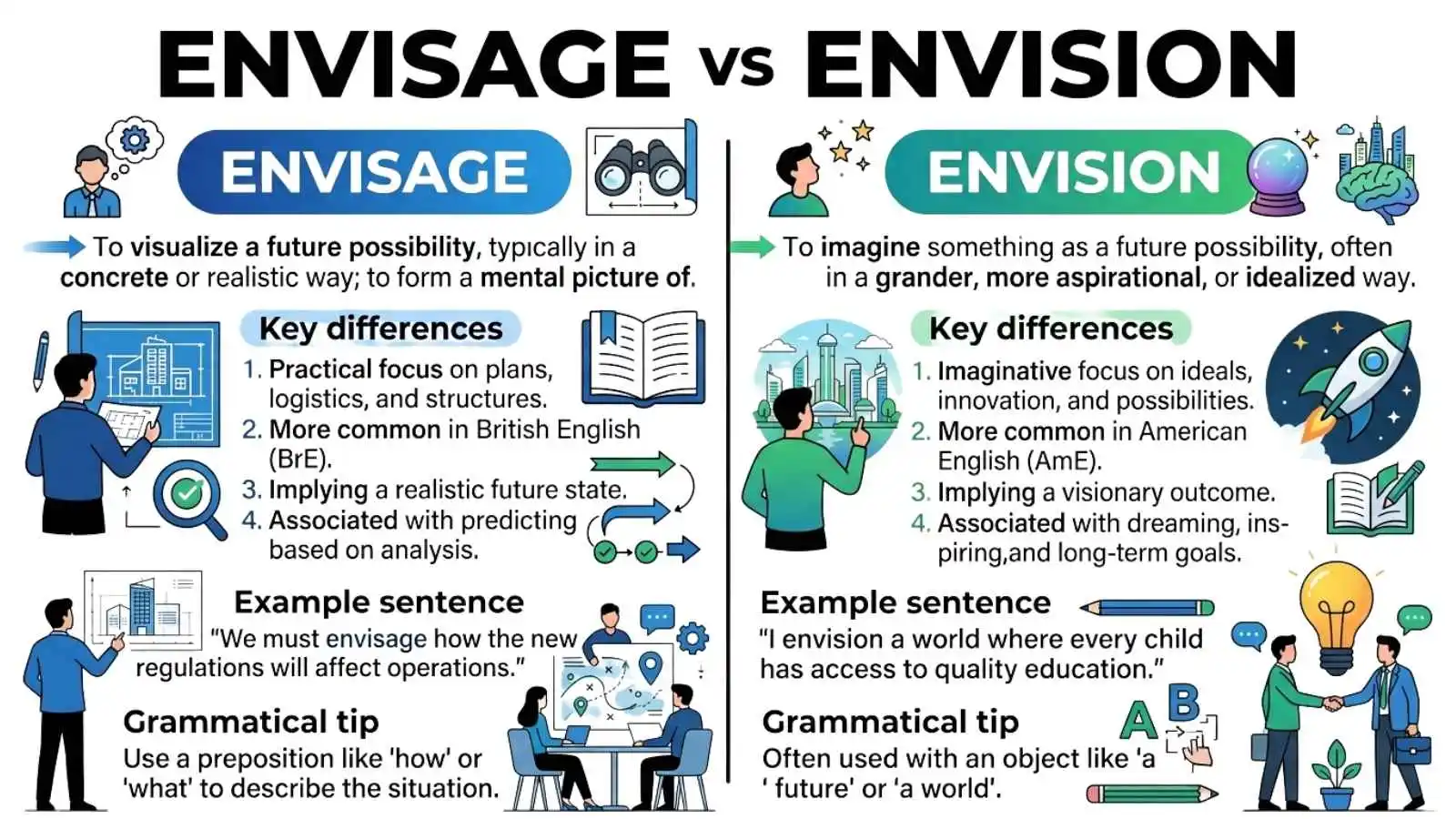
Envisage means to picture something in your mind, especially something that might happen in the future. It is more common in British English.
Envision means the same thing. To picture or imagine something that could happen. It is more common in American English.
Quick examples:
- I envisage a future where clean energy powers every home. (British style)
- I envision a future where clean energy powers every home. (American style)
- She could not envisage how things would work out in the end.
- He could not envision the size of the crowd at the event.
Both sentences say the same thing. Both are correct. The difference is mostly about where you live and who you are writing for.
The Origin of Envisage and Envision
Let us look at where each word came from. This makes it much easier to understand why one is used more in some places than others.
“Envisage” comes from French. The French word “envisager” means to look at something face to face, or to picture it in your mind. This word moved into English in the early 1800s. Because British English has always had a close relationship with French, “envisage” settled naturally into British writing and speech. It has been used in the UK for over two hundred years.
“Envision” is an American English word. It was formed by adding the prefix “en” to the word “vision.” “Vision” comes from the Latin word “visio,” which means sight or the ability to see. Put “en” in front and you get “envision,” meaning to bring something into your vision, or to picture it clearly in your mind.
“Envision” became popular in American writing during the twentieth century. It felt fresh and direct, which matched the American style of writing. Over time, it became the go-to word for American writers when talking about imagining the future.
Both words do the same job. They both mean to picture something in your mind. But their roots are different, and that is why they landed in different places around the world.
British English vs American English
This is one of the clearest British vs American word differences in modern English. The words are not just spelling variants. They are actually preferred by different groups of speakers.
In British English: “Envisage” is the more common word. You will find it in UK newspapers, business writing, academic papers, and everyday speech. British writers reach for “envisage” almost automatically.
In American English: “Envision” is the more common word. You will find it in American news articles, company mission statements, school essays, and daily conversation. American writers prefer “envision” without even thinking about it.
In Canadian, Australian, and Indian English: Both words are used. Canadian and Australian writers tend to lean toward British habits, so “envisage” shows up more often. Indian English also uses both, though “envision” is gaining ground in modern writing.
| Feature | Envisage | Envision |
| British English | Very common | Rare |
| American English | Rare | Very common |
| Canadian English | More common | Less common |
| Australian English | More common | Less common |
| Indian English | Both used | Both used |
| Formal writing | Both correct | Both correct |
| Casual writing | Both correct | Both correct |
Which Word Should You Use?
The answer here depends on who you are writing for. There is no single right answer for everyone. But there are clear rules based on your audience.
If you write for British readers: Use “envisage.” It sounds natural to them and fits the style they expect.
If you write for American readers: Use “envision.” It is what American readers are used to seeing in professional and casual writing.
If you write for Canadian or Australian readers: “Envisage” is slightly more common, but both words work fine.
If you write for a global audience: Both words are understood everywhere. Pick the one that feels more natural to you. Or check which one your editor or style guide prefers.
If you are a student: Ask your teacher which one to use. you are in a British school, use “envisage.” If you are in an American school, use “envision.”
The most important thing is to stay consistent. Do not switch back and forth between the two words in the same piece of writing. Pick one and stick with it throughout.
Common Mistakes with Envisage and Envision
Here are the most common mistakes people make with these two words, along with easy fixes.
Mistake
1: Using “envisage” in American writing and making it sound out of place. Example: “We envision sorry, envisage a brighter tomorrow for all.” Fix: Pick one word and stay with it. For an American audience, use “envision.”
2: Using “envision” in formal British writing. Example: An official UK government report saying “We envision a cleaner future.” Fix: Use “envisage” in British formal writing. It matches the expected tone.
3: Thinking one word is wrong or does not exist. Both words are real. Both are in every major dictionary. Neither one is a mistake.
4: Confusing “envisage” or “envision” with “visualize.” “Visualize” means to create a mental picture, often in a more deliberate or focused way. All three words are related but not exactly the same.
5: Using either word in a sentence where “imagine” would be clearer. Sometimes “imagine” is the simplest and clearest choice. Example: “Can you imagine how beautiful it will look?”
Quick tip: If your reader is American, type “envision.” If your reader is British, type “envisage.” If you are not sure, either word works.
Envisage and Envision in Everyday Examples
Let us look at how each word appears in real writing.
business email (American style): “We envision a strong partnership that will grow over the next five years.”
business email (British style): “We envisage a productive relationship that will benefit both companies.”
news headline (UK paper): “Government Envisages New Housing Plan for Young Families”
news headline (US paper): “City Leaders Envision Greener Parks and Cleaner Streets by 2030”
social media post: “I envision my future self living somewhere sunny and creative. What about you? “
formal report: “The committee envisages several challenges during the early stages of the project.”
school essay: “The author envisioned a world where people lived in peace with nature.”
Notice how smoothly each word fits its setting. The meaning never changes. Only the location and audience shift.
Envisage vs Envision Google Trends and Usage Data
Search data shows an interesting split between these two words based on country.
In the United States, “envision” is searched and used far more than “envisage.” American websites, articles, and social posts use “envision” so often that it feels like the default word.
In the United Kingdom, “envisage” is the clear leader. British newspapers, government reports, and everyday writing almost always choose “envisage” over “envision.”
In India, Pakistan, Australia, and Canada, searches for both words are common. These countries have mixed writing habits, influenced by both British and American English.
The phrase “envisage vs envision” is searched by writers who want to know which word to use before they publish content for a specific audience. This is one of the top reasons this keyword keeps showing up in search engines worldwide.
| Word | Where Most Common | Search Volume | Used in Formal Writing |
| Envisage | UK, Australia, Canada | Moderate | Yes |
| Envision | USA, Global digital content | High | Yes |
| Visualize | Global | High | Yes |
| Imagine | Global | Very High | Yes |
Did You Know?
“Envisage” appears in classic British literature and official government documents going back to the 1800s. But “envision” only became popular in the twentieth century. Some language experts say “envision” is now spreading globally through American media, movies, and technology companies. Many international brands based in the US use “envision” in their mission statements. This is slowly making “envision” more common even in countries that traditionally used “envisage.”
Memory Trick
Here is an easy way to remember which word belongs where.
Think about the letter “A” in “envisAGE.” The “A” stands for “Across the Atlantic” as in the UK, on the other side of the Atlantic Ocean from America. So “envisage” is the UK word.
Now think about “envISION.” It ends in “ISION” which sounds like “vision.” American companies love talking about their “vision.” So “envision” is the American word.
Say this to yourself: “EnvisAGE is for the AGE-old British style. EnVISION is for the American VISION.”
Once you picture it this way, the choice becomes very easy.
Practice Exercise
Fill in the blank with the best word: envisage or envision.
Use the context clues (British or American style) to help you choose.
- The UK prime minister said, “We ________ a stronger economy for all citizens.”
- The American tech company wrote, “We ________ a world connected by fast and safe internet.”
- She could not ________ how the small town would grow into a large city one day.
- The report from the London office said they ________ delays in the project timeline.
- The New York startup said, “We ________ a future where everyone can work from anywhere.”
- The British author ________ a society where kindness was more valued than money.
- “I truly ________ us winning this championship,” said the American coach.
- The UK charity ________ a world free from hunger within the next generation.
Answer Key:
- envisage UK prime minister, British context
- envision American tech company, US context
- either word works no specific location given
- envisage London office, British context
- envision New York startup, American context
- envisaged British author, British context
- envision American coach, US context
- envisages UK charity, British context
How did you do? 8 out of 8 Excellent! You have fully understood the difference. 5 to 7 Good work! Read the British vs American section one more time. Below 5 No problem. Go back through the examples slowly and try again.
Frequently Asked Questions
1. Are “envisage” and “envision” the same word? They mean the same thing, but they are different words with different origins. “Envisage” came from French and is more common in British English. “Envision” was formed in American English and is more popular in the United States.
2. Is “envisage” used in American English? It is not very common in American writing. American writers usually use “envision” instead. If you use “envisage” in an American article, it may sound slightly formal or out of place.
3. Is “envision” wrong in British English? It is not wrong, but it is less common. British readers will understand it, but “envisage” is the more natural and expected choice in UK writing.
4. Which word should I use in a business email? Check who you are writing to. For British clients, use “envisage.” American clients, use “envision.” For mixed or global audiences, either word is fine.
5. Can I use “imagine” instead of both? Yes. “Imagine” is always a safe and clear choice. It works in every country, every context, and every writing style. If you are unsure, “imagine” is your best backup word.
6. Which word is more formal? Both words carry the same level of formality. Neither one is more serious or more casual than the other. They are equals in tone.
7. Do search engines care which word I use? Search engines do not prefer one over the other for grammar reasons. But using the right word for your audience makes your content feel more natural, which helps readers stay longer on your page. That is always good for SEO.
Conclusion:
“Envisage” and “envision” mean the same thing. Both words describe the act of picturing something in your mind, especially something that might happen in the future. Neither word is wrong. Neither word is old or outdated. They are both alive and used every day around the world.
The real difference is location and audience. “Envisage” is the British English word. It has been used in the UK for over two hundred years. “Envision” is the American English word. It grew popular in the twentieth century and is now spreading globally through American media and business culture.
If you write for British readers, use “envisage.” although you write for American readers, use “envision.” If you write for a global audience, pick the one you feel more comfortable with and stay consistent throughout your writing.
The most important rule is this: do not mix both words in the same piece of writing. Pick one. Stick with it. Your writing will feel clean, confident, and easy to read every single time.