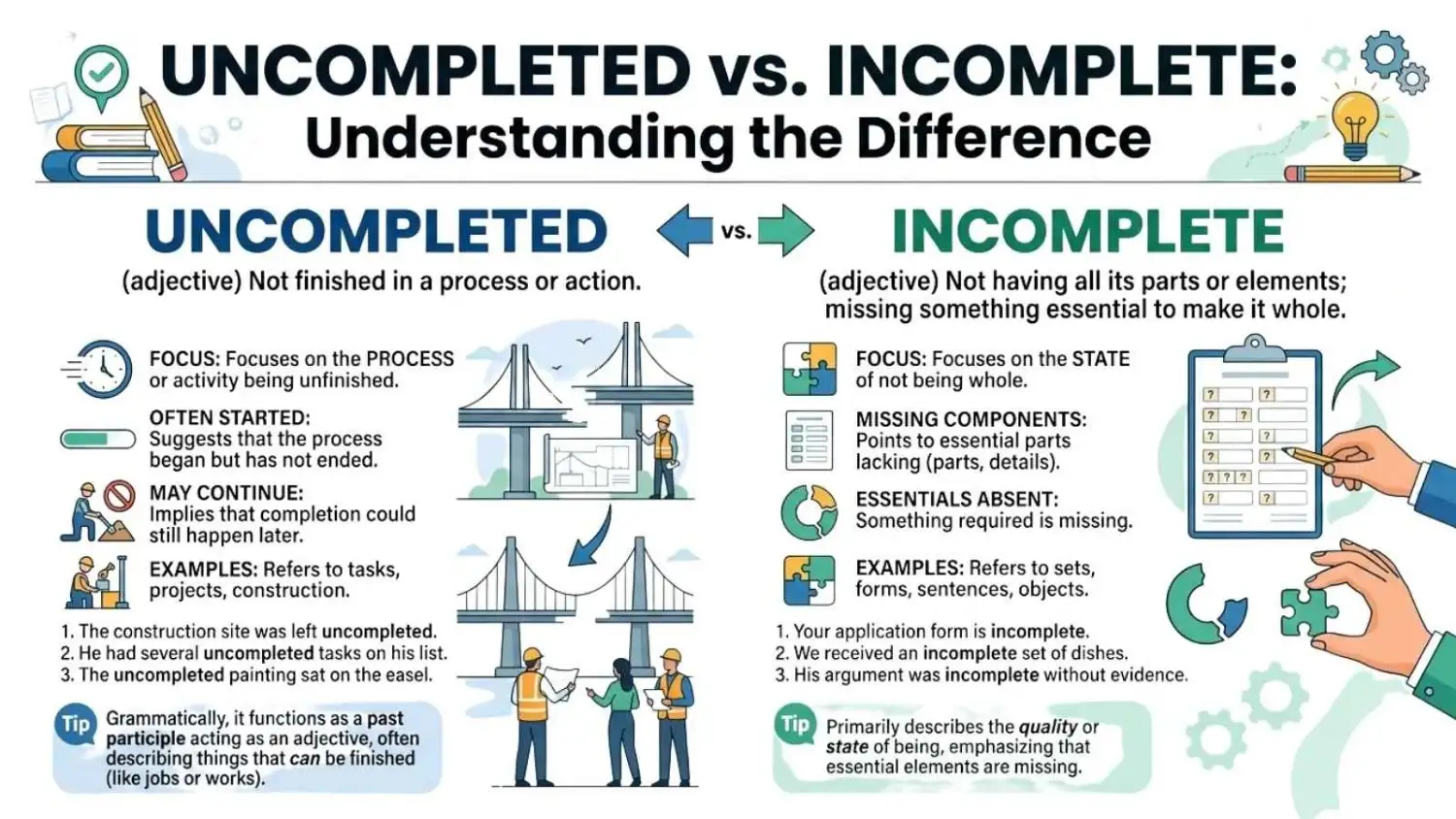
You are writing an email. they want to say that a task is not done yet. You type “uncompleted.” Then you stop. Should it be “incomplete” instead? Both words feel right. Both seem to mean the same thing. So which one do you actually use?
This small question trips up a lot of people. Writers, students, office workers, and teachers all face it. The two words look similar. They sound similar. And they both talk about something that is not finished. So it makes sense that people get confused.
But here is the thing. These two words are not exactly the same. The other one exists but feels awkward in most sentences. If you pick the wrong one, your writing can sound strange, even if the meaning is clear.
In this guide, you will get a straight answer fast. . You will also see real examples from emails, news, and daily life. By the end, you will always know which word to pick.
Uncompleted vs Incomplete Quick Answer
Both words are real. But they are not equal in how people use them today.
Incomplete means something is not finished or is missing some parts. This is the word most people use. You will find it in school, work, news, and everyday talk.
Uncompleted also means something is not finished. But it is used much less often. In many sentences, it sounds old-fashioned or stiff. Most writers skip it and use “incomplete” instead.
Quick examples:
- The form is incomplete. Please fill in the missing parts.
- The project is incomplete and needs more work.
- She handed in an uncompleted assignment by mistake.
Both sentences make sense. But “incomplete” sounds more natural in most cases. It is the safer, smarter word to use.
The Origin of Uncompleted and Incomplete
Let us look at where each word came from. This helps explain why one feels stronger than the other.
“Incomplete” comes from the Latin word “incompletus.” This old Latin word meant “not filled up” or “not finished.” The prefix “in” means “not.” The word “completus” meant “filled” or “finished.” Put them together and you get “incomplete,” meaning not finished.
This word has been part of English for hundreds of years. Writers, teachers, doctors, and lawyers have all used it in formal and everyday writing. Because of this long history, “incomplete” feels natural and correct to most English speakers today.
“Uncompleted” is built differently. It uses the prefix “un,” which also means “not,” added to the word “completed.” So “uncompleted” means “not completed.” This is a newer and simpler way to build the word.
Many English words are built this way. Think of “unfinished,” “unpaid,” or “unseen.” These words are correct and useful. But “uncompleted” never became as popular as “incomplete.” Writers mostly stuck with “incomplete,” and “uncompleted” stayed on the edges of the language.
This is why “incomplete” feels like the go-to word, while “uncompleted” sounds slightly unusual or stiff in many sentences.
British English vs American English
This is not a spelling issue between British and American English. Both countries use the same spellings for both words. There is no British version and no American version.
In the United States, people say “the form is incomplete” and “the task is uncompleted.” In the United Kingdom, people say exactly the same things. Canada, Australia, and India all follow the same pattern too.
The real question is not about spelling or location. It is about which word sounds more natural and modern. And the answer is the same everywhere: “incomplete” is the better choice in almost every situation.
| Word | British English | American English | Common Use |
| Incomplete | Yes | Yes | Very common, all situations |
| Uncompleted | Yes | Yes | Less common, sounds stiff |
| Completed | Yes | Yes | Very common |
| Completion | Yes | Yes | Very common |
Which Word Should You Use?
Use “incomplete” in almost every case. It works in school papers, work emails, news writing, formal reports, and casual messages. It is clear, natural, and accepted everywhere.
Here is simple advice based on who you are writing for:
For US readers: Use “incomplete.” It is the standard word in American writing.
For UK or Commonwealth readers: Use “incomplete.” It is also the standard word in British, Canadian, Australian, and Indian English.
For global readers: Stick with “incomplete.”
When in doubt, always choose “incomplete.” It never sounds wrong. It always fits.
Common Mistakes with Uncompleted and Incomplete
Here are mistakes people make with these two words, along with easy fixes.
Mistakes
1: Using “uncompleted” in formal or professional writing. Wrong: “Please submit your uncompleted sections before Friday.” Better: “Please submit your incomplete sections before Friday.”
2: Using “incomplete” when you want to say a physical structure was not finished. This can work either way, but “uncompleted” fits more naturally here. Okay: “The bridge was incomplete when work stopped.”
3: Thinking “uncompleted” is wrong or does not exist. It does exist. It just sounds less natural in everyday sentences.
4: Using either word when “unfinished” works better. Sometimes “unfinished” is the clearest choice. Example: “She left an unfinished painting on the wall.”
Quick writing tip: Before you write, ask yourself this. Would “not finished” or “missing some parts” work here? If yes, use “incomplete.” It always fits and always sounds right.
Uncompleted vs Incomplete in Everyday Examples
Let us see how each word looks in real writing situations.
an email: “Your application is incomplete. Please add your contact number and resubmit.”
In a news headline: “City Council Reviews Incomplete Road Projects Across Three Districts”
social media post: “Sending out an incomplete draft by accident is every writer’s worst fear. “
Using “uncompleted” naturally: “The uncompleted highway section has been a traffic problem for two years.”
“The museum put the artist’s uncompleted works on display after his death.”
Notice the pattern. “Incomplete” works smoothly in almost every setting. “
Uncompleted vs Incomplete Google Trends and Usage Data
When we look at how often people search for these words, the difference is very clear.
“Incomplete” is searched far more often than “uncompleted” in every country. The United States, United Kingdom, India, Canada, and Australia all show strong, steady search numbers for “incomplete.” It appears in school content, health forms, tax papers, job applications, and online writing guides.
“Uncompleted” is searched far less. Most searches for “uncompleted” come from people checking if it is a real word, or comparing it to “incomplete” to decide which one to use.
Interest in “incomplete” stays high all year.
| Word | Correct? | How Often Used | Best Context |
| Incomplete | Yes | Very often | Any situation |
| Uncompleted | Yes | Rarely | Physical projects or tasks |
| Unfinished | Yes | Often | Creative work, tasks |
| Not complete | Yes | Often | Casual speech |
Did You Know?
The word “incomplete” is used in medicine too. Doctors use phrases like “incomplete fracture,” which means a bone is cracked but not fully broken. They also say “incomplete recovery” when a patient gets better but not fully.
Memory Trick
Here is an easy way to remember which word to use.
Think of the word “incomplete” like a jigsaw puzzle with missing pieces. The puzzle exists. It was started. But some pieces are not there. That is what “incomplete” means: something exists but is missing parts.
Think of “uncompleted” like a half-built house. But then it stopped. The house was never completed.
Say this to yourself: “If it is missing something, it is incomplete.
This small difference helps you pick the right word every time.
Practice Exercise
Try these questions. Fill in the blank with the best word: incomplete or uncompleted.
- The teacher returned the ________ homework and asked the student to redo it.
- The old stadium has been ________ for over ten years. No one finished building it.
- Your online form is ________ . Please add your date of birth.
- Three of the five tasks on the list are still ________.
- The ________ bridge became a symbol of wasted money in the city.
- She sent an ________ email by mistake, without the attachment.
- The research paper was ________ because two sections were missing.
Answer Key:
- incomplete missing parts in homework
- uncompleted a physical structure that was never finished
- incomplete a form with missing fields
- uncompleted a physical structure left unfinished
- incomplete an email missing something
- incomplete a paper missing sections
How did you do? 8 out of 8 You have fully got it! 5 to 7 Great! Read the memory trick one more time. Below 5 No worries. Go through the examples again slowly.
Frequently Asked Questions
1. Is “uncompleted” a real word? Yes, it is real. But it is not used very often in modern English. Most writers use “incomplete” instead, since it sounds more natural in everyday sentences.
2. Can I use “uncompleted” in a work email? You can, but “incomplete” sounds more polished and professional. For example, “Your report is incomplete” sounds better than “Your report is uncompleted.”
3. What is the difference between “incomplete” and “unfinished”? Both mean something is not done yet. “Incomplete” often means something is missing parts. ” spelled and used the same way in British and American English. There is no regional difference.
5. Which word should a student use in a school essay? Always use “incomplete” in school writing. It is the standard, accepted, and natural choice in academic work.
6. Can “incomplete” describe a person? It can, but it is not common. You might say someone feels “incomplete” without something they love. But for tasks and documents, it is the go-to word.
Conclusion:
“Incomplete” and “uncompleted” both mean something is not finished. But they are not used the same way in modern English.
“Incomplete” is the word most people use. It works in school, work, news, and daily life. It is natural, clear, and accepted everywhere in the world. Doctors, teachers, lawyers, and everyday writers all use it without a second thought.
There is no British or American difference here. Both words stay the same everywhere. The real choice is about which word sounds right in your sentence.
When you are not sure, always go with “incomplete.” It is the safe, smart, and natural choice in almost every situation. Use it with confidence and your writing will always sound clear and correct.

Emily Carter is an English grammar writer based in Portland, Oregon, with 7+ years of experience turning tricky grammar rules into simple, easy lessons.










