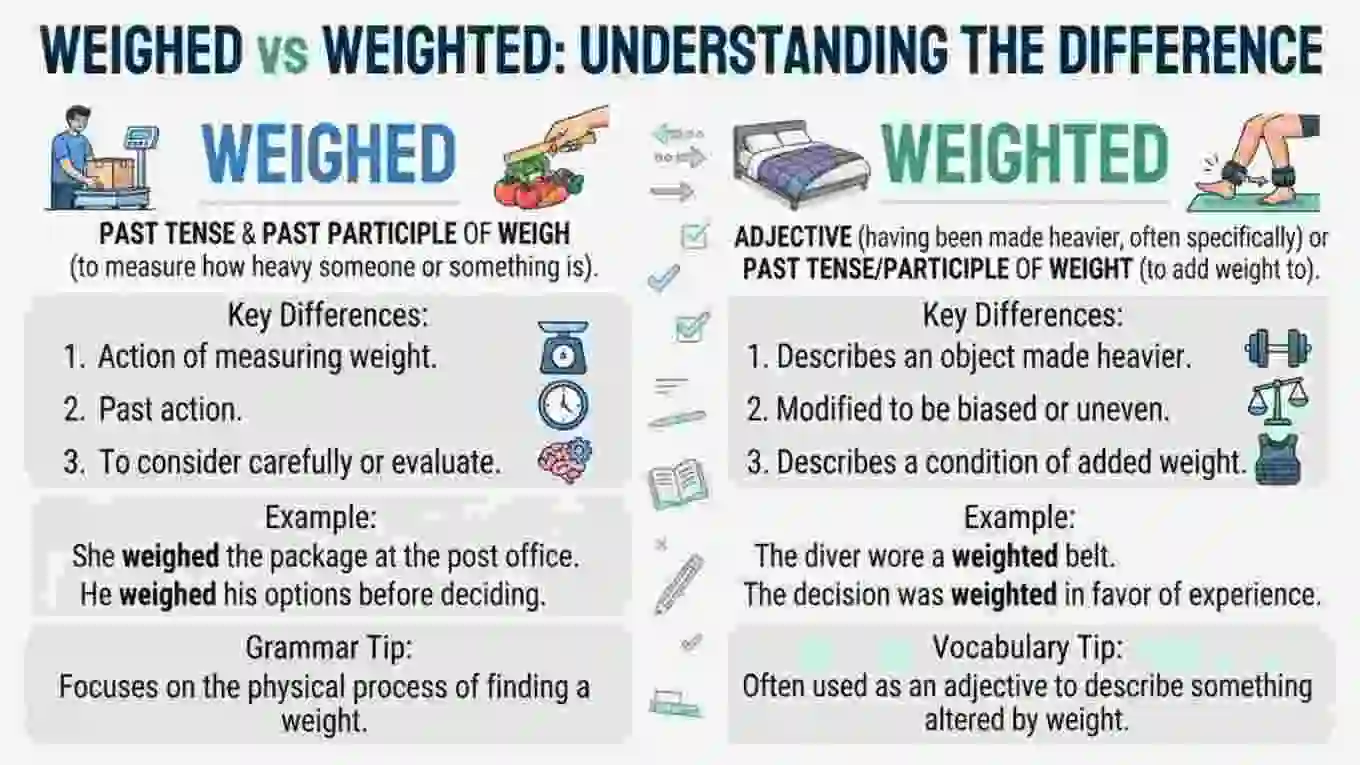
Have you ever stopped while writing and wondered whether to use weighed or weighted?
These two words look and sound very similar.The confusion often happens because both words come from the word weight.
The word weighed is related to finding or checking the weight of something. For example, you can say, “I weighed the box.” This means you checked how heavy the box was.
So, which word should you use? It depends on what you want to say.
In this guide, we will explain weighed vs weighted in very simple English. You will learn their meanings, differences, examples, common mistakes, and when to use each word.
Weighed vs Weighted: Quick Answer
Weighed is the past tense and past participle of weigh.
It means to check or measure how heavy something is.
Example:
I weighed the apples before buying them.
Weighted usually means having extra weight added to something. It can also mean giving more importance or value to something.
Example:
The training ball was weighted with extra material.
Simple rule
- Weighed = checked the weight
- Weighted = added weight or gave more importance
| Word | Meaning | Example |
| Weighed | Checked how heavy something is | I weighed the bag. |
| Weighted | Had weight added or was given more value | The ball was weighted. |
What Does Weighed Mean?
Weighed is the past form of the verb weigh.
To weigh something means to find out how heavy it is.
For example:
I weighed the package.
This means I checked the package’s weight.
You can use weighed when talking about people, animals, objects, food, packages, and many other things.
Examples of weighed
- She weighed the flour.
- He weighed the fish.
- We weighed the box.
- The doctor weighed the child.
- I weighed my suitcase.
- They weighed the fruit.
- The shopkeeper weighed the rice.
- She weighed the ingredients.
- The nurse weighed the baby.
- He weighed the parcel before sending it.
In all these examples, weighed means that someone checked the weight.
What Does Weighted Mean?
Weighted comes from the word weight.
It can mean that something has extra weight added to it.
For example:
The bag was weighted with sand.
This means sand was added to the bag to make it heavier.
Weighted can also have another meaning. It can mean that something has been given more importance than something else.
For example:
The final exam is heavily weighted in the course grade.
This means the final exam has a large effect on the final grade.
So, weighted can be about physical weight or importance.
Examples of weighted
- The study used weighted data.
- The exercise uses a weighted ball.
Weighed vs Weighted: Main Difference
The main difference is simple.
Weighed means someone checked the weight of something.
Weighted means something has extra weight or importance.
Compare these two sentences:
I weighed the bag.
This means I checked how heavy the bag was.
I used a weighted bag.
This means the bag has extra weight in it.
The two words are related, but they do not mean the same thing.
Weighed vs Weighted Examples
Here are some simple examples to make the difference clear.
Example 1
Weighed:
I weighed the package.
Meaning: I checked its weight.
Weighted:
The package was weighted with metal.
Meaning: Metal was added to make it heavier.
Example 2
Weighed:
The doctor weighed the patient.
Meaning: The doctor checked the patient’s weight.
Weighted:
The exercise uses a weighted vest.
Meaning: The vest has extra weight.
Example 3
Weighed:
She weighed the flour.
Meaning: She checked how much the flour weighed.
Weighted:
The decision was weighted toward cost.
Meaning: Cost was given more importance.
When to Use Weighed
Use weighed when you mean checked the weight.
A simple way to remember it is:
Someone weighs something → it was weighed.
Examples:
I weighed the bag.
The chef weighed the ingredients.
She weighed the baby.
We weighed the luggage.
He weighed the package.
They weighed the fish.
The worker weighed the boxes.
If the action is about checking weight, weighed is usually the right word.
When to Use Weighted
Use weighted when something has extra weight or when something has been given more importance.
Examples:
He lifted a weighted bar.
The bag was weighted with sand.
She wore a weighted vest.
The test has a weighted score.
The final project is heavily weighted.
The results were weighted by age.
In these cases, weighted describes something that has extra weight or a different level of importance.
Weighed or Weighted for Weight Measurement?
This is one of the most common areas of confusion.
If you are talking about checking weight, use weighed.
Correct:
I weighed the box.
Not correct for this meaning:
I weighted the box.
If you mean that you added weight to the box, then weighted can be correct.
Example:
I weighted the box with stones.
So remember:
Check weight = weighed
Add weight = weighted
Weighed or Weighted in School and Exams?
In school, weighted is often used when one part of a grade has more value than another part.
For example:
The final exam is weighted at 40% of the grade.
This means the final exam counts for 40% of the total grade.
You would not normally use weighed here.
More examples
Homework is weighted less than exams.
The teacher used a weighted grading system.
Here, weighted means that different parts have different levels of importance.
Weighed or Weighted in Data and Statistics?
Weighted is also common in data, research, and statistics.
It can mean that some data points are given more importance than others.
For example:
The survey results were weighted by age.
This means the researchers adjusted the results so that age groups had a specific level of influence.
Another example:
The study used weighted data.
You would use weighed only if you were talking about physically checking the weight of something.
Weighed vs Weighted in Everyday English
Here are some everyday examples:
| Sentence | Correct Word | Why |
| I ___ the bag. | weighed | I checked its weight. |
| The bag was ___ with stones. | weighted | Stones added extra weight. |
| She ___ the fruit. | weighed | She checked the fruit’s weight. |
| He used a ___ vest. | weighted | The vest has extra weight. |
| The doctor ___ the baby. | weighed | The doctor checked the baby’s weight. |
| The exam is heavily ___. | weighted | The exam has more importance. |
| We ___ the luggage. | weighed | We checked its weight. |
| The ball is ___. | weighted | It has extra weight. |
Common Mistakes With Weighed and Weighted
Many people use these words incorrectly because they look almost the same.
Mistake 1: Using weighted for checking weight
Incorrect:
I weighted the box to see how heavy it was.
Better:
I weighed the box to see how heavy it was.
Use weighed when you check the weight.
Mistake 2: Using weighed for extra weight
Incorrect:
He used a weighed vest for exercise.
Better:
He used a weighted vest for exercise.
A weighted vest has extra weight.
Mistake 3: Confusing physical weight with importance
Incorrect:
Here, the exam has more importance in the final grade.
How to Remember Weighed vs Weighted
Use this easy memory trick:
Think:
Weighed = measured
I weighed the box.
You checked the weight.
Think:
Weighted = added weight
The box is weight with stones.
You added weight.
But remember that weighted can also mean given more importance.
Easy trick
WEIGHED → CHECK
WEIGHTED → ADD or IMPORTANCE
This simple trick can help you choose the right word.
Weighed vs Weighted: Verb Forms
The word weighed comes from the verb weigh.
Here are its main forms:
| Form | Word | Example |
| Base | weigh | I weigh the package. |
| Past | weighed | I weighed the package. |
| Past participle | weighed | The package was weighed. |
| -ing form | weighing | I am weighing the package. |
Weighted comes from weight:
| Form | Word | Example |
| Base | weight | We weight the object. |
| Past | weighted | We weighted the object. |
| Past participle | weighted | The object was weighted. |
| -ing form | weighting | The process involves weighting the data. |
However, in normal everyday English, the verb weight is much less common than weigh. People usually use weighted as an adjective or in special contexts such as data, grading, or adding weight.
Weighed is Correct?
Yes.
Weighed is the correct past form of weigh.
Example:
She weighed the package.
Weighted is Correct?
Yes.
Weighted is also a correct English word.
It can describe something that has extra weight.
Example:
He bought a weighted blanket
Weighed vs Weighted: Which One Should You Use?
Use the word based on your meaning.
Choose weighed when you mean:
- checked the weight
- measured the weight
- found out how heavy something is
Choose weighted when you mean:
- something contains extra weight
- something has more importance
- data or scores have different levels of importance
Quick comparison
I weighed the bag.
= I checked the bag’s weight.
I used a weighted bag.
= The bag has extra weight.
= The exam has a large effect on the final grade.
Frequently Asked Questions
Is it weighed or weighted?
Both words are correct, but they have different meanings. Use weighed for checking weight. Use weighted for extra weight or added importance.
Is “I weighted the box” correct?
It can be correct if you mean that you added weight to the box. If you mean that you checked how heavy the box was, use “I weighed the box.”
Is a weighted blanket correct?
Is “I weighed my luggage” correct?
Yes. “I weighed my luggage” means that you checked how heavy your luggage was.
What is the difference between weighed and weighted in school?
Weighed means checked weight.
How do I remember weighed vs weighted?
Remember this simple rule:
Weighed = checked weight
Weighted = added weight or importance
Final Answer: Weighed vs Weighted
The difference between weighed vs weighted is easy once you know what each word means.
Weighed is the past form of weigh. It means that someone checked or measured the weight of something.
I weighed the box.
Weighted usually means that something has extra weight.
The box is weight with stones.
So, when you mean checking weight, use weighed.
When you mean extra weight or extra importance, use weighted.
Easy rule to remember:
Weighed = checked
Weighted = added weight or importance
Once you remember this rule, you can easily choose between weighed and weighted in most sentences.

Emily Carter is an English grammar writer based in Portland, Oregon, with 7+ years of experience turning tricky grammar rules into simple, easy lessons.