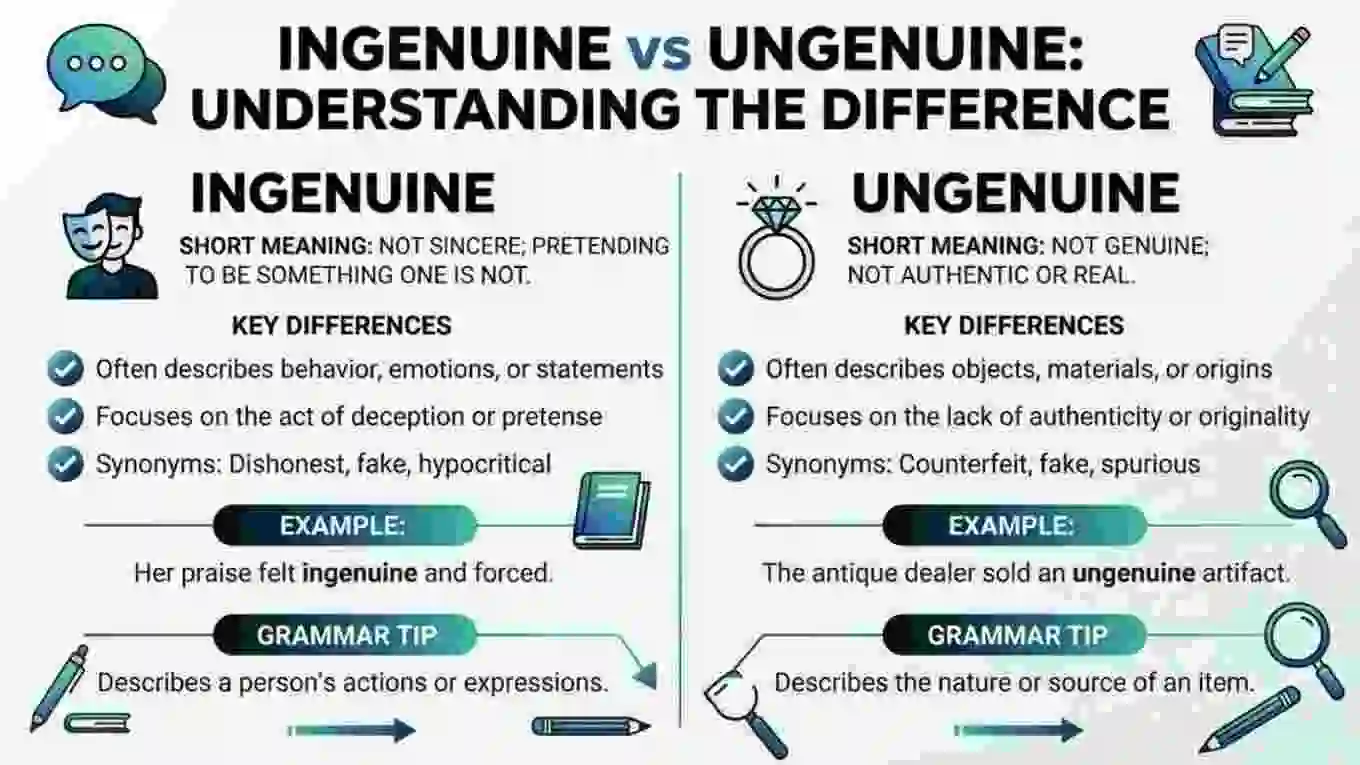
Have you ever wanted to say that something is not real, but you were not sure whether to write ingenuine or ungenuine?
This can be confusing because both words look possible. English uses both in- and un- to make words with a negative meaning. So it may seem that both forms should work in the same way.
The short answer is that ungenuine is the safer and more accepted choice in modern English. Collins lists ungenuine as an adjective meaning false or not genuine.
The word ingenuine is also found in some English word sources. It can mean false or not genuine. However, it is rare and is not the usual word most writers choose today.
In many cases, you may find an even clearer word. Depending on your meaning, you can use fake, false, inauthentic, insincere, or disingenuous.
This guide explains the difference between ingenuine and ungenuine, their meanings, correct use, history, examples, common mistakes, and better word choices.
Ingenuine or Ungenuine – Quick Answer
Ungenuine is the safer standard choice when you mean not genuine, false, or not real.
Ingenuine is a rare word that does appear in some English sources, but it is not common in modern everyday writing.
| Word | Status | Simple meaning |
| Ungenuine | Accepted | Not genuine, false, or fake |
| Ingenuine | Rare | Not genuine or not authentic |
| Genuine | Standard | Real, true, or sincere |
Simple rule
If you want clear modern English, use:
ungenuine
Or, when it fits better, use a more common word such as:
fake
false
inauthentic
insincere
Collins lists ungenuine and gives synonyms such as artificial, false, forged, and fake.
What Does Ungenuine Mean?
Ungenuine means not genuine.
It can describe something that is false, fake, or not real.
It can also describe a person, feeling, or action that does not seem honest or real.
For example:
Her smile seemed ungenuine.
This means her smile did not seem real or sincere.
Another example:
The product looked ungenuine.
This means the product did not seem real or original.
Collins defines ungenuine as “false” and lists it with words such as fake and artificial.
What Does Ingenuine Mean?
Ingenuine is a rare word that can mean false, not genuine, or not authentic. Wiktionary lists it as an English adjective with this meaning.
For example:
The film showed an ingenuine version of the event.
The meaning is that the version was not genuine or real.
However, many readers may find ingenuine unusual.
For clear writing, you can often replace it with:
The film showed an inauthentic version of the event.
Or:
The film showed a false version of the event.
These words are easier for most readers.
Main Difference Between Ingenuine and Ungenuine
The main difference is how common and accepted the words are in modern use.
Ungenuine has a clear dictionary entry in Collins. It is used to mean false or not genuine.
Ingenuine is recorded in some word sources, but it is much less common. Wiktionary lists it as an English adjective, while some usage sources advise avoiding it.
So, if your goal is simple and clear writing, ungenuine is the safer choice.
Example
Less common:
His apology sounded ingenuine.
More common:
His apology sounded ungenuine.
Even more natural:
His apology sounded insincere.
The best choice can depend on what you want to say.
Ingenuine vs Ungenuine Comparison
| Term | Meaning | Modern use | Example |
| Ungenuine | Not real or sincere | Accepted but not very common | Her smile seemed ungenuine. |
| Ingenuine | Not genuine or authentic | Rare | The work seemed ingenuine. |
| Genuine | Real, true, or sincere | Very common | Her smile was genuine. |
| Inauthentic | Not real or true | Common | The story felt inauthentic. |
| Insincere | Not honest or heartfelt | Common | His apology was insincere. |
Genuine vs Ungenuine
It helps to understand the base word first.
Genuine means real, true, or sincere.
For example:
This is a genuine leather bag.
Here, genuine means the bag is made from real leather.
It can also describe feelings:
She showed genuine happiness.
Here, the happiness was real.
The opposite can be described as ungenuine:
Her happiness seemed ungenuine.
Collins explains that genuine can describe real things and real feelings.
Ungenuine Meaning in Simple English
The easiest meaning of ungenuine is:
not real or not sincere.
You can use it for:
- A fake product
- A false claim
- A forced smile
- A fake friendship
- A false feeling
- A person who does not seem sincere
For example:
His kindness felt ungenuine.
This means his kindness did not seem real.
Is Ingenuine a Real Word?
This question needs a careful answer.
Ingenuine is found in some English word sources. Wiktionary lists it as an English adjective meaning false, not genuine, or not authentic.
However, it is rare.
This means that seeing the word in a dictionary or old text does not mean it is the best choice for normal writing.
For most modern writing, ungenuine or a clearer word such as inauthentic or insincere will be easier for readers.
Is Ungenuine a Real Word?
Yes.
Ungenuine is listed by Collins as an adjective. Collins gives its meaning as false and lists related words such as artificial, false, forged, and fake.
It is not as common as words like fake, false, or insincere, but it is a real word.
Example:
The website looked ungenuine.
Ingenuine or Ungenuine for a Person
When talking about a person, be careful about the exact meaning.
If you mean the person is not honest or sincere, words like insincere or disingenuous may be better.
For example:
His answer sounded insincere.
This clearly means that the answer did not seem honest or sincere.
Disingenuous has a more specific meaning. It can describe someone who is not honest or open, often while pretending to be so.
So do not use ungenuine for every situation.
Choose the word that best matches your meaning.
Ingenuine or Ungenuine for Things
For things, ungenuine can mean that something is not real or original.
For example:
The seller was offering an ungenuine product.
But a more natural sentence may be:
The seller was offering a fake product.
Or:
The product was not authentic.
The best word depends on the situation.
Better Words Than Ingenuine or Ungenuine
Sometimes the easiest way to solve the problem is to choose another word.
Use “fake”
Use fake when something is not real.
The watch was fake.
Use “false”
Use false when something is not true.
The claim was false.
Use “inauthentic”
Use inauthentic when something is not real, true, or true to its original form. Cambridge defines it as not real, true, or what people say it is.
The food felt inauthentic.
Use “insincere”
Use insincere when a person or feeling is not honest or real.
Her apology sounded insincere.
Use “disingenuous”
Use disingenuous when someone is not open or honest, especially when they act as if they are.
His answer was disingenuous.
This word is not always the same as fake.
Origin and History
The word genuine has a long history.
Etymonline traces genuine to the Latin word genuinus, meaning native, natural, or inborn. The modern sense of something truly coming from its claimed source developed later.
The negative forms are more complex.
English uses several ways to make a word negative. Both in- and un- can have a meaning like “not,” but English does not let us freely add either one to every word.
That helps explain why ungenuine is found in modern dictionaries while ingenuine remains much less common.
The word inauthentic is another common negative form. Etymonline dates inauthentic to the late 1700s and explains it as in- + authentic.
British English vs American English
There is no clear British vs American spelling difference between ingenuine and ungenuine.
Ungenuine is used in English without a special US spelling and UK spelling split. Collins lists the word in its English dictionary and also shows it in its American English dictionary.
So this is not like:
- color / colour
- center / centre
- favorite / favourite
You do not need one spelling for the US and another for the UK.
The bigger issue is common use, not regional spelling.
Which One Should You Use?
For most modern writing, use ungenuine if you want to use this pair.
But in many cases, an easier word may work better.
Everyday writing
Use:
fake
Her smile looked fake.
Formal writing
Use:
inauthentic
The source appears inauthentic.
When talking about feelings
Use:
insincere
His apology seemed insincere.
When talking about a person’s behavior
Use:
disingenuous
His response seemed disingenuous.
If you specifically need the word from this pair
Use:
ungenuine
Common Mistakes
Mistake 1: Treating Ingenuine and Ungenuine as equal common choices
Problem:
Both words are equally common.
Better:
Ungenuine is the safer modern choice.
Why?
The word is clearly listed by Collins, while ingenuine is much rarer.
Mistake 2: Using Ingenuine in formal writing
Less safe:
The report contains an ingenuine claim.
Better:
The report contains a false claim.
Or:
The claim is not genuine.
Mistake 3: Using Ungenuine when You Mean Insincere
Less clear:
His apology was ungenuine.
Clearer:
His apology was insincere.
If the problem is that a person does not mean what they say, insincere may be the better word.
Mistake 4: Using Disingenuous for Every Fake Thing
Wrong idea:
This fake bag is disingenuous.
Better:
This bag is fake.
Disingenuous usually describes a person’s words, actions, or way of acting, not a fake object.
Mistake 5: Confusing Ingenuine With Ingenuous
These words look very similar.
But they are not the same.
Ingenuous can mean innocent, simple, or open.
Ingenuine means not genuine in the rare use where it appears.
Do not mix them up.
Everyday Examples
Here are simple examples with ungenuine:
- Her smile seemed ungenuine.
- His kindness felt ungenuine.
- The product looked ungenuine.
- The website seemed ungenuine.
- Their friendship appeared ungenuine.
- The offer did not seem genuine.
- His interest felt ungenuine.
- The apology sounded ungenuine.
- The story seemed ungenuine.
- The message felt ungenuine.
Here are examples with more common alternatives:
- Her smile looked fake.
- His apology sounded insincere.
- The product was not authentic.
- The claim was false.
- His answer seemed disingenuous.
Real-Life Usage
In conversation
“Do you believe his apology?”
“Not really. It sounded insincere.”
This is more natural than forcing the word ungenuine into every sentence.
In an email
The message seemed inauthentic, so I did not reply.
At school
The student gave a false reason for missing class.
At work
The offer did not seem genuine.
On social media
That smile looks so fake.
In formal writing
The source appears inauthentic and should be checked.
The best word depends on the exact meaning.
Related Search Questions
What does ungenuine mean?
Ungenuine means not genuine, false, or not real. It can describe something that is fake or a person, feeling, or action that does not seem sincere. Collins lists ungenuine as an adjective meaning false.
Is ingenuine correct?
Ingenuine is found as a rare English word meaning not genuine or not authentic. However, it is not a common modern choice. For clear writing, ungenuine or a more common word such as inauthentic is usually safer.
Is ungenuine a proper word?
Yes. Collins lists ungenuine as an English adjective and gives the meaning “false.”
What is the opposite of genuine?
The opposite can be fake, false, inauthentic, or ungenuine, depending on the sentence. If you are talking about a person’s honesty or feelings, insincere may be a better choice.
Is ungenuine the same as insincere?
Not always. Ungenuine means not genuine or not real. Insincere means not honest or not truly felt. They can overlap when talking about feelings, words, or behavior.
Is ingenuine the same as disingenuous?
Not exactly. Ingenuine can mean not genuine, but it is rare. Disingenuous is a standard word for someone who is not open or honest, especially when they appear to be honest.
What is a simple word for ungenuine?
The best simple word is often fake. Other choices include false, not real, inauthentic, and insincere. The right word depends on whether you are talking about an object, fact, feeling, or person.
Usage and Search Trends
People may search for ingenuine or ungenuine because both forms look like they could mean “not genuine.”
The question is also linked to a wider English spelling issue: negative prefixes such as in- and un- do not always work in a simple way.
There is no need to give made-up search volume or Google Trends numbers for this topic. The useful answer comes from dictionary records and real word use.
Searchers may also use related questions such as:
- ingenuine or ungenuine
- is ingenuine a word
- is ungenuine a word
- ungenuine meaning
- ingenuine meaning
- what does ungenuine mean
- another word for ungenuine
- opposite of genuine
- ungenuine vs genuine
- inauthentic vs ungenuine
- insincere vs ungenuine
- disingenuous vs ungenuine
These searches all point to the same main need: finding a clear word for something that is not genuine.
Comparison Table
| Word | Simple meaning | Best use | Example |
| Genuine | Real or sincere | Real things and feelings | Her smile was genuine. |
| Ungenuine | Not genuine | Something false or not real | The offer seemed ungenuine. |
| Ingenuine | Not genuine | Rare use | The claim seemed ingenuine. |
| Fake | Not real | Everyday speech | The watch was fake. |
| False | Not true | Claims and facts | The claim was false. |
| Inauthentic | Not real or true | Formal and general use | The story felt inauthentic. |
| Insincere | Not truly felt or honest | Feelings and words | His apology was insincere. |
| Disingenuous | Not open or honest | Words and behavior | His answer was disingenuous. |
FAQs
1. Which is correct, ingenuine or ungenuine?
For modern, clear English, ungenuine is the safer choice. Collins lists it as an adjective meaning false. Ingenuine is also recorded in some sources, but it is rare. If you want the most natural word, you may prefer fake, false, inauthentic, or insincere, based on your meaning.
2. Is “ingenuine” a real English word?
Yes, some English sources record ingenuine as an adjective meaning false or not genuine. It is not a common word in modern everyday English, though. Because many readers may find it unusual, a clearer word such as inauthentic or false may work better.
3. Is “ungenuine” a real word?
Yes. Ungenuine is listed in Collins as an adjective meaning false. It can describe something that is not real or sincere. It also has related forms, such as ungenuineness, which means the state of being ungenuine.
4. What is the opposite of genuine?
Several words can act as opposites of genuine. Common choices include fake, false, inauthentic, artificial, and ungenuine. For feelings or behavior, insincere may be a better choice. The best word depends on what you are describing.
5. Should I use “ungenuine” in an essay?
You can, but a more common word may be clearer. In an essay, words such as false, inauthentic, insincere, or fake may fit better. If you use ungenuine, make sure it clearly matches your meaning and sentence.
6. What is the difference between ungenuine and inauthentic?
Both can mean that something is not real or true. Inauthentic is more common and is often a good choice in formal writing. Cambridge defines it as not real, true, or what people say it is. Ungenuine has a similar meaning but is less common.
7. What is the best word instead of ingenuine?
There is no single replacement for every sentence. Use fake for something not real, false for something not true, inauthentic for something not real or true, and insincere for words or feelings that are not honest. These choices are often clearer than the rare word ingenuine.
Conclusion
The choice between ingenuine or ungenuine can seem hard because both forms look natural. The key is to look at how English speakers and dictionaries use them today.
Ungenuine is a real English word. Collins lists it as an adjective meaning false. It can describe something that is not real, original, or sincere.
Ingenuine is also found in some English sources. It can mean not genuine or not authentic. However, it is rare, so many readers may find it unusual.
For simple and clear writing, ungenuine is the safer choice when you want to use this pair. But you should also think about the exact meaning.
Use fake for something that is not real. Use false for something that is not true. Utilize inauthentic for something that is not real or true. Use insincere for feelings or words that are not honest.
So, the simple answer is:
Ungenuine is the safer modern choice. Ingenuine exists as a rare word, but it is not the usual choice.