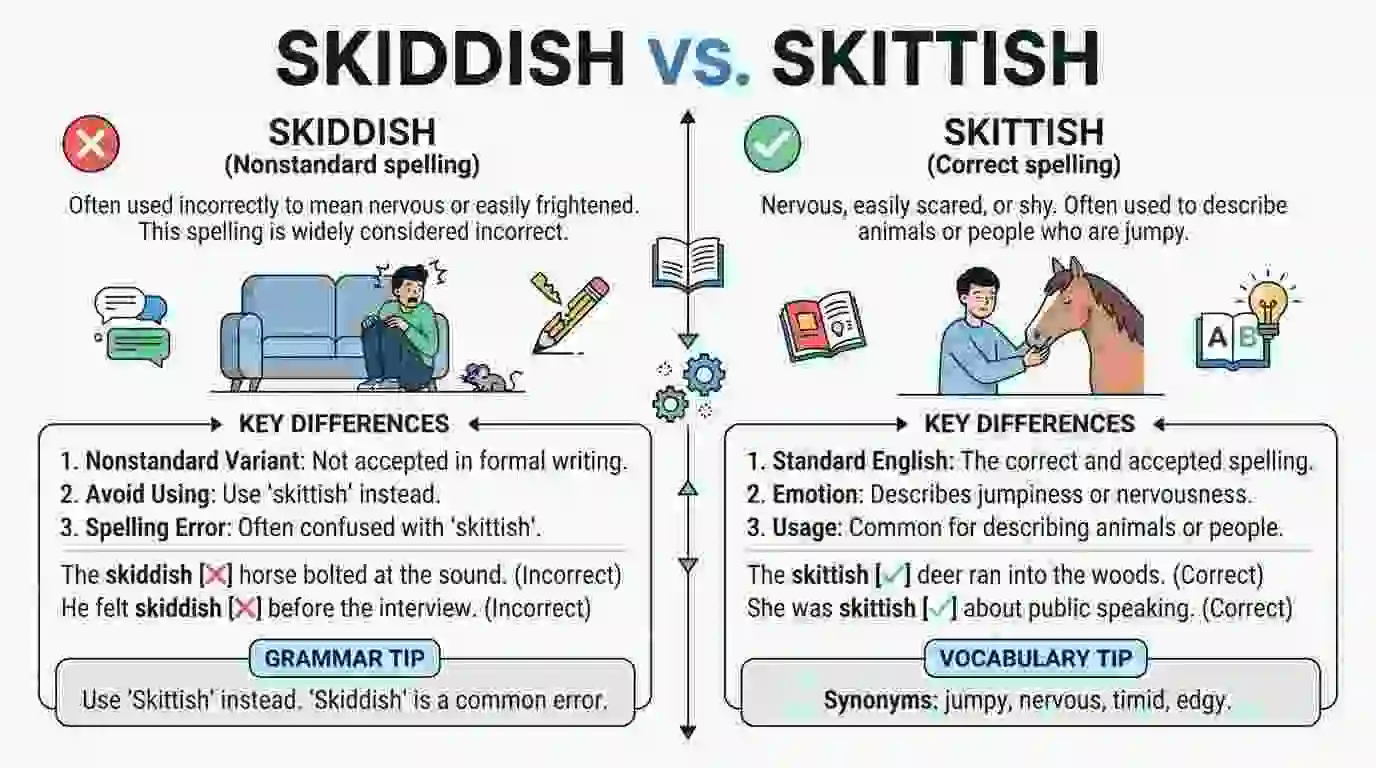
Have you ever stopped while writing and wondered if the word is skiddish or skittish?
You are not alone. These two spellings look very close. They also sound very similar. This can make the word hard to spell, even for people who know what it means.
The good news is simple: skittish is the correct standard spelling.
Skiddish is not the usual modern spelling of this word. If you want to describe a person or animal that gets scared easily, use skittish.
For example:
The horse is very skittish.
This means the horse is nervous and gets scared easily.
The word skittish can also describe a person who is nervous, shy, or not calm. It can also describe someone who keeps changing their mind or does not stay steady.
In this guide, you will learn the difference between skiddish and skittish, what skittish means, where the word came from, how to use it, common spelling mistakes, and many easy examples.
Skiddish or Skittish – Quick Answer
Skittish is the correct standard spelling.
Skiddish is generally a spelling mistake when you mean the adjective skittish.
| Word | Correct? | Meaning |
| Skittish | Yes | Nervous, easily scared, or not calm |
| Skiddish | No, not the standard spelling | Usually a misspelling of skittish |
Correct example
The dog became skittish when it heard the loud noise.
Incorrect example
The dog became skiddish when it heard the loud noise.
So, if you are asking “Is it skiddish or skittish?”, choose skittish.
What Does Skittish Mean?
Skittish is an adjective.
It can mean nervous, easily scared, or easily worried.
We often use it for animals.
For example:
The cat is skittish around strangers.
This means the cat feels nervous around people it does not know.
We can also use skittish for people.
She felt skittish before the big meeting.
Here, it means she felt nervous or uneasy.
Cambridge gives the main meaning as nervous or easily frightened. It also lists another meaning for a person who is not serious and may change their ideas or views often.
What Is the Difference Between Skiddish and Skittish?
The main difference is spelling.
Skittish is the standard word.
Skiddish is usually an incorrect spelling.
The correct word has two t’s:
skittish
A simple way to remember it is:
ski + tt + ish = skittish
Do not change the tt to dd.
Correct
The puppy is skittish.
Incorrect
The puppy is skiddish.
Skittish Meaning in Simple English
The easiest meaning of skittish is:
Someone or something that gets scared or nervous easily.
It is often used for animals.
For example:
The horse was skittish near the busy road.
The horse was nervous because of the traffic.
You can also use it for people:
Tom was skittish before his first interview.
Tom was nervous before the interview.
When Do We Use Skittish?
You can use skittish in several situations.
1. For animals
This is one of the most common uses.
The deer are very skittish.
The deer get scared easily.
The horse became skittish during the storm.
The horse became nervous because of the storm.
2. For people
You can use the word for people who feel nervous or uneasy.
She was skittish after hearing the strange noise.
She felt nervous after hearing the noise.
3. For people who keep changing
Skittish can also describe someone who changes their mind or does not stay steady.
For example:
The company was worried about skittish investors.
Here, the investors may change their minds quickly because they are unsure or worried.
This use is also found in modern English dictionaries.
Skittish Examples
Here are some easy examples:
- The horse is skittish.
- My cat is skittish around new people.
- The dog became skittish after the loud bang.
- The deer looked skittish in the woods.
- The puppy was skittish at first.
- She felt skittish before the test.
- The bird was too skittish to come close.
- The rabbit became skittish when it heard the noise.
- He was a little skittish before the meeting.
- The horse grew skittish during the storm.
- The shy dog can be very skittish.
- The investors became skittish after the news.
Skiddish or Skittish in a Sentence
If you want to use this word in a sentence, use skittish.
Correct sentences
My dog is skittish around strangers.
The horse became skittish during the storm.
The cat is very skittish.
She was skittish before her first speech.
Wrong spelling
My dog is skiddish around strangers.
The meaning is clear, but skiddish is not the standard spelling of the word you want.
Common Mistakes
Mistake 1: Writing Skiddish
Wrong:
The horse is skiddish.
Correct:
The horse is skittish.
The correct spelling has tt, not dd.
Mistake 2: Using Skittish as a Noun
Wrong:
His skittish was easy to see.
Correct:
His nervousness was easy to see.
Skittish is an adjective.
It describes a person, animal, or thing.
Mistake 3: Confusing Skittish With Scared
Skittish and scared are close in meaning, but they are not always the same.
Scared means afraid.
Skittish often means nervous or easily scared.
For example:
The horse is skittish around cars.
This tells us that the horse gets nervous easily.
Mistake 4: Using Skittish for Every Kind of Fear
The word does not always mean very afraid.
It can mean nervous, uneasy, or quick to react.
The puppy was skittish around new people.
The puppy may not be very afraid. It may simply feel nervous.
Mistake 5: Thinking Skiddish Is a British Spelling
It is not a normal British vs American spelling difference.
Skittish is the standard spelling in both British and American English.
The difference is not like:
- colour / color
- favourite / favorite
- centre / center
For skittish, use the same spelling in both main forms of English.
Skittish vs Scared
These words are related, but they are not exact matches.
| Word | Simple meaning | Example |
| Skittish | Nervous or easily scared | The horse is skittish. |
| Scared | Feeling fear | The child was scared. |
| Nervous | Worried or uneasy | I felt nervous before the test. |
| Afraid | Feeling fear | She was afraid of the dog. |
| Frightened | Feeling fear | The bird was frightened. |
Skittish often suggests that someone or something reacts quickly to things that may seem scary.
Skittish vs Nervous
Nervous is a wider word.
You can feel nervous before:
- A test
- A job interview
- A meeting
- A speech
- A trip
Skittish is often used for people or animals that are easily scared or uneasy.
For example:
I was nervous before my exam.
But:
The horse was skittish near the traffic.
Both words can show worry, but they are used in different ways.
British English vs American English
There is no major spelling difference here.
Both British and American English use:
skittish
So you can write:
The horse is skittish.
in both British English and American English.
The pronunciation can sound a little different between UK and US speech, but the spelling stays the same. Cambridge lists UK and US pronunciations for the word.
Which One Should You Use?
Use skittish.
This is the standard spelling for everyday writing, school work, work writing, and online content.
For school
Use:
The horse was skittish.
For work
Use:
Investors became skittish after the news.
For everyday writing
Use:
My cat is very skittish.
For British English
Use:
skittish
For American English
Use:
skittish
You do not need to change the spelling based on the country.
Where Did Skittish Come From?
The word skittish is very old.
It has been used in English since the early 1400s.
Its early meaning was linked to being lively or playful. Around the 1500s, it began to describe horses that were shy, nervous, easily scared, or likely to run away.
Later, the word gained more meanings.
It could describe a person who was changeable or not steady. It could also describe someone who was shy or reserved.
The exact early source is not fully certain. Etymonline suggests a link to an old Scandinavian word related to moving quickly.
The modern meaning is now easy to understand:
skittish = nervous or easily scared
Is Skiddish Ever Correct?
If you mean the normal English adjective skittish, then skiddish is not the spelling you should use.
You may see skiddish online because people sometimes spell words by sound. But seeing a spelling online does not make it the standard form.
For normal English writing, choose:
skittish
This is especially important in:
- School work
- Essays
- Emails
- Business writing
- Articles
- Reports
- Formal writing
Real-Life Use of Skittish
In a conversation
“Why is your dog hiding?”
“He is a little skittish around new people.”
At school
The teacher asked us to use “skittish” in a sentence.
At work
Some investors became skittish after the bad news.
In an email
The horse may be skittish around loud sounds.
On social media
My new puppy is so skittish!
In a story
The deer was skittish and ran into the trees.
These examples show that skittish can fit both casual and more formal writing.
Related Words
Some words are close in meaning to skittish.
- Nervous
- Scared
- Afraid
- Frightened
- Shy
- Uneasy
- Worried
- Jumpier
- Easily scared
The best word depends on the sentence.
For example:
The horse is skittish.
sounds natural.
The horse is nervous.
also works.
But:
The horse is afraid.
has a slightly different meaning. It says the horse feels fear, rather than simply being easy to scare.
Related Search Questions
What is the correct spelling, skiddish or skittish?
The correct standard spelling is skittish. The word means nervous, easily scared, or uneasy. Skiddish is generally a misspelling of skittish.
What does skittish mean?
Skittish means nervous or easily scared. It is often used for animals such as horses, dogs, cats, deer, and birds. It can also describe people who feel nervous or who change their views often.
Is skittish a real word?
Yes. Skittish is a standard English word. It has been used in English for many centuries and is found in major dictionaries.
Is skiddish a word?
Skiddish is not the standard spelling of the adjective that means easily scared or nervous. If that is the meaning you want, write skittish.
Is skittish British or American?
Skittish is used in both British and American English. There is no main UK vs US spelling change for this word.
What is an easy synonym for skittish?
Easy synonyms include nervous, easily scared, afraid, uneasy, and jumpy. The best choice depends on the sentence.
How do you use skittish in a sentence?
You can say:
The horse is skittish around loud noises.
This means the horse becomes nervous or scared when it hears loud sounds.
Usage and Search Trends
People often search for skiddish or skittish because the two spellings look and sound close.
The extra d in skiddish is easy to write by mistake. The standard word, however, is skittish.
There is no need to invent a search volume number or claim that one spelling gets more searches. Reliable public data does not need to be used to answer the spelling question.
For SEO, the useful search variations around this topic include:
- skiddish or skittish
- skittish meaning
- what does skittish mean
- skittish definition
- is skiddish a word
- is skittish a word
- skittish vs scared
- how to use skittish in a sentence
- skittish meaning in English
- correct spelling of skittish
These variations all match the main search intent.
Skiddish or Skittish Comparison Table
| Term | Correct? | Meaning | Example |
| Skittish | Yes | Nervous or easily scared | The horse is skittish. |
| Skiddish | No, not the standard spelling | Usually a misspelling of skittish | Avoid this spelling. |
| Nervous | Yes | Worried or uneasy | I felt nervous before the test. |
| Scared | Yes | Feeling fear | The child was scared. |
FAQs
1. Is it skiddish or skittish?
It is skittish when you mean nervous or easily scared. The spelling has two t’s. Skiddish is generally a spelling mistake for this word.
2. Why do people spell skittish as skiddish?
The mistake may happen because the word can sound like it has a d sound to some speakers. People may also spell it based on how they hear it. The standard spelling is still skittish.
3. Can skittish describe a person?
Yes. You can use skittish for a person who is nervous, uneasy, shy, or easily worried. It can also describe someone whose views or plans change often.
4. Can you use skittish for animals?
Yes. This is a very common use. You can describe a horse, dog, cat, deer, bird, or other animal as skittish when it gets scared or nervous easily.
5. Does skittish mean scared?
It can be close to scared, but the words are not exactly the same. Skittish often means easily scared or nervous. Scared directly means feeling fear.
6. Is skittish formal or informal?
Skittish can work in both everyday and formal writing. It is a normal English adjective. For example, it can describe a horse in a story or investors in a business report.
7. What is the opposite of skittish?
Possible opposites include calm, relaxed, steady, and confident. The best opposite depends on the sentence. For an animal, calm is often a good choice.
Conclusion
When you are choosing between skiddish or skittish, use skittish.
Skittish is the standard spelling. It means nervous, easily scared, or uneasy. It is often used for animals, especially animals that quickly react to loud sounds, new people, or strange places.
You can also use skittish for people. For example, someone may feel skittish before a big meeting or may be described as skittish if they change their views often.
The spelling is the same in both British and American English. You do not need to change it based on the country.
Remember the spelling:
skittish = s-k-i-t-t-i-s-h
It has two t’s.
If you see skiddish when you mean this word, treat it as a spelling mistake in normal English writing.
So the simple answer is:
Skittish is correct. Skiddish is not the standard spelling.