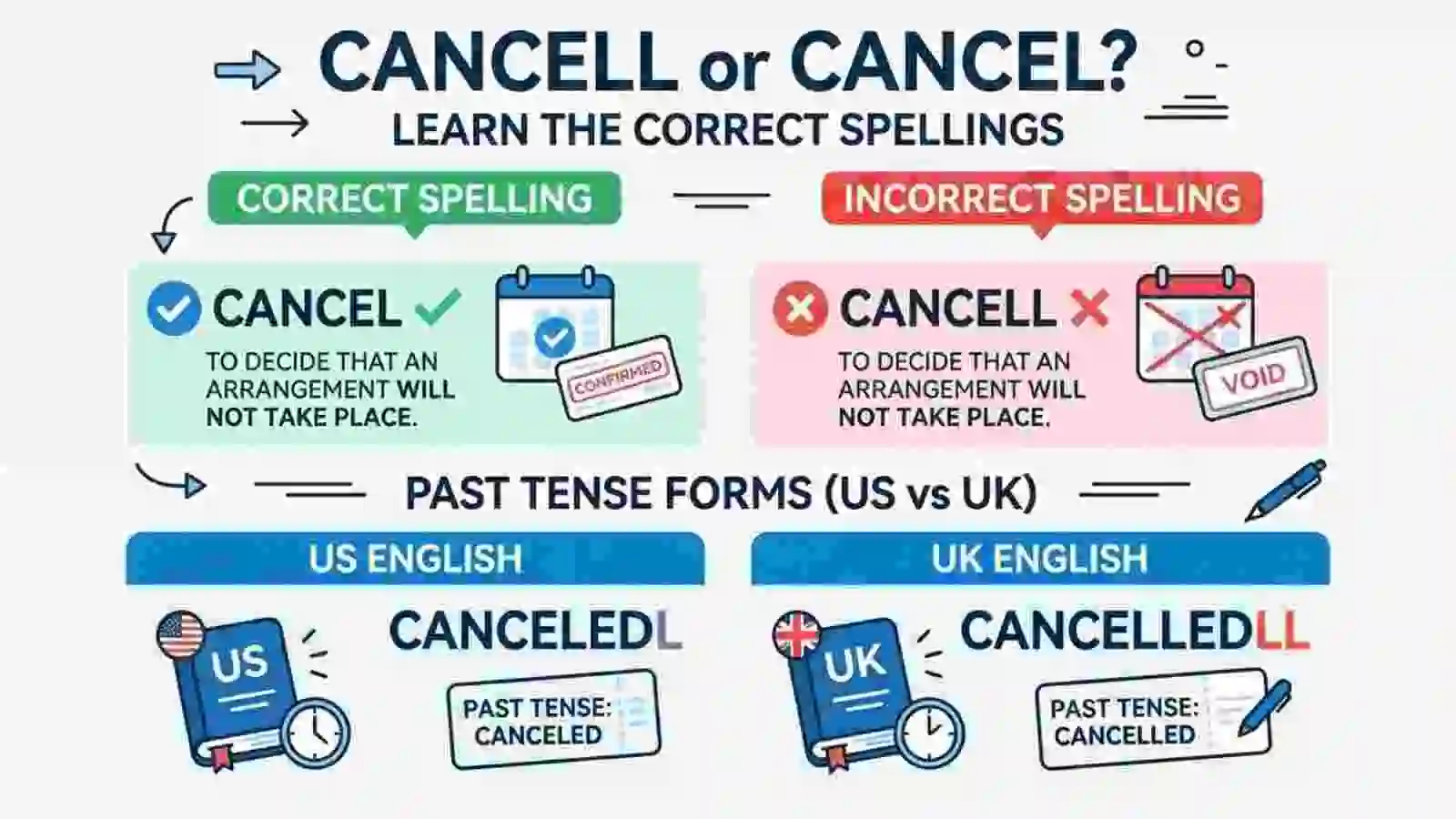
Have you ever typed cancell or cancel and stopped to check the spelling? You are not alone. English has many words where one extra letter can make a spelling look right when it is not.
The word cancel is common in everyday English. We use it when we stop a plan, event, order, booking, meeting, or service. But some people write cancell because they see forms such as cancelled and cancelling.
So, is cancell correct? No. The correct base word is cancel.
There is one useful point to know. When we add some endings, the spelling can change. British English often uses cancelled and cancelling, while American English usually uses canceled and canceling.
In this guide, you will learn the simple difference between cancell and cancel, why the mistake happens, how to use cancel in a sentence, and when to use cancelled, canceled, cancelling, and canceling.
Cancell or Cancel – Quick Answer
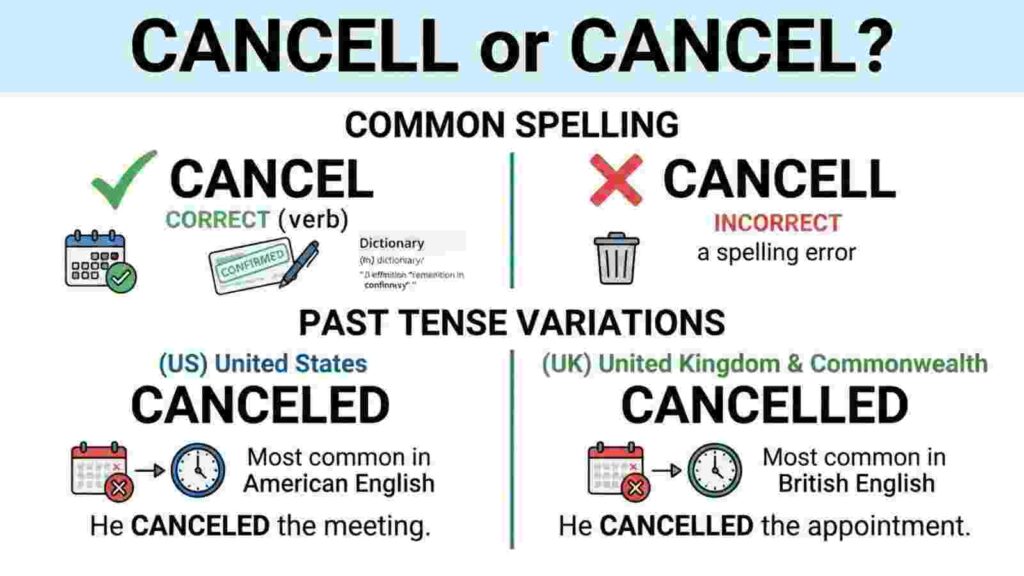
Cancel is the correct spelling.
Cancell is not the standard spelling of the base verb.
Use:
- cancel as the main verb
- cancelled in British English
- canceled in American English
- cancelling in British English
- canceling in American English
For example:
I need to cancel my appointment.
Not:
I need to cancell my appointment.
Cambridge Dictionary lists cancel as the verb. It also gives cancelled/cancelling for British English and canceled/canceling for American English.
What Does Cancel Mean?
Cancel means to stop something that was planned or arranged.
You can cancel:
- A meeting
- A trip
- A flight
- An appointment
- A class
- A subscription
- An order
- A party
- A reservation
- A plan
For example:
We had to cancel the trip.
This means the trip will not happen.
You can also use cancel when you stop an order or service.
I want to cancel my subscription.
Cambridge Dictionary defines cancel as deciding that an event will not happen or stopping an order for something you no longer want.
Why Do People Write Cancell?
The mistake often happens because of words such as cancelled and cancelling.
Look at these forms:
- cancel
- cancelled
- cancelling
- canceled
- canceling
When people see cancelled, they may think the base word must be cancell.
But that is not how the word works.
The base word is:
cancel
The extra l appears in common British forms such as:
cancelled
and
cancelling
American English usually keeps one l in:
canceled
and
canceling.
So remember:
Cancel has one l.
Cancell vs Cancel: Main Difference
The main difference is simple.
| Term | Is it correct? | Meaning | Example |
| cancel | Yes | Stop something planned | I need to cancel the order. |
| cancell | No | Not the standard base spelling | Do not write “cancell.” |
| cancelled | Yes | Past form, mainly British | The match was cancelled. |
| canceled | Yes | Past form, mainly American | The match was canceled. |
| cancelling | Yes | -ing form, mainly British | She is cancelling the booking. |
| canceling | Yes | -ing form, mainly American | She is canceling the booking. |
This is why cancell can look familiar even though it is not the correct base form.
Cancel as a Verb
Cancel is mainly used as a verb.
A verb tells us what someone does.
Examples:
I will cancel the meeting.
Please cancel my order.
They canceled the flight.
She cancelled her appointment.
The word can be used in many everyday situations.
Cancel a Meeting
We need to cancel the meeting.
Cancel an Order
I want to cancel my order.
Cancel a Trip
They had to cancel their trip.
Cancel a Subscription
He decided to cancel his subscription.
Cancel an Appointment
I need to cancel my appointment.
Cancelled or Canceled?
This is where British and American English differ.
British English
British English usually uses:
cancelled
Example:
The flight was cancelled.
American English
American English usually uses:
canceled
Example:
The flight was canceled.
Both forms are correct. The choice depends on the type of English you are using. Cambridge lists cancelled as the British form and canceled as the American form.
Cancelling or Canceling?
The same pattern appears with the -ing form.
British English
cancelling
Example:
We are cancelling the event.
American English
canceling
Example:
We are canceling the event.
Both forms are accepted in their usual regional styles.
Origin and History of Cancel
The word cancel has a long history.
It entered English in the late 14th century. At first, it meant to cross out written words with lines.
The word came through Anglo-French and Old French from the Latin word cancellare. This Latin word was linked to the idea of a lattice or crossed lines.
Over time, cancel gained the meaning of making something no longer valid.
Today, we use it for plans, orders, events, services, and many other things.
For example:
Please cancel my booking.
The related noun cancellation means the act of stopping something that was planned.
British English vs American English
The base spelling is the same in both forms:
cancel
The main difference appears when we add endings.
| Form | British English | American English |
| Base word | cancel | cancel |
| Past form | cancelled | canceled |
| -ing form | cancelling | canceling |
| Noun | cancellation | cancellation / cancelation |
Cambridge notes that cancellation is also spelled cancelation in US English, though cancellation is very common.
For the keyword cancell or cancel, there is no British vs American choice.
Use:
cancel
in both.
Which One Should You Use?
Use cancel when you need the basic verb.
Everyday Writing
Use:
I need to cancel my order.
Formal Writing
Use:
We regret that we must cancel the meeting.
School Writing
Use:
The school decided to cancel the event.
Business Writing
Use:
Please cancel the previous order.
American English
Use:
cancel
canceled
canceling
British English
Use:
cancel
cancelled
cancelling
The most important rule is simple:
Never use “cancell” as the base word.
Common Mistakes With Cancell and Cancel
1. Writing Cancell Instead of Cancel
Incorrect:
Please cancell my order.
Correct:
Please cancel my order.
Why?
The base word has only one l.
2. Writing Cancell in a Formal Email
Incorrect:
I would like to cancell my appointment.
Correct:
I would like to cancel my appointment.
The correct base form is cancel.
3. Thinking Cancelled Means Cancell Is the Base Word
Incorrect idea:
cancelled → cancell + ed
Correct idea:
cancel → cancelled
The spelling changes when the ending is added in British English.
4. Mixing British and American Forms
Mixed:
The event was canceled, but we are cancelling the next one.
This is not always wrong, but it mixes two spelling styles.
For consistent British English, use:
The event was cancelled, but we are cancelling the next one.
For consistent American English, use:
The event was canceled, but we are canceling the next one.
5. Using Cancell in a Search or Email
Incorrect:
I want to cancell my booking.
Correct:
I want to cancel my booking.
This mistake is easy to avoid once you remember the base form.
10 Everyday Examples of Cancel
- I need to cancel my appointment.
- We had to cancel the meeting.
- Please cancel my order.
- They decided to cancel the trip.
- The school may cancel the class.
- She wants to cancel her subscription.
- The airline canceled the flight.
- The match was cancelled because of rain.
- He is canceling his booking.
- They are cancelling the event.
Notice that the base word is always cancel.
Real-Life Usage of Cancel
In Conversations
People often use cancel when talking about plans.
“Are we still going out tonight?”
“No, I need to cancel.”
This is a very common everyday use.
In Emails
You may write:
I would like to cancel my appointment.
Or:
Please cancel my order.
At School
A school may cancel a class because of bad weather.
The teacher canceled the class.
At Work
A manager may cancel a meeting.
We had to cancel the morning meeting.
On Social Media
People may say:
The event has been canceled.
Or:
Tonight’s show is cancelled.
In Formal Writing
You may see:
The company decided to cancel the agreement.
The exact form can depend on the type of English being used.
Related Search Questions
Is Cancell a Word?
Cancell is not the standard spelling of the base verb cancel. If you mean “to stop a plan, event, order, or service,” use cancel.
Is Cancel Correct?
Yes. Cancel is the correct base spelling in both British and American English.
Is Cancelled Correct?
Yes. Cancelled is a correct spelling and is common in British English.
Is Canceled Correct?
Yes. Canceled is the common American English spelling of the past form.
Is Cancelling Correct?
Yes. Cancelling is the common British English spelling of the -ing form.
Is Canceling Correct?
Yes. Canceling is the common American English spelling of the -ing form.
Usage and Search Trends
There is no need to use fake search numbers to understand this spelling question.
The main reason people search for cancell or cancel is likely the extra l seen in forms such as cancelled and cancelling.
The word cancel is common in everyday English. People use it for meetings, flights, orders, plans, appointments, subscriptions, and events.
Dictionary examples also show cancel in many normal situations, such as canceling plans, appointments, and orders.
The key point is that cancell is not the standard base spelling.
Cancell or Cancel Comparison Table
| Form | Correct? | Where Used | Example |
| cancel | Yes | Base verb | Cancel the order. |
| cancell | No | Not standard | Avoid this form. |
| cancelled | Yes | Mainly British English | The flight was cancelled. |
| canceled | Yes | Mainly American English | The flight was canceled. |
| cancelling | Yes | Mainly British English | We are cancelling the event. |
| canceling | Yes | Mainly American English | We are canceling the event. |
| cancellation | Yes | Noun | The cancellation was announced. |
FAQs About Cancell or Cancel
1. Is it cancell or cancel?
The correct spelling is cancel. Cancell is not the standard base spelling. You should write “cancel the order,” “cancel the meeting,” or “cancel the appointment.”
2. Why does cancelled have two Ls?
In British English, the word cancel usually gets another l before -ed, giving cancelled. This can make people think the base word is “cancell,” but the base word is still cancel.
3. Should I write canceled or cancelled?
Both are correct. Canceled is common in American English, while cancelled is common in British English. Choose one style and keep it consistent in the same piece of writing.
4. Is canceling or cancelling correct?
Both are correct. Canceling is common in American English. Cancelling is common in British English.
5. Is cancell a British spelling?
No. British English uses cancel as the base word. The British forms are cancelled and cancelling when the extra l is added.
6. How do you use cancel in a sentence?
You can use cancel when you stop a plan, event, order, or service. For example: “I need to cancel my appointment.” The word works as a verb in this sentence.
7. What is the noun form of cancel?
The main noun is cancellation. It means the act of stopping something that was planned. For example: “The cancellation of the flight caused problems for many travelers.”
Conclusion
So, cancell or cancel, which one is correct?
The answer is simple: cancel is correct.
Cancell is not the standard spelling of the base verb. Use cancel when you want to say that you will stop a plan, event, order, meeting, appointment, or service.
The extra l can cause confusion because British English often uses cancelled and cancelling. American English usually uses canceled and canceling. Both styles are correct.
The easiest way to remember the rule is this:
The base word is cancel.
Do not write cancell.
If you use British English, you can write cancelled and cancelling.
If you use American English, you can write canceled and canceling.
Once you remember the base word, the spelling becomes much easier. When you are unsure, write cancel. That is the correct form in both British and American English.