You’re writing a story, and your character needs to wake up. Do you write “she wakened” or “she awakened”? Both feel close. Both sound like real words. So is there any real difference, or are these just two ways to say the same thing?
Let’s break this down in plain, easy words.
Quick Answer
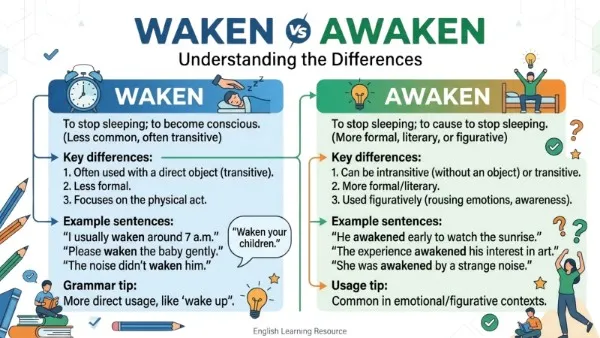
Waken means to wake up, or to make someone wake up. Example: “The loud noise wakened the baby.”
Awaken means almost the same thing, to wake up, but it’s used a bit more often, and it can also mean to become aware of something, not just to physically wake up. Example: “The trip awakened her love for travel.”
Simple way to think about it: both words work for actual sleep. But “awaken” stretches further, it can also mean waking up to a new idea or feeling, not just opening your eyes in the morning.
Where These Two Words Come From
Both words come from a very old English word for “to wake.” Long ago, English had a few different forms of this word, and over hundreds of years, some stuck around while others faded.
“Waken” stayed close to its simple, older meaning, just waking up from sleep, plain and direct. It’s been used this way for a very long time.
“Awaken” grew from adding a small piece to the front of “waken,” a piece that often means “to begin” or “to bring about.” Over time, this small addition helped “awaken” pick up a wider meaning. It kept the sleep meaning, but it also grew to describe waking up to new feelings, ideas, or understanding, not just physical sleep.
So these words aren’t really two random spellings of the same thing. One stayed simple and direct. The other grew a bit wider over time.
Breaking Down the Real Difference
| Waken | Awaken | |
| Basic meaning | To wake up from sleep | To wake up from sleep, or to become aware of something |
| Feels like | Plain, simple, direct | A bit more common, and a bit wider in meaning |
| Example (sleep) | “He wakened at dawn.” | “He awakened at dawn.” |
| Example (idea) | Rarely used this way | “The book awakened new thoughts in her.” |
A Simple Way to Check Yourself
Ask this: am I only talking about sleep, or am I also talking about a new feeling or idea?
If it’s just about physical sleep, both words work fine, though “awaken” is used a bit more often in everyday writing.
If you’re talking about something deeper, like a new understanding or feeling stirring inside someone, “awaken” is almost always the better word to reach for.
Try It Yourself
Guess which word fits best before checking the answer.
- “The alarm ___ him at seven every morning.” → wakened or awakened, both work
- “Her trip to Italy ___ a love for cooking.” → awakened
- “The baby ___ crying in the middle of the night.” → wakened or awakened, both work
- “The speech ___ something powerful in the crowd.” → awakened
- “Please don’t ___ the dog, he’s finally asleep.” → waken or awaken, both work
If most of these felt clear, you already understand the small but real difference here.
Which Word Should You Use?
Writing about someone physically waking up: Either word works, but “awaken” is used more often in modern writing and speech.
Writing about someone realizing something new, or a feeling stirring inside them: Use “awaken.” This is where the two words really split apart in meaning.
Writing something short and simple, like a children’s book: “Waken” can feel a bit more plain and easy, though “awaken” is still perfectly clear too.
Writing something more poetic or emotional: “Awaken” almost always fits better here, since it naturally carries that wider, deeper feeling.
Not sure which to pick: Go with “awaken.” It’s the more common choice today and works well in almost every situation.
Common Mistakes People Make
Thinking these words are always fully interchangeable. For plain sleep, yes, they’re close enough. But for deeper meanings, like realizing something new, only “awaken” really fits well.
Overusing “waken” in modern writing. It’s not wrong, but it can feel a little old-fashioned or stiff compared to “awaken,” which shows up more often in everyday use today.
Forgetting “awaken” can describe feelings, not just sleep. Many people only think of these words in terms of physical sleep, missing out on the wider, more emotional use that “awaken” offers.
Assuming one word is simply “more correct” than the other. Neither is wrong. They’re just slightly different tools, one plain and direct, one a bit wider in what it can describe.
Seeing These Words in Real Life
A parenting text: “Please don’t waken the baby, she just fell asleep.”
A motivational quote: “Travel has a way of awakening parts of yourself you didn’t know were there.”
Simple children’s story: “The prince wakened from his long sleep.”
A poem: “Spring awakens the sleeping earth once more.”
A casual morning text: “Sorry, did I awaken you with my call?”
Why People Search This So Often
Writers and students search “waken vs awaken” a lot while working on stories, poems, or school essays, wanting to pick the word that best fits the feeling they’re going for.
People learning English search this pair too, since both words look and sound so close, making it hard to tell if there’s a real difference at all.
This mix-up shows up the same way everywhere English is spoken, since it’s about word meaning, not about which country you’re in.
A Few Related Word Pairs Like This
| Pair | Simple Meaning | Wider Meaning |
| Waken / Awaken | To wake from sleep | To wake from sleep, or realize something new |
| Rise / Arise | To get up physically | To come about, or happen |
| Wake / Awake | To stop sleeping (verb) | Not sleeping (adjective), or to stop sleeping |
Common Questions
Is “waken” an old-fashioned word? It’s not wrong to use today, but it does feel a bit more old or formal compared to “awaken,” which shows up more often in everyday writing and speech.
Can “awaken” always replace “waken”? For most sentences about sleep, yes. But “waken” can’t always replace “awaken” when talking about a new feeling or idea, since “waken” doesn’t usually stretch that far.
Which word is more common today? “Awaken” tends to show up more often in modern books, articles, and everyday speech.
Do these words work the same way in British and American English? Yes, both words are understood and used the same way in both. This isn’t a regional spelling difference.
Is one of these words considered more poetic? “Awaken” often feels more poetic or emotional, especially when talking about feelings, dreams, or new understanding, rather than plain physical sleep.
Can I use either word for a baby waking up? Yes, both “wakened” and “awakened” work fine here, though “awakened” tends to sound a little more natural in everyday conversation.
Why do both words still exist if they’re so close in meaning? Because “awaken” grew a wider meaning over time, while “waken” kept its simple, original meaning, so both still serve slightly different purposes today.
Wrapping This Up;
“Waken” and “awaken” both mean to wake up, but “awaken” carries a bit more range. It works for plain sleep, just like “waken,” but it also stretches to cover waking up to new feelings, ideas, or understanding, something “waken” doesn’t usually do.
A simple way to check yourself: if it’s just about sleep, either word works, though “awaken” feels more natural in most modern writing. If it’s about something deeper stirring inside someone, “awaken” is almost always the better pick.
Once this small difference clicks, choosing between these two words gets a lot easier, whether you’re writing a story, a poem, or just a quick text.

Emily Carter is an English grammar writer based in Portland, Oregon, with 7+ years of experience turning tricky grammar rules into simple, easy lessons.