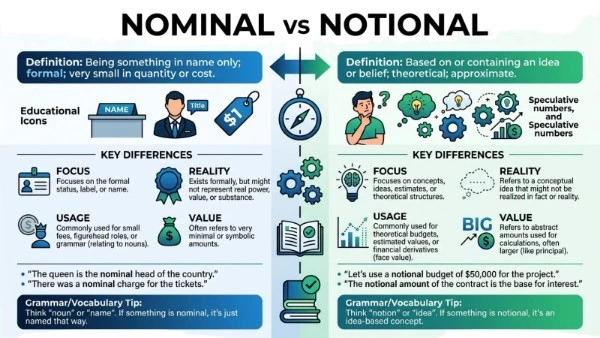
Some English words look almost alike but carry very different meanings. Nominal vs notional is one such pair. Both words are common in formal English, business, grammar, economics, and academic writing. Because they sound similar, it is easy to mix them up.
Nominal usually refers to something that exists in name, title, or form. It can also mean a very small amount. For example, a nominal fee is a small fee.
Notional usually refers to something that exists as an idea, concept, or estimated amount rather than as a real thing. For example, a notional value is a value used for calculation, even when that amount is not actually exchanged.
People often search for nominal vs notional because both words can describe something that is not fully real or actual. However, they do not mean the same thing.
The good news is that the difference becomes easy when you focus on the main idea. Nominal is linked to a name, stated amount, or small amount. Notional is linked to an idea, concept, or assumed value.
This guide explains the difference with simple rules and clear examples.
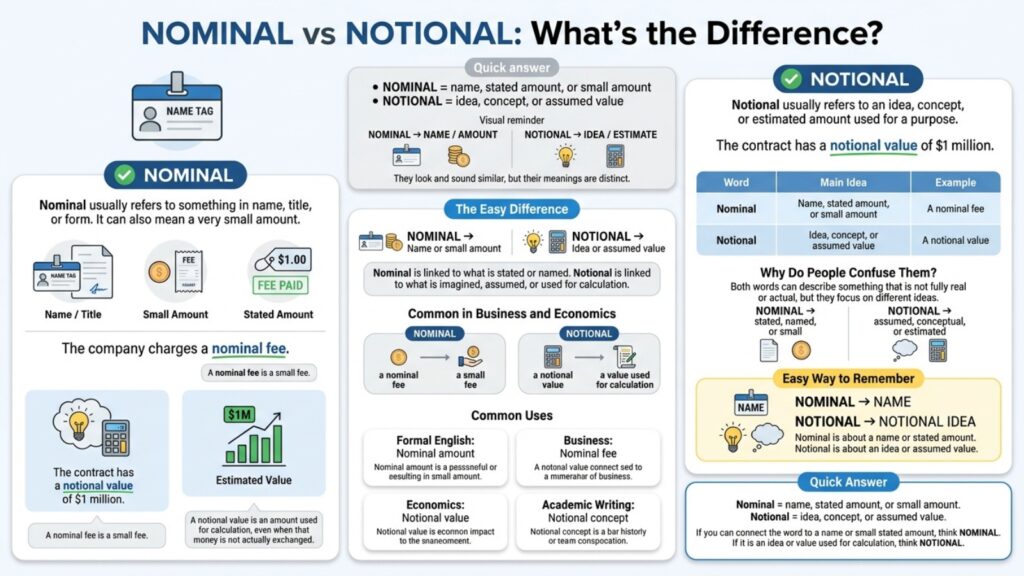
Nominal vs Notional – Quick Answer
The simplest answer is:
Nominal = in name, stated, or very small.
Notional = based on an idea, concept, or assumed value.
What does nominal mean?
Nominal can mean something that exists in name or title.
He is the nominal leader of the group.
It can also mean a very small amount.
We paid a nominal fee.
In economics, nominal can refer to a value that has not been adjusted for inflation or other changes.
The nominal price of the product increased.
What does notional mean?
Notional usually means something based on an idea or assumption rather than something directly real or physical.
The contract has a notional value of $1 million.
The $1 million may be used to calculate payments, but it does not necessarily mean that $1 million changes hands.
In grammar, notional can also describe meaning or an idea rather than grammatical form.
Quick comparison
| Word | Main idea | Example |
| Nominal | In name, stated, or small | A nominal fee |
| Notional | Conceptual or assumed | A notional value |
The Origin of Nominal vs Notional
The two words are related because both have roots connected to ideas and names, but they developed different meanings.
The origin of nominal
Nominal comes from Latin nomen, meaning name.
It entered English through French and developed meanings related to names.
This connection is still clear today.
For example:
He is the nominal head of the organization.
This means he holds the title, even if someone else has most of the real power.
Nominal later developed other meanings, including “very small” and “stated” values.
For example:
The company charges a nominal fee.
The fee is real, but it is very small.
The origin of notional
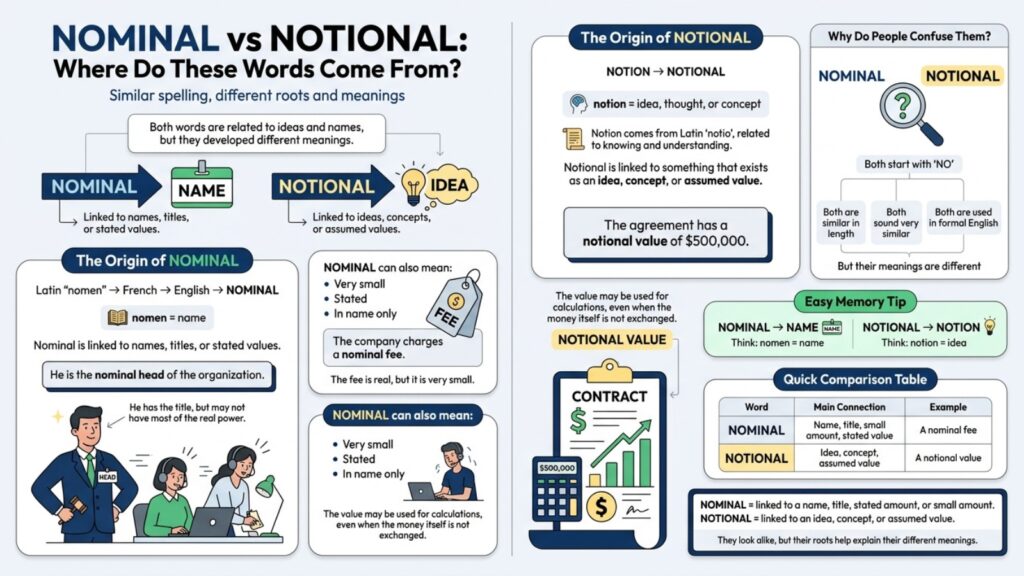
Notional comes from notion, meaning an idea, thought, or concept.
Notion comes from Latin notio, which is related to knowing or understanding.
So, notional is connected to something that exists as an idea or concept.
For example:
The agreement has a notional value of $500,000.
The value may be used for calculations, even though the money itself may not be exchanged.
Why do people confuse them?
The words look and sound very similar:
- Nominal
- Notional
Both can also appear in technical writing.
But their central ideas are different:
Nominal → name or stated amount
Notional → idea or assumed amount
British English vs American English Spelling
There is no major spelling difference between British and American English for nominal and notional.
Both forms use:
- nominal
- notional
- nominally
- notion
- notional value
Comparison table
| Word | British English | American English | Meaning |
| nominal | Nominal | Nominal | In name, stated, or small |
| notional | Notional | Notional | Conceptual or assumed |
| nominally | Nominally | Nominally | In name or officially |
| notion | Notion | Notion | Idea or belief |
| notionally | Notionally | Notionally | In a conceptual sense |
British English examples
The company charged a nominal fee.
The loan has a notional value.
American English examples
The company charged a nominal fee.
The loan has a notional value.
The spelling stays the same.
So, unlike colour/color or centre/center, there is no British or American spelling choice here.
Which Word Should You Use?
Choose the word based on what you mean.
Use nominal for a small amount
Use nominal when something costs very little.
There is a nominal charge for delivery.
Members pay a nominal fee.
Here, nominal means small or minimal.
Use nominal for a title
Use nominal when someone has a title but may not have much real power.
She is the nominal leader of the team.
Use nominal for stated values
In economics and finance, nominal can describe a stated value that has not been adjusted.
The nominal wage increased by 5%.
Use notional for an assumed value
Use notional when a value exists mainly for calculation or discussion.
The investment has a notional value of $2 million.
Use notional for an idea
Use notional when something is based on an idea or concept.
The plan is still notional.
This means the plan is still an idea rather than a final, real plan.
For global English
Both words are standard in British and American English.
The choice depends on meaning, not location.
Common Mistakes with Nominal vs Notional
Mistake 1: Using notional for a small fee
Incorrect:
We charge a notional fee of $5.
If you mean the fee is very small, use nominal.
Correct:
We charge a nominal fee of $5.
Mistake 2: Using nominal for a conceptual value
Incorrect:
The contract has a nominal value of $10 million.
If the value is an assumed amount used for calculation, notional may be the better word.
Correct:
The contract has a notional value of $10 million.
Mistake 3: Thinking nominal always means fake
Nominal does not simply mean “fake.”
For example:
The company charges a nominal fee.
The fee is real. It is just small.
Mistake 4: Thinking notional means worthless
Notional does not mean worthless.
A notional amount can be very large. It may simply be an amount used for calculation or reference.
Mistake 5: Confusing nominal with notional in finance
These words have specific meanings in finance.
Nominal can describe a stated value.
Notional often describes an amount used to calculate financial payments or exposure.
Always check the context before choosing the word.
Nominal vs Notional in Everyday Examples
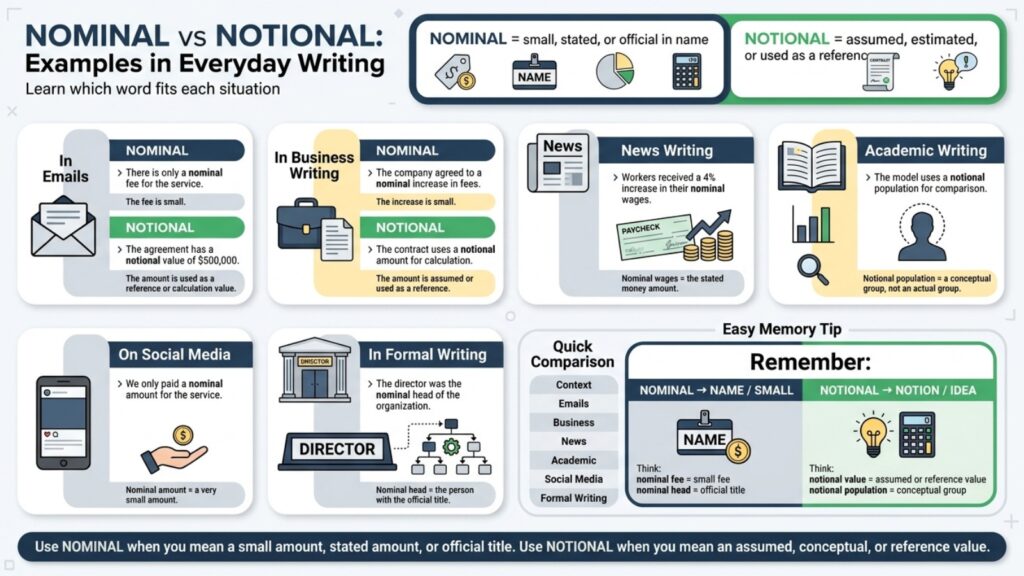
In emails
There is only a nominal fee for the service.
Here, the fee is small.
Another example:
The agreement has a notional value of $500,000.
Here, the amount is used as a reference or calculation value.
In business writing
The company agreed to a nominal increase in fees.
This means the increase is small.
The contract uses a notional amount for calculation.
This means the amount is assumed or used as a reference.
News writing
Workers received a 4% increase in their nominal wages.
This refers to the stated money amount.
In academic writing
The model uses a notional population for comparison.
Here, the population is conceptual rather than an actual group.
On social media
We only paid a nominal amount for the service.
This means the amount was very small.
In formal writing
The director was the nominal head of the organization.
This means the director held the official title.
Nominal vs Notional in Different Fields
Finance
Both words are common in finance, but they have different uses.
Nominal value can mean a stated value.
Notional value can mean an amount used to calculate financial results.
For example:
The bond has a nominal value of $1,000.
The derivative has a notional value of $5 million.
Economics
Nominal is very common in economics.
For example:
Nominal wages increased by 4%.
A nominal value is often compared with a real value, which takes factors such as inflation into account.
Grammar
Notional can also appear in grammar.
A notional meaning focuses on the basic idea or meaning of a word or sentence.
Business
Nominal can describe a small cost.
The service has a nominal charge.
Notional can describe a planned or assumed figure.
The project has a notional budget of $2 million.
Nominal vs Notional – Google Trends & Usage Data
Searches for nominal vs notional usually come from people who see these words in technical or formal writing.
The words appear often in different fields.
Nominal is common in:
- Economics
- Finance
- Business
- Law
- Grammar
- General English
- Pricing
Notional is common in:
- Finance
- Economics
- Grammar
- Education
- Business
- Planning
- Academic writing
Search interest can vary by country and context. Both British and American English use these words, so there is no major regional spelling difference.
People may encounter nominal more often in everyday business phrases such as:
nominal fee
nominal value
People may encounter notional more often in technical phrases such as:
notional value
notional plan
The most important point is that search popularity does not change the meanings.
Nominal vs Notional: Comparison Table
| Feature | Nominal | Notional |
| Main idea | Name, stated value, or small amount | Idea, concept, or assumed value |
| Related word | Name | Notion |
| Small amount | Yes | No |
| Official title | Yes | No |
| Stated value | Yes | Sometimes, depending on context |
| Assumed value | Not usually | Yes |
| Financial use | Very common | Very common |
| Economics | Very common | Common |
| Grammar | Common | Common |
| Example | Nominal fee | Notional value |
| British spelling | Nominal | Notional |
| American spelling | Nominal | Notional |
Nominal vs Notional: Easy Examples
Examples
1: Small payment
The club charges a nominal fee.
The fee is real but small.
2: Official title
He is the nominal manager.
He has the title, but he may not have much real control.
3: Financial amount
The contract has a notional value of $1 million.
The amount may be used to calculate financial obligations.
4: An idea
The new system is still notional.
The system is still an idea or plan.
Example 5: Stated price
The product has a nominal price of $100.
The phrase focuses on the stated price.
Easy Trick to Remember Nominal vs Notional
Use the first part of each word.
Nominal → Name
Think:
Nominal = name
This helps with:
nominal leader
nominal value
Notional → Notion
Think:
Notional = notion
A notion is an idea.
So:
Notional = idea or concept
You can remember the difference like this:
Nominal = name or small stated amount
Notional = notion or assumed idea
This simple trick can help you choose the right word quickly.
FAQs;
1. What is the difference between nominal and notional?
Nominal usually means related to a name, stated value, or small amount. Notional usually means based on an idea, concept, or assumed value.
2. Is a nominal fee small?
Yes. A nominal fee is usually a small fee.
There is a nominal fee for entry.
3. What does notional value mean?
A notional value is an amount used as a reference or for calculations. It does not always mean that the full amount is actually exchanged.
4. Does nominal mean fake?
No. Nominal does not simply mean fake. It can mean official in name or very small in amount.
5. Is notional the same as imaginary?
Not exactly. Notional can describe something conceptual, assumed, or used for calculation. It does not always mean completely imaginary.
6. Is nominal or notional used in finance?
Both are used in finance, but they have different meanings. Nominal often refers to a stated value, while notional often refers to an amount used for calculation or reference.
7. Are nominal and notional interchangeable?
No. They may seem similar, but you should not normally use them as synonyms. Choose nominal for names, stated values, or small amounts, and notional for concepts or assumed values.
Conclusion;
The difference between nominal vs notional becomes much easier when you remember their basic ideas. Nominal is connected with a name, stated value, or small amount. Notional is connected with a notion, idea, or assumed value.
For example, a nominal fee is a small fee. A nominal leader is someone who holds a title, even if they have little real power. In finance, a nominal value can refer to a stated value.
By contrast, a notional value is often an amount used for reference or calculation. Something can also be notional when it exists as an idea or concept rather than as a finished reality.
There is no British versus American spelling difference. Both nominal and notional are spelled the same in both forms of English.
The easiest memory trick is “nominal = name” and “notional = notion.” If you mean a title, stated amount, or small fee, choose nominal. If you mean an idea, concept, or assumed amount, choose notional. Once you remember that simple difference, these two similar words become much easier to use correctly.