What is the difference between a composer and an arranger? If you listen to music, you may see both names in song credits. Sometimes one person is listed as the composer. Another person is listed as the arranger. This can make the roles seem the same.
They are not the same.
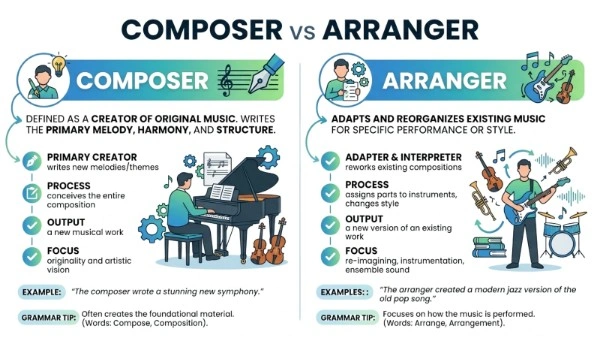
A composer creates the original music. They may write a melody, harmony, rhythm, or full musical work. An arranger takes existing music and changes how it is presented. The arranger may add new instruments, change the rhythm, write new harmonies, or prepare the music for a different group.
For example, a composer may write a song for piano and voice. An arranger may take that same song and create a version for a jazz band, choir, or orchestra.
People search for composer vs arranger because they want to understand music credits, songwriting, and the people behind a piece of music. The difference can also matter when artists give credit for a song or performance.
In simple terms, the composer creates the music, while the arranger shapes an existing piece for a new sound or setting.
Composer vs Arranger – Quick Answer
Here is the easiest way to understand the difference:
- Composer: Creates original music.
- Arranger: Changes or adapts existing music.
- Composer: May create the melody, harmony, rhythm, and structure.
- Arranger: Decides how the existing music will sound in a new version.
Example
Imagine someone writes a song for a singer and piano.
The person who writes the original song is the composer.
Later, another musician creates a version for a full orchestra. That person is the arranger.
The arranger may decide:
- Which instruments play
- Which instruments carry the melody
- How the introduction sounds
- How the rhythm changes
- Where harmonies are added
- How the ending works
Simple rule
Composer = creates the musical work.
Arranger = creates a new musical version of an existing work.
However, one person can be both.
A composer may write a song and then arrange it for an orchestra or band.
The Origin of Composer vs Arranger
The words composer and arranger have different origins, but both are connected to the idea of creating or organizing music.
The origin of composer
Composer comes from the verb compose.
The word compose comes from Latin componere, meaning “to put together” or “place together.” It later developed the meaning of creating or putting together a work, including music.
A composer is therefore someone who puts musical ideas together to create a piece.
Over time, the word became strongly linked with people who create musical works.
Examples include:
The composer wrote a new symphony.
She is a talented film composer.
The composer created the melody and harmony.
The origin of arranger
Arranger comes from arrange.
Arrange comes from Old French and ultimately has roots connected with putting things into order or position.
An arranger organizes musical material into a particular form.
For example, a song may already exist, but an arranger can prepare it for:
- Orchestra
- Choir
- Jazz band
- Marching band
- String quartet
- Solo instrument
The arranger decides how the existing musical ideas will work in that new setting.
Why do the words cause confusion?
Both people work creatively with music.
A composer creates the original musical material. An arranger works with musical material and changes its presentation.
The roles can overlap, too.
A composer may arrange their own work. An arranger may also make creative changes that strongly affect the final sound.
British English vs American English Spelling
There is no major British English vs American English spelling difference between composer and arranger.
Both varieties use:
- Composer
- Arranger
- Compose
- Arrange
- Composition
- Arrangement
The spelling stays the same.
Comparison table
| Word | British English | American English | Meaning |
| Composer | Composer | Composer | Person who creates music |
| Arranger | Arranger | Arranger | Person who adapts music |
| Compose | Compose | Compose | Create a musical work |
| Arrange | Arrange | Arrange | Adapt or organize music |
| Composition | Composition | Composition | A musical work |
| Arrangement | Arrangement | Arrangement | A version or adaptation |
British English examples
The composer wrote the piece in 2025.
The arranger created a version for orchestra.
American English examples
The composer wrote the piece in 2025.
The arranger created a version for orchestra.
The spelling is exactly the same.
Which Term Should You Use?
There is no British or American spelling choice here. You should choose the word based on the person’s role.
Use composer for the creator
Use composer when a person creates the original music.
John is the composer of the symphony.
The composer wrote the original melody.
Use arranger for the adapter
Use arranger when a person takes existing music and prepares it for a new performance or group.
Sarah was the arranger for the choir version.
The arranger added strings and brass to the song.
Use both when one person does both jobs
Sometimes the same musician creates and arranges a piece.
David composed and arranged the song.
This is completely normal.
For music credits
Be accurate when possible.
If someone wrote the original musical work, credit them as the composer.
If someone adapted that work for a new group or performance, credit them as the arranger.
Common Mistakes with Composer vs Arranger
Mistake 1: Calling every music creator an arranger
Incorrect:
The arranger wrote the original song from scratch.
This may be wrong if the person created the original musical work.
Better:
The composer wrote the original song.
If another person later adapted it, that person is the arranger.
Mistake 2: Thinking an arranger only changes instruments
An arranger can do much more than choose instruments.
They may change:
- Harmony
- Rhythm
- Musical form
- Texture
- Instrument roles
- Introductions
- Endings
So, arranging can involve a lot of creative work.
Mistake 3: Thinking composers never arrange music
Composers can arrange their own work.
For example:
The composer wrote a piano piece and later arranged it for orchestra.
The same person can be both composer and arranger.
Mistake 4: Thinking an arrangement is a completely new composition
Usually, an arrangement is based on an existing musical work.
The arranger changes the presentation while keeping important parts of the original work.
Mistake 5: Using the words as exact synonyms
Composer and arranger are not exact synonyms.
A composer creates the original musical work.
An arranger adapts existing music.
Composer vs Arranger in Everyday Examples
In emails
You might write:
Could you please send me the composer’s name?
Or:
We need an arranger to prepare the song for a four-part choir.
In news articles
A music article might say:
The composer received an award for the new film score.
Another article might say:
The arranger created a new orchestral version of the classic song.
On social media
A musician might post:
Proud to share my latest work as a composer!
An arranger might write:
I just finished a new arrangement for our jazz group.
In formal writing
The composer created the original work in 1995.
The arranger later prepared the piece for a full orchestra.
In music programs
A concert program may list:
Composer: Jane Smith
Arranger: Robert Jones
This tells the audience who created the original work and who prepared the arrangement.
Composer vs Arranger in Different Types of Music
The roles can appear in many areas of music.
Classical music
Composers write:
- Symphonies
- Concertos
- Sonatas
- Operas
- Chamber music
Arrangers may adapt these works for different groups.
Film music
A composer may write the original film score.
Other musicians may arrange the music for different instruments or performances.
Popular music
A songwriter or composer may create the original song.
An arranger may then create a version for a band, orchestra, choir, or live show.
Jazz
Arranging is especially important in jazz.
An arranger may take a song and create detailed parts for:
- Saxophones
- Trumpets
- Trombones
- Piano
- Bass
- Drums
The arrangement can strongly shape how the final performance sounds.
Choir music
A composer may write an original choral work.
An arranger may take an existing song and create a version for:
- SATB choir
- Children’s choir
- Men’s choir
- Women’s choir
Composer vs Arranger – Google Trends & Usage Data
Searches for composer vs arranger are closely linked to music education, songwriting, music careers, and questions about music credits.
The terms appear in different contexts.
Composer is often searched with:
- Music
- Songs
- Film
- Classical music
- Symphony
- Soundtrack
- Songwriting
- Music theory
Arranger is often searched with:
- Music arrangement
- Orchestra
- Choir
- Jazz
- Band
- Song arrangement
- Music production
Search interest can vary by country and by the type of music being discussed.
For example, people studying classical music may see composer often. People working with bands, orchestras, choirs, or music production may encounter arranger more often.
Google Trends can help show search interest over time and across countries. However, search volume does not decide the meaning of either word.
The key difference stays the same:
Composer creates. Arranger adapts.
Composer vs Arranger: Comparison Table
| Feature | Composer | Arranger |
| Main role | Creates music | Adapts existing music |
| Creates original melody | Often | Not usually |
| Creates original harmony | Often | May change or add harmony |
| Chooses instruments | Sometimes | Often |
| Changes rhythm | Sometimes | Often |
| Creates new arrangement | Sometimes | Yes |
| Works with existing songs | Sometimes | Very often |
| Writes orchestral parts | May | Often |
| Works with choirs | Yes | Yes |
| Can be the same person | Yes | Yes |
| Main idea | Creation | Adaptation |
Composer vs Arranger: Simple Examples
Example 1: New song
Emma writes a completely new song.
She creates:
- Melody
- Chords
- Rhythm
- Structure
Emma is the composer.
Example 2: Orchestra version
Later, David takes Emma’s song and creates a version for a 60-piece orchestra.
David is the arranger.
Example 3: One person does both
Emma writes the song and then creates the orchestra version herself.
Emma is both the:
- Composer
- Arranger
Example 4: Choir arrangement
A traditional song already exists.
A musician creates a new SATB choir version.
That musician is the arranger of the new version.
The original creator may be someone else.
Why the Difference Matters
The difference between a composer and arranger is more than a job title.
It can matter for credit.
If you created the original musical work, you may receive composer credit.
If you created a new arrangement, you may receive arranger credit.
The distinction can also matter for:
- Copyright
- Royalties
- Music publishing
- Performance credits
- Concert programs
- Album credits
The exact legal rules can vary by country and by the type of work. However, keeping the roles clear helps musicians give proper credit.
FAQs ;
1. What is the difference between a composer and an arranger?
A composer creates the original music, while an arranger adapts existing music for a new group, instrument, style, or performance.
2. Can a composer also be an arranger?
Yes. One person can compose a piece and arrange it for another group or performance.
3. Does an arranger write music?
Yes. Arrangers often write new musical parts. However, they normally work from an existing musical work.
4. Is an arranger a songwriter?
Not always. A songwriter may create a song’s original melody, lyrics, or structure. An arranger may later adapt that song for performance.
5. Who gets credit, the composer or arranger?
Both can receive credit when both roles are involved. The composer gets credit for the original work, while the arranger gets credit for the arrangement.
6. Can an arrangement become a new song?
An arrangement can sound very different from the original, but it is normally based on an existing work. Whether it is legally treated as a new work depends on the nature of the changes and applicable copyright law.
7. Which is harder, composing or arranging?
Neither is simply harder. They require different skills. Composing focuses on creating musical ideas, while arranging focuses on developing and presenting those ideas in a new way.
Easy Trick to Remember Composer vs Arranger
Use this simple rule:
Composer = creates.
Arranger = adapts.
Think about a house.
The composer is like the person who creates the original design.
The arranger is like the person who changes the design for a different space.
In music:
Composer → original musical work
Arranger → new version of that work
If you remember these two words, you will usually know which term to use.
Conclusion;
The difference between composer vs arranger is simple once you understand their main jobs. A composer creates the original musical work. An arranger takes existing music and changes it for a new setting, group, style, or performance.
A composer may create a melody, harmony, rhythm, and musical structure. An arranger may then decide how those ideas should sound when played by an orchestra, choir, jazz band, or another group. The arranger can make major creative choices, but the work is still based on existing music.
One person can also do both jobs. A composer may write a song and then arrange it for an orchestra. In that case, the person is both the composer and arranger.
There is no British or American spelling difference between these terms. Composer and arranger are spelled the same in both forms of English.
The easiest rule is to remember: a composer creates, while an arranger adapts. When you use these terms in music credits, articles, programs, or professional writing, this simple difference will help you describe each person’s role correctly.