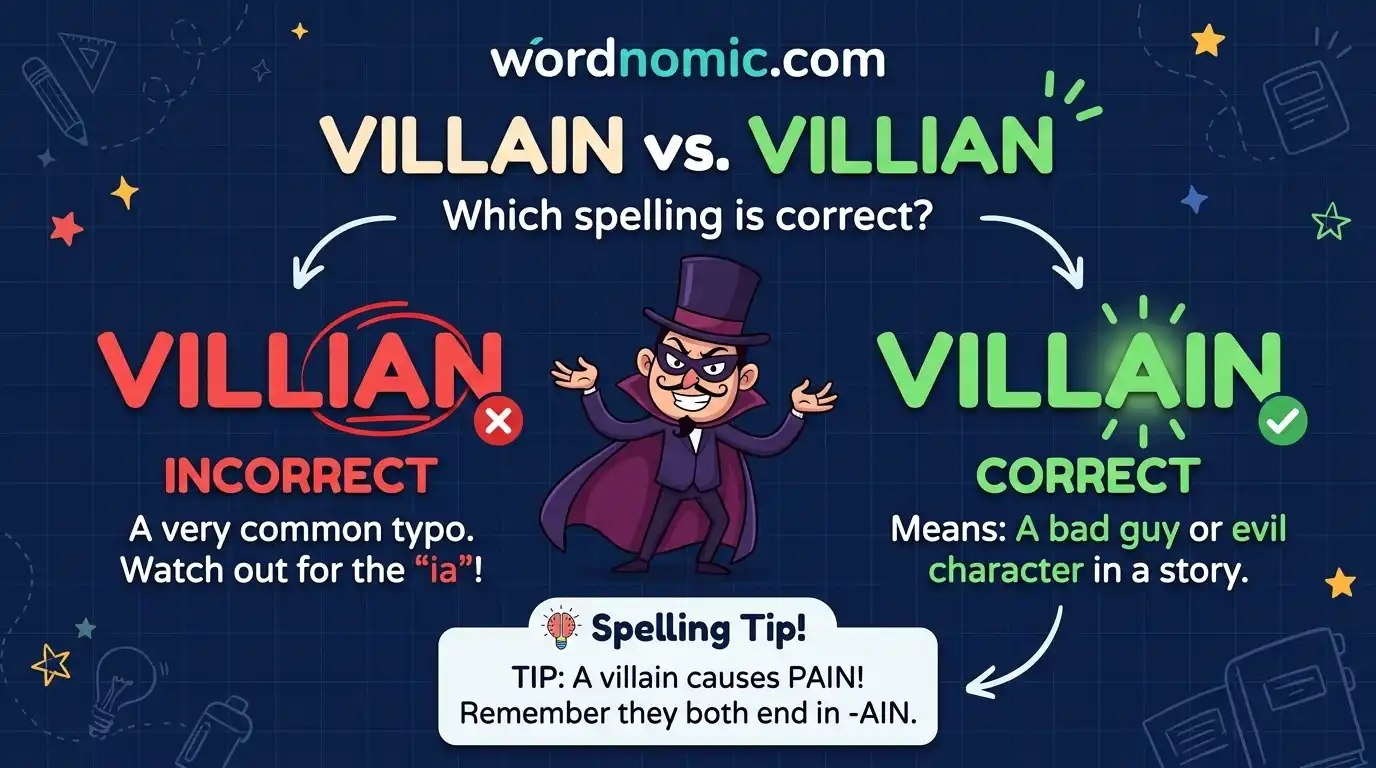
If you are unsure whether to write villian or villain, the correct spelling is villain. The spelling villian is incorrect when you want to describe a bad person, an evil character, or someone who causes harm.
A villain is often the main enemy in a story, book, film, or TV show. For example, a superhero may try to save a city while the villain tries to destroy it. The villain creates problems for the hero and often drives the story forward.
The confusion comes from the order of the letters near the end of the word. The correct spelling is V-I-L-L-A-I-N. It has two Ls, followed by A-I-N. The incorrect spelling villian puts the I before the A in the ending.
If you only need a quick answer, remember this simple rule: villain is correct, and villian is incorrect. Below, you will find the meaning, pronunciation, sentence examples, related words, and easy ways to remember the correct spelling.
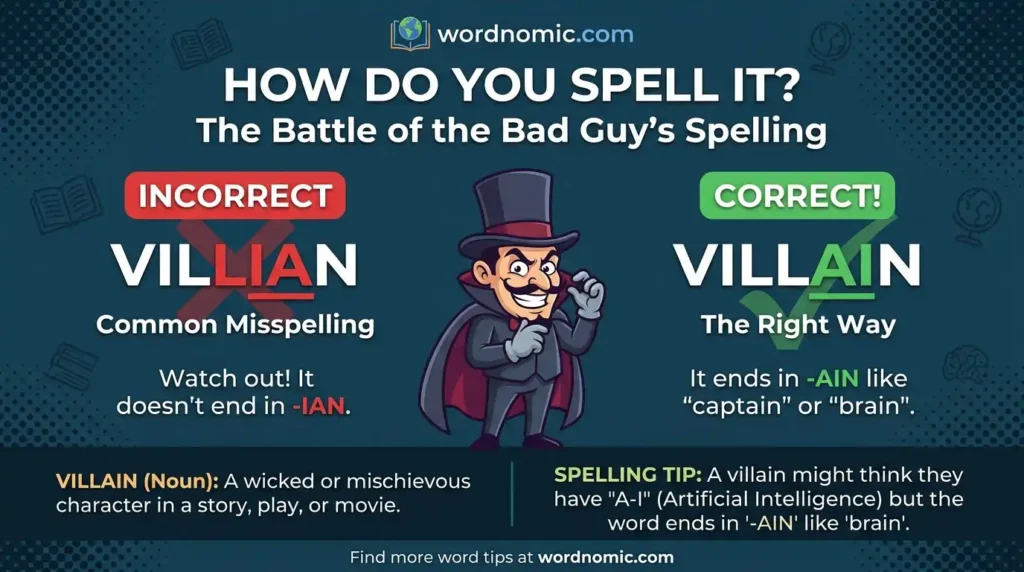
Villain vs. Villian: Quick Answer
| Word | Is it correct? | Meaning |
| Villain | Yes | A bad person or an evil character |
| Villian | No | A common misspelling of villain |
Here are two examples:
- Correct: The villain tried to defeat the hero.
- Incorrect: The villian tried to defeat the hero.
The first sentence uses the correct spelling. The second sentence contains a spelling mistake.
When writing about a movie, a book, a superhero, or a person who acts in a cruel way, use villain. You should also use this spelling in school assignments, essays, emails, stories, and other forms of writing.
What Does Villain Mean?
A villain is a person who does evil, cruel, dishonest, or harmful things. In fiction, a villain is usually a character who opposes the hero or creates the main problem in a story.
For example, imagine a story about a brave girl who wants to save her village. A greedy king steals the villagers’ food and stops anyone from helping them. The girl tries to protect the people, while the king tries to stop her. In this story, the king acts as the villain.
Villains can appear in many types of stories, including:
- Superhero movies
- Fairy tales
- Adventure books
- Crime stories
- Mystery novels
- Fantasy films
- TV dramas
- Video games
However, the word is not limited to fictional characters. People also use villain to describe a real person who behaves in a cruel or harmful way.
For example:
The dishonest businessman became the villain of the news story.
This sentence describes someone who is seen as responsible for wrongdoing.
The word can also be used in a more creative way. A writer might describe a bad habit, a poor decision, or a problem as the villain of a situation.
For example:
Lack of preparation was the real villain behind the failed project.
Here, the word does not describe an actual person. It highlights the main cause of a problem.
Why Do People Spell Villain as Villian?
The mistake usually happens because the two spellings look similar. Both contain the same letters, but the order of the A and I changes.
The correct spelling is:
V-I-L-L-A-I-N
The incorrect spelling is:
V-I-L-L-I-A-N
Look closely at the last four letters:
- Correct: L-A-I-N
- Incorrect: L-I-A-N
The difference is small, but it changes the spelling.
Another reason for this mistake is pronunciation. When people say villain, the ending is usually pronounced like “uhn.” The A and I do not sound like two separate, clear vowel sounds in ordinary pronunciation. As a result, someone who has heard the word many times may still be unsure about its written form.
This is why remembering the letters is more helpful than relying on pronunciation alone.
An Easy Trick to Remember the Correct Spelling
Use this simple spelling pattern:
VILL + AIN = VILLAIN
First, remember the beginning: VILL.
Next, remember that the word ends in AIN, not IAN.
You can also connect the word to the idea of a villain in a story. When you write about the bad character who fights the hero, remember that the correct word has A before I in its final three letters.
Try writing the word a few times:
- Villain
- Villain
- Villain
Reading and writing the correct form can help you remember it when you need it.
How to Use Villain in a Sentence
The word villain is a noun. A noun names a person, place, thing, or idea. In this case, it names a person or character who acts as an enemy or does harmful things.
Here are examples showing how the word works in everyday writing.
1. In a movie
The villain wanted to take control of the city.
This sentence describes the enemy in a fictional story.
2. In a book
The writer introduced the villain near the beginning of the novel.
Here, the word refers to a character created by the writer.
3. In a superhero story
The superhero stopped the villain before anyone got hurt.
The villain is the person causing danger.
4. In a fairy tale
The villain tricked the prince into entering the forest.
This example shows how the word can describe a character who uses tricks to harm or mislead others.
5. In a mystery
The detective spent weeks trying to discover the villain’s identity.
Here, the villain is the person responsible for the crime or wrongdoing.
6. In a school play
My friend played the villain in our school performance.
The word describes the role that the friend acted.
What Is the Difference Between a Villain and a Hero?
A villain and a hero often have opposite goals in a story. The hero usually tries to help people, solve a problem, or protect something valuable. The villain often tries to stop the hero or causes the problem the hero must solve.
| Feature | Hero | Villain |
| Main role | Often the main character who faces a challenge | Often the character who creates or increases the conflict |
| Typical actions | Helps, protects, or saves others | Harms, threatens, or deceives others |
| Main goal | Often works toward a positive outcome | Often works toward a harmful or selfish goal |
| Relationship | May fight against the villain | May oppose the hero |
| Example | A firefighter saving people from danger | A character who deliberately starts a dangerous fire |
These are common patterns, not rules for every story.
Some stories have heroes who make bad choices. Other stories have villains who believe they are doing the right thing. A character may even change roles during the story.
For example, a person who begins as an enemy may later help the hero. In another story, a trusted friend may turn against the main character. These changes can make the story more interesting.
The key point is that hero and villain describe roles or behavior. They do not change the spelling of either word.
Villain, Villainous, and Villainy: What Is the Difference?
These three words are related, but they do not serve the same purpose in a sentence.
| Word | Type | Meaning | Example |
| Villain | Noun | A bad person or character | The villain escaped. |
| Villainous | Adjective | Evil, cruel, or harmful | He made a villainous plan. |
| Villainy | Noun | Evil or harmful behavior | The story revealed years of villainy. |
Villain
Use villain when you are talking about the person or character.
Example: The villain hid the stolen treasure.
The word identifies the person who performs the action.
Villainous
Use villainous when you want to describe an action, plan, or quality.
Example: The character carried out a villainous act.
Here, the word describes the act rather than naming the person.
Villainy
Use villainy when you are talking about evil or harmful behavior.
Example: The story follows the hero’s struggle against the villainy of a cruel ruler.
This word focuses on the behavior or wrongdoing itself.
Learning these related words can help you use villain correctly and write more clearly.
Is Villain the Same in British and American English?
Yes. Villain is spelled the same way in British English and American English.
There is no standard British spelling villian and no standard American spelling villian. Both varieties use villain.
For example:
- British English: The villain was caught at the end of the film.
- American English: The villain was caught at the end of the movie.
The words film and movie may be used differently depending on the speaker and situation, but villain has the same spelling.
This is useful to remember if you write for readers in the United States, the United Kingdom, Canada, Australia, or other English-speaking countries. You do not need to change the spelling based on your audience.
Is Villain a Noun or an Adjective?
The word villain is a noun.
It names a person or character. It does not normally work as an adjective in standard English.
For example:
- Correct: The villain entered the room.
- Correct: The villain’s plan failed.
- Correct: The story has a villain.
- Related adjective: The villainous character entered the room.
In the sentence The villain’s plan failed, the word villain shows possession. It means the plan belongs to or is connected with the villain.
In the sentence The villainous character entered the room, the word villainous describes the character.
Knowing the difference between nouns and adjectives can help you choose the right form when writing a story or describing a character.
What Is the Plural of Villain?
The plural of villain is villains.
You normally add -s to make the word plural.
- One villain
- Two villains
- Several villains
- The villains escaped
Examples:
The hero had to face three villains.
The movie features several villains with different goals.
Do not write villians when you mean more than one villain. The correct plural keeps the same A-I letter order and adds S at the end.
The same spelling rule applies whether you are talking about one character or many characters.
Common Spelling Mistakes Related to Villain
The most common mistake is writing villian instead of villain. However, it is also useful to pay attention to the plural form and related words.
1. Writing Villian Instead of Villain
Incorrect: The villian stole the money.
Correct: The villain stole the money.
Why? The A comes before the I in the correct spelling.
2. Writing Villians Instead of Villains
Incorrect: The villians worked together.
Correct: The villains worked together.
Why? The correct singular word is villain, so its plural form is villains.
3. Using Villainous When You Mean Villain
Incorrect: The villainous escaped from the castle.
Correct: The villain escaped from the castle.
Why? Villain names the person. Villainous describes something evil or cruel. You need a noun in the first sentence’s intended meaning.
4. Using Villain When You Mean Villainous
Incorrect: The character made a villain plan.
Better: The character made a villainous plan.
Why? The sentence needs a describing word before plan. The adjective villainous fits that role.
5. Confusing a Villain With an Antagonist
These words are related, but they are not always interchangeable.
A villain is usually a character who does evil or harmful things. An antagonist is a character or force that opposes the main character.
An antagonist might not be evil. For example, a police officer may oppose the main character in a story without being a villain. A natural disaster may also act as an opposing force, even though it is not a person.
Use the word that best fits the meaning you want to express.
What Is the Origin of the Word Villain?
The word villain has a long history in English. It came through Old French from a word connected to a person who lived or worked on a farm or estate. Over time, the word developed a negative meaning and became associated with a person who behaved badly.
Today, the word is commonly used for evil characters in fiction and for people viewed as cruel or responsible for wrongdoing.
This history helps explain why the modern meaning is different from the word’s earlier associations. However, you do not need to know its history to spell it correctly. The most useful spelling point remains the same: villain ends in A-I-N, not I-A-N.
Frequently Asked Questions
Is villian a real word?
Villian is not the standard spelling of the English word for an evil person or fictional enemy. In ordinary writing, treat it as a spelling mistake and use villain.
How do you spell villain correctly?
Spell it V-I-L-L-A-I-N. It begins with V, has two Ls, and ends with A-I-N.
Why is villain spelled with A before I?
That is the established spelling of the word in modern English. Remembering the letter pattern is more reliable than trying to guess the spelling from pronunciation.
What is another word for villain?
Depending on the context, similar words include enemy, evildoer, criminal, and antagonist. They do not all mean exactly the same thing, so choose one that matches the situation.
For example, antagonist refers to someone or something that opposes the main character, while criminal refers to someone who commits a crime.
Can a hero become a villain?
Yes. In fiction, a hero may become a villain if their actions or goals change. For example, a hero who begins by protecting people might later use power to control them.
This type of character change is often called a fall from grace or a turn to the dark side, depending on the story.
What is the opposite of villain?
The most common opposite is hero. However, the best opposite depends on the sentence. Good person, protector, or heroic character may also fit some situations.
What is the plural form of villain?
The plural form is villains. For example: The heroes defeated the villains.
How do you pronounce villain?
In common English pronunciation, villain sounds like VIL-uhn. The first syllable receives the main stress. Pronunciation can vary slightly across accents.
Conclusion
The correct spelling is villain, not villian. A villain is a person who behaves badly or a character who opposes the hero in a story. The plural form is villains, and related words include villainous and villainy.
To avoid the spelling mistake, remember the final letters: A-I-N. Whether you are writing about a superhero movie, a book, a video game, or a real-life situation, villain is the standard spelling in both British and American English.