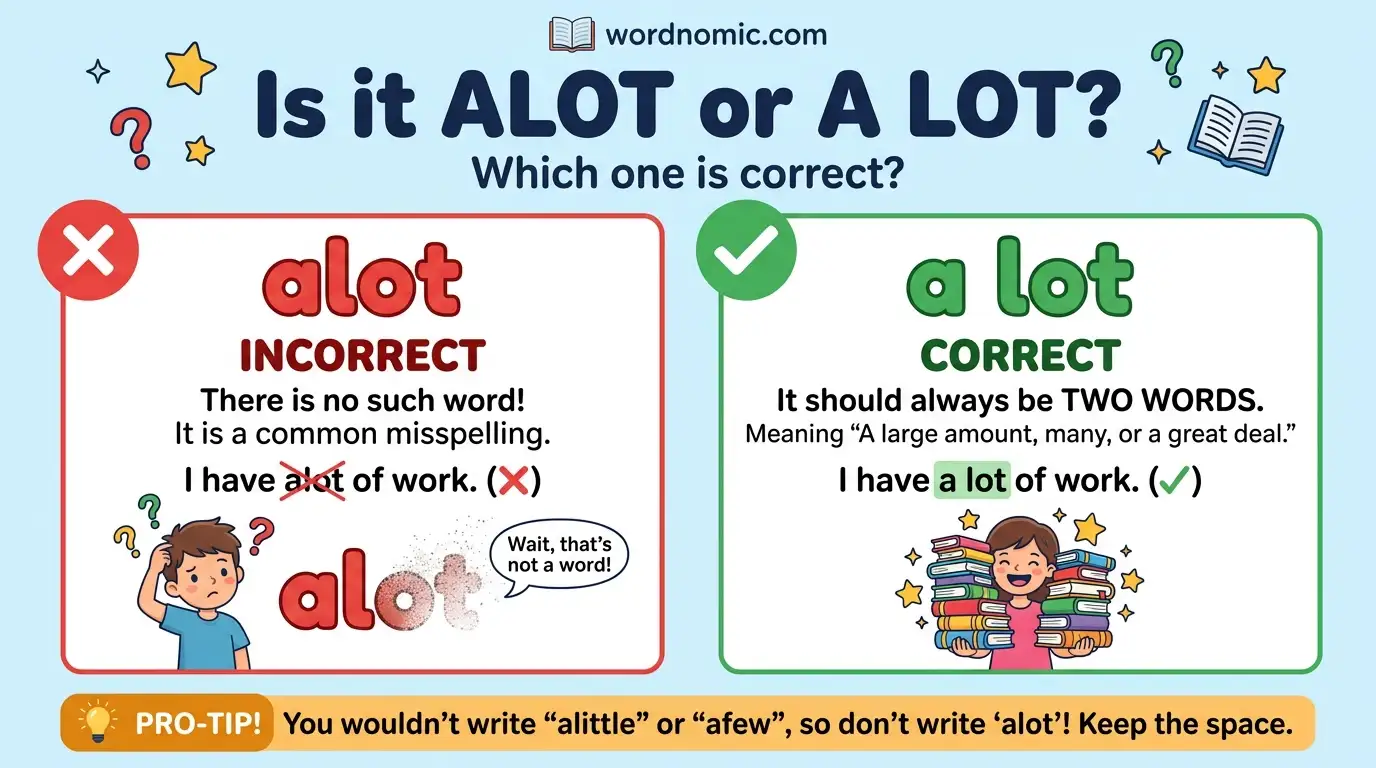
Have you ever stopped while writing and wondered whether to use alot or a lot? You are not alone. These two forms look almost the same, but only one is correct in standard English.
The correct spelling is a lot, written as two separate words. It means “much,” “many,” or “a large amount.” For example, you can say, “I have a lot of work today” or “She has a lot of friends.”
The spelling alot is a common mistake. It may look right because people often join words together when they write or type quickly. However, standard English does not accept alot as the correct form of this expression.
Learning the difference is simple. Once you know the rule, you can use the right spelling in schoolwork, emails, work reports, social media posts, and everyday messages.
This guide explains why a lot has two words, how to use it in sentences, which mistakes to avoid, and what alternatives you can use in formal writing.
Alot or A Lot: Quick Answer
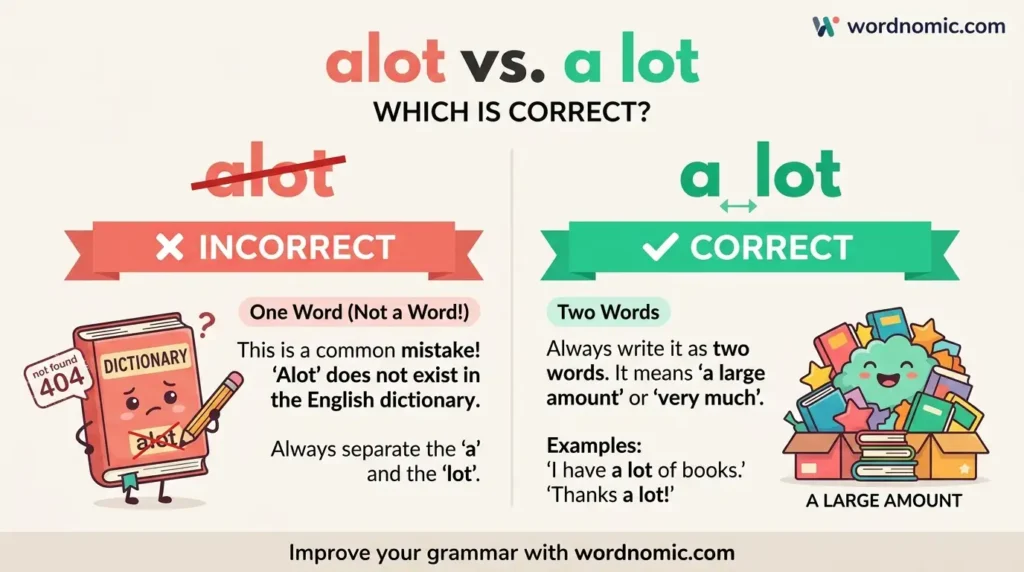
A lot is the correct spelling. Write it as two words. Alot is a spelling mistake in standard English.
Use a lot when you mean much, many, or very often.
Examples:
- Correct: I have a lot of work.
- Incorrect: I have alot of work.
- Correct: She reads a lot.
- Incorrect: She reads alot.
The phrase can describe a large number of things, a large amount of something, or an action that happens often.
definition in the Cambridge English Dictionary
+1
The Origin of A Lot
The word lot has a long history in English. It comes from Old English hlot, which was linked to the idea of a share or something given by chance. The word later gained other meanings.
Oxford Learner’s Dictionaries
+1
Over time, people began using a lot to mean a large amount or number. It also became common as a way to say “very much” or “often.” These uses date back to the 19th century.
Oxford Learner’s Dictionaries
+1
So, why do people write alot?
The main reason is simple. When people speak, they may hear the phrase as one unit. When they type quickly, they may leave out the space. This can lead to the spelling mistake alot.
However, the standard form remains a lot. The fact that a spelling mistake appears online does not make it correct.
A Lot vs. Allot vs. Alot
There is another word worth knowing: allot.
- A lot: A large amount or number. Example: I have a lot of books.
- Allot: To give or set aside something for a purpose. Example: We will allot one hour for the meeting.
- Alot: An incorrect spelling when you mean a lot.
Remembering these three forms can help you avoid confusion.
British English vs. American English Spelling
There is no spelling difference between British and American English for this phrase. Both use a lot, with a space.
The rules are the same in the United States, the United Kingdom, Canada, Australia, and other English-speaking places.
| Form | British English | American English | Correct? |
| A lot | A lot of work | A lot of work | Yes |
| Alot | Alot of work | Alot of work | No |
| Allot | Allot time for a task | Allot time for a task | Yes, different meaning |
| Lots of | Lots of people | Lots of people | Yes |
For example:
- British English: We have a lot of time.
- American English: We have a lot of time.
- Both: They spend a lot of money on books.
The spelling stays the same. You do not need to change it based on your reader’s country.
Which Spelling Should You Use?
Use a lot in almost every situation where you mean “much,” “many,” or “often.”
Here is how to use it in different types of writing.
For school: Write “I learned a lot from this lesson.”
work: Write “We have a lot of tasks to finish.”
For emails: Write “Thank you for your help. I learned a lot.”
For social media: Write “I had a lot of fun today.”
For formal writing: You can use a lot, but words such as many, much, a large number of, and a great deal of may sound more formal.
Cambridge Dictionary
+1
For example:
- Everyday: A lot of people joined the meeting.
- More formal: Many people joined the meeting.
Both sentences are correct. The second may suit a formal report better.
Common Mistakes with A Lot
These are common errors to watch for when writing.
1. Writing “alot” instead of “a lot”
Incorrect: I have alot of homework.
Correct: I have a lot of homework.
Why? The phrase needs a space between a and lot.
2. Using “alot” in an email
Incorrect: Thank you alot for your help.
Correct: Thank you a lot for your help.
Why? The standard phrase has two words, even in a short email.
3. Using “alot” in schoolwork
Incorrect: We learned alot about science.
Correct: We learned a lot about science.
Why? Schoolwork should use standard spelling.
4. Confusing “a lot” with “allot”
Incorrect: The teacher will a lot ten minutes for the test.
Correct: The teacher will allot ten minutes for the test.
Why? Allot is a verb that means to give or set aside something.
5. Forgetting “of” before a noun
Incorrect: I have a lot books.
Correct: I have a lot of books.
Why? When a noun follows this phrase, you usually need of.
You can also use a lot without of when no noun follows it.
- Correct: I read a lot.
- Correct: I read a lot of books.
6. Using “a lot of” with every noun in formal writing
Less formal: A lot of people took part in the study.
More formal: Many people took part in the study.
Why? Both forms are correct, but many may be a better fit for a formal report.
A Lot in Everyday Examples
Here are 10 simple examples showing how to use the phrase in real life.
- I have a lot of work today.
- She has a lot of friends.
- We learned a lot at school.
- He drinks a lot of water.
- Thank you a lot for your help.
- They travel a lot during the summer.
- There are a lot of cars on this road.
- I spend a lot of time reading.
- The news report shared a lot of useful facts.
- Our team has a lot to do before Friday.
Notice that a lot can be used in different ways. It can come before of and a noun, or it can appear at the end of a sentence to describe how much or how often something happens.
A Lot in Emails and Work
You might write:
“Thank you for your support. I learned a lot from your advice.”
This sounds natural in a friendly work email.
For a formal report, you could write:
“The team collected a large amount of data during the study.”
Both expressions show a large amount, but the second sounds more formal.
A Lot in News Writing
A news report might say:
“A lot of people attended the public meeting.”
For a more formal news style, the writer could say:
“Many people attended the public meeting.”
The choice depends on the tone of the report.
A Lot on Social Media
People often use simple, casual words on social media.
For example:
“Had a lot of fun with my friends today!”
This is correct and natural. Even in a short post, you should keep the space in a lot.
A Lot: Google Trends and Usage Data
People may search for alot or a lot when they want to check their spelling. Others may search for a lot meaning, a lot in a sentence, or is alot one word?
However, exact search numbers should not be guessed. Without a verified comparison for a set country and time period, it would be wrong to claim that one country searches for this spelling more than another.
You can explore search interest using Google Trends. Choose a country, set a time range, and compare relevant search terms. Keep in mind that Google Trends shows relative search interest, not the exact number of searches. Its help page also explains that misspellings and spelling variations may not always appear in its comparisons.
Trends Help
+1
For spelling advice, the clearest evidence comes from trusted dictionaries and grammar guides. These support a lot as the standard phrase and show how people use it to describe amounts, numbers, and frequency.
definition in the Cambridge English Dictionary
+1
A Lot vs. Alot: Comparison Table
| Form | Meaning | Example | Standard spelling? |
| A lot | A large amount or number | I have a lot of work. | Yes |
| Alot | Intended to mean a lot | I have alot of work. | No |
| Allot | To give or set aside | We will allot more time. | Yes |
| Lots of | A large amount or number | Lots of people came. | Yes |
| A lot (without “of”) | Very much or often | I exercise a lot. | Yes |
The key rule is easy to remember: use a lot for amounts or frequency, and use allot when you mean to assign or give something. Do not use alot as a single word.
Frequently Asked Questions
1. Is alot one word?
No. In standard English, alot is not the correct spelling when you mean a large amount or number. Write a lot as two words. For example, write “I have a lot of work,” not “I have alot of work.”
2. Why is a lot two words?
A lot is made up of two words: a and lot. Together, they form a phrase that means a large amount or number. The space is part of the standard spelling, so you should keep it in schoolwork, emails, and other writing.
3. Is a lot formal or informal?
A lot is common in everyday speech and informal writing. It is also correct in many other settings. In formal reports, you may prefer words such as many, much, or a large amount of, depending on the sentence.
4. Is a lot correct in British and American English?
Yes. Both British and American English use a lot. There is no regional spelling change. You should use the same two-word form whether you are writing for readers in the United States, the United Kingdom, or another English-speaking country.
5. What is the difference between a lot and allot?
A lot means a large amount or number. Allot means to give, assign, or set aside something for a purpose. For example, “I have a lot of work” describes the amount of work, while “We will allot one hour” means one hour will be set aside.
6. Can I use a lot in formal writing?
Yes, but think about your audience and tone. In a formal report, “Many people took part in the study” may sound more suitable than “A lot of people took part in the study.” Both are correct, but the first is often more formal.
7. What can I use instead of a lot?
You can use many, much, lots of, a great deal of, or a large number of. The best choice depends on the sentence. Use many for countable things, such as books, and much or a great deal of for things such as time or money.
Conclusion
When choosing between alot or a lot, always use a lot when you mean a large amount, a large number, or something that happens often. The correct form has two words, not one.
For example, write “I have a lot of homework” or “She reads a lot.” Both sentences use the phrase correctly. The spelling stays the same in British and American English, so you do not need to change it for readers in different countries.
Remember that allot is a real word with a different meaning. It means to give or set aside something for a purpose. For example, “We will allot 30 minutes for the task.” The spelling alot is not correct for either of these meanings.
In everyday writing, a lot is a natural and useful phrase. In formal writing, words such as many, much, and a large amount of may fit better.
The easiest rule is to remember the space. When you mean “much” or “many,” write a lot. This small habit will help you avoid a common spelling mistake in emails, schoolwork, reports, and online posts.

Emily Carter is an English grammar writer based in Portland, Oregon, with 7+ years of experience turning tricky grammar rules into simple, easy lessons.