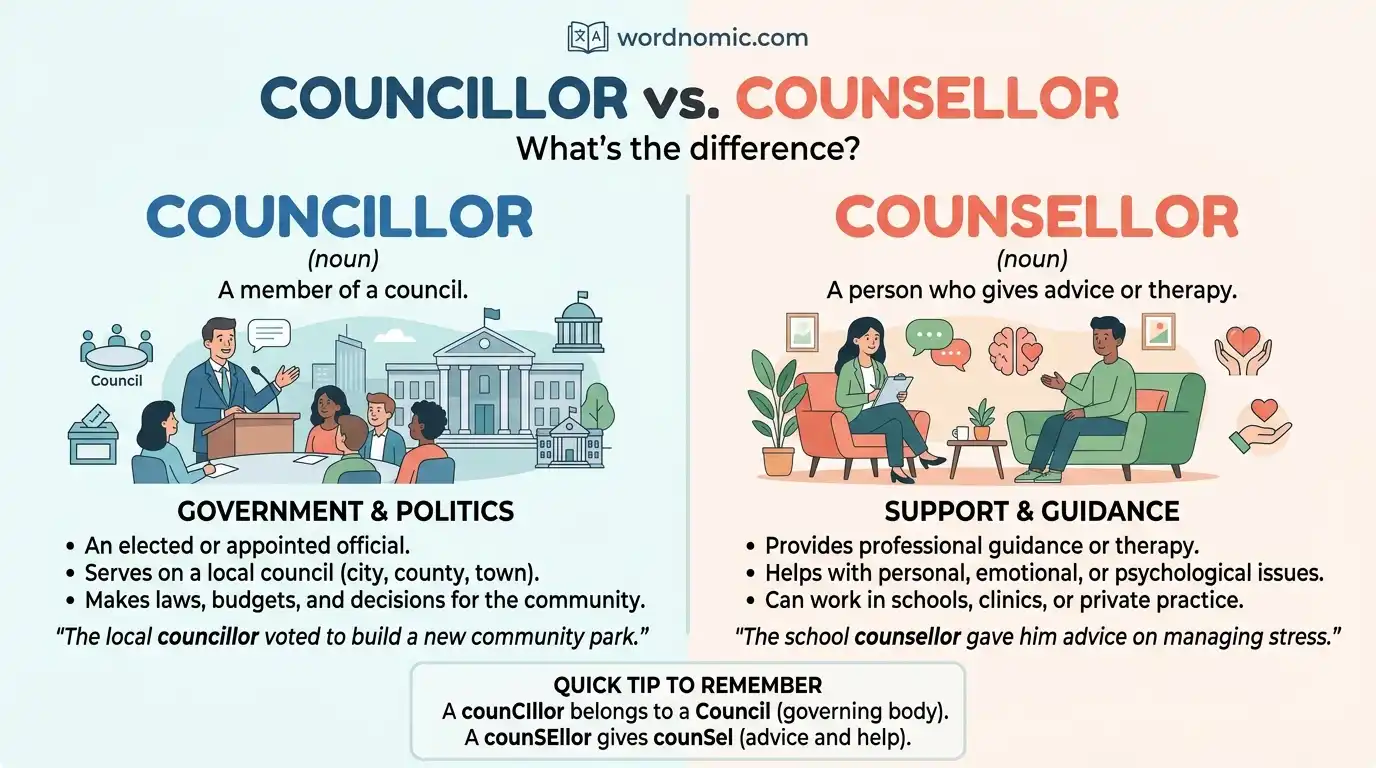
Have you ever wondered whether to write councillor or counsellor? Both words are correct, but they have different meanings. Choosing the wrong one can change the meaning of your sentence.
A councillor is an elected or appointed member of a council. This person may help make decisions about a town, city, or local area. A counsellor, on the other hand, is someone who gives advice, guidance, or support. A school counsellor may help students with school problems, while a counsellor may also support people with personal concerns.
The two words look almost the same. They both contain many of the same letters, and both can sound similar in some accents. This makes them easy to mix up, especially when writing quickly.
The good news is that there is a simple way to remember the difference. Think of a council when you write councillor. Think of counselling when you write counsellor. The first word relates to a group that makes decisions, while the second relates to advice and support.
Below, you will learn the meaning of each word, how to spell them, when to use them, and how British and American English differ.

Councillor or Counsellor: Quick Answer
Both councillor and counsellor are correct spellings in British English, but they have different meanings.
- Councillor: A member of a council, often a local government body.
- Counsellor: A person who gives advice, guidance, or emotional support.
Examples:
- The councillor attended a meeting about road repairs.
- The counsellor helped the student deal with exam stress.
In American English, the usual spellings are councilor and counselor, with one L in the ending. The meanings remain the same.
Remember: a councillor works as a member of a council, while a counsellor offers counsel, or advice.
What Does Councillor Mean?
A councillor is a person who serves on a council. A local councillor may represent people in a town, city, or other area. They may attend meetings, discuss local problems, and help make decisions about public services.
English meaning – Cambridge Dictionary
+1
For example, a local councillor may discuss road repairs, rubbish collection, parks, public spaces, or other issues that affect residents.
A councillor’s exact duties depend on the council and the country. Some councillors serve on local government bodies, while others may belong to different types of councils.
Example sentences:
- The councillor met residents to discuss the damaged road.
- Our local councillor raised the issue at a council meeting.
- She became a councillor after winning the local election.
- The councillor asked the council to improve the public park.
What Is a Council?
A council is a group of people who meet to discuss issues and make decisions within a particular area or organization.
A council might manage local government, guide a school or organization, or oversee a particular activity. The word councillor refers to a member of such a group.
A simple way to remember the spelling is to look at the word council:
- Council: the group.
- Councillor: a member of the group.
This connection helps you choose the right spelling when writing about local government or council meetings.
What Does Counsellor Mean?
A counsellor is a person who gives advice, guidance, or support. Counsellors may help people deal with personal concerns, school choices, work decisions, relationships, or other challenges. Some have professional training in counselling and mental health support.
Collins English Dictionary
+1
For example, a school counsellor may help a student choose subjects or manage stress. A career counsellor may help someone explore job options. A relationship counsellor may help people work through problems in a relationship.
The type of support depends on the counsellor’s role, training, and area of work.
Example sentences:
- The school counsellor helped me choose my subjects.
- She spoke to a counsellor about her worries.
- A career counsellor helped him explore different jobs.
- The couple decided to see a relationship counsellor.
What Is Counselling?
Counselling is a process in which a person receives guidance or support to help deal with a concern, problem, or decision.
The word counselling is linked to counsellor. Both use the same double-L spelling in standard British English.
For example:
- The student received counselling at school.
- She booked a counselling session.
- He asked for career counselling before changing jobs.
The key connection is easy to remember:
Counsel → Counsellor → Counselling
These words relate to giving advice or support, not serving as a member of a council.
Main Differences Between Councillor and Counsellor
The biggest difference is the person’s role. A councillor serves on a council, while a counsellor provides advice or support.
| Feature | Councillor | Counsellor |
| Meaning | A member of a council | A person who gives advice or support |
| Main connection | Council | Counsel and counselling |
| Common setting | Local government or an organization | School, workplace, or counselling service |
| Typical work | Discusses issues and helps make decisions | Helps people explore concerns and choices |
| Example | The councillor attended a public meeting. | The counsellor spoke with a student. |
| British spelling | Councillor | Counsellor |
| American spelling | Councilor | Counselor |
Although the two words look similar, you cannot normally swap them.
For example, a person who helps residents with local government matters may be a councillor. A person who helps someone work through a personal problem may be a counsellor.
One role is connected to membership of a council. The other is connected to advice and support.
Origin and History of the Two Words
The words have related histories, which helps explain why they look and sound alike.
Counsellor comes from older forms of English and French linked to the idea of giving advice. Its history goes back to Latin words associated with advice, discussion, and consultation. The spelling counsellor reflects this older word family.
oxfordlearnersdictionaries.co.uk
+1
Councillor developed as a word for a member of a council. Its spelling connects it to council, which refers to a group that meets to discuss matters or make decisions. Over time, the two spellings became linked to different meanings.
Today, the easiest way to tell them apart is not to study their history. Instead, connect each word to its modern use:
- Councillor: council membership.
- Counsellor: advice and support.
British English vs. American English
British and American English usually use different spellings for both words. The meanings stay broadly the same.
| British English | American English | Meaning |
| Councillor | Councilor | Member of a council |
| Counsellor | Counselor | Person who gives advice or support |
| Counselling | Counseling | The act or process of giving support |
Cambridge Dictionary identifies councillor as the UK spelling and councilor as the US form. It also identifies counsellor as the UK spelling of counselor.
English meaning – Cambridge Dictionary
+1
Which Spellings Should You Use in the UK?
If you are writing in British English, use:
- Councillor
- Counsellor
- Counselling
These are standard spellings in British usage.
Which Spellings Should You Use in the United States?
If you are writing in American English, use:
- Councilor
- Counselor
- Counseling
American English usually drops one L from these forms.
Does the Meaning Change Between British and American English?
The main distinction remains the same. A councilor or councillor is a member of a council. A counselor or counsellor provides advice or support.
The main difference is spelling, not the basic meaning.
Pronunciation can vary by accent, but the two words may sound very similar. If you hear one without seeing it written, you may need the context to know which word the speaker means.
Which One Should You Use?
Choose the word based on the person’s job or role, then follow the spelling style used by your audience.
Use councillor when the person is a member of a council in British English.
Example: The councillor spoke about the need for safer roads.
Use counsellor when the person gives advice or support in British English.
Example: The counsellor helped the student prepare for a difficult conversation.
For American readers, use councilor for a council member and counselor for an adviser or support professional.
If you write for an international audience, you can make the meaning clear by adding a little context. For example, write local council member or school counsellor when needed.
The most important rule is simple: check the role first, then check the regional spelling.
Common Mistakes With Councillor and Counsellor
These are the mistakes to watch for when using the two words.
1. Using Counsellor for a Local Government Member
Incorrect: The counsellor voted on the town’s budget.
Correct: The councillor voted on the town’s budget.
Why? The sentence describes a member of a council, so councillor is the right word in British English.
2. Using Councillor for Someone Who Gives Personal Support
Incorrect: I spoke to a councillor about my exam stress.
Correct: I spoke to a counsellor about my exam stress.
Why? The person provides support with a personal concern. The word counsellor fits this role.
3. Mixing British and American Spellings
Incorrect in standard British English: The councilor attended the meeting.
Correct in standard British English: The councillor attended the meeting.
Why? British English usually uses councillor. American English usually uses councilor.
4. Writing Counselor in British English
Incorrect for standard British spelling: The school counselor helped me.
Correct in British English: The school counsellor helped me.
Why? British English uses counsellor, with two Ls in the ending. The American form is counselor.
5. Confusing Council With Counsel
Incorrect: The school council gave me advice about my personal worries.
Better: The school counsellor gave me advice about my personal worries.
Why? A council is a group. Counsel means advice or guidance. The best word depends on what happened.
A school council may discuss student issues, while a school counsellor may help a student with a personal concern.
6. Using the Wrong Related Word
Incorrect: She received counciling after a difficult time.
Correct: She received counselling after a difficult time.
Why? The correct British spelling is counselling. American English uses counseling.
These mistakes are easy to avoid once you connect each word to its meaning.
10 Everyday Examples of Councillor and Counsellor
The following sentences show how each word fits into a different situation.
- Local government: The councillor promised to raise the road safety issue at the next meeting.
- Community concerns: Residents wrote to their councillor about the lack of street lights.
- Public services: The councillor asked for better rubbish collection in the area.
- Local elections: Our town elected a new councillor last month.
- School support: The counsellor helped the student plan for the next school year.
- Career choices: I booked a meeting with a career counsellor before applying for college.
- Personal concerns: He decided to speak with a counsellor about his worries.
- Relationships: The couple met a relationship counsellor to discuss their problems.
- Work decisions: A career counsellor helped her think about a change in jobs.
- Formal writing: The report thanked the councillor for attending the public meeting.
Notice that the first four examples use councillor. The remaining examples use counsellor. The context tells you which word fits.
Real-Life Usage: Conversations, Emails, and Work
The difference matters in everyday writing because each word points to a different role.
In Conversations
You might say:
- “Our councillor is meeting residents on Friday.”
- “I have an appointment with my counsellor tomorrow.”
The first sentence refers to a council member. The second refers to someone providing support.
In Emails
If you are contacting a local government representative, you could write:
Dear Councillor,
If you are contacting a person who provides counselling, you could write:
Dear Ms Smith,
You can also use the person’s professional title if that is how they introduce themselves.
At School or College
A councillor may serve on a student council or a local council. A counsellor may help students with study plans, career choices, or personal concerns.
For example, a student may contact a school counsellor to discuss subject choices before selecting courses.
At Work
A councillor may discuss local policies or public services. A counsellor may help someone explore career options or manage a work-related concern.
Some workplaces also use counselling services to support employees.
In Formal Writing
Use the spelling that matches the type of English you are writing in. In British English, write councillor and counsellor. In American English, write councilor and counselor.
Keep the distinction clear, especially in job descriptions, reports, letters, and applications.
Related Search Questions
What Is the Difference Between a Councillor and a Counsellor?
A councillor is a member of a council who takes part in discussions and decisions. A counsellor gives advice, guidance, or support. The words have different meanings even though they look and sound similar.
Is Councillor the Correct British Spelling?
Yes. Councillor is the standard British spelling for a member of a council. American English usually uses councilor.
Is Counsellor the Correct British Spelling?
Yes. Counsellor is the standard British spelling for someone who gives advice or support. American English usually uses counselor.
Can a Counsellor Be a Council Member?
Not usually just because they are a counsellor. The two words describe different roles. However, one person could hold both roles in separate settings. Their title depends on the role being discussed.
Are Councillor and Counsellor Pronounced the Same?
They can sound very similar, and some speakers may pronounce them almost identically. The surrounding sentence often makes the meaning clear. When writing, use the spelling that matches the person’s role.
What Is the Plural of Councillor and Counsellor?
In British English, the plurals are councillors and counsellors. In American English, they are usually councilors and counselors.
Is Counselling the Same as Council Work?
No. Counselling means giving or receiving advice and support. Council work involves taking part in the activities of a council. The words are related in appearance but describe different things.
Usage and Search Trends
People may look up these words when writing a school assignment, preparing a formal letter, checking a job title, or learning the difference between British and American spelling.
The two words can be hard to distinguish by sound alone. That is why their meanings and word connections are useful:
- Council connects to councillor.
- Counsel connects to counsellor.
- Counselling describes the process of providing support.
There is no need to assume that one word is more popular or more correct everywhere. The right choice depends on the meaning and the regional spelling standard. No specific search-volume or trend figures are needed to explain this distinction.
Frequently Asked Questions
1. Should I write councillor or counsellor?
Use councillor for a member of a council. Use counsellor for a person who gives advice or support. Both are correct British English spellings, but they are not interchangeable because they have different meanings.
2. Is councillor or counselor correct in American English?
For a member of a council, American English usually uses councilor. For a person who gives advice or support, it uses counselor. The British forms are councillor and counsellor.
3. What is the difference between counsel and council?
A council is a group that meets to discuss matters or make decisions. Counsel means advice or guidance. A councillor belongs to a council, while a counsellor gives counsel or support.
4. How do you remember the difference between councillor and counsellor?
Think of the word council when you mean a council member. Think of counsel when you mean advice or support. This simple link helps you choose the correct word without guessing.
5. What is the plural of councillor?
The British English plural is councillors. In American English, councilors is the usual spelling. For example, The councillors met to discuss local services.
6. What is the plural of counsellor?
The British English plural is counsellors. In American English, the usual spelling is counselors. For example, The school has two counsellors who support students.
7. Are councillor and counsellor interchangeable?
No. A councillor serves as a member of a council, while a counsellor gives advice or support. Using one in place of the other can change the meaning of a sentence, so always check the person’s role.
Conclusion
The difference between councillor or counsellor is simple once you know what each person does. A councillor is a member of a council who may help make decisions about local issues. A counsellor gives advice, guidance, or support to people who need help with personal, school, career, or other concerns.
Both spellings are correct in British English, but each has its own meaning. In American English, the usual forms are councilor and counselor. The main difference between British and American English is the spelling, not the basic meaning.
To remember the words, connect councillor with council and counsellor with counsel. This small trick can help you avoid mistakes in essays, emails, schoolwork, and professional writing.
If you are unsure which word to use, ask yourself one question: Is the person a member of a council, or are they giving advice and support? Once you know the answer, choosing the correct word becomes much easier.

Emily Carter is an English grammar writer based in Portland, Oregon, with 7+ years of experience turning tricky grammar rules into simple, easy lessons.