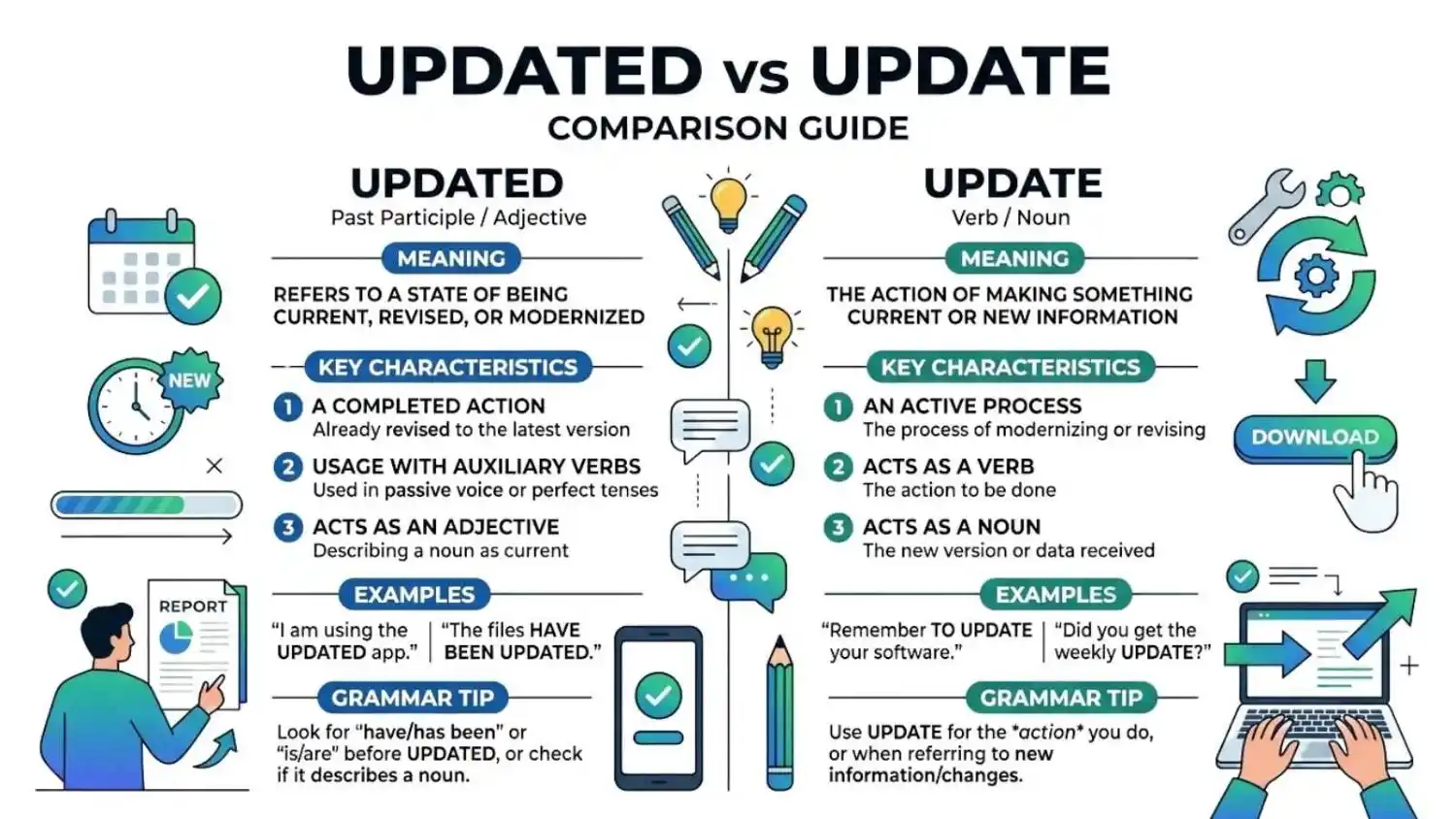
Have you ever wondered whether to use updated or update in a sentence? These two words come from the same verb, but they do different jobs. Choosing the wrong form can make a sentence sound unclear or grammatically incorrect.
Update is usually a verb or noun. As a verb, it means to make something more current or add new information. As a noun, it means new information about something.
Updated is the past tense and past participle of update. It can describe something that someone changed or made more current. It can also work as an adjective.
For example, you can say, “Please update the file” when you want someone to make changes. You can say, “I updated the file yesterday” when the change has already happened.
People often search for updated or update because both words appear in similar sentences. The main difference is the time of the action and the role of the word in the sentence.
This guide explains the difference between updated and update, with simple rules, examples, common mistakes, and useful writing tips.
Updated or Update – Quick Answer
The simple difference is:
- Update = the base verb or a noun.
- Updated = the past tense or past participle of the verb update.
- Update can mean to add new information or make something current.
- Updated means the change has already happened.
Examples with “update”
Please update the report.
I need to update my profile.
We will update the website tomorrow.
As a noun:
I have an update for you.
The manager gave us an update.
Examples with “updated”
I updated the report yesterday.
She updated her profile last week.
The website was updated this morning.
As an adjective:
Please use the updated version.
Easy rule
Use update for an action that needs to happen or for new information.
Use updated when the action has already happened or when you describe something as current.
The Origin of Updated or Update
The word update is made from up and date.
The word first developed in English as a way to bring something up to the latest date or condition.
Over time, update became common in many areas, especially business, news, technology, and computing.
Today, we use it when something gets new information or changes.
For example:
Please update the document.
The past form is:
updated
So:
update → updated
Why does “updated” have an “-ed”?
Updated is a regular past-tense verb.
Many regular English verbs form the past tense by adding -ed.
For example:
- update → updated
- change → changed
- open → opened
- clean → cleaned
- start → started
The same -ed form can also work as a past participle.
The team updated the file.
The file was updated.
British English vs American English Spelling
There is no spelling difference between update and updated in British and American English.
Both varieties use:
- update
- updated
- updating
- updates
The word is spelled the same in both forms of English.
Comparison table
| Form | British English | American English | Example |
| Base verb | update | update | Please update the file. |
| Past tense | updated | updated | I updated the file. |
| -ing form | updating | updating | We are updating the site. |
| Third-person form | updates | updates | She updates the report. |
| Noun | update | update | I have an update. |
Unlike words such as colour/color or organise/organize, update does not have a major British-American spelling difference.
Which Spelling Should You Use?
You do not need to choose a British or American spelling for update.
The correct form is the same in both varieties.
The important choice is whether you need update or updated.
Use “update” for a current or future action
Please update the document.
I will update the page later.
We need to update the information.
“updated” for a completed action
I updated the document yesterday.
She updated the page this morning.
We updated the information last week.
Use “updated” as an adjective
Please read the updated report.
We need the updated version.
The updated website is easier to use.
For US audiences
Use:
update
and:
updated
For UK audiences
Use the same forms:
update
and:
updated
The meaning and spelling remain the same.
Common Mistakes with Updated or Update
Mistake 1: Using “update” after a past-time word
Incorrect:
I update the report yesterday.
Correct:
I updated the report yesterday.
The word yesterday shows that the action happened in the past.
Mistake 2: Using “updated” for a future action
Incorrect:
I will updated the file tomorrow.
Correct:
I will update the file tomorrow.
After will, use the base verb.
Mistake 3: Confusing “update” as a noun and verb
Update can be both a noun and a verb.
As a verb:
Please update the document.
As a noun:
Please send me an update.
Mistake 4: Forgetting the “d”
Incorrect:
I update the file yesterday.
Correct:
I updated the file yesterday.
The past form needs -ed.
Mistake 5: Using “updated” when you mean “new”
These words can be close in meaning, but they are not always the same.
This is an updated report.
This means the report was changed or improved.
This is a new report.
This means the report did not exist before.
Updated or Update in Everyday Examples
Both words appear often in emails, websites, news, social media, and formal writing.
In emails
When asking someone to make a change:
Please update the attached document.
When telling someone that you made the change:
I have updated the attached document.
When giving information:
Here is an update on the project.
Business writing
The team will update the customer records.
The team updated the customer records yesterday.
Please review the updated customer records.
In news writing
News websites often use update as a noun:
Update: Officials have released new information.
They may also use updated:
The report was updated after officials confirmed the details.
On social media
People often use update when sharing new information:
Quick update: The event starts at 7 p.m.
They may use updated to describe a changed post:
I have updated the post with new details.
In formal writing
The policy was updated to reflect the latest rules.
The company will update its policy next month.
Updated or Update – Google Trends & Usage Data
Both update and updated are very common English words.
Their search intent often depends on the topic.
Technology searches
People often search for:
- software update
- phone update
- Windows update
- update drivers
- app update
- latest update
The word updated also appears in searches such as:
- updated software
- updated version
- updated information
- updated guide
- updated list
News searches
Update is common when people want the latest information:
- latest update
- news update
- weather update
- election update
- project update
Business searches
Businesses use both words:
- customer update
- project update
- update information
- updated report
- updated records
- updated policy
Search intent
| Search term | Likely intent |
| update | Learn about or make a change |
| updated | Find something that has been changed |
| latest update | Find new information |
| updated version | Find the newest version |
| update information | Change existing information |
| updated information | Information that has already been changed |
Search interest can change over time and across countries. Exact Google Trends data should be checked for a specific country and date.
Updated vs Update: Comparison Table
| Feature | Update | Updated |
| Basic form | update | updated |
| Word type | Verb or noun | Verb or adjective |
| Main verb meaning | Make current | Made current |
| Time | Present/base or future | Past/completed |
| Example | I will update it. | I updated it. |
| Adjective use | Rare in this form | Common |
| Example adjective | Not usually used | Updated report |
| British spelling | update | updated |
| American spelling | update | updated |
Update, Updated, Updating, and Updates
Understanding the other forms can make the difference easier.
Update
I need to update the file.
Updated
I updated the file yesterday.
Updating
I am updating the file now.
Updates
She updates the file every week.
These forms come from the same verb.
| Form | Example |
| update | Please update it. |
| updated | I updated it. |
| updating | I am updating it. |
| updates | She updates it. |
FAQs About Updated or Update
1. What is the difference between update and updated?
Update is the base verb or a noun.
Updated is the past form of the verb and can also be an adjective.
Please update the file.
I updated the file.
2. Is “updated” past tense?
Yes.
Updated is the simple past tense of update.
I updated the report yesterday.
It is also the past participle.
The report was updated yesterday.
3. Should I say “please update” or “please updated”?
The correct phrase is “please update.”
After please, use the base verb.
Please update the file.
Not:
Please updated the file.
4. Is “will update” or “will updated” correct?
The correct form is will update.
After will, use the base verb.
I will update the report tomorrow.
5. Is “updated” an adjective?
Yes.
For example:
Please read the updated version.
Here, updated describes the version.
6. Is update the same in British and American English?
Yes.
Both British and American English use update, updated, updating, and updates.
7. Can update be a noun?
Yes.
For example:
I have an update for you.
Here, update means new information.
Conclusion
The difference between updated or update is mainly about grammar and time. Update is the base form of the verb. It can also work as a noun. Updated is the past tense and past participle of update, and it can also work as an adjective.
Use update when you want someone to make a change or when you talk about new information. For example, “Please update the file” asks someone to make a change. “I have an update” means you have new information.
Use updated when the change has already happened. For example, “I updated the file yesterday” tells us that the action is complete. You can also say “the updated file” when describing a file that has been changed.
There is no British-American spelling difference here. Both forms are written the same way in both varieties of English.
The easiest rule is simple: update means make a change, while updated means the change has already happened.