Have you ever seen someone use the words ironic and unironic and wondered what they mean? These words look like opposites, but their use can be confusing, especially online.
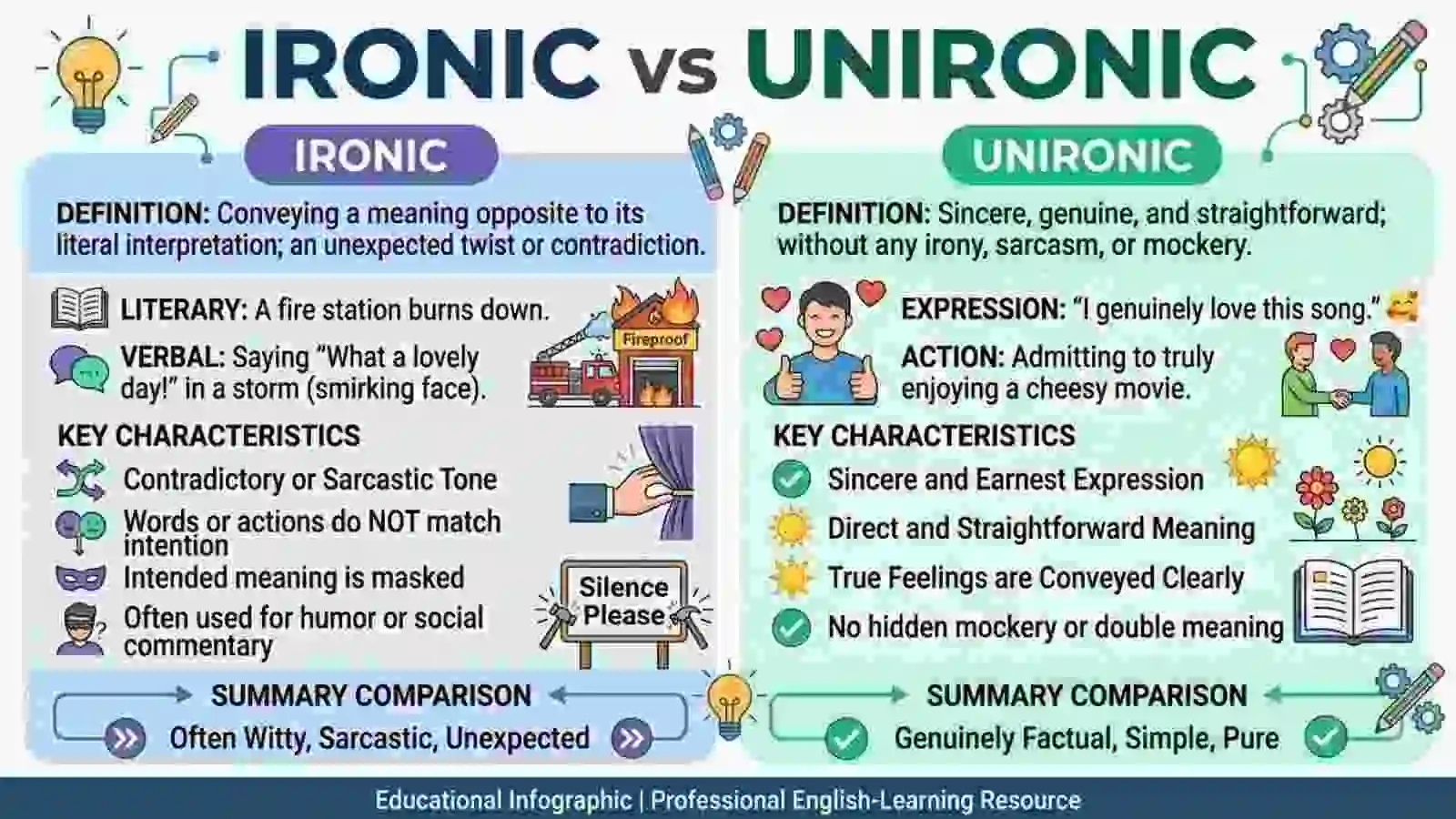
Ironic usually describes something that happens in a way that is different from what people expect. It can also describe words or actions that mean the opposite of their normal or intended meaning.
Unironic means something is not ironic. It describes a statement, feeling, or action that is meant seriously and directly.
For example, if someone says, “I love being late,” while clearly making fun of their own bad habit, the comment may be ironic. If they truly enjoy arriving late and mean exactly what they say, the statement is unironic.
People often search for ironic vs unironic because social media has made the word “ironic” very common. People may call something ironic even when they simply mean funny, strange, or unexpected. Unironic is often used to make it clear that someone is being completely serious.
This guide explains the difference between ironic and unironic, their origins, examples, common mistakes, British and American usage, and simple ways to use them correctly.
Ironic vs Unironic – Quick Answer
The simple difference is:
- Ironic = involving irony or an intended contrast between meaning and reality.
- Unironic = not ironic; meant seriously and without irony.
Example of ironic
He posted an ironic review saying the terrible movie was “the best film ever made.”
He does not really mean it.
Example of unironic
She gave the movie the best rating because she genuinely loved it.
Her opinion is unironic because she means what she says.
Easy memory trick
Think of unironic as:
un + ironic = not ironic
The prefix un- often means “not.”
For example:
- happy → unhappy
- fair → unfair
- clear → unclear
- ironic → unironic
The Origin of Ironic vs Unironic
The word ironic comes from irony.
Irony comes from the Greek word eirōneia, which referred to a kind of feigned ignorance or a way of speaking that hides the speaker’s true meaning.
The word later entered English through Latin and French.
Over time, irony developed several related meanings. Today, people commonly use it when there is a contrast between what is expected and what actually happens.
For example:
A fire station catches fire.
This can be described as ironic because a fire station is expected to help protect buildings from fire.
The origin of “unironic”
Unironic is much easier to understand.
It combines:
un- + ironic
The prefix un- means “not.”
So:
unironic = not ironic
The word became especially useful in modern informal English because people often use irony, jokes, sarcasm, and exaggerated statements online.
Someone may say:
I unironicly love this song.
The standard spelling is actually:
I unironically love this song.
This means the person genuinely loves the song and is not joking.
British English vs American English Spelling
There is no major spelling difference between ironic and unironic in British and American English.
Both varieties use:
- ironic
- irony
- unironically
- unironic
The words have the same basic meanings.
Comparison table
| Word | British English | American English | Meaning |
| ironic | ironic | ironic | Involving irony |
| irony | irony | irony | A contrast or ironic situation |
| unironic | unironic | unironic | Not ironic |
| ironically | ironically | ironically | In an ironic way |
| unironically | unironically | unironically | In a serious, non-ironic way |
Unlike words such as colour/color, these words do not change spelling based on region.
One spelling point
The correct adverb is:
unironically
Not:
unironicly
The -ly is added to unironic:
unironic + ly = unironically
Which Spelling Should You Use?
Both ironic and unironic are valid words. The choice depends on what you mean, not where your reader lives.
Use “ironic” when there is irony
For example:
It was ironic that the anti-social media campaign went viral online.
The situation contains a clear contrast.
Use “unironic” when someone is serious
For example:
He is an unironic fan of the old show.
This means he genuinely likes the show.
Use “unironically” for serious statements
For example:
I unironically enjoy watching old cartoons.
The speaker wants to make clear that they are not joking.
For American English
You can use:
ironic
unironic
ironically
unironically
For British English
You can use the same forms:
ironic
unironic
ironically
unironically
For global English
These words are widely understood. However, unironic and unironically are more common in informal writing.
In formal writing, you may prefer clearer phrases such as:
genuinely
seriously
without irony
For example:
I genuinely enjoy the song.
This may be clearer than:
I unironically enjoy the song.
Common Mistakes with Ironic vs Unironic
Mistake 1: Thinking ironic means “funny”
Ironic does not simply mean funny.
Something can be ironic without being funny.
For example:
A traffic officer gets a speeding ticket.
The situation may be ironic, but it does not have to be humorous.
Mistake 2: Calling every surprise ironic
Something unexpected is not automatically ironic.
For example:
It rained on a sunny day.
This is surprising, but it is not necessarily ironic.
Irony usually involves a meaningful contrast between expectation and reality.
Mistake 3: Using “unironic” when you mean “unfunny”
These words do not mean the same thing.
Unironic means not ironic.
Unfunny means not funny.
For example:
His comment was unironic.
This means he was serious.
Mistake 4: Writing “unironicly”
Incorrect:
She said it unironicly.
Correct:
She said it unironically.
Mistake 5: Confusing irony with sarcasm
Irony and sarcasm are related, but they are not identical.
Sarcasm often uses words that mean the opposite of what the speaker really thinks, usually to mock or criticize.
Irony is a broader idea that can involve situations, events, words, or expectations.
Ironic vs Unironic in Everyday Examples
These words are common in social media and informal writing.
In emails
Ironic:
It is ironic that the meeting about saving time lasted three hours.
Unironic:
I am unironically excited about the new schedule.
In a formal email, it may be better to use clearer wording.
For example:
I genuinely support the new schedule.
In news writing
News writers may describe an ironic situation:
It was ironic that the campaign against online distractions became a viral online story.
However, journalists usually explain the contrast rather than simply calling something ironic.
On social media
This is where unironic appears often.
I unironically love this old song.
This is my favorite movie, and I am being completely unironic.
People often use unironically to tell readers that a statement is genuine.
In formal writing
Ironic can be useful:
The outcome was ironic because it was the opposite of what the group expected.
Unironic is less common in formal writing.
A more formal choice may be:
The statement was sincere.
or:
The writer expressed genuine support.
Ironic vs Unironic – Google Trends & Usage Data
Search interest for ironic is much broader than interest in unironic.
This is partly because ironic is an older and more established English word. It appears in dictionaries, books, news reports, academic writing, and everyday conversation.
Unironic is especially common in informal online language.
Common searches for “ironic”
People may search for:
- ironic meaning
- what does ironic mean
- examples of irony
- ironic situations
- ironic meaning in a sentence
- irony examples
Common searches for “unironic”
People may search for:
- unironic meaning
- what does unironic mean
- unironically meaning
- ironic vs unironic
- what does unironically mean
Online usage
Social media has increased the use of unironically.
People often use it to separate a genuine opinion from a joke.
For example:
I unironically listen to this every day.
This tells the reader:
“I really mean this.”
Exact Google Trends interest can change by country and over time. Search results can also vary based on current internet culture and popular topics.
Ironic vs Unironic: Side-by-Side Comparison
| Feature | Ironic | Unironic |
| Basic meaning | Involving irony | Not involving irony |
| Opposite | Unironic | Ironic |
| Tone | Can be playful or indirect | Usually serious |
| Common online | Yes | Yes |
| Formal use | Common | Less common |
| Example | An ironic comment | An unironic opinion |
| Adverb | ironically | unironically |
| Main purpose | Shows irony or contrast | Shows genuine meaning |
Ironic vs Unironic Examples
1
He said, “Great job!” after the computer crashed.
If he meant the opposite, this may be ironic or sarcastic.
2
He said, “Great job!” because he truly liked the work.
This is unironic.
3
She unironically wears the same style every day.
This means she genuinely likes the style.
4
It was ironic that the person who warned everyone about lateness arrived late.
There is a contrast between expectation and reality.
FAQs;
1. What is the difference between ironic and unironic?
Ironic describes something involving irony.
Unironic means something is not ironic and is meant seriously.
2. What does unironic mean?
Unironic means sincere or serious rather than ironic.
For example:
He is an unironic fan of the band.
This means he genuinely likes the band.
3. What does unironically mean?
Unironically means sincerely or genuinely, without using irony.
For example:
I unironically love this movie.
The speaker really loves it.
4. Is unironic a real word?
Yes. Unironic is a recognized English word. It is especially common in informal and online writing.
5. Is ironic the same as sarcastic?
No.
Sarcasm often involves saying something that means the opposite, usually to mock someone. Irony is a broader concept and can describe situations as well as statements.
6. Is ironic the opposite of unironic?
Yes, in a basic sense.
Ironic means involving irony.
Unironic means not involving irony.
7. Is “unironicly” correct?
No.
The correct spelling is:
unironically
For example:
I unironically enjoy this song.
Conclusion;
Understanding ironic vs unironic is easier when you focus on the speaker’s meaning. Ironic describes something that involves irony, often through a contrast between what people expect and what actually happens. Unironic means the opposite. It describes something that is sincere, direct, or not meant as irony.
The word ironic has a long history that comes from Greek and developed through Latin and French. Unironic is formed by adding the prefix un-, which means “not.” This makes its basic meaning easy to understand.
Both words have the same spelling in British and American English. The main difference is how they are used. Ironic is common in both formal and informal writing. Unironic and unironically are especially common online and in casual speech.
One important point is that ironic does not simply mean funny or unexpected. True irony usually involves a clear contrast between expectation and reality, or between what is said and what is meant.
When you want to show that you are being completely serious, unironic or unironically can make your meaning clear.

Emily Carter is an English grammar writer based in Portland, Oregon, with 7+ years of experience turning tricky grammar rules into simple, easy lessons.