Have you ever written “enflamed” or “inflamed” and stopped to wonder which word is right? Both forms look correct. Both can be found in English. This makes the choice confusing, especially when you are writing about pain, swelling, fire, anger, or strong feelings.
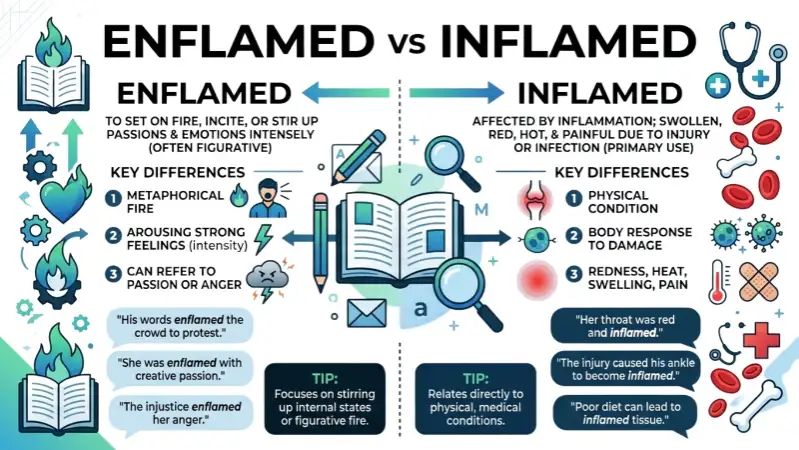
The good news is that both “enflamed” and “inflamed” are real words, but they are not used in exactly the same way. Inflamed is much more common in modern English. It often describes a body part that is swollen, red, or irritated. It can also describe strong anger or a situation that has become more intense.
Enflamed is much less common. It can mean set on fire or made passionate or excited. It may appear in older, literary, or figurative writing.
People search “enflamed or inflamed” because the words look and sound similar. They may also wonder if one is a British spelling and the other is an American spelling.
In this guide, you will learn the simple difference, see clear examples, compare British and American usage, and learn which word is best for everyday and professional writing.
Enflamed or Inflamed – Quick Answer
Inflamed is the more common and usually preferred word.
It can mean swollen, irritated, or affected by inflammation.
The doctor examined my inflamed throat.
It can also mean made more angry or intense.
His comments inflamed the argument.
Enflamed is also a real word, but it is much less common. It can mean set on fire or filled with strong emotion or passion.
The sunset enflamed the sky with color.
Quick Comparison
| Word | Main Meaning | Common Use |
| inflamed | Swollen, irritated, or made more intense | Very common |
| enflamed | Set on fire or filled with strong feeling | Less common |
For most modern writing, inflamed is the safer choice.
The Origin of Enflamed or Inflamed
The two words have different forms but share a connection with the idea of fire.
The Origin of Inflamed
Inflamed comes from the Latin word inflammare, which means to set on fire or to kindle.
The word entered English through French and later developed several meanings.
The original fire meaning led to the modern figurative meaning of making something more intense.
For example:
The speech inflamed public anger.
The word also became strongly linked with the body’s response to injury or illness.
Today, inflamed commonly describes tissue that becomes red, swollen, painful, or irritated.
The Origin of Enflamed
Enflamed also comes from the idea of setting something on fire.
The prefix en- can mean “to cause to be in a particular state.”
So enflame can carry the idea of setting something on fire or filling it with strong emotion.
The word has existed in English for a long time, but it is much less common than inflame.
Why Do They Look So Similar?
Both words developed around the same basic idea of fire and intensity.
Over time, inflame became the standard and much more common form in modern English.
That is why you are far more likely to see:
inflamed skin
than:
enflamed skin
British English vs American English Spelling
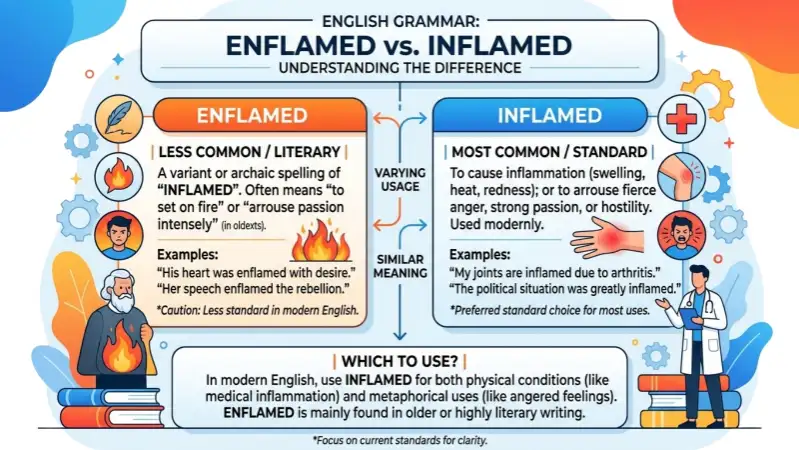
There is no major British versus American spelling difference between these words.
Both British and American English use:
inflamed
Both can also recognize:
enflamed
The main difference is frequency and context, not national spelling rules.
Comparison Table
| English Variety | More Common | Less Common |
| American English | inflamed | enflamed |
| British English | inflamed | enflamed |
| Canadian English | inflamed | enflamed |
| Australian English | inflamed | enflamed |
For example:
American English:
The skin around the wound is inflamed.
British English:
The skin around the wound is inflamed.
The spelling stays the same.
This is not like color/colour or organize/organise, where regional spelling rules may change the word.
Which Spelling Should You Use?
In most situations, choose inflamed.
For Medical Writing
Use:
inflamed
Examples:
The patient’s throat is inflamed.
The joint became inflamed after the injury.
Inflamed is the normal word in medical and health writing.
For Everyday Writing
Use:
inflamed
Example:
My skin looks inflamed after the treatment.
For Formal Writing
Use:
inflamed
Example:
The injury caused the surrounding tissue to become inflamed.
For Figurative Writing
Inflamed is also a strong choice.
The article inflamed public anger.
When Can You Use Enflamed?
It may work well in literary or poetic writing.
The clouds were enflamed by the setting sun.
Still, inflamed is usually the more familiar word.
Common Mistakes with Enflamed or Inflamed
Mistake 1: Using “enflamed” for a Medical Condition
Some writers may use enflamed because they connect the word with inflammation.
❌ The patient’s knee is enflamed.
✅ The patient’s knee is inflamed.
When talking about swelling, irritation, or inflammation, use inflamed.
Mistake 2: Thinking “Enflamed” Is Always Wrong
This is also incorrect.
Enflamed is a real English word.
It can be used for fire or strong emotion.
The sky was enflamed with red and orange light.
So do not treat it as a simple spelling error.
Mistake 3: Using “Inflamed” Only for the Body
Inflamed has more than one meaning.
It can describe physical inflammation:
His ankle is inflamed.
It can also describe anger:
The comment inflamed the debate.
Mistake 4: Confusing “Inflamed” With “Inflammable”
These words are different.
Inflamed means affected by inflammation or made more intense.
Inflammable means easily set on fire.
Do not use them as synonyms.
Mistake 5: Assuming One Is British and One Is American
This is not a British versus American spelling issue.
Both varieties use inflamed.
Enflamed or Inflamed in Everyday Examples
In Emails
The customer reported an inflamed area around the injury.
The issue has inflamed tensions between the two teams.
In News Reports
The speech inflamed public anger.
The region has seen an increase in inflamed political debate.
On Social Media
My skin became inflamed after trying the new product.
That post really inflamed the discussion.
In Formal Writing
The damaged tissue became inflamed after the injury.
The report inflamed concerns about the new policy.
In Literary Writing
The setting sun enflamed the clouds with brilliant color.
Here, enflamed creates a strong visual image.
Enflamed or Inflamed – Google Trends & Usage Data
Searches for “enflamed or inflamed” mainly come from people who want to check spelling, meaning, and correct usage.
The two words have very different levels of common use.
Inflamed is widely used in:
- Medical writing
- Health articles
- News reports
- Everyday English
- Academic writing
- Formal documents
- Figurative writing
Enflamed is much less common and appears more often in:
- Literary writing
- Poetry
- Historical writing
- Figurative descriptions
- Writing about fire or passion
Google Trends measures relative search interest, not the exact number of searches. Search interest can change by country, time, and topic.
For SEO, useful related searches include:
- enflamed or inflamed
- inflamed meaning
- enflamed meaning
- inflamed vs enflamed
- inflamed skin
- what does inflamed mean
- enflame meaning
The strongest search intent is usually a spelling and usage question.
Enflamed vs Inflamed: Comparison Table
| Feature | Inflamed | Enflamed |
| Correct English word? | Yes | Yes |
| Common today? | Yes | Much less common |
| Medical inflammation | Yes | Usually no |
| Swelling or irritation | Yes | Usually no |
| Anger or conflict | Yes | Yes, but less common |
| Fire-related meaning | Yes | Yes |
| Literary use | Yes | Yes |
| British English | Yes | Yes |
| American English | Yes | Yes |
| Best general choice | Yes | Usually no |
The biggest difference is modern usage.
Inflamed is the normal choice in most situations.
Enflamed is more specialized and less common.
Inflamed: Different Meanings
One reason this word can be confusing is that inflamed has several meanings.
Physical Meaning
It can describe tissue that is red, swollen, painful, or irritated.
The injured area became inflamed.
Emotional Meaning
It can mean made angry or more emotional.
His words inflamed the crowd.
Figurative Meaning
It can mean made stronger or more intense.
The news inflamed fears about the economy.
These meanings all connect to the old idea of fire or heat.
Enflamed: Different Meanings
Enflamed can also have several uses.
Fire
The dry grass was enflamed by the fire.
Strong Emotion
Her heart was enflamed with passion.
Strong Visual Description
The clouds were enflamed by the evening sun.
These uses are less common in everyday modern English.
FAQs About Enflamed or Inflamed
Is “inflamed” the correct spelling?
Yes. Inflamed is the standard and much more common spelling.
Is “enflamed” a real word?
Yes. Enflamed is a real English word, but it is much less common than inflamed.
What is the difference between enflamed and inflamed?
Inflamed commonly means swollen, irritated, or made more intense. Enflamed can mean set on fire or filled with strong emotion.
Which word should I use for swollen skin?
Use inflamed.
The skin is inflamed.
Is enflamed a British spelling of inflamed?
No. Enflamed is not simply a British spelling. Both British and American English use inflamed.
Can inflamed describe anger?
Yes. Inflamed can mean made more angry or intense.
The comment inflamed public anger.
Which word is more common?
Inflamed is much more common in modern English.
Conclusion
When choosing between enflamed or inflamed, the best answer depends on what you mean. Both are real English words, but inflamed is the much more common choice in modern English.
Use inflamed when you are talking about swelling, irritation, or physical inflammation. For example, you can say that an injured knee is inflamed. The word also works when something makes anger, fear, or conflict stronger.
Enflamed has a narrower and less common use. It can describe something that is set on fire or filled with strong passion. It often appears in literary, poetic, or figurative writing.
There is no major British versus American spelling difference here. Both varieties commonly use inflamed, and both recognize enflamed.
For everyday, medical, academic, and professional writing, inflamed is usually the safest choice. If you want a poetic image of fire or passion, enflamed may fit better.
The easiest rule is simple: swelling or irritation = inflamed. For most other modern uses, inflamed is still the better choice. Save enflamed for situations where its special fire or passion meaning adds something useful.

Emily Carter is an English grammar writer based in Portland, Oregon, with 7+ years of experience turning tricky grammar rules into simple, easy lessons.