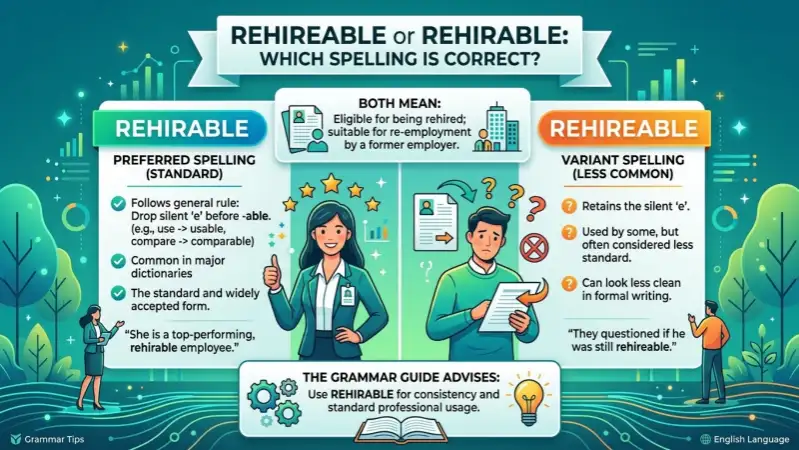
Have you ever written about hiring someone again and stopped at the word “rehireable”? You may wonder if it should have one “e” or two. The choice can be confusing because both rehireable and rehirable look possible at first glance.
The word comes from rehire, which means to hire someone again. When you add the ending -able, spelling can become tricky. This is why people often search for “rehireable or rehirable” when writing job applications, HR notes, company policies, or workplace documents.
The main issue is not the meaning. Both forms are used to describe someone who can be hired again. The question is which spelling is clearer and more accepted.
In this guide, you will get the answer first. . You will also see common mistakes, simple examples, a comparison table, FAQs, and usage tips.
By the end, you will know how to write this word with confidence.
Rehireable or Rehirable – Quick Answer
Both rehireable and rehirable appear in English, but many readers find rehireable clearer and more direct.
Rehireable means that someone can be hired again.
Example:
John is rehireable after leaving the company.
Rehirable can also be used with the same meaning:
John is rehirable after leaving the company.
However, because rehire ends with a silent e, writers may wonder whether to keep or remove that e before adding -able.
Quick Comparison
| Word | Meaning | Use |
| rehireable | Able to be hired again | Clear and easy to understand |
| rehirable | Able to be hired again | Also used |
| rehire | Hire again | Base verb |
| rehired | Hired again | Past tense |
| rehiring | Hiring again | -ing form |
For professional writing, you may also avoid the issue completely by writing:
eligible for rehire
This phrase is very common in workplace and HR writing.
The Origin of Rehireable or Rehirable
To understand these spellings, start with the base word hire.
Hire means to employ someone or pay someone to do a job.
The prefix re- means “again.”
So:
re + hire = rehire
To rehire someone means to hire that person again.
Examples:
The company decided to rehire Maria.
The manager wants to rehire two former workers.
The adjective is then formed with -able.
The suffix -able often means “can be” or “able to be.”
For example:
- read → readable
- wash → washable
- enjoy → enjoyable
- use → usable
This gives us:
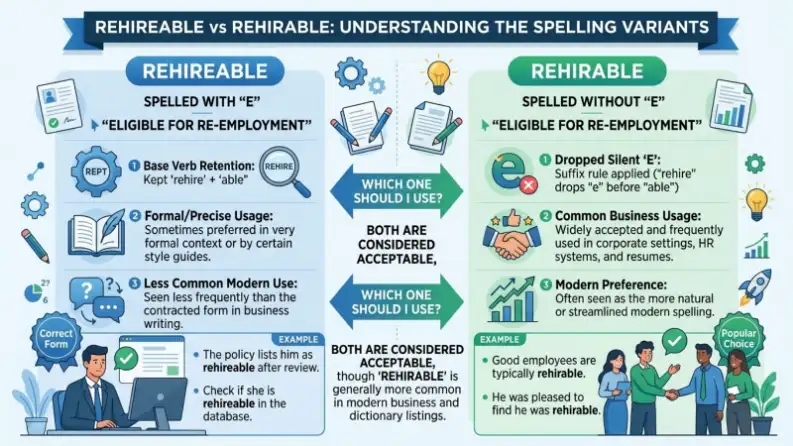
rehire + able = rehireable
But English spelling can change when a word ending in e takes a suffix. That creates the alternative form rehirable.
Why Are Both Forms Confusing?
The confusion comes from the final e in rehire.
Some writers keep the e:
rehire + able → rehireable
Others remove the final e:
rehire + able → rehirable
This is not unusual in English. Suffix rules can vary depending on the word and how the resulting form is used.
British English vs American English Spelling
There is no major British versus American spelling difference between rehireable and rehirable.
Both forms can appear in English writing.
However, professional workplace writing often avoids the unusual adjective altogether.
Instead of:
She is rehireable.
You can write:
She is eligible for rehire.
This version is especially clear in HR documents.
Comparison Table
| Writing Style | Preferred Clear Form | Example |
| American English | rehireable / eligible for rehire | She is eligible for rehire. |
| British English | rehireable / eligible for rehire | She is eligible for rehire. |
| Global English | eligible for rehire | He is eligible for rehire. |
| Informal writing | rehireable | He is rehireable. |
Unlike words such as color/colour or organize/organise, this is not mainly a US-versus-UK spelling issue.
The bigger issue is word choice and clarity.
Which Spelling Should You Use?
If you need to choose between rehireable and rehirable, consider your audience and the type of writing.
For HR Documents
The clearest choice is often:
eligible for rehire
Example:
The employee is eligible for rehire.
This sounds natural and professional.
For American English
You may use:
rehireable
Example:
The employee is rehireable under company policy.
But eligible for rehire may still sound more natural in formal HR writing.
For British English
You can use:
rehireable or rehirable, but a clearer phrase is often better.
Example:
The employee is eligible for rehire.
For General Writing
If your readers may not know the word, use:
eligible for rehire
It is simple and clear.
For Job Applications
If you are describing your own status, you can write:
I am eligible for rehire.
This sounds more natural than:
I am rehireable.
Common Mistakes with Rehireable or Rehirable
Mistake 1: Treating “rehireable” as the Only Possible Form
Some writers think rehireable is the only form.
The main goal is clear writing.
Mistake 2: Writing “Rehire-able”
Some writers add a hyphen:
❌ rehire-able
For normal modern writing, use:
✅ rehireable
or
✅ rehirable
Mistake 3: Using “Rehireble”
This spelling leaves out the a from -able.
❌ rehireble
✅ rehireable
Mistake 4: Using “Rehired” When You Mean “Can Be Rehired”
These words do not have the same meaning.
Rehired means someone was hired again.
Sarah was rehired last month.
Sarah is rehireable.
Mistake 5: Using an Unclear Word in HR Writing
The word can sound unusual to some readers.
Instead of:
The worker is rehireable.
You can write:
The worker is eligible for rehire.
This is often the better professional choice.
Rehireable or Rehirable in Everyday Examples
In Emails
Please confirm whether the former employee is eligible for rehire.
Or:
The former employee is rehireable under our policy.
HR Documents
Employees who leave in good standing may be considered eligible for rehire.
This form is clear and profession
On Social Media
After leaving the company on good terms, she was still eligible for rehire.
In Formal Writing
The employee may be considered rehireable if a suitable position becomes available.
Rehireable – Google Trends & Usage Data
Searches for “rehireable or rehirable” are likely to come from people who are unsure about spelling rather than people looking for a broad definition.
- Human resources
- Job applications
- Employment
- Workplace policies
- Employee records
- Business writing
- Grammar and spelling
Google Trends measures relative search interest, not the exact number of searches. Search interest for a niche spelling question can be much lower than interest for broad employment terms.
Related searches may include:
- rehireable meaning
- rehirable meaning
- rehireable definition
- is rehireable a word
- is rehirable a word
- eligible for rehire
- rehire meaning
For SEO, it is useful to answer the spelling question quickly and then explain the more natural professional phrase “eligible for rehire.”
Rehireable vs Rehirable: Comparison Table
| Feature | Rehireable | Rehirable |
| Meaning | Able to be hired again | Able to be hired again |
| Base word | Rehire | Rehire |
| Common use | Workplace writing | Workplace writing |
| Meaning changes? | No | No |
| British spelling | Used | Used |
| American spelling | Used | Used |
| Best formal alternative | Eligible for rehire | Eligible for rehire |
The key point is that the meaning does not change.
The main difference is spelling preference and clarity.
Rehireable vs Eligible for Rehire
For professional writing, this is an important distinction.
Rehireable is a compact adjective.
The employee is rehireable.
Eligible for rehire is a phrase.
The employee is eligible for rehire.
The second version is often easier to understand because it clearly explains the idea.
It is especially useful in:
- HR records
- Employment letters
- Company policies
- Reference checks
- Job applications
- Formal emails
If your goal is simple and professional writing, eligible for rehire is often the safest choice.
FAQs About Rehireable or Rehirable
Is “rehireable” a correct word?
Yes. Rehireable is used to describe someone who can be hired again.
Is “rehirable” correct?
Yes. Rehirable is also used with the meaning “able to be hired again.”
Which is better, rehireable or rehirable?
Rehireable is a clear choice because it keeps the spelling of rehire visible. However, eligible for rehire is often better for formal workplace writing.
Is there a British and American spelling difference?
No major regional spelling difference exists.
What is the best phrase for an HR document?
Eligible for rehire is often the clearest and most professional phrase.
Is “rehired” the same as “rehireable”?
No.
Rehired means someone was hired again.
Rehireable means someone can be hired again.
For example:
Tom was rehired in June.
Tom is rehireable.
Conclusion;
The difference is mainly about spelling and style, not meaning.
Rehireable keeps the base word rehire easy to see. Rehirable removes the final e before the -able ending. Both forms can appear in English writing, and neither creates a British versus American spelling difference.
However, there is an even better choice for many professional situations: eligible for rehire. This phrase is clear, natural, and easy for most readers to understand. It works well in HR documents, workplace emails, job applications, and company policies.
If you are writing casually, rehireable is a clear option. If you are writing something formal, consider using eligible for rehire instead.
Most importantly, do not confuse rehireable with rehired. Someone who is rehireable can be hired again. Someone who was rehired has already been hired again.
So, when in doubt, use eligible for rehire for professional writing. It removes the spelling question and makes your meaning clear.











