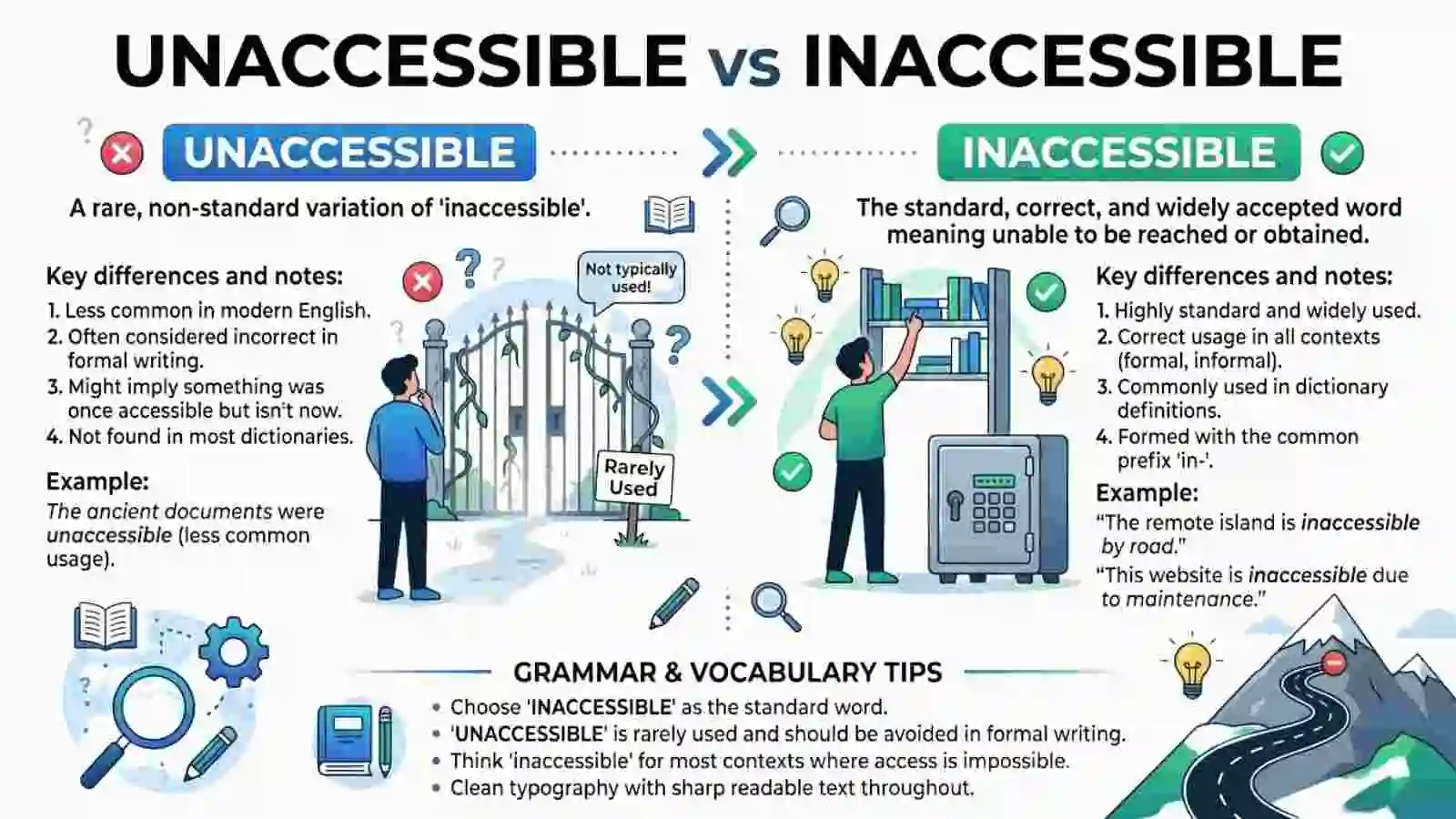
Have you ever written unaccessible and wondered if it should be inaccessible? This is a common spelling question because both forms seem possible. English has many words that begin with un-, so it can feel natural to write unaccessible. However, standard English normally uses inaccessible.
Inaccessible means that something cannot be reached, entered, used, understood, or obtained. For example, you can say, “The road is inaccessible because of the snow.” You can also say, “The website is inaccessible,” when people cannot reach or use it.
Unaccessible is sometimes seen, but it is not the standard choice in modern English. It may appear in older texts or as a rare variant, but most writers should avoid it.
People search for unaccessible vs inaccessible because the prefix un- often means “not.” Words such as unclear, unable, and unavailable make unaccessible look logical. Yet English does not always build words in the way we might expect.
In this guide, you will learn why inaccessible is the preferred word, how to spell it, how British and American English use it, and how to avoid common mistakes.
Unaccessible vs Inaccessible – Quick Answer
The quick answer is:
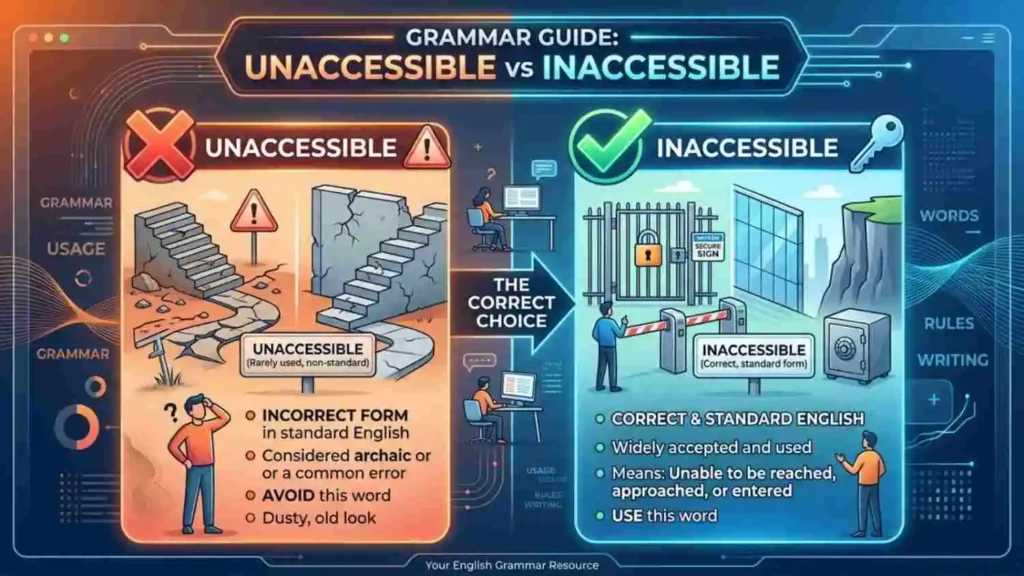
Inaccessible is the standard and preferred word.
Unaccessible is rare and usually not recommended in modern standard English.
What does inaccessible mean?
Inaccessible means something cannot be reached, entered, used, or understood.
Examples:
The mountain village was inaccessible during the storm.
The building is inaccessible to wheelchair users.
The website became inaccessible after the server failed.
His writing was difficult and inaccessible to most readers.
Is unaccessible correct?
Unaccessible can be found in English, but it is uncommon and nonstandard in most modern usage.
For normal writing, choose:
inaccessible
Instead of:
unaccessible
Easy rule
When you mean “not accessible,” use:
inaccessible
Think:
accessible → inaccessible
The Origin of Unaccessible vs Inaccessible
Understanding the word’s history helps explain why inaccessible is the standard form.
The origin of accessible
Accessible comes from Latin roots related to the idea of approaching or reaching something.
The Latin verb accedere meant “to approach” or “to come near.”
Over time, related forms entered French and then English.
In English, accessible came to mean something that can be reached, entered, used, or understood.
For example:
The building is accessible.
This means people can reach or enter it.
The origin of inaccessible
The word inaccessible is formed by adding the negative prefix in- to accessible.
The prefix in- can mean not.
So:
accessible → inaccessible
The meaning becomes:
not accessible
The prefix in- appears in many English words:
- accurate → inaccurate
- active → inactive
- visible → invisible
- complete → incomplete
- accessible → inaccessible
This is why inaccessible is the standard form.
Why does “unaccessible” seem correct?
English also uses un- to create negative words.
For example:
- happy → unhappy
- clear → unclear
- safe → unsafe
- known → unknown
- available → unavailable
Because of this pattern, unaccessible may seem logical.
However, English does not always let writers choose either un- or in-. Many words have a fixed form based on their history.
For accessible, the established negative form is:
inaccessible
British English vs American English Spelling
There is no important spelling difference between British English and American English here.
Both varieties use:
inaccessible
The form unaccessible is not the normal standard spelling in either variety.
Comparison table
| Feature | British English | American English |
| Preferred spelling | inaccessible | inaccessible |
| Less common form | unaccessible | unaccessible |
| Meaning | Not accessible | Not accessible |
| Standard negative form | inaccessible | inaccessible |
| Example | The road is inaccessible. | The road is inaccessible. |
British English example
The path is inaccessible because of the heavy rain.
American English example
The path is inaccessible because of the heavy rain.
The spelling does not change.
So, unlike words such as colour/color or centre/center, this is not a British versus American spelling issue.
It is mainly a question of choosing the standard word.
Which Spelling Should You Use?
For almost all modern English writing, use:
inaccessible
This applies to:
- School assignments
- University writing
- Business emails
- Websites
- News articles
- Blogs
- Reports
- Formal documents
- Everyday writing
For US readers
Use inaccessible.
The service is inaccessible to many users.
For UK readers
Use inaccessible.
The service is inaccessible to many users.
For Commonwealth readers
Use inaccessible as well.
For a global audience
Inaccessible is the safest choice because it is the widely recognized standard form.
If you are writing for search engines, professional readers, or students, avoid unaccessible unless you are specifically discussing the word itself.
Common Mistakes with Unaccessible vs Inaccessible
Mistake 1: Using unaccessible in normal writing
❌ The website is unaccessible.
✅ The website is inaccessible.
Mistake 2: Thinking every negative word uses “un-“
This is one of the main reasons people write unaccessible.
English has many words that use un-, but not every adjective follows that pattern.
For example:
- visible → invisible
- possible → impossible
- legal → illegal
- regular → irregular
The correct form must be learned with the word.
Mistake 3: Adding an extra “n”
Some writers may spell it:
❌ inaccessable
The correct spelling is:
✅ inaccessible
The middle part is access.
Think:
in + access + ible
Mistake 4: Dropping a “c”
❌ inacessible
✅ inaccessible
There are two c letters in the word:
inaccessible
Mistake 5: Using “inaccessible” when “unavailable” is better
These words can overlap, but they are not always the same.
Inaccessible often means something cannot be reached or used.
Unavailable usually means something cannot be obtained or is not ready for use.
Compare:
The road is inaccessible.
The manager is unavailable.
The first focuses on access. The second focuses on availability.
Unaccessible vs Inaccessible in Everyday Examples
In emails
The file is currently inaccessible.
The office is inaccessible after 8 p.m.
These sentences are clear and professional.
In news writing
Several roads became inaccessible after the storm.
This is common in reports about weather, travel, disasters, and public services.
On social media
The website is inaccessible right now.
People may use the word when a website, account, or service cannot be reached.
In formal writing
The study found that the service remained inaccessible to people in rural areas.
This use is common in academic and policy writing.
In technology
Inaccessible is often used when users cannot access a website, app, file, system, or device.
The database is currently inaccessible.
The website became inaccessible after the update.
Buildings
The word can describe physical access.
The old building is inaccessible to wheelchair users.
This can refer to a lack of ramps, lifts, or other access features.
In writing and ideas
Inaccessible can also mean difficult to understand.
The book uses language that is inaccessible to beginners.
Here, the book is not physically blocked. Its ideas are simply hard for the reader to understand.
Unaccessible vs Inaccessible – Google Trends & Usage Data
Inaccessible is much more common than unaccessible in standard modern English.
The word appears across many topics, including:
- Technology
- Education
- Travel
- Disability access
- Websites
- Buildings
- Roads
- Science
- Academic writing
- Public services
Unaccessible appears far less often and is often treated as a spelling or word-choice error.
Search interest in inaccessible can increase when people search about website access, disability access, blocked roads, unavailable locations, and digital services.
The word also has several meanings. This gives it a wider search range than unaccessible.
For SEO, this matters. If your target keyword is unaccessible vs inaccessible, the article should explain both forms, but the main correct form should be clearly identified as inaccessible.
Google search results can change over time and by country. Search volume also does not always show how often a word appears in natural writing.
The most useful language rule remains simple:
Use inaccessible in standard English.
Unaccessible vs Inaccessible: Side-by-Side Comparison
| Word | Standard? | Meaning | Recommended? | Example |
| Inaccessible | Yes | Not accessible | Yes | The road is inaccessible. |
| Unaccessible | Rare/nonstandard | Intended to mean not accessible | Usually no | Avoid in normal writing. |
| Accessible | Yes | Easy to reach or use | Yes | The building is accessible. |
| Access | Yes | Ability or right to enter/use | Yes | We have access to the file. |
| Accessibility | Yes | Quality of being accessible | Yes | The site has good accessibility. |
Inaccessible: Common Word Forms
Learning the related forms can help you remember the correct spelling.
Accessible
The building is accessible.
Inaccessible
The building is inaccessible.
Accessibility
The website needs better accessibility.
Access
Users need access to the system.
Inaccessibility
The inaccessibility of the building caused problems.
These forms all come from the same word family.
FAQs;
1. Is unaccessible a correct word?
Unaccessible can be found in some English texts, but it is rare. In modern standard English, inaccessible is the preferred form.
2. Is inaccessible the correct spelling?
Yes. Inaccessible is the standard spelling.
The road is inaccessible.
3. Why is it inaccessible and not unaccessible?
The established negative form of accessible uses the prefix in-.
accessible → inaccessible
English does not always use un- for negative adjectives.
4. Is inaccessible British or American English?
Inaccessible is standard in both British and American English.
5. What does inaccessible mean?
It means something cannot be reached, entered, used, obtained, or understood.
The website is inaccessible.
The mountain is inaccessible.
6. How do you spell inaccessible?
The correct spelling is:
I-N-A-C-C-E-S-S-I-B-L-E
A useful way to remember it is:
in + access + ible
7. Is “inaccessable” correct?
No. The correct spelling is inaccessible, with -ible at the end.
❌ inaccessable
✅ inaccessible
Conclusion;
The difference between unaccessible vs inaccessible is mainly a matter of standard word choice.
Inaccessible is the correct and preferred word in modern standard English. It means something cannot be reached, entered, used, or understood.
The road is inaccessible.
The website is inaccessible.
The book is inaccessible to beginners.
Although unaccessible may look natural because English often uses the prefix un-, it is not the usual standard form. For school work, business writing, websites, reports, and formal documents, inaccessible is the safer choice.
There is also no British versus American spelling difference here. Both British and American English use inaccessible.
The easiest way to remember the word is to connect it with accessible:
accessible → inaccessible
Also remember the spelling:
in + access + ible = inaccessible
Do not write inaccessable or normally use unaccessible when you mean the standard word.
If you want your English to look clear, correct, and professional, choose inaccessible.

Emily Carter is an English grammar writer based in Portland, Oregon, with 7+ years of experience turning tricky grammar rules into simple, easy lessons.