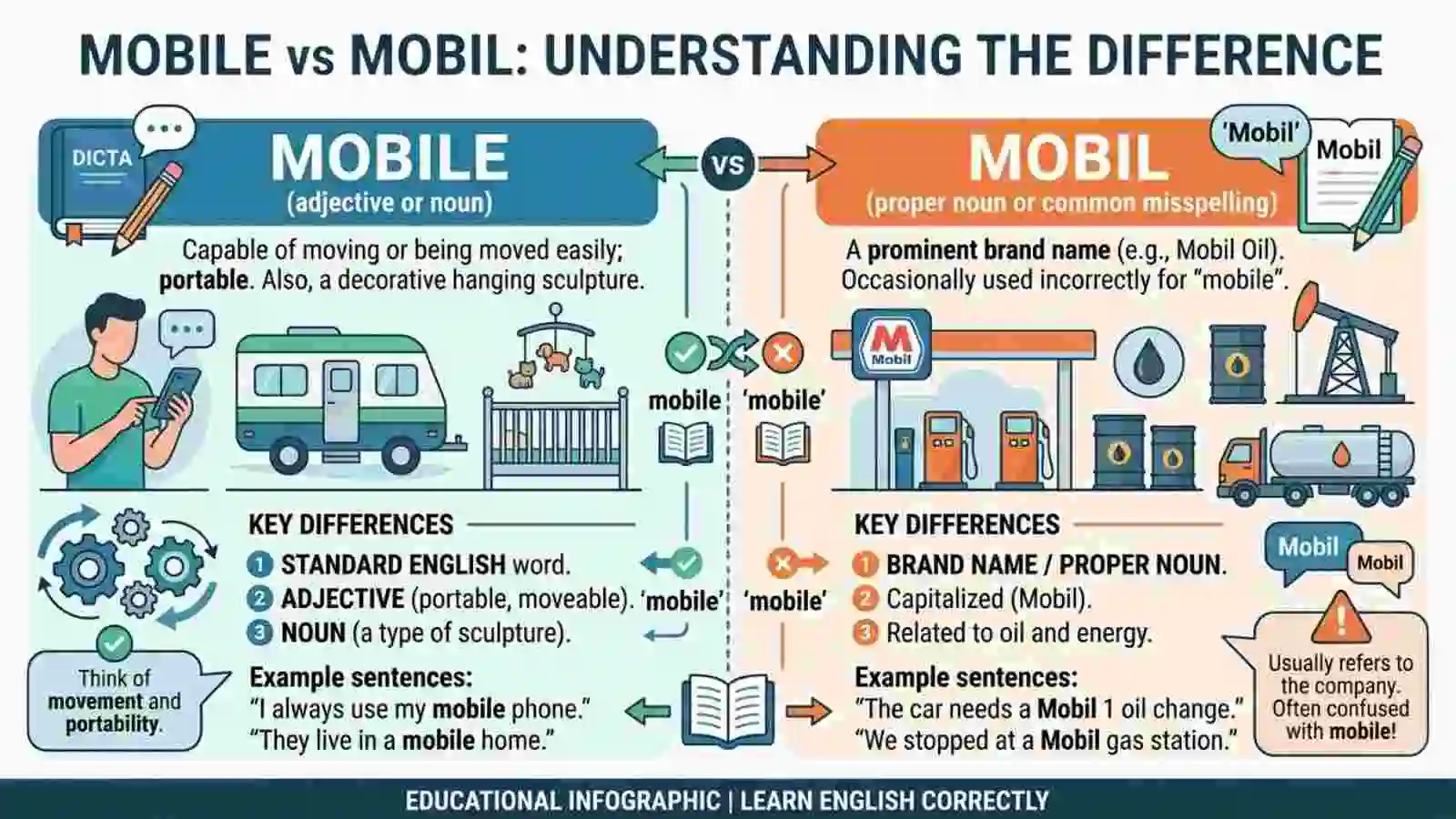
Have you ever typed mobil and mobile and wondered which spelling is correct? These two forms look almost the same, but they are not normally used in the same way.
In standard English, mobile is the correct spelling when you mean something that can move, a mobile phone, or technology that can be used while moving. For example, you can say, “I lost my mobile phone” or “This device is mobile.”
Mobil is different. In English, it is best known as a brand name. Mobil is a major fuel and lubricant brand. It is written with a capital M when used as the brand name.
People search for mobil vs mobile because the missing e can look like a spelling mistake. In some languages, forms related to mobil are also used, which can add to the confusion.
For English writing, the rule is simple: use mobile for the general English word. Use Mobil when you are talking about the specific brand.
This guide explains the difference, origin, spelling, British and American usage, common mistakes, examples, and practical tips.
Mobil vs Mobile – Quick Answer
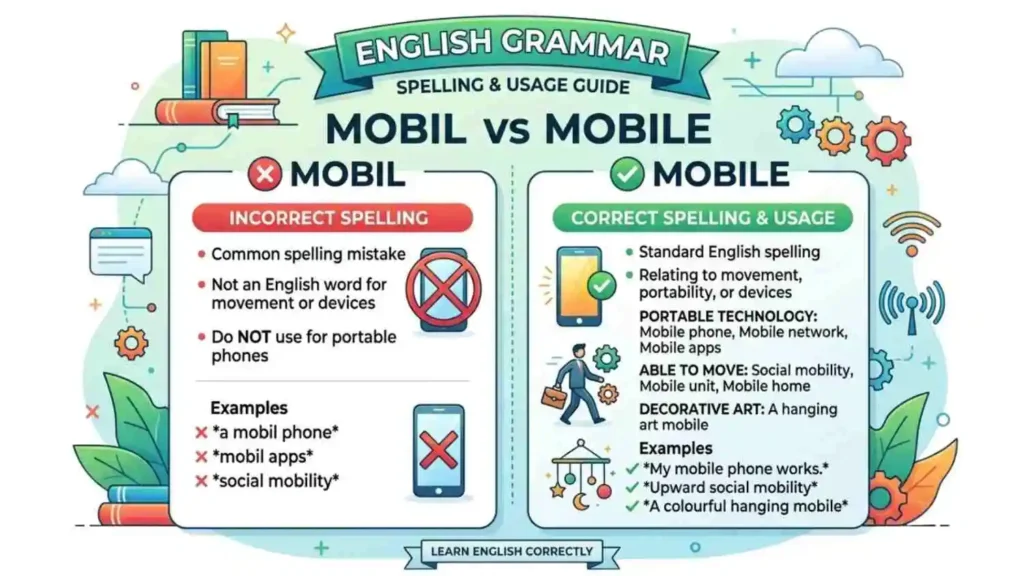
The short answer is:
- Mobile = the normal English word.
- Mobil = mainly a brand name in English.
Examples of mobile
I bought a new mobile phone.
This hospital has a mobile medical unit.
The team needs a mobile internet connection.
Mobile can mean able to move or easy to move. It can also describe technology, phones, computers, and services that can be used while moving.
Examples of Mobil
We stopped at a Mobil station.
He uses Mobil motor oil.
Here, Mobil refers to the commercial brand. The official Mobil website describes Mobil as a fuel and lubricant brand.
Easy rule
If you mean the general English word:
Use mobile.
If you mean the fuel or lubricant brand:
Use Mobil.
The Origin of Mobil vs Mobile
The words have different histories and uses.
The origin of mobile
Mobile comes from Latin mobilis, meaning “movable” or “able to move.”
The Latin word is related to movere, meaning “to move.”
Over time, the word entered European languages and later English.
Today, mobile has several meanings.
It can describe something that moves:
The unit is mobile.
It can describe something that can be moved:
We need a mobile laboratory.
It can describe communication technology:
She uses a mobile phone.
Cambridge lists mobile as an adjective meaning able to move or be moved and also as a technology term.
The origin of Mobil
Mobil is not simply a shorter spelling of the ordinary English word mobile.
In modern English, Mobil is strongly associated with the brand name used for fuels, lubricants, and related services. The official company website uses the trademarked form Mobil™.
This is why capitalization matters:
mobile = common English word
Mobil = brand name
So, if you write mobil phone, you have normally made a spelling mistake.
The correct phrase is:
mobile phone
British English vs American English Spelling
Mobile is spelled the same way in British English and American English.
However, there is an important difference in pronunciation and some differences in everyday usage.
British English
In British English, mobile is commonly used for a mobile phone.
Call me on my mobile.
I forgot my mobile phone.
Cambridge lists mobile as a noun meaning a mobile phone, mainly in UK English.
American English
American English usually uses cell phone instead of mobile when talking about a phone.
Call me on my cell phone.
I left my cell phone at home.
However, mobile is still a normal American English word when used as an adjective.
mobile technology
mobile device
Cambridge also notes that American English commonly uses cell phone where British English uses mobile phone.
Comparison table
| Feature | British English | American English |
| General spelling | mobile | mobile |
| Mobile technology | mobile | mobile |
| Mobile device | mobile device | mobile device |
| Phone | mobile / mobile phone | cell phone |
| Brand | Mobil | Mobil |
| Spelling “mobil” for the general word | Incorrect | Incorrect |
So, there is no British spelling mobil and American spelling mobile.
Mobile is the standard English spelling in both varieties.
Which Spelling Should You Use?
Your choice depends on what you mean.
Use “mobile” in normal English
Use mobile when you mean something that can move or can be used while moving.
We need a mobile unit.
Mobile technology is growing fast.
She bought a mobile phone.
Use “Mobil” for the brand
Use Mobil when referring to the fuel and lubricant brand.
We stopped at a Mobil station.
He bought Mobil oil.
The capital letter is important because Mobil is a brand name.
For US readers
If you are writing about a phone, cell phone is often more natural for an American audience.
I left my cell phone in the car.
But mobile phone is still understandable and correct.
For UK readers
Mobile and mobile phone are common choices.
I will call you on my mobile.
For Commonwealth readers
Usage can vary by country, but mobile is widely understood for a mobile phone.
For a global audience
Use mobile phone if you want the meaning to be clear to readers around the world.
For the brand, always use:
Mobil
Common Mistakes with Mobil vs Mobile
Mistake 1: Writing “mobil phone”
❌ I bought a new mobil phone.
✅ I bought a new mobile phone.
Mobile phone is the correct spelling.
Mistake 2: Using “mobil” as a general English word
❌ The company has a mobil medical unit.
✅ The company has a mobile medical unit.
Mistake 3: Forgetting the capital letter for Mobil
❌ We stopped at a mobil station.
When you mean the brand:
✅ We stopped at a Mobil station.
Mistake 4: Thinking Mobil is the British spelling
❌ British English uses mobil.
✅ British English uses mobile.
The spelling does not change between British and American English.
Mistake 5: Confusing “mobile” with “cell phone”
Mobile is a broad word.
Cell phone is the common American term for a mobile phone.
For example:
UK: I need my mobile.
US: I need my cell phone.
Both refer to a portable telephone.
Mobil vs Mobile in Everyday Examples
In emails
For general English:
Please send the file to my mobile phone.
For a business message about the brand:
We purchased Mobil lubricants for the vehicles.
In news writing
A technology article might say:
Mobile technology is changing how people communicate.
A business article might say:
Mobil expanded its range of automotive lubricants.
On social media
You might see:
My mobile battery died!
Or:
I need a new mobile phone.
For the brand:
I use Mobil oil in my car.
In formal writing
Mobile is common in formal writing about technology, transport, healthcare, and communication.
Mobile devices are now widely used in education.
The hospital operates a mobile medical unit.
Mobil should be used when the brand itself is being discussed.
In everyday speech
British speakers often say:
I will call you on my mobile.
Americans are more likely to say:
I will call you on my cell phone.
Cambridge identifies mobile phone as mainly UK usage and cell phone as the usual US term.
Mobil vs Mobile – Google Trends & Usage Data
Search interest for mobile is much broader than interest in Mobil because mobile is a common English word used across many subjects.
People search for mobile in connection with:
- Mobile phones
- Mobile apps
- Mobile devices
- Mobile internet
- Mobile technology
- Mobile banking
- Mobile networks
- Mobile games
- Mobile computing
Cambridge lists mobile across movement, technology, communications, and other areas of English.
Mobil, on the other hand, has a much narrower meaning in English when used as a brand. It is linked mainly with fuels, lubricants, vehicles, and related products. The official Mobil website lists fuel and lubricant services in many countries.
This means Google searches for mobile can come from many different topics, while Mobil searches are more likely to be brand-related.
Search interest can also vary by country. In countries where people commonly say mobile phone, searches containing mobile may be more common for telephone-related topics. In the United States, people often use cell phone instead.
Google Trends shows relative search interest rather than a simple count of every word used online. Trends can also change based on country, time, news, and search intent.
For SEO, this means you should not treat mobil and mobile as interchangeable keywords. They can have very different search intent.
Mobil vs Mobile: Side-by-Side Comparison
| Feature | Mobil | Mobile |
| Standard English word | Usually no | Yes |
| Brand name | Yes | No |
| Common meaning | Fuel/lubricant brand | Able to move or portable |
| Phone use | Incorrect | Correct |
| Capitalization | Mobil | Usually lowercase |
| British English | Brand name | Common English word |
| American English | Brand name | Common English word |
| Example | Mobil station | Mobile phone |
| SEO search intent | Usually brand-related | Very broad |
| Pronunciation | Brand name | Varies by accent |
Mobil vs Mobile: More Examples
Here are some quick examples to make the difference clear.
| Incorrect or special form | Correct form | Meaning |
| mobil phone | mobile phone | Portable telephone |
| mobil app | mobile app | App for a mobile device |
| mobil device | mobile device | Portable electronic device |
| mobil network | mobile network | Wireless phone network |
| Mobil station | Mobil station | Brand-related |
| Mobil oil | Mobil oil | Brand-related |
Remember that Mobil can be correct when it is the brand.
FAQs About Mobil vs Mobile
1. Is “mobil” a correct English word?
Mobil is not normally the standard spelling of the general English word. It is best known in English as the name of the Mobil brand.
2. Is mobile the correct spelling?
Yes. Mobile is the standard spelling when you mean something that can move or a mobile phone, device, service, or technology.
3. Is “mobil phone” correct?
No. The correct spelling is mobile phone.
I left my mobile phone at home.
4. Is Mobil a brand name?
Yes. Mobil is a brand associated with fuels, lubricants, and related services.
5. Is mobile British or American English?
Mobile is used in both British and American English. However, British English commonly uses mobile phone, while American English usually uses cell phone.
6. Why does the word mobile have an “e”?
The spelling comes from the word’s history and its development through English from Latin roots. The standard English spelling is mobile.
7. Should I use mobile or Mobil in an article?
Use mobile for the general English word.
Use Mobil only when you mean the specific brand.
Conclusion
The difference between mobil vs mobile is simple once you know what each form means.
Mobile is the standard English word. It can describe something that can move, a mobile device, mobile technology, or a mobile phone. It is used in both British and American English.
She bought a new mobile phone.
In British English, mobile phone is a common term for a cell phone. In American English, cell phone is usually more common.
Mobil has a different role.
The most important rule is easy:
Use mobile for the normal English word.
Use Mobil for the brand.
If you are writing about phones, apps, devices, networks, or technology, mobile is almost certainly the spelling you need. If you are writing about Mobil products or stations, use Mobil.
Knowing this small difference will help you avoid spelling errors and make your writing clearer for both British and American readers.











