Words can be funny in many ways. Sometimes, a writer uses a word with two meanings to make a joke. Other times, a writer uses words that sound alike or look alike to create a clever effect. This is where play on words vs pun can become confusing.
Many people search for this phrase because they want to know whether play on words and pun mean the same thing. They are very close, but there is a small difference worth knowing.
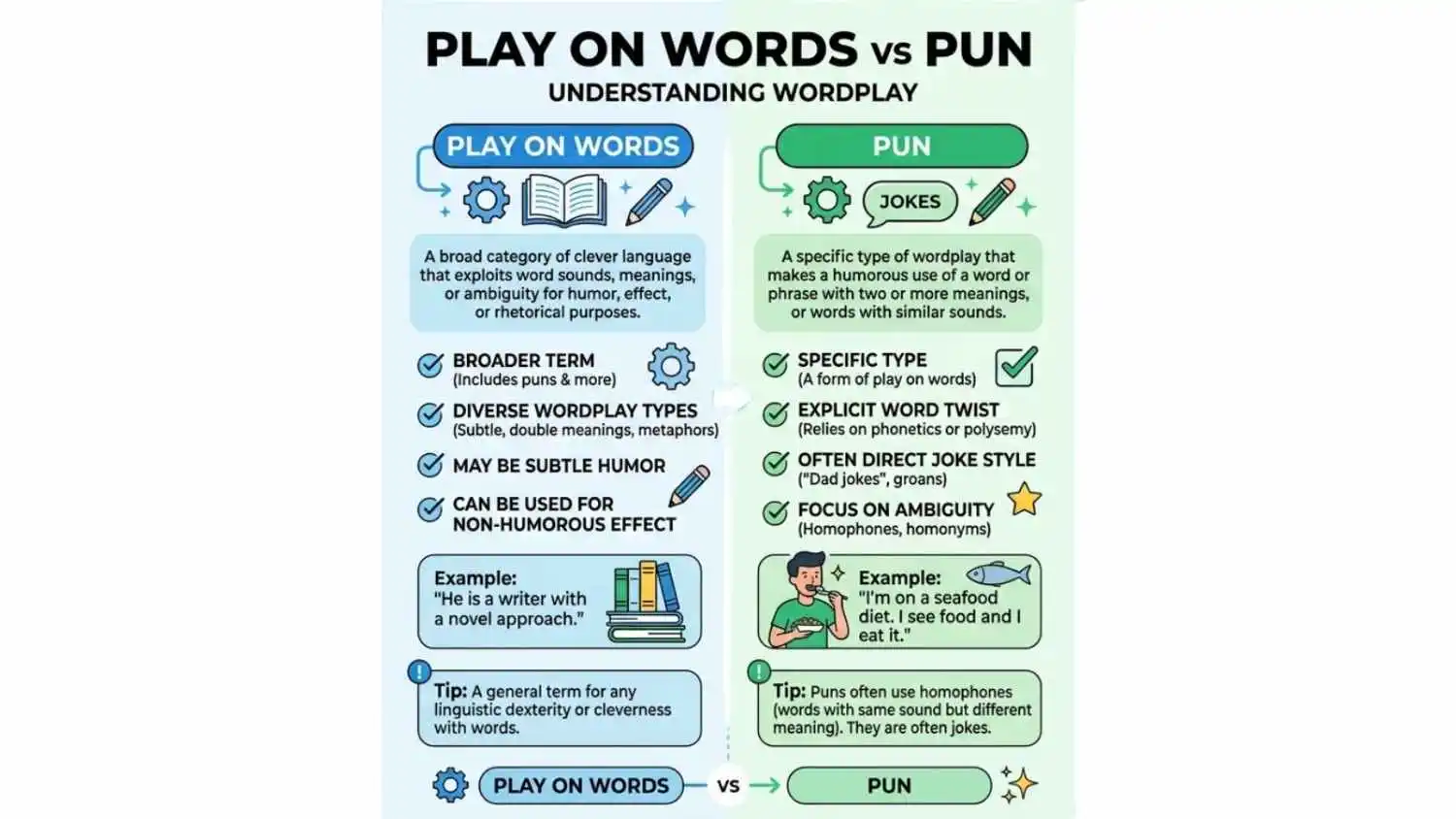
A pun is a type of wordplay that uses words with multiple meanings or similar sounds to create humor or another clever effect. Wordplay is a wider term. It can include puns, double meanings, sound patterns, and other creative uses of language.
For example:
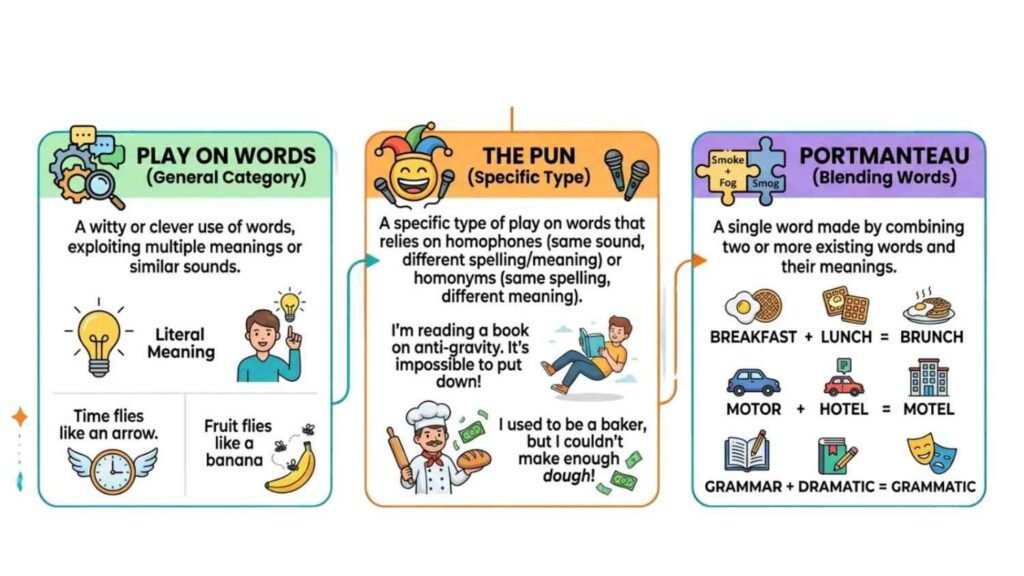
I used to be a baker, but I couldn’t make enough dough.
Here, dough means bread mixture, but it can also mean money. This is a pun.
People often use puns in jokes, advertisements, headlines, books, social media posts, and everyday speech.
In this guide, we will explain play on words vs pun, their meanings, origins, differences, examples, common mistakes, and correct usage.
Play on Words vs Pun – Quick Answer
The quick answer is:
A pun is a type of wordplay.
The terms are closely related, but they are not always exact synonyms.
What is wordplay?
Wordplay means using words in a clever, unusual, or creative way.
It can use:
- Double meanings
- Similar sounds
- Similar spellings
- Different meanings
- Unexpected combinations
- Puns
What is a pun?
A pun is a form of wordplay that usually uses two or more meanings of a word or similar-sounding words.
For example:
The bicycle couldn’t stand on its own because it was two-tired.
Here, two-tired sounds like too tired.
This is a pun.
Simple rule
Think of it this way:
Wordplay = the larger group
Pun = one type of wordplay
So, every pun can be called wordplay, but not every kind of wordplay is necessarily a pun.
The Origin of Play on Words vs Pun
Both ideas have a long history in English.
The origin of wordplay
The phrase wordplay combines two simple words:
word + play
The word play has long been used to describe fun, activity, or creative action.
When people use language in a playful or creative way, it can be called wordplay.
The phrase became common as writers and speakers used language to create humor, clever meanings, and artistic effects.
The origin of pun
The history of pun is less certain.
The modern English word pun became common around the 17th century. Its exact origin is debated.
Some language experts connect it to older words related to making a joke or using a word cleverly. However, there is no single origin that is accepted with complete certainty.
Puns themselves are much older than the modern word pun. Writers and speakers have used double meanings and similar sounds for centuries.
Why do people confuse the terms?
The confusion happens because a pun is a form of wordplay.
For example:
Time flies like an arrow. Fruit flies like a banana.
This sentence plays with the different meanings of flies and like.
It is wordplay, and it can also be viewed as a pun.
That overlap makes the two terms seem identical.
British English vs American English Spelling
There is almost no spelling difference between wordplay and pun in British and American English.
Both varieties use:
- wordplay
- pun
- puns
- wordplay techniques
- wordplay examples
Comparison table
| Word | British English | American English |
| Wordplay | wordplay | wordplay |
| Pun | pun | pun |
| Puns | puns | puns |
| Wordplay example | Correct | Correct |
| Pun example | Correct | Correct |
There is one style point worth knowing.
Wordplay is normally written as one word.
Correct:
The author uses clever wordplay.
Less standard:
The author uses clever word play.
In modern English, wordplay is the usual form.
Which Spelling Should You Use?
You do not need to choose between British and American spelling for these terms.
Use:
wordplay
and:
pun
Both are standard.
For US readers
The advertisement uses a clever pun.
For UK readers
The advertisement uses a clever pun.
The word is spelled the same way.
For Commonwealth readers
The same forms are widely understood.
For global readers
Use wordplay when talking about creative language in general.
Use pun when talking about a specific joke or word-based effect.
This distinction makes your writing more precise.
Common Mistakes with Play on Words vs Pun
Mistake 1: Thinking they are always exact synonyms
A pun is a type of wordplay.
So it is safer to think:
pun = one kind of wordplay
rather than:
pun = all wordplay
Mistake 2: Writing “play of words”
❌ That joke is a play of words.
✅ That joke is a play on words.
The common phrase is:
play on words
However, wordplay is often the simplest choice.
Mistake 3: Writing “play on word”
❌ It is a play on word.
✅ It is a play on words.
The fixed phrase normally uses the plural words.
Mistake 4: Calling every joke a pun
Not every joke is a pun.
A joke can be funny without using words in a double or clever way.
A pun specifically depends on language.
Mistake 5: Confusing “pun” with “punctuation”
These words look somewhat similar, but they have completely different meanings.
A pun is a type of wordplay.
Punctuation refers to marks such as commas, periods, and question marks.
Play on Words vs Pun in Everyday Examples
In advertising
Companies often use puns because they are short and easy to remember.
For example, a bakery might use:
Donut worry, be happy.
The phrase plays with do not and donut.
This is a pun.
In headlines
News writers sometimes use wordplay to make headlines more interesting.
For example:
Lettuce celebrate!
The word lettuce sounds like let us.
This is a playful use of language.
On social media
People often use puns in captions and posts.
I am grape at making jokes.
Here, grape is used as a playful replacement for great.
Emails
Wordplay can make informal emails more fun.
Let’s get this meeting rolling!
This can be a playful phrase if the topic involves wheels or movement.
For formal business emails, however, simple and direct language is often better.
In books
Authors use wordplay to create humor, style, or hidden meanings.
The writer uses wordplay throughout the story.
A particular example may be a pun, while other examples may use different language techniques.
In everyday conversation
People often make puns without planning them.
I wondered why the baseball was getting bigger. Then it hit me.
The phrase hit me has more than one possible meaning.
This creates the joke.
Play on Words vs Pun – Google Trends & Usage Data
Searches for play on words and pun often come from people who want to understand humor, writing, language, and creative expression.
Common related searches include:
- Play on words meaning
- Play on words examples
- Pun meaning
- Pun examples
- Funny puns
- Wordplay examples
- Difference between wordplay and pun
- Types of wordplay
The word pun is widely used in everyday English. It is especially common in humor, advertising, entertainment, social media, and writing.
Wordplay has a broader meaning, so it appears in discussions about literature, poetry, jokes, advertising, linguistics, and creative writing.
Search interest can vary by country and context. Google Trends measures relative search interest rather than the total number of times a word appears in all English writing.
For SEO, a useful article should explain the difference early. People searching for play on words vs pun usually want a simple answer first.
The key point is:
A pun is a form of wordplay, while wordplay covers a wider range of creative language techniques.
Play on Words vs Pun: Side-by-Side Comparison
| Feature | Play on Words | Pun |
| Basic meaning | Creative use of words | A type of wordplay |
| Main purpose | Humor, style, or clever meaning | Usually humor or clever meaning |
| Uses double meanings | Sometimes | Often |
| Uses similar sounds | Sometimes | Often |
| Wider term | Yes | No |
| Can include puns | Yes | It is a pun |
| Common in jokes | Yes | Yes |
| Common in advertising | Yes | Yes |
| Example | Clever use of language | “I’m reading a book about anti-gravity. It’s impossible to put down.” |
What Is a Play on Words?
The phrase play on words means using words in a creative way.
For example:
The math teacher has too many problems.
The word problems can mean math questions or difficulties.
This is a play on words.
It can also be called wordplay.
What Is a Pun?
A pun usually depends on:
- A word with two meanings, or
- Two words that sound similar.
For example:
I used to be a banker, but I lost interest.
The word interest can mean money earned from savings or loans. It can also mean attention or concern.
That double meaning creates the joke.
Types of Puns
There are several common types of puns.
Homophonic puns
These use words that sound alike but have different meanings.
Example:
I need a break because I have been working hard.
A joke could play with break and brake.
Homographic puns
These use words that have the same spelling but different meanings.
Example:
The fisherman went to the bank.
Bank can mean the side of a river or a financial institution.
Double-meaning puns
These use a word or phrase with more than one meaning.
Example:
The baker quit because he couldn’t make enough dough.
Dough means bread mixture.
It can also mean money in informal English.
FAQs;
1. Is a pun the same as a play on words?
Not exactly. A pun is a type of wordplay. The phrase play on words can describe a wider range of creative uses of language.
2. What is a simple example of a pun?
I used to be a banker, but I lost interest.
The word interest has two meanings here.
3. What is a play on words?
A play on words is a creative use of language that can involve double meanings, similar sounds, or unusual word combinations.
4. Is “play on words” grammatically correct?
Yes.
That headline is a clever play on words.
You can also say:
That headline uses clever wordplay.
5. Should I write wordplay or word play?
Wordplay is the standard modern form when you mean creative use of language.
6. Are puns always funny?
No. Puns are often used for humor, but they can also be used for clever effects, titles, advertising, and creative writing.
7. What is the difference between wordplay and a pun?
Wordplay is the broader term. A pun is a specific type of wordplay that often uses multiple meanings or similar-sounding words.
Conclusion;
The difference between play on words vs pun is simple once you see how the two terms relate. Wordplay is the broader idea. It means using language in a creative, clever, or unusual way. It can involve double meanings, sounds, spelling, or other language tricks.
A pun is one type of wordplay. It often uses a word with two meanings or two words that sound alike. For example, “I lost interest” can be a pun because interest can mean both attention and money earned from an investment.
The phrase play on words is also correct. You can say:
That is a clever play on words.
You can also say:
That is clever wordplay.
For everyday writing, pun is best when you mean a specific word-based joke. Use wordplay when you are talking about creative language more generally.
There is no British or American spelling difference for these terms. Wordplay and pun are standard in both varieties of English.
The easiest rule to remember is:
Wordplay is the bigger category. A pun is one kind of wordplay.