You read a sign that says “This coffee shop is a haven for book lovers.” Then you hear someone talk about “heaven” during a church service. Wait, are these the same word, just spelled a bit differently? Not even close, though they sound close enough to trip people up.
Let’s clear this up in plain, easy words.
Quick Answer
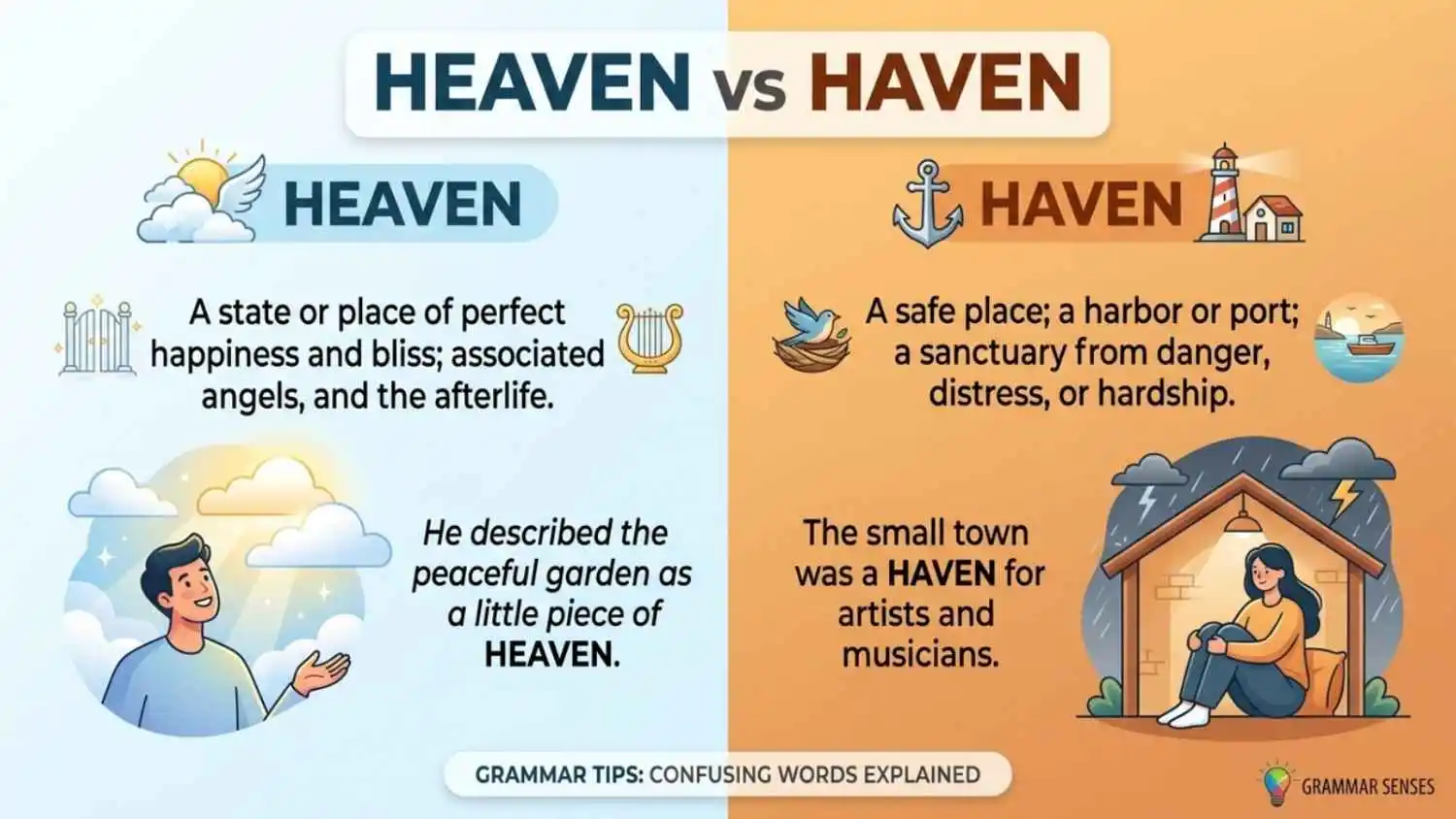
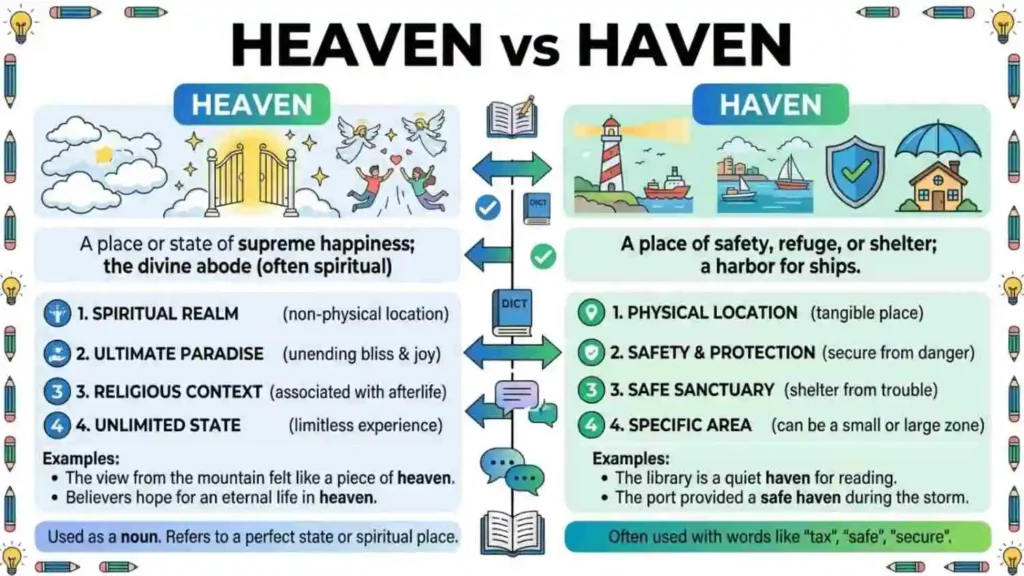
Heaven is most often a religious word. Many faiths use it to mean a place of peace and happiness after death, often thought of as being with a higher power. Example: “She believed her grandmother was now in heaven.”
Haven means a safe, calm place, away from trouble or stress. It does not have to be religious at all. Example: “The small cabin became her haven from the busy city.”
Simple way to remember it: heaven is about faith and the afterlife. Haven is about safety and calm, right here on Earth.
Why These Two Words Sound So Close
These two words are not actually related, even though they sound and look almost the same. That’s really the tricky part here.
Heaven comes from an old English word, “heofon,” which meant “sky” or “the space above the earth.” Long ago, many cultures pictured the sky as the home of gods or spirits, so over time, “heaven” grew into meaning a holy, peaceful place beyond this world, tied closely to religious belief.
Haven comes from a different old word, tied to the idea of a safe harbor for ships, a calm bay where boats could rest away from rough seas. Over time, this meaning grew beyond just ships and harbors, coming to mean any safe, peaceful place a person could turn to, away from stress or danger.
So even though they share a similar sound, these two words grew from two totally separate ideas, one tied to the sky and belief, the other tied to safety and shelter.
Breaking Down the Real Difference
| Heaven | Haven | |
| Main meaning | A holy place, often tied to religion | A safe, calm place |
| Tied to religion? | Yes, most of the time | No, not necessarily |
| Example | “He hoped to go to heaven.” | “The library was her haven after a long day.” |
| Can describe a real place? | Rarely, mostly a spiritual idea | Yes, often used for real places |
A Simple Way to Check Yourself
Ask this: am I talking about a religious or spiritual place, or a safe, calm place in real life?
If it’s about faith, the afterlife, or something spiritual, you want “heaven.”
If it’s about a real place that feels safe, calm, or comforting, you want “haven.”
Try It Yourself
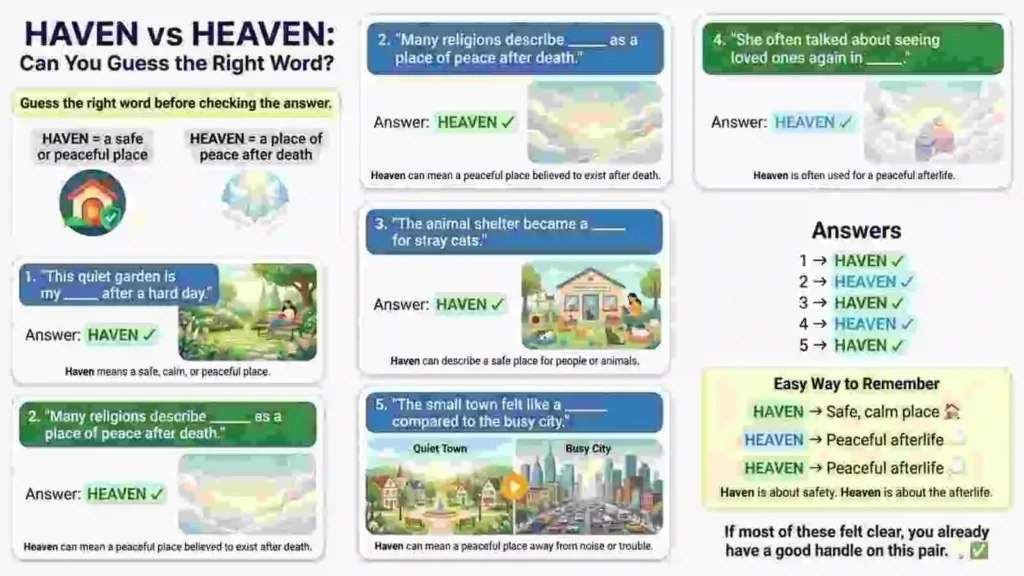
Guess the right word before checking the answer.
- “This quiet garden is my ___ after a hard day.” → haven
- “Many religions describe ___ as a place of peace after death.” → heaven
- “The animal shelter became a ___ for stray cats.” → haven
- “She often talked about seeing loved ones again in ___.” → heaven
- “The small town felt like a ___ compared to the busy city.” → haven
If most of these felt clear, you already have a good handle on this pair.
When Each Word Actually Fits
Talking about religious belief or the afterlife: Use “heaven.” Example: “He believed heaven was watching over him.”
Describing a safe, comforting place in real life: Use “haven.” Example: “The bookstore was a haven for quiet readers.”
Describing something wonderful, in a casual, non-religious way: “Heaven” is sometimes used loosely here too, like “This dessert is heaven,” meaning it’s amazing, not literally about the afterlife.
Talking about a place that shelters people or animals: “Haven” fits well here, since it’s tied closely to the idea of safety and shelter.
Writing something formal about safety, protection, or refuge: “Haven” is the more fitting word, since it stays grounded in real-world safety, not spiritual belief.
Common Mistakes People Make
Mixing up the spelling while writing quickly. Since these words sound and look so close, it’s an easy typo to make, especially in fast texting or writing.
Using “heaven” when talking about a safe, real-world place. While it’s sometimes used loosely in casual talk, “haven” is the more accurate word for describing calm, safe places on Earth.
Assuming both words are tied to religion. Only “heaven” carries that strong religious meaning by default. “Haven” is a completely non-religious word on its own.
Trusting spellcheck to catch the mix-up. Since both words are spelled correctly on their own, spellcheck often won’t flag this, even when it’s the wrong word for your sentence.
Seeing These Words in Real Life
A text to a friend: “This spa day is basically heaven, I never want to leave.”
A nonprofit’s website: “Our shelter is a haven for animals in need.”
Religious sermon: “Heaven offers comfort and peace beyond this world.”
A travel blog: “This quiet beach town felt like a true haven from city life.”
A casual comment about food: “This pizza is heaven, seriously.”
Why People Search This So Often
Writers and students search “heaven vs haven” a lot while typing quickly, pausing right before choosing the correct spelling in an email, story, or paper.
People learning English search this pair too, since the close sound and spelling between the two words can feel confusing without a clear, simple explanation.
Business owners and nonprofit groups also search this often, especially when naming a shelter, retreat, or safe space, wanting to pick the word that best fits their real, non-religious meaning.
A Few More Word Pairs Like This
| Pair | Meaning 1 | Meaning 2 |
| Heaven / Haven | A spiritual, holy place | A safe, calm place |
| Breath / Breathe | The air you take in | The act of taking air in |
| Quiet / Quite | Not loud | Very, or completely |
| Loose / Lose | Not tight | To not win, or misplace something |
Common Questions;
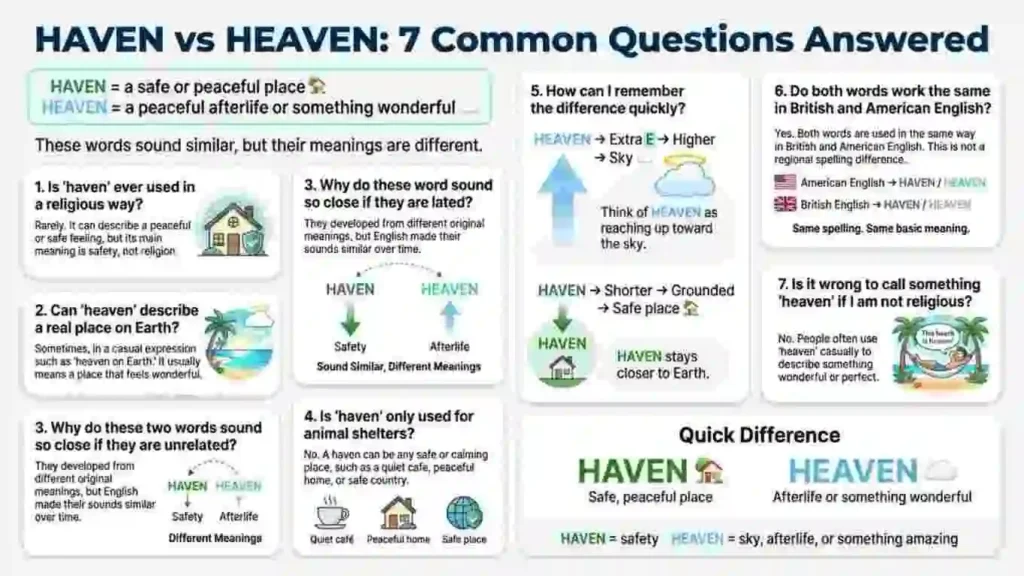
Is “haven” ever used in a religious way? Rarely, though it can sometimes describe a peaceful, safe feeling that overlaps loosely with spiritual comfort. Its main meaning stays tied to safety, not religion.
Can “heaven” describe a real place on Earth? Mostly in a casual, joking way, like calling a favorite vacation spot “heaven on Earth,” but this is more of a loose expression than its literal, religious meaning.
Why do these two words sound so close if they’re unrelated? It’s mostly coincidence in how English developed over time, with both words ending up sounding similar despite coming from very different original meanings.
Is “haven” only used for animal shelters? No, it’s used much more broadly, for any safe or calming place, like a quiet cafe, a peaceful home, or even a safe country for refugees.
How can I remember the difference quickly? Try this: “heaven” has an extra “e,” almost like it’s reaching a little higher, up toward the sky. “Haven” stays shorter and more grounded, like a safe spot right here on Earth.
Do both words work the same in British and American English? Yes, both words are used the same way in British and American English. This isn’t a regional spelling issue, just a simple sound-alike mix-up.
Is it wrong to say something is “heaven” if I’m not religious? Not at all. Many people use “heaven” casually to describe something wonderful, without meaning it in a strict religious sense.
Wrapping This Up;
“Heaven” and “haven” sound close, but they carry very different meanings. “Heaven” ties closely to faith, the afterlife, or something spiritual. “Haven” stays grounded in the real world, describing a safe, calm place away from stress or danger.
A quick way to check yourself: talking about faith or the afterlife, “heaven.” Talking about a safe, comforting place in real life, “haven.” That one small check clears up the mix-up almost every time.
Since spellcheck won’t always catch this one, it’s worth a quick second look, especially in writing meant to sound clear and correct.