When you want to describe a person who has a thin body, you may use the words slender or skinny. But are they the same? Not always. These two words are close in meaning, but they can give a very different feeling.
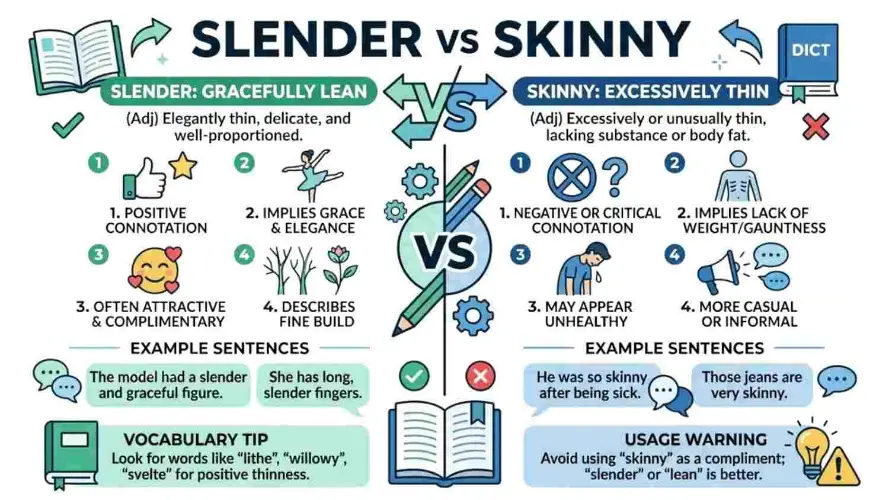
Many people search for “slender vs skinny” because they want to choose the right word in English. The main difference is tone. Slender usually sounds positive, polite, or elegant. Skinny simply means very thin, but it can sometimes sound negative or critical.
For example, you can say, “She has a slender figure.” This sounds polite and often gives a positive image. You can also say, “He is very skinny.” This tells us that he is very thin, but it may not sound as kind.
Knowing this small difference can help you write better English. It can also help you avoid sounding rude when talking about someone’s body.
In this guide, we will compare slender vs skinny, explain their origins, show everyday examples, and help you choose the right word.
Slender vs Skinny – Quick Answer
Slender and skinny both describe someone or something that is thin.
The main difference is the feeling they give.
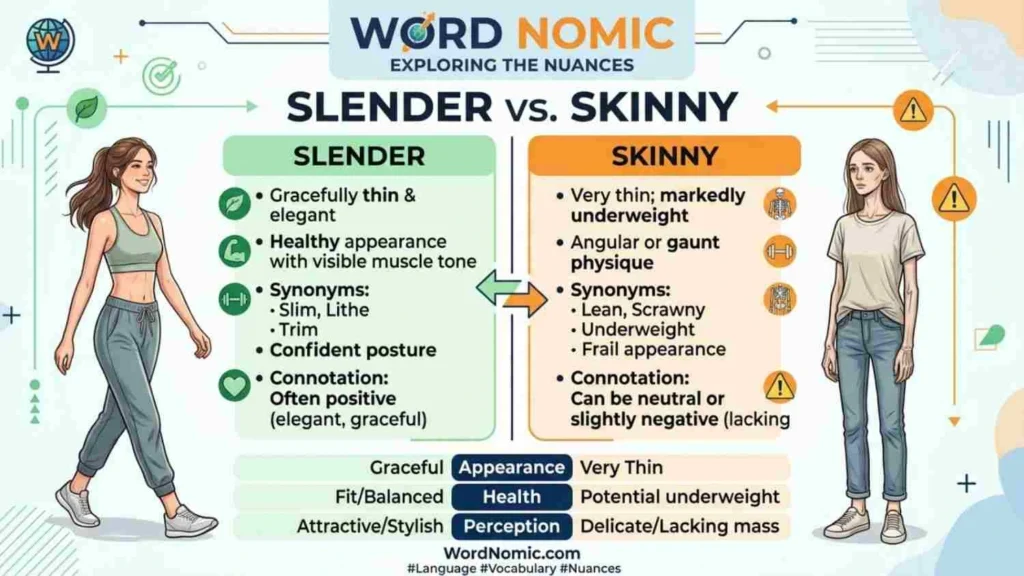
- Slender = thin in an attractive, graceful, or healthy-looking way.
- Skinny = very thin, often with little body fat.
- Slender usually has a positive or neutral tone.
- Skinny can be neutral, but it may sound negative.
Examples
Slender:
She has a slender figure.
This sounds polite and positive.
Skinny:
He was very skinny as a child.
This simply describes his body size, although the word can sound less positive.
The two words can also describe objects.
She wore a slender gold bracelet.
The dog has skinny legs.
So, slender often suggests a thin and graceful shape, while skinny focuses more on being very thin.
The Origin of Slender vs Skinny
The words slender and skinny have different histories.
The Origin of Slender
Slender entered English in the Middle English period. Its exact origin is not fully clear, but it became linked with the idea of something being small, thin, or slight.
Over time, slender developed a wider meaning.
Today, it can describe:
- A thin person
- A narrow object
- A small amount
- A weak chance
For example:
She has a slender waist.
There is only a slender chance of success.
The word often gives an image of something narrow, fine, or graceful.
The Origin of Skinny
Skinny comes from the word skin. It developed in English as a way to describe someone who has very little flesh or fat.
The word became common in informal English.
Today, skinny often means very thin.
For example:
The boy looked skinny after being sick.
Because of its link to having little flesh, skinny can sometimes sound less polite than slender.
British English vs American English Spelling
There is no major spelling difference between slender and skinny in British and American English.
Both varieties use:
| Word | British English | American English |
| Slender | slender | slender |
| Skinny | skinny | skinny |
| Comparative | slenderer / more slender | slenderer / more slender |
| Superlative | slenderest / most slender | slenderest / most slender |
The spelling slender stays the same in both forms of English.
The spelling skinny also stays the same.
However, the use and tone of these words can vary slightly by context.
British English
She is tall and slender.
He was a skinny teenager.
American English
She is tall and slender.
He was a skinny teenager.
Both sentences are correct in British and American English.
Which Spelling Should You Use?
You do not need to choose between British and American spelling here. Both slender and skinny have the same spelling in both forms.
Instead, choose the word based on your meaning and audience.
Use Slender When:
You want to sound polite or positive.
She has a slender figure.
It is also useful in formal writing.
The plant has slender leaves.
Use Skinny When:
You want to describe someone or something as very thin.
The cat has skinny legs.
It is more common in casual speech.
If you are writing about someone’s body, slender is often a safer choice because it sounds more positive.
For global English, slender is also a good choice when you want a polite and neutral tone.
Common Mistakes with Slender vs Skinny
Many learners use these words as exact synonyms. They are close, but the tone can change.
Mistake 1: Thinking They Always Have the Same Tone
Incorrect idea:
Slender and skinny always sound the same.
They do not.
Slender often sounds positive.
Skinny can sound negative.
Mistake 2: Using Skinny in Formal Compliments
You may say:
She looks slender in that dress.
This sounds natural and polite.
But:
She looks skinny in that dress.
This may sound like criticism.
Mistake 3: Thinking Skinny Always Means Unhealthy
Skinny means very thin. It does not always mean that a person is unhealthy.
For example:
He has always been skinny.
This describes his body type. It does not prove anything about his health.
Mistake 4: Using Slender for Everything
Slender is not always the best choice.
For example:
The dog has slender legs.
This can sound graceful.
But if you want to stress that the legs are unusually thin, skinny may be more natural:
The dog has skinny legs.
The best choice depends on the meaning you want to give.
Slender vs Skinny in Everyday Examples
Understanding examples is one of the best ways to learn the difference.
Everyday Speech
My sister is tall and slender.
My brother was very skinny when he was young.
The first sentence sounds positive. The second focuses on being very thin.
In Emails
For professional or polite writing, slender is usually better.
The model has a slender design.
Instead of:
The model has a skinny design.
However, skinny can work when the subject is an object and the style is casual.
In News Writing
News writers may use either word depending on the context.
The athlete has a slender build.
This sounds neutral and professional.
The rescued dog was weak and skinny.
Here, skinny helps show that the dog was very thin.
On Social Media
Social media often uses both words.
I love this slender dress design.
These jeans make me look skinny!
The meaning depends on the speaker and context.
In Formal Writing
Slender is normally the better choice.
The plant has long, slender leaves.
The bridge has slender support columns.
Skinny is more informal.
The plant has skinny leaves.
This is understandable, but it sounds less formal.
Slender vs Skinny: Comparison Table
| Feature | Slender | Skinny |
| Basic meaning | Thin and narrow | Very thin |
| Tone | Usually positive or neutral | Neutral or sometimes negative |
| Formal writing | Common | Less common |
| Casual speech | Common | Very common |
| Describes people | Yes | Yes |
| Describes objects | Yes | Yes |
| Suggests elegance | Often | Usually not |
| Can sound critical | Rarely | Sometimes |
| Best for polite body descriptions | Yes | Not always |
Simple Rule
Remember this:
Slender = thin and graceful.
Skinny = very thin.
This rule will help you choose the right word in most situations.
When Slender and Skinny Are Not Interchangeable
Although both words can mean thin, they do not always work in the same sentence.
Consider:
She has a slender figure.
This sounds like a compliment.
Now compare:
She has a skinny figure.
This sounds less natural and may sound negative.
Another example:
The tree has slender branches.
This gives an image of thin, graceful branches.
The tree has skinny branches.
This sounds more casual and stresses their thin size.
The difference is not always about facts. It is often about tone and image.
Slender vs Skinny: Google Trends & Usage Data
Search interest for “slender vs skinny” comes from people who want to understand the difference between similar English words.
The words themselves are used much more often than the exact comparison phrase.
Skinny is especially common in casual English, fashion, fitness, and everyday speech.
Slender appears often in:
- Fashion writing
- Descriptions of people
- Literature
- Product descriptions
- Nature writing
- Formal English
The exact popularity of each word can change by country and topic. Search trends also change over time.
In general, American and British English both use slender and skinny. Neither word is limited to one major English-speaking country.
For SEO and content writing, it is useful to cover both words because users may search for them when they are unsure about tone, meaning, or correct usage.
Slender vs Skinny: Side-by-Side Examples
| Situation | Better Word | Example |
| Polite description of a person | Slender | She has a slender figure. |
| Very thin person | Skinny | He was very skinny as a child. |
| Elegant body shape | Slender | She has a slender waist. |
| Very thin legs | Skinny | The puppy has skinny legs. |
| Plant branches | Slender | The tree has slender branches. |
| Casual body description | Skinny | He is tall and skinny. |
| Formal description | Slender | The plant has slender leaves. |
| Positive fashion description | Slender | The dress creates a slender look. |
FAQs;
1. Is slender the same as skinny?
Not exactly. Both mean thin, but slender often suggests a graceful or attractive thin shape. Skinny usually means very thin and can sometimes sound negative.
2. Is slender a positive word?
Yes. Slender usually has a positive or neutral tone when describing a person’s body.
3. Is skinny a rude word?
It can be. Skinny is not always rude, but it can sound critical when you use it to describe someone’s body.
4. Which is better, slender or skinny?
It depends on the context. Use slender for a polite or positive description. Use skinny when you simply want to stress that something is very thin.
5. Can slender describe objects?
Yes. You can describe narrow or thin objects as slender.
The vase has a slender neck.
6. Can skinny describe objects?
Yes. Skinny can describe thin parts of objects or animals, especially in casual English.
The chair has skinny legs.
7. Is slender more formal than skinny?
Yes. Slender is generally more suitable for formal and professional writing. Skinny is more common in casual speech.
Conclusion;
The difference between slender vs skinny is mainly about meaning, tone, and context.
Both words describe something thin. However, slender usually gives a more positive, polite, or graceful image. Skinny focuses more strongly on being very thin and can sometimes sound negative.
Use slender when you want to describe a person, object, or shape in a polite or elegant way. For example, “She has a slender figure” sounds positive. “The tree has slender branches” sounds natural and descriptive.
Use skinny when you want to stress that someone or something is very thin. It is especially common in casual English.
Neither word has a different British or American spelling. Both are spelled slender and skinny in both varieties of English.
The easiest rule is simple: slender often means thin and graceful, while skinny usually means very thin. Knowing this difference will help you choose words that sound natural, clear, and polite.