Have you ever stopped while writing and wondered, “Should I write catchup or catch-up?” You are not alone. This small spelling question can cause confusion because English uses several forms of this word.
The form you should use depends on what you mean. Catch-up is the standard form when the word works as a noun or an adjective. For example, you can say, “We had a catch-up after work” or “I watched a catch-up lesson.”
The word can also appear as a verb phrase: catch up. For example, “I need to catch up on my work.”
The form catchup is less common as a general English spelling. However, it can appear in some brand names, product names, or informal uses.
People search for “catchup vs catch-up” because they want to know which form is correct in emails, articles, school work, and professional writing.
In this guide, we will explain the difference between catchup vs catch-up, show common mistakes, and give simple examples.
Catchup vs Catch-Up – Quick Answer
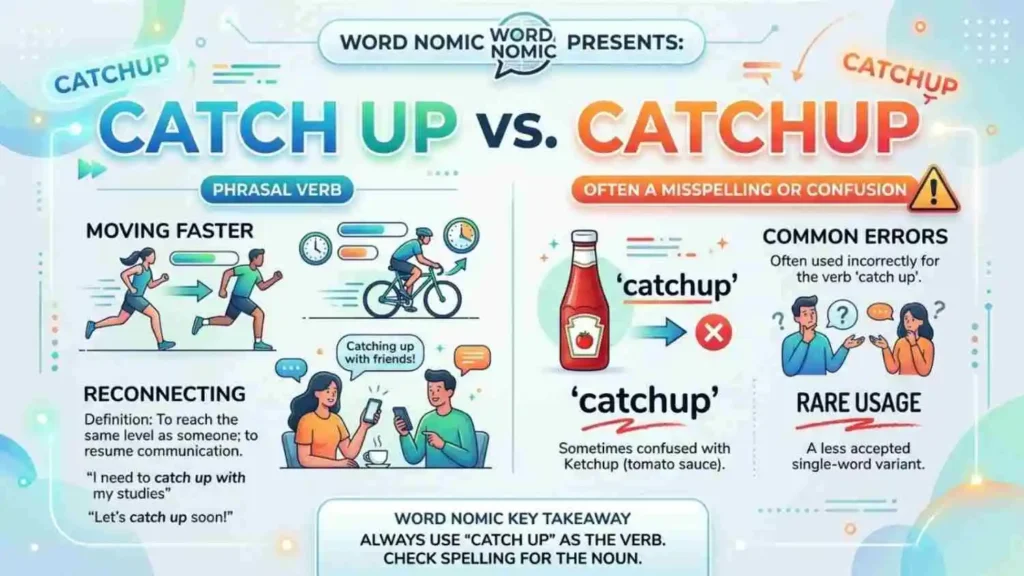
The main answer is simple:
- Catch up = verb phrase
- Catch-up = noun or adjective
- Catchup = uncommon as a standard English spelling
Catch Up as a Verb
Use catch up when you mean to reach the same level, learn missed information, or talk to someone after some time.
I need to catch up on my work.
Let’s catch up next week.
She is trying to catch up with her class.
Catch-Up as a Noun
Use catch-up when it acts as a noun.
We had a quick catch-up after lunch.
I need a catch-up with my manager.
Catch-Up as an Adjective
Use catch-up before a noun when it describes something designed to help someone reach the current level.
I watched a catch-up lesson.
The school offers catch-up classes.
What About Catchup?
Catchup as one word is not the usual standard form for these uses.
For normal English writing, choose catch up or catch-up based on the grammar.
The Origin of Catchup vs Catch-Up
The phrase catch up comes from the verb catch and the adverb or particle up.
The verb catch has a long history in English. It comes from Anglo-French and developed from earlier words related to taking hold of or capturing something.
The word up is an old English word that has been used for many centuries.
Together, catch up developed the meaning of reaching someone or something that is ahead.
For example:
The runner caught up with the leader.
The phrase later gained other meanings.
It can mean becoming informed about something:
I need to catch up on the news.
It can also mean talking with someone after not seeing them for some time:
Let’s catch up soon.
How Did Catch-Up Develop?
When a verb phrase becomes a noun or adjective, English often joins the words with a hyphen.
That is why we have:
catch up
as a verb phrase, but:
catch-up
as a noun or adjective.
This difference helps readers understand the grammar of the sentence.
The one-word form catchup is much less common in standard English. It may appear in names, labels, or informal writing, but it is not the normal choice for general English.
British English vs American English Spelling
British and American English generally use the same forms:
- catch up for the verb
- catch-up for the noun
- catch-up for the adjective
There is no major British-American spelling change in this word.
| Use | British English | American English |
| Verb | catch up | catch up |
| Noun | catch-up | catch-up |
| Adjective | catch-up | catch-up |
| One-word form | catchup is uncommon | catchup is uncommon |
British English Examples
I need to catch up on my emails.
We had a quick catch-up yesterday.
She joined a catch-up class.
American English Examples
I need to catch up on my emails.
We had a quick catch-up yesterday.
She joined a catch-up class.
The spelling stays the same in both forms of English.
Which Spelling Should You Use?
Your choice depends mainly on the grammar of your sentence.
Use Catch Up as a Verb
Use catch up when someone performs the action.
I need to catch up on my reading.
We should catch up soon.
He is working hard to catch up.
Use Catch-Up as a Noun
Use catch-up when you are talking about a meeting, conversation, or period used to share information.
Let’s have a catch-up tomorrow.
I had a catch-up with my boss.
Use Catch-Up as an Adjective
Use catch-up when it describes another noun.
The school offers catch-up classes.
I completed the catch-up work.
What Should Global Writers Use?
For global English, the safest rule is simple:
Use “catch up” as a verb and “catch-up” as a noun or adjective.
Avoid catchup in formal writing unless it is part of a specific name or brand.
Common Mistakes with Catchup vs Catch-Up
Mistake 1: Writing Catchup as a Verb
Incorrect:
I need to catchup on my work.
Correct:
I need to catch up on my work.
The verb phrase has two separate words.
Mistake 2: Using Catch-Up as a Verb
Incorrect:
I need to catch-up on my emails.
Correct:
I need to catch up on my emails.
Do not use a hyphen when catch up is the verb phrase.
Mistake 3: Leaving Out the Hyphen in a Noun
Less standard:
We had a catchup after work.
Better:
We had a catch-up after work.
The hyphen makes the noun form clear.
Mistake 4: Using Catchup in Formal Writing
Catchup may appear in informal text or names, but it is not the usual standard form.
For professional writing, use:
catch up
or:
catch-up
depending on the sentence.
Mistake 5: Confusing Catch Up With Catch-Up
Compare these sentences:
I need to catch up with Sarah.
Here, catch up is a verb phrase.
I had a catch-up with Sarah.
Here, catch-up is a noun.
The meaning is related, but the grammar is different.
Catchup vs Catch-Up in Everyday Examples
The best way to learn the difference is to see the words in real sentences.
Emails
When writing an email, use catch up as a verb:
I would like to catch up with you about the project.
You can use catch-up as a noun:
Could we arrange a quick catch-up next week?
In Business Writing
Professional writing often uses both forms.
We need to catch up on the latest sales figures.
Let’s schedule a catch-up meeting.
The first example uses the verb phrase. The second uses catch-up as a describing word.
In News Writing
A news article may use catch up when describing an action:
The team is trying to catch up with its rivals.
It may use catch-up before a noun:
The government announced a catch-up plan.
On Social Media
Informal posts often use catch up:
Haven’t seen you in ages. Let’s catch up!
You may also see:
Quick catch-up with an old friend today!
In Formal Writing
Use the standard forms:
Students can use the program to catch up on missed lessons.
The school provides catch-up classes for students who need extra help.
Avoid catchup unless there is a special reason to use it.
Catchup vs Catch-Up – Google Trends & Usage Data
Searches for “catchup vs catch-up” usually come from people who are unsure about the correct spelling or grammar.
The phrase catch up is very common because it has several meanings. People use it in work, school, social life, news, and everyday conversation.
Catch-up is also common, especially in:
- Business
- Education
- News
- Meetings
- Social media
- Casual conversation
The one-word form catchup is much less common in standard English.
Search interest can vary by country and context. British and American users both use catch up and catch-up. The difference is mainly grammatical rather than regional.
Google Trends can also show changes in search interest over time. However, search volume for an exact spelling question does not always represent how often a word appears in normal writing.
For SEO writers, it is useful to explain all three forms because users may type catchup, catch-up, or catch up when searching for the answer.
Catchup vs Catch-Up – Comparison Table
| Form | Grammar | Meaning | Example |
| catch up | Verb phrase | Reach the same level or get current | I need to catch up on my work. |
| catch up | Verb phrase | Talk after some time | Let’s catch up soon. |
| catch-up | Noun | A meeting or conversation | We had a catch-up. |
| catch-up | Adjective | Related to catching up | She joined a catch-up class. |
| catchup | Uncommon one-word form | Usually not standard for these uses | Avoid it in formal writing. |
Simple Rule to Remember
Think of it this way:
Action = catch up
Thing or description = catch-up
For example:
I need to catch up.
We had a catch-up.
I joined a catch-up class.
This simple rule works in most cases.
Catch Up vs Catch-Up vs Catchup Examples
Here are more examples to make the difference clear.
Correct
I need to catch up on my reading.
Correct
Let’s have a catch-up tomorrow.
She attended a catch-up session.
Usually Avoid
I need to catchup on my reading.
Usually Avoid
Let’s have a catchup tomorrow.
In standard English writing, the two-word and hyphenated forms are the safer choices.
FAQs;
1. Is catchup one word?
Usually, no. Catchup is not the standard spelling for the common verb and noun uses. Use catch up or catch-up instead.
2. Is catch-up hyphenated?
Yes, when catch-up works as a noun or adjective.
We had a catch-up.
I joined a catch-up class.
3. Is catch up two words?
Yes. When it works as a verb phrase, write catch up as two words.
I need to catch up on my work.
4. Which is correct: catch up or catch-up?
Both can be correct, but they have different grammar.
Catch up is a verb phrase.
Catch-up is usually a noun or adjective.
5. Should I write catchup in an email?
It is better to avoid catchup in a professional email. Use catch up or catch-up based on the sentence.
6. Is catch-up used in British English?
Yes. British English uses catch-up as a noun and adjective and catch up as a verb.
7. Is catch-up used in American English?
Yes. American English also uses catch-up and catch up in the same main ways.
Conclusion;
The difference between catchup vs catch-up is mostly about standard spelling and grammar. The most important thing to remember is that catch up and catch-up do different jobs.
Use catch up as a verb phrase. For example, “I need to catch up on my work” and “Let’s catch up soon.” The two words stay separate because they describe an action.
Use catch-up as a noun or adjective. For example, “We had a quick catch-up” and “She attended a catch-up class.” The hyphen helps show that the words work together as one unit.
The one-word form catchup is not the normal choice in standard English. It may appear in informal writing or special names, but professional writers should generally avoid it.
These rules work in both British and American English. So, when you are unsure, remember the simple rule: action means catch up, while a thing or description means catch-up.

Emily Carter is an English grammar writer based in Portland, Oregon, with 7+ years of experience turning tricky grammar rules into simple, easy lessons.