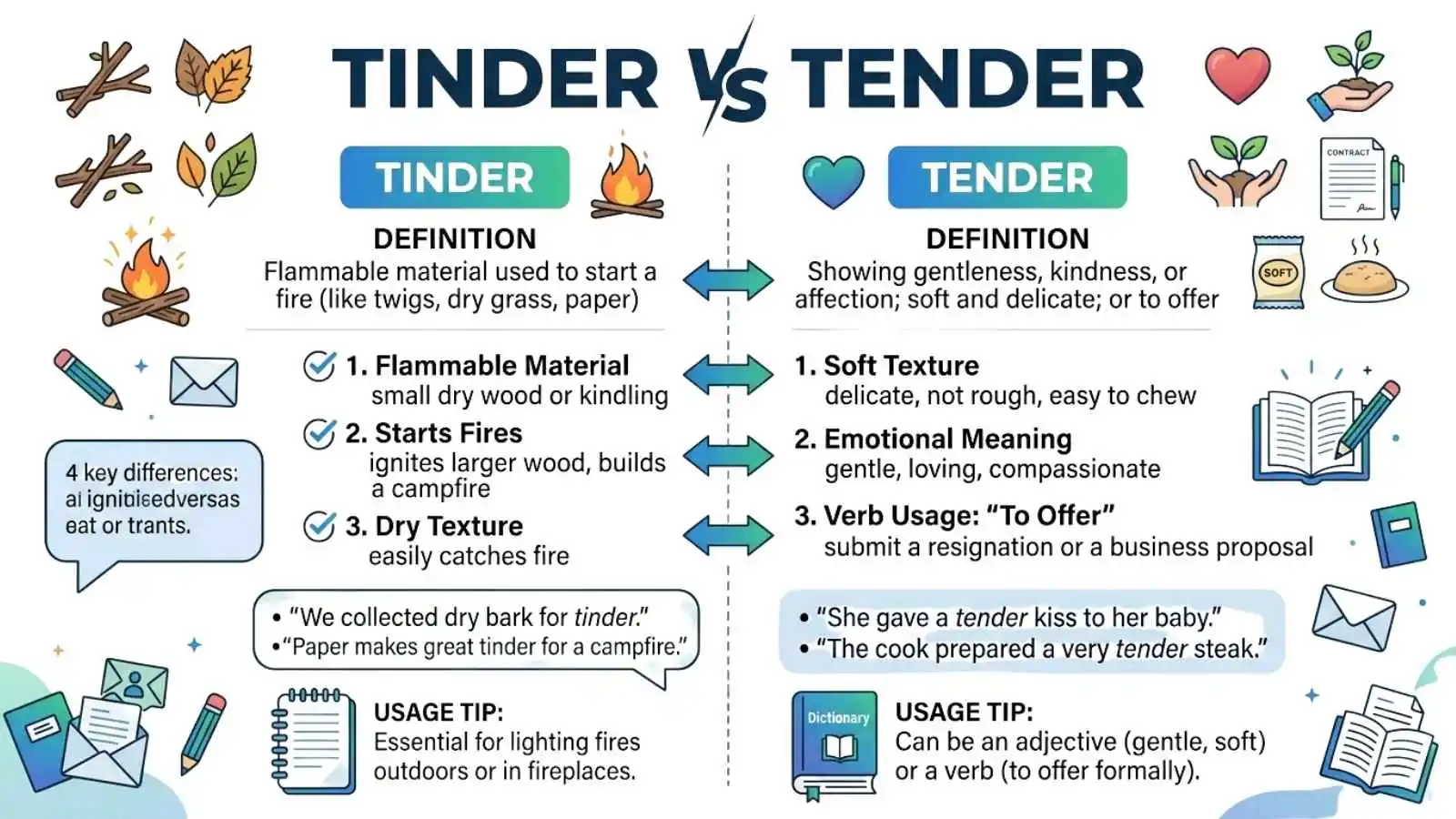
You read a sentence. It talks about starting a fire, or maybe about a soft, gentle touch. You see a word that looks like “tinder” or “tender.” You pause. They look so close. Just one letter is different. But do they mean anything alike? Or are they totally different words?
This mix-up happens more than you might think. Both words look almost the same on the page. Both sound close when spoken fast. But they come from different roots and mean very different things. One is about fire. The other is about softness, care, or even offering something.
People search “tinder vs tender” because they see both words often, in books, in daily talk, and yes, even as the name of a well-known dating app. They want a clear answer: are these words related, or just two words that happen to look alike?
This guide gives you a fast answer first. Then it explains where each word comes from, how to use them the right way, and how to never mix them up again.
Tinder vs Tender – Quick Answer
These two words are not related in meaning. They just happen to look similar.
- Tinder = dry material, like small sticks, dry grass, or paper, used to help start a fire. It can also refer to the well-known dating app named after this idea, since the app is meant to help “spark” a connection.
- Tender = soft, gentle, or easily hurt. It can describe food that is soft and easy to chew, a kind and caring feeling, or even the act of formally offering something, like money or a resignation.
Simple examples:
- “We gathered dry leaves and tinder to start the campfire.” ✅
- “The meat was so tender it fell off the bone.” ✅
- “She gave her friend a tender hug after the sad news.” ✅
- “He had to tender his resignation before moving abroad.” ✅
In short: “tinder” is about fire-starting material. “Tender” is about softness, care, or offering something formally.
Where Do These Words Come From?
Tinder comes from Old English, from the word “tynder,” which was linked to the idea of setting something on fire. This word has stayed close to its original meaning for hundreds of years. Tinder has always meant small, dry material that catches fire easily, helping a small flame grow into a full fire.
Tender comes from a completely different root. It traces back to the Latin word “tener,” which meant “soft,” “delicate,” or “young.” This Latin word moved through French and into English, keeping its soft, gentle meaning the whole way. Over time, English also added a second meaning to “tender”: the act of formally offering or presenting something, like an offer of money, a resignation, or a bid for a job. This second meaning comes from a separate but related Latin word, “tendere,” meaning “to stretch out” or “to offer.”
So while “tinder” and “tender” look alike, they come from two very different word families. One is tied to fire. The other is tied to softness and offering. They ended up looking similar purely by chance, not because they share a history.
British English vs American English Spelling
This is an important point to clear up. Tinder and tender are not a British versus American spelling pair, like “colour” and “color.” Both words are spelled the same way in every English-speaking country. There is no regional spelling split here at all.
| Feature | American English | British English |
| Spelling of “tinder” | Same | Same |
| Spelling of “tender” | Same | Same |
| Meaning of “tinder” | Fire-starting material | Fire-starting material |
| Meaning of “tender” | Soft, gentle, or to formally offer | Soft, gentle, or to formally offer |
| Regional spelling difference | None | None |
So there is no spelling rule to learn here, like “colour” and “color.” Both words are correct everywhere. The real task is knowing which word fits the meaning you want.
Which Word Should You Use?
Since spelling does not change by region, the right word depends entirely on what you are trying to say.
- Talking about starting a fire? Use “tinder.” Example: “Collect some dry tinder before it rains.”
- Talking about soft food, a gentle feeling, or a caring moment? Use “tender.” Example: “She spoke in a tender voice to calm the child.”
- Talking about formally offering money, a bid, or a resignation? Use “tender” as well, since this is a second, separate meaning of the same word. Example: “The company plans to tender a new offer for the contract.”
- Talking about the dating app? The company named the app “Tinder” and capitalized it because it is a brand name inspired by the idea of a small spark growing into something bigger.
If you are ever unsure, remember this: “tinder” only has one main meaning, tied to fire. “Tender” has several meanings, tied to softness, care, or a formal offer.
Common Mistakes with Tinder and Tender
Mistake 1: Mixing up the spelling by accident Because the words look so close, people sometimes type the wrong one without noticing.
- ❌ “The steak was so tinder, it melted in my mouth.”
- ✅ “The steak was so tender, it melted in my mouth.”
Mistake 2: Assuming the words are related in meaning Since they look alike, some people think “tinder” and “tender” share a root or a similar meaning. They do not. One is about fire. The other is about softness or offering.
Mistake 3: Forgetting that “tender” has more than one meaning
Some people know “tender” only as a word that means soft or gentle. They become confused when people use “tender” to describe offering money, submitting a bid, or resigning from a job.
- Example: “The city will open the tender process for the new bridge project next month.” (this “tender” means a formal offer or bid, not softness)
Mistake 4: Writing “Tinder” in lowercase when talking about the app Since “Tinder” is a brand name, it should always be capitalized when referring to the dating app.
- ❌ “I matched with someone on tinder.”
- ✅ “I matched with someone on Tinder.”
Tinder and Tender in Everyday Examples
In an email: “Please submit your tender for the new office renovation project by Friday.”
In news writing: “Firefighters warned that dry tinder in the forest could make wildfires spread faster this summer.”
On social media: “Just had the most tender, juicy steak at dinner tonight!
Formal writing: The company with the strongest tender offer will win the contract.
In casual talk: “He was so tender with his little sister when she was scared.”
Notice how “tinder” almost always shows up around fire, camping, or wildfires. “Tender” shows up in a much wider range of settings, from food to feelings to business offers.
Tinder vs Tender – Google Trends and Usage Data
People search for Tinder much more often because millions use the popular dating app. They also search for its traditional meaning as fire-starting material, especially during camping seasons and wildfire news events.
People search for tender steadily across many topics. They look for recipes about tender food, advice about emotions and relationships, and information about business or legal tenders, bids, and formal offers.
By region:
- United States: “Tinder” searches spike heavily due to the dating app’s popularity. “Tender” remains steady in cooking, business, and everyday writing.
Word Comparison Table
| Word | Type | Common Meaning | Example Use |
| Tinder | Noun | Fire-starting material | “Add some tinder to the fire pit.” |
| Tinder (capitalized) | Brand name | Dating app | “We met on Tinder.” |
| Tender | Adjective | Soft, gentle, easily hurt | “The chicken was tender and juicy.” |
| Tender | Verb/Noun | To formally offer, or a formal offer/bid | “The company submitted a tender for the project.” |
FAQs
1. Are “tinder” and “tender” related words? No. They come from completely different roots. “Tinder” is tied to fire. “Tender” is tied to softness, care, or formally offering something.
3. Can “tender” mean more than just “soft”? Yes. “Tender” can also mean a formal offer, like a business bid, or the act of formally presenting something, like a resignation.
4. Is there a British versus American spelling difference between these words? No. Both words are spelled and used the same way in both British and American English.
5. What is a “legal tender”? This refers to money that is officially accepted as payment in a country, like coins and paper currency. It uses the “formal offering” meaning of “tender.”
6. What does it mean to “tender your resignation”? It means to formally submit or offer your resignation to your employer, using the “to formally offer” meaning of “tender.”
7. Why do these two words look so similar if they are unrelated? It is simply a coincidence in English. Many words that look alike come from entirely different word families and languages.
Conclusion
“Tinder” and “tender” may look almost the same, but they come from two completely different word families and mean very different things. “Tinder” is about fire-starting material, and it is also the name of a popular dating app. “Tender” is about softness, gentle care, and even the act of formally offering something, like money or a resignation.
There is no British versus American spelling difference here. Both words are spelled the same everywhere, and knowing the difference comes down to meaning, not location. The two words simply look alike by chance, not because they share any real history.
Next time you see these words, remember this simple trick: think “fire” for tinder, and think “soft” or “offer” for tender. That small memory trick will help you use both words correctly every time.

Emily Carter is an English grammar writer based in Portland, Oregon, with 7+ years of experience turning tricky grammar rules into simple, easy lessons.










