You are writing a work email. T want to say people are getting involved and paying attention. You type the word. Then you stop. Is it “engage”? Or is it “ingage”? They sound the same when you say them out loud. But only one spelling is correct.
This mix-up happens a lot. The word shows up in business writing, school work, and social media posts about likes, comments, and shares. Since the word is used so often today, people want to make sure they spell it the right way.
The confusion happens because the start of the word is easy to mishear. When people say it fast, the first part can sound like “in-gage” instead of “en-gage.” This makes some people guess the wrong spelling.
In this guide, you will get a fast answer first. Then you will learn where the word comes from. You will see real examples, an easy table, and simple tips. By the end, you will always know which spelling to use.
Engage or Ingage – Quick Answer
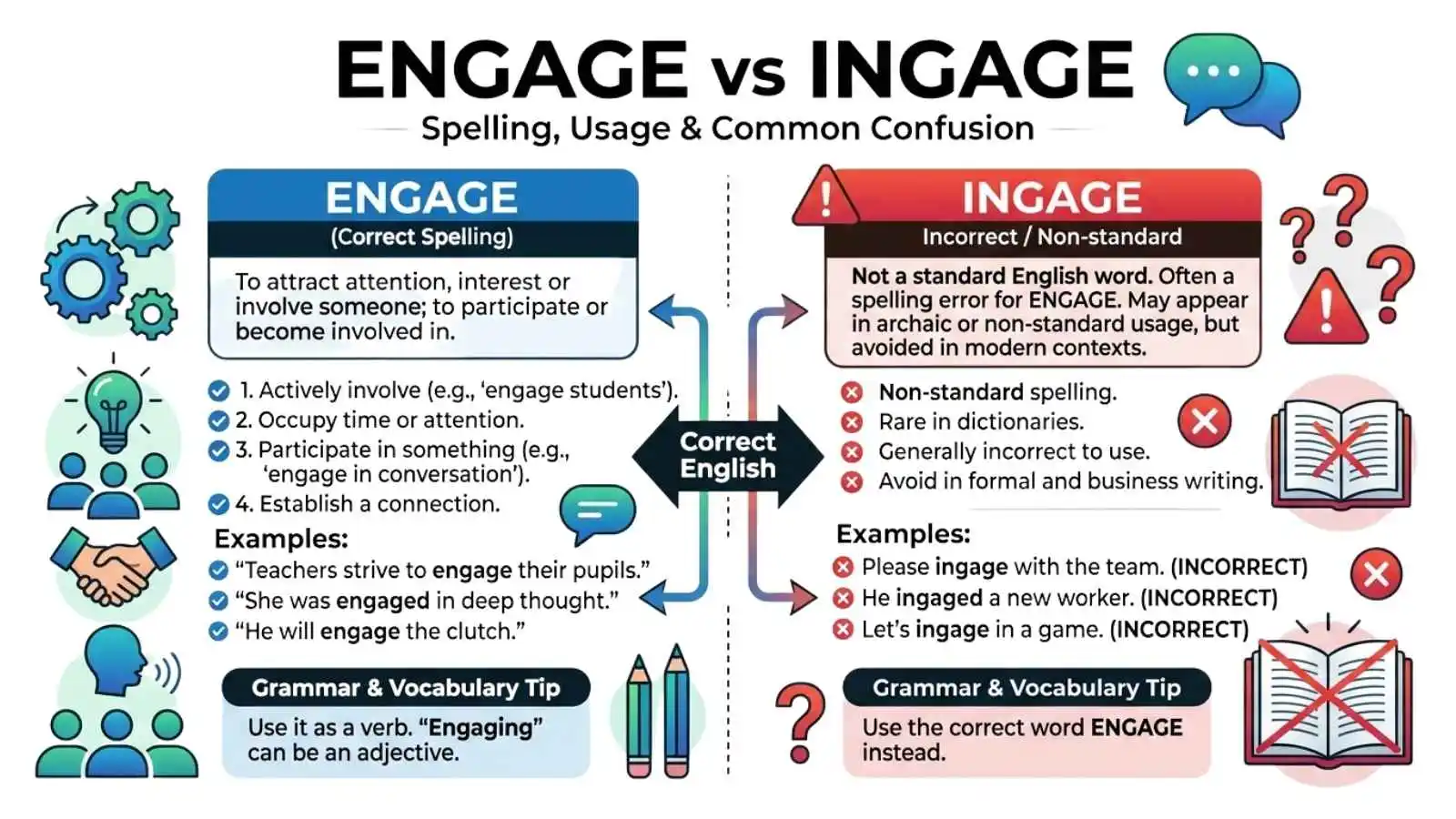
The correct spelling is engage. It starts with the letters “en-.”
Ingage is not correct. It is a common spelling mistake.
Simple examples:
- “We want to engage more customers online.” ✅
- “The teacher tried to engage the whole class.” ✅
- “We want to ingage more customers online.” ❌ (Wrong spelling)
Easy way to remember it: think of other common words that start with “en-,” like “enjoy,” “enter,” and “enable.” “Engage” follows the exact same pattern.
The Origin of Engage
The word “engage” comes from an old French word, “engager,” which meant “to pledge” or “to bind by a promise.” That French word was built from “en-,” meaning “to make” or “to put into,” and “gage,” which meant a pledge or a promise, almost like a small token given to show you meant to keep your word.
Over time, English borrowed this word and slowly widened its meaning. “Engage” grew to mean getting involved in something, paying attention to something, or making a commitment, whether that is a task, a conversation, or another person.
This is why “engage” always starts with “en-.” That small piece of the word has been part of it since it first came into English from French. There was never a form of the word that started with “in-.” The “ingage” spelling is simply a modern mistake, made because the sound at the start of the word is easy to mishear, not because of any real older spelling.
British English vs American English Spelling
Some English words are spelled differently in British and American English, like “colour” and “color.”
But “engage” is not one of those words. Both British English and American English spell it the exact same way: engage, starting with “en-.”
There is no British version and no American version of this word. It stays the same everywhere in the world.
| Word Form | American English | British English |
| Base word | Engage | Engage |
| Past tense | Engaged | Engaged |
| Noun form | Engagement | Engagement |
| Wrong spelling | Ingage (never correct) | Ingage (never correct) |
As shown above, every form of this word matches across both spelling systems. Once you learn the correct spelling, it works the same no matter where you live.
Which Spelling Should You Use?
Since both British and American English agree on this word, the answer stays the same no matter where you are.
- Writing in the United States? Use “engage.”
- Writing in the United Kingdom or Commonwealth countries like Canada, Australia, or India? Use “engage.”
- Writing for a global audience? Use “engage.”
There is no place in the world where “ingage” is correct. It is not a regional spelling. This is not an old or accepted form of the word. It is simply a common typing slip. You can safely use “engage” in any kind of writing, from school papers to business reports to social media posts.
Common Mistakes with Engage
Here are the most common errors people make, and how to fix them.
Mistake 1: Writing “ingage” instead of “engage” This is the most common mistake of all. It happens because the start of the word is easy to mishear.
- ❌ “We want to ingage our audience.”
- ✅ “We want to engage our audience.”
Mistake 2: Writing “engagment” instead of “engagement” This mistake often happens along with the first one, since both words are related and both can be typed too fast.
- ❌ “Customer engagment improved this month.”
- ✅ “Customer engagement improved this month.”
Mistake 3: Mixing up “engage” and “encourage” Both words start with “en-” and both are used in similar settings, like marketing or teaching, but they mean different things. “Engage” means to get someone involved or interested. “Encourage” means to give someone support or confidence to do something.
- “We want to engage our readers with fun content.”
- “We want to encourage our readers to leave a comment.”
Mistake 4: Forgetting the “e” at the end when adding “-ing” When you add “-ing” to “engage,” the ending “e” is dropped.
- ❌ “We are engageing more users this week.”
- ✅ “We are engaging more users this week.”
Engage in Everyday Examples
In an email: “Our new campaign aims to engage more customers on social media.”
In news writing: “The company hopes the new app will engage younger users.”
On social media: “Loving how this post is helping us engage with our followers! 💬”
In formal writing: “The report highlights ways to engage employees and improve morale.”
Notice how “engage” fits smoothly into business, teaching, and social media talk. It is one of the most common words used when people talk about getting others interested or involved.
Engage – Google Trends and Usage Data
Search data shows that “engage” is searched far more often than “ingage” all over the world. Countries like the United States, the United Kingdom, Canada, India, and Australia all show strong, steady searches for “engage,” especially in marketing, business, and social media content.
Searches for “ingage” still happen, but in much smaller numbers. Most of these searches come from people who are simply checking their spelling before sending a message or posting online. This shows that “ingage” is a common typing mistake, not an accepted form of the word.
Interest in “engage” often rises around marketing seasons, product launches, and school terms, since so many businesses and teachers talk about ways to engage their audience or their students.
Word Comparison Table
| Spelling | Correct? | Common Region | Search Volume |
| Engage | Yes | US, UK, Global | High |
| Ingage | No | Misspelling, all regions | Low |
| Engagement (noun) | Yes | US, UK, Global | High |
| Engaging (adjective) | Yes | US, UK, Global | Moderate |
FAQs:
1. Is “ingage” ever correct in English? No. “Ingage” is not found in any standard English dictionary. It is always a spelling mistake.
2. Why do people spell it “ingage” by mistake? Because the start of the word can sound like “in-” when spoken quickly, some people guess the wrong spelling.
3. Is “engage” spelled differently in British and American English? No. Both versions of English use the exact same spelling: “engage.”
5. What is the noun form of “engage”? The noun form is “engagement.” Example: “Customer engagement grew after the new website launched.”
6. Is “engage” the same as “involve”? They are close in meaning, but “engage” often suggests active interest or attention, while “involve” simply means being part of something.
7. How do I spell the “-ing” form of “engage”? Drop the final “e” and add “-ing”: “engaging.” Example: “The speaker was very engaging.”
Conclusion:
The word “engage” trips people up because its start is easy to mishear, making “ingage” feel like it could be right. But the rule is simple: “engage” always starts with “en-,” just like “enjoy,” “enter,” and “enable.”
This word comes from an old French word meaning “to pledge” or “to bind by a promise.” Over time, it grew into the word we use today for getting people involved, interested, or committed. That old root is also why related words like “engagement” and “engaging” all share the same spelling pattern.
There is no British versus American difference here. The word stays exactly the same everywhere in the world. Whether you are writing a business report, a school paper, or a social media post, always use “engage.”
Now that you know the simple reason behind the spelling, you will not have to guess again. Just remember: it starts with “en-,” and you will always get it right.