You are writing a work email. They want to talk about someone who buys from your store. You type the word. Then you look at it again. Is it “costumer”? Or is it “customer”? They look almost the same. Only one letter is different. But that one letter changes the whole meaning.
This mix-up happens a lot. Both words are real English words. That is what makes this so tricky. Unlike some spelling mistakes, “costumer” is not a made-up word. It is a real word. It just does not mean what most people think it means.
People search “costumer vs customer” because they want to avoid an embarrassing mistake in a work email, a school paper, or a business sign. Getting this wrong can confuse your reader or make your writing look careless.
In this guide, you will get a fast, clear answer right away. Then you will learn where both words come from. You will see real examples, an easy table, and simple tips. By the end, you will always know which word to use, every time you write it.
Costumer or Customer – Quick Answer
Here is the fast answer:
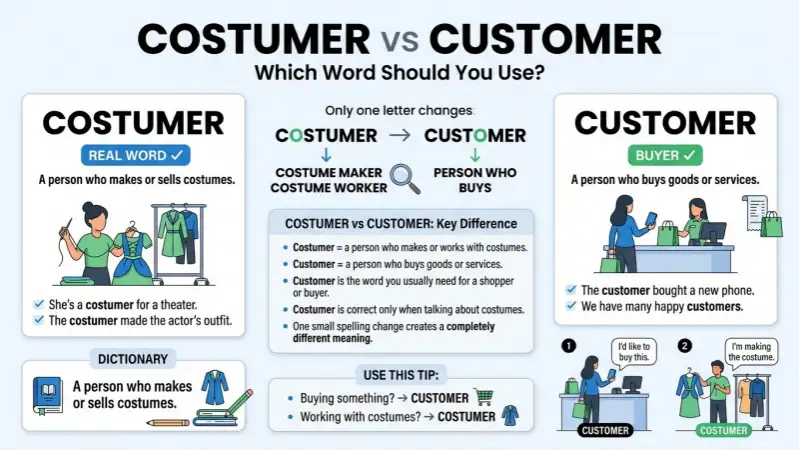
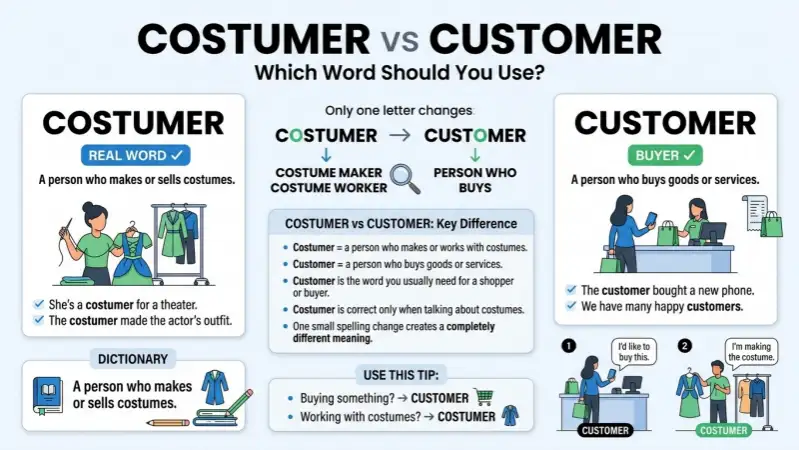
Customer = a person who buys something, like goods or services. This is the word almost everyone means to use.
Costumer = a person who makes, sells, or rents costumes, like for movies, plays, or Halloween.
Simple examples:
- “The customer paid for her coffee.” ✅ (a buyer)
- “The costumer sewed the actor’s dress for the play.” ✅ (someone who makes costumes)
- “The costumer paid for her coffee.” ❌ (wrong word, unless you really mean a costume-maker)
Easy rule: If you are talking about someone buying something, always use customer. Save “costumer” only for people who work with costumes.
The Origin of Customer and Costumer
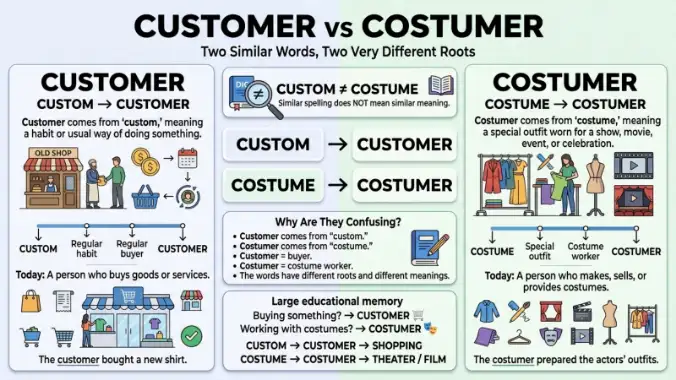
These two words come from very different roots, even though they look alike.
Customer comes from the word “custom.” Long ago, “custom” meant a habit or a regular way of doing something. A “customer” was someone who had a habit of buying from a certain shop. Over time, the word grew to mean anyone who buys goods or services, whether they shop there often or not.
Costumer comes from the word “costume.” A costume is a special outfit, often worn for a show, a movie, or a special event like Halloween. A “costumer” is a person whose job is to make, sell, or provide these costumes. This word is often used in theater, film, and fashion work.
So while the two words share a similar spelling pattern, “custom” and “costume” are separate words with separate histories. That is the real reason people get confused. The words look like close cousins, but they are not related in meaning at all.
British English vs American English Spelling
Some English words are spelled differently in British and American English. Words like “colour” and “color” are classic example.
But this is not that kind of case. Customer and costumer are spelled the same way in both British and American English. There is no British version and no American version of either word.
What matters here is not country or region. What matters is which word you actually mean.
| Word | American English | British English | Meaning |
| Customer | Customer | Customer | A person who buys something |
| Costumer | Costumer | Costumer | A person who makes or supplies costumes |
| Common mix-up | Yes, in both regions | Yes, in both regions | Typing or spelling slip |
As the table shows, the spelling stays the same everywhere. The only real task is picking the right word for what you want to say.
Which Word Should You Use?
Since spelling does not change by country, the real question is always about meaning, not location.
- Talking about someone who shops at a store, restaurant, or website? Use “customer.”
- Talking about someone who makes or provides costumes for a play, movie, or event? Use “costumer.”
- Writing a business email, a sign, or a review? You almost always want “customer.”
- Writing about theater, film production, or Halloween costumes? You might actually need a “costumer.”
For most people, in most writing, “customer” is the word you want. “Costumer” is a much rarer word, used mainly in specific jobs like costume design or theater work.
Common Mistakes with Costumer and Customer
Here are the most common errors people make, and how to fix them.
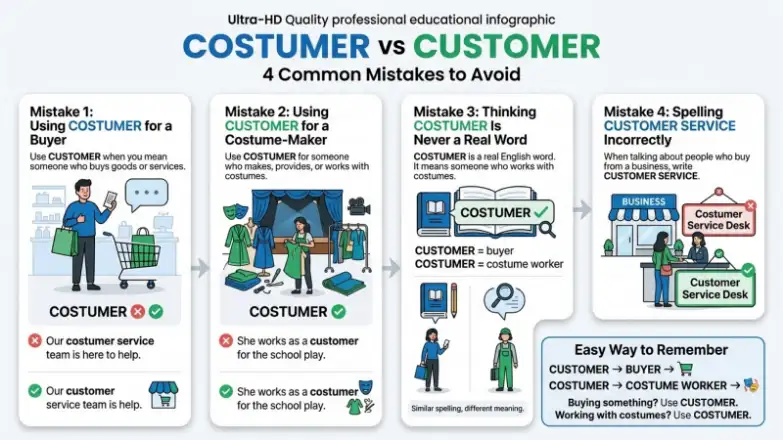
Mistake 1: Typing “costumer” when you mean a buyer This is the most common mistake. People miss the extra letter “s” in “custom” and accidentally add an extra “o” instead.
- ❌ “Our costumer service team is here to help.”
- ✅ “Our customer service team is here to help.”
Mistake 2: Writing “customer” when you actually mean a costume-maker This happens less often, but it can confuse readers who work in theater or film.
- ❌ “She works as a customer for the school play.”
- ✅ “She works as a costumer for the school play.”
Mistake 3: Assuming “costumer” is just a typo. Some people think “costumer” is never a real word. This is not true. It is a real word, just with a very different meaning.
Mistake 4: Spelling “customer service” as “costumer service” on signs or business cards This mistake shows up often in printed materials, and it can look unprofessional.
- ❌ “Costumer Service Desk”
- ✅ “Customer Service Desk”
Costumer and Customer in Everyday Examples
In an email: “Thank you for being a loyal customer. We appreciate your business.”
In news writing: “The store reported a rise in customer complaints after the price increase.”
On social media: “Shoutout to our amazing costumer who designed all the costumes for the school musical! “
Formal writing: “The company’s customer satisfaction score improved by ten percent this year.”
In theater or event writing: “The costumer spent weeks preparing outfits for the entire cast.”
Notice how “customer” fits into business, shopping, and daily life. “Costumer” fits into a much smaller world: costumes, theater, and film work.
Costumer vs Customer – Google Trends and Usage Data
Search data shows that “customer” is searched far more often than “costumer” around the world. This makes sense, since almost every business, from small shops to large companies, talks about customers every day.
Searches for “costumer” are much smaller in number. Most of these searches come from two kinds of people: those who work in theater, film, or costume design, and those who are checking if they spelled “customer” correctly by accident.
By region:
- United States: Very high search volume for “customer,” especially in business and retail writing.
- United Kingdom: Same strong pattern, with “customer” used constantly in shops, banks, and services.
- Global: “Customer” is one of the most searched business terms worldwide, while “costumer” stays a small, specialized word.
Word Comparison Table
| Word | Correct? | Meaning | Common Use |
| Customer | Yes | A person who buys goods or services | Business, retail, service industries |
| Costumer | Yes | A person who makes or provides costumes | Theater, film, Halloween, events |
| Customor | No | Misspelling of “customer” | Never correct |
| Costumor | No | Misspelling of “costumer” | Never correct |
FAQs:
1. Is “costumer” a real word? Yes. It is a real word, but it means someone who makes or supplies costumes, not someone who buys things.
2. What is the correct word for someone who buys something? “Customer” is the correct word for a buyer or shopper.
3. Why do people mix up “costumer” and “customer”? Because the two words look almost the same and are only one letter apart, it is easy to type the wrong one by mistake.
4. Is “costumer” spelled differently in British and American English? No. Both words are spelled the same way in both British and American English.
5. Which word should I use in a business email? Use “customer” in almost all business writing, unless you are specifically talking about costumes.
6. What is the plural form of each word? The plural of “customer” is “customers.” The plural of “costumer” is “costumers.”
7. Can a business use the word “costumer” by mistake and still be understood? It might still be understood from context, but it will look like a spelling mistake and can seem unprofessional, especially on signs, menus, or official writing.
Conclusion:
“Costumer” and “customer” are two different, real English words that are easy to mix up because they look so similar. “Customer” means a person who buys goods or services, and it is the word almost everyone means to use in daily writing, business emails, and customer service. “Costumer” means a person who makes or supplies costumes, and it belongs to a much smaller world of theater, film, and special events.
There is no British versus American spelling difference here. Both words stay the same everywhere in the world. The real key is knowing which meaning you want before you type.
Next time you write this word, pause for one second and ask yourself: am I talking about a buyer, or someone who makes costumes? In almost every case, the answer will be “customer.” Keep that simple question in mind, and you will never mix up these two words again.