You are writing a report. They want to say something old was replaced by something new. You type the word. Then you stop. Is it “superseded”? Or is it “superceded”? Both spellings look like they could be right. But only one of them is correct.
This mix-up happens a lot, even among careful writers. The word shows up in business writing, law, science, and school work.Many people naturally spell this word with “-cede” because they see the same pattern in many similar English words.
But this word breaks the pattern, and that is exactly why it trips so many people up.
People search “superseded vs superceded” because they want to double-check before sending an email, finishing a report, or submitting a paper. Getting it wrong can make writing look careless, even if the rest of the sentence is perfect.
In this guide, you will get a fast answer first. Then you will learn where the word comes from, why it breaks the usual pattern, and how to remember the right spelling every time.
Superseded or Superceded – Quick Answer
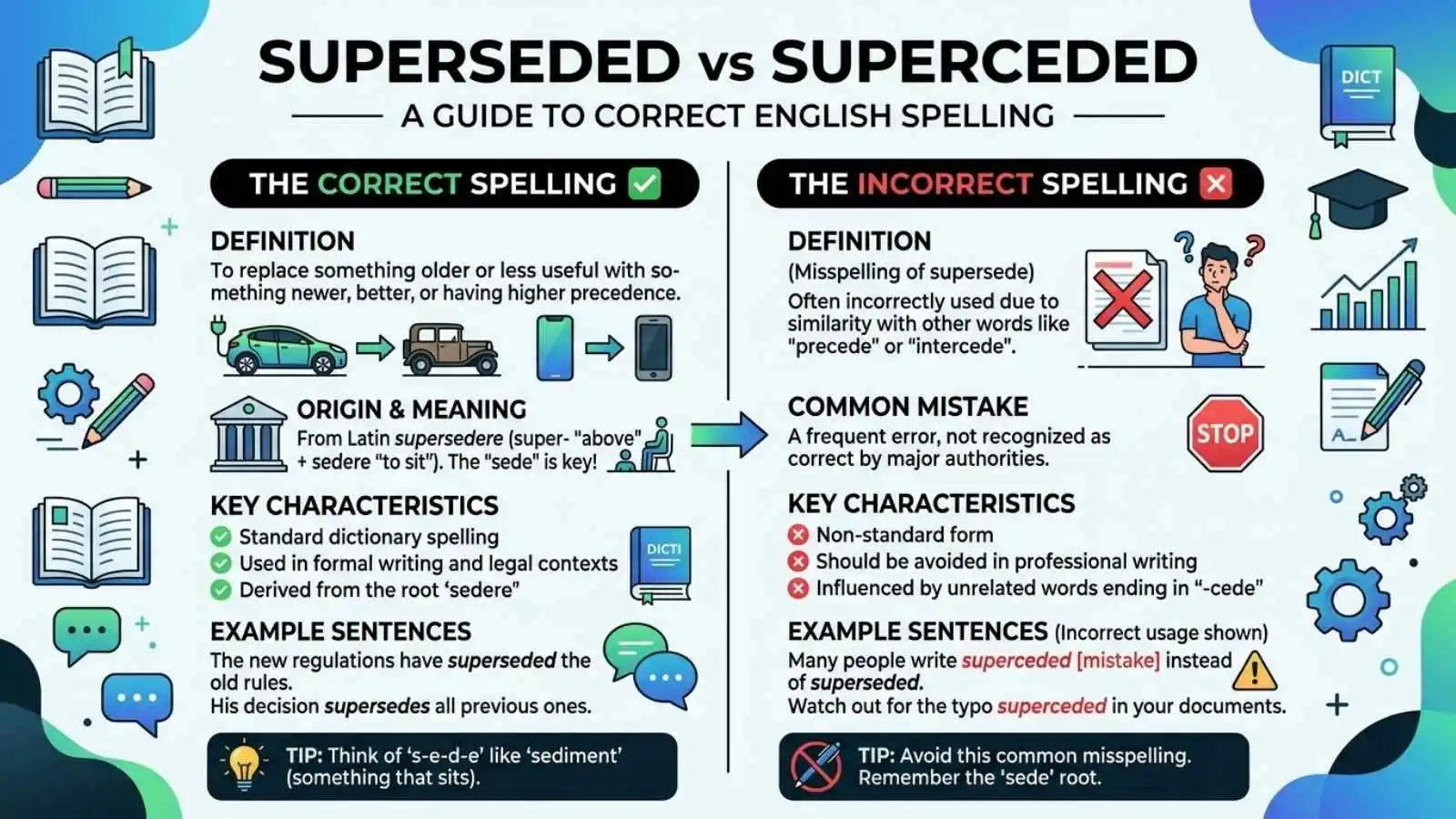
The correct spelling is superseded. It has an “s” in the middle, not a “c.”
Superceded is not correct. It is one of the most common spelling mistakes in English.
Simple examples:The committee superseded the old rule with a new one. ✅
The company has superseded this model with a newer version. ✅
The committee superceded the old rule with a new one. ❌ (Wrong spelling)
Easy way to remember it: Think of “supersede” as starting with “super,” just like “supersonic” or “superstar.” Both words use an “s,” not a “c.”
The Origin of Superseded
The word “supersede” comes from the Latin word “supersedere.” People formed this word by combining “super,” which means “above” or “over,” with “sedere,” which means “to sit.” So the word originally meant something like “to sit above” or “to sit in place of.” Over time, this grew into the modern meaning: to take the place of something older, replacing it with something new.
Here is the key reason so Many people misspell this word because they know common English words such as “precede,” “proceed,” “concede,” and “exceed,” which end in “-cede” or “-ceed.”
These words come from a different Latin root, “cedere,” which means “to go” or “to yield.”
“Supersede” looks and sounds like it belongs to that same family, but it does not. It comes from “sedere” (to sit), not “cedere” (to go). Because of this, “supersede” keeps an “s” in the middle instead of a “c,” making it one of the few common English words that breaks the usual “-cede” pattern.
British English vs American English Spelling
Some English words are spelled differently in British and American English, like “colour” and “color.”
But “superseded” is not one of those words. Both British English and American English spell it the exact same way: superseded, with an “s” in the middle.
There is no British version and no American version of this word. It stays the same everywhere in the world.
| Word Form | American English | British English |
| Base word | Supersede | Supersede |
| Past tense | Superseded | Superseded |
| -ing form | Superseding | Superseding |
| Wrong spelling | Supercede / Superceded (never correct) | Supercede / Superceded (never correct) |
As shown above, every form of this word matches across both spelling systems. Once you learn the correct spelling, it stays the same no matter where you live.
Which Spelling Should You Use?
Since both British and American English agree on this word, the answer stays the same everywhere.
- Writing in the United States? Use “superseded.”
- Writing in the United Kingdom or Commonwealth countries like Canada, Australia, or India? Use “superseded.”
- Writing for a global audience? Use “superseded.”
There is no place in the world where “superceded” is the correct spelling. It is not a regional form. This is not an older or accepted version of the word. It is simply one of the most common spelling mistakes in English, caused by confusion with other “-cede” words. You can safely use “superseded” in any kind of writing, from legal documents to school papers to everyday emails.
Common Mistakes with Superseded
Here are the most common errors people make, and how to fix them.
Mistake 1: Writing “superceded” instead of “superseded” This is by far the most common mistake. It happens because so many similar words use “-cede.”
- ❌ “This policy was superceded last year.”
- ✅ “This policy was superseded last year.”
Mistake 2: Writing “supercede” instead of “supersede” The same mistake often shows up in the base form of the word too.
- ❌ “The new law will supercede the old one.”
- ✅ “The new law will supersede the old one.”
Mistake 3: Confusing “supersede” with “succeed” “Succeed” means to do well or to come after someone in a role, like a new leader taking over. “Supersede” means to replace something because it is outdated or no longer needed.
- “The new manager will succeed the old one.” (taking over the role)
- “The new manager’s plan will supersede the old plan.” (replacing an outdated plan)
Mistake 4: Assuming the spelling follows the same rule as “proceed” or “exceed” Since “proceed,” “exceed,” and “concede” are so common, people assume “supersede” must follow the same “-cede” or “-ceed” pattern. It does not, and remembering this exception is the real key to spelling it correctly.
Superseded in Everyday Examples
In an email: “Please note that this agreement supersedes any previous contracts between us.”
In news writing: The city replaced its old traffic laws with a new set of rules this year.
On social media: Heads up! We replaced our old app with a faster new version.
In formal writing: “This updated policy supersedes all earlier versions and takes effect immediately.”
Notice how “superseded” often appears in serious, formal writing, like legal notices, business updates, and official announcements. It is a strong, clear word for showing that something old has been replaced.
Superseded – Google Trends and Usage Data
Search data shows that people search for “superseded” more often than “superceded.” However, many people still search for the incorrect spelling, showing how common this mistake remains.
. Many language and grammar websites list “supersede” as one of the most frequently misspelled words in English.
By region:
- United States: “Superseded” appears often in legal, business, and government writing.
- United Kingdom and Commonwealth countries: People use the same spelling, and they make the same common mistake just as often.
- Global and academic writing: Both regions show steady searches for the correct spelling, especially from students and professionals double-checking their work.
Word Comparison Table
| Spelling | Correct? | Common Region | Search Volume |
| Superseded | Yes | US, UK, Global | High |
| Superceded | No | Misspelling, all regions | Moderate (common mistake) |
| Supersede (base form) | Yes | US, UK, Global | High |
| Supercede (base form) | No | Misspelling, all regions | Moderate (common mistake) |
FAQs:
1. Is “superceded” ever correct in English? No. “Superceded” is not found in any standard English dictionary. It is always a spelling mistake, though a very common one.
2. Why do so many people spell it “superceded”? Because many similar words like “proceed,” “exceed,” and “concede” use “-cede” or “-ceed,” people assume “supersede” follows the same pattern. It does not, since it comes from a different Latin root.
3. Is “superseded” spelled differently in British and American English?
No. People use the same spelling, “superseded,” in both British and American English.
4. What does “superseded” mean? It means something has been replaced by something newer, often because the old version is outdated.
5. What is the difference between “supersede” and “succeed”? “Succeed” often means to come after someone in a role or to do well at something. “Supersede” means to replace something outdated with something new.
6. Is “supersede” one of the most commonly misspelled English words? Yes. Many language experts and dictionaries list it as one of the top commonly misspelled words, precisely because of the “-cede” confusion.
7. How can I remember the correct spelling? Think of “super” plus “sede,” both spelled with an “s.” Picture words like “supersonic” or “superstar,” which also start with “super” and use an “s.”
Conclusion:
The word “superseded” trips up even careful writers because so many similar-sounding words use “-cede” or “-ceed” instead. But the rule is simple: “supersede” comes from a Latin word meaning “to sit above,” not from the Latin root behind words like “proceed” or “exceed.” This is why it keeps an “s” in the middle, breaking the usual pattern.
There is no British versus American difference here. The word stays exactly the same everywhere in the world. Whether you are writing a legal notice, a business email, or a school report, always use “superseded.”
Now that you know the reason behind this tricky spelling, you will not have to guess again. Just remember: it is built from “super” and “sede,” both with an “s,” and you will always get it right.

Emily Carter is an English grammar writer based in Portland, Oregon, with 7+ years of experience turning tricky grammar rules into simple, easy lessons.