You are writing about a road with no bends in it. Or maybe you are writing about a small strip of water between two lands. You say the word out loud. It sounds the same both times. But when you go to write it, you stop. Is it “straight”? Or is it “strait”? They sound the same. But they mean two very different things.
This mix-up happens a lot. Both words sound the same, so many people only learn one spelling and use it for everything. But using the wrong one can make writing look off, especially when talking about maps, news, or trips.
People look up “straight vs strait” because they hear both words a lot but are not sure how to spell each one. Since the words sound the same, spelling is the only clue to tell them apart.
This guide gives you a fast answer first. Then it shows you where each word comes from, how to use them the right way, and easy tricks to keep them straight in your head for good.
Straight vs Strait – Quick Answer
These words sound the same, but they mean different things and are spelled in different ways.
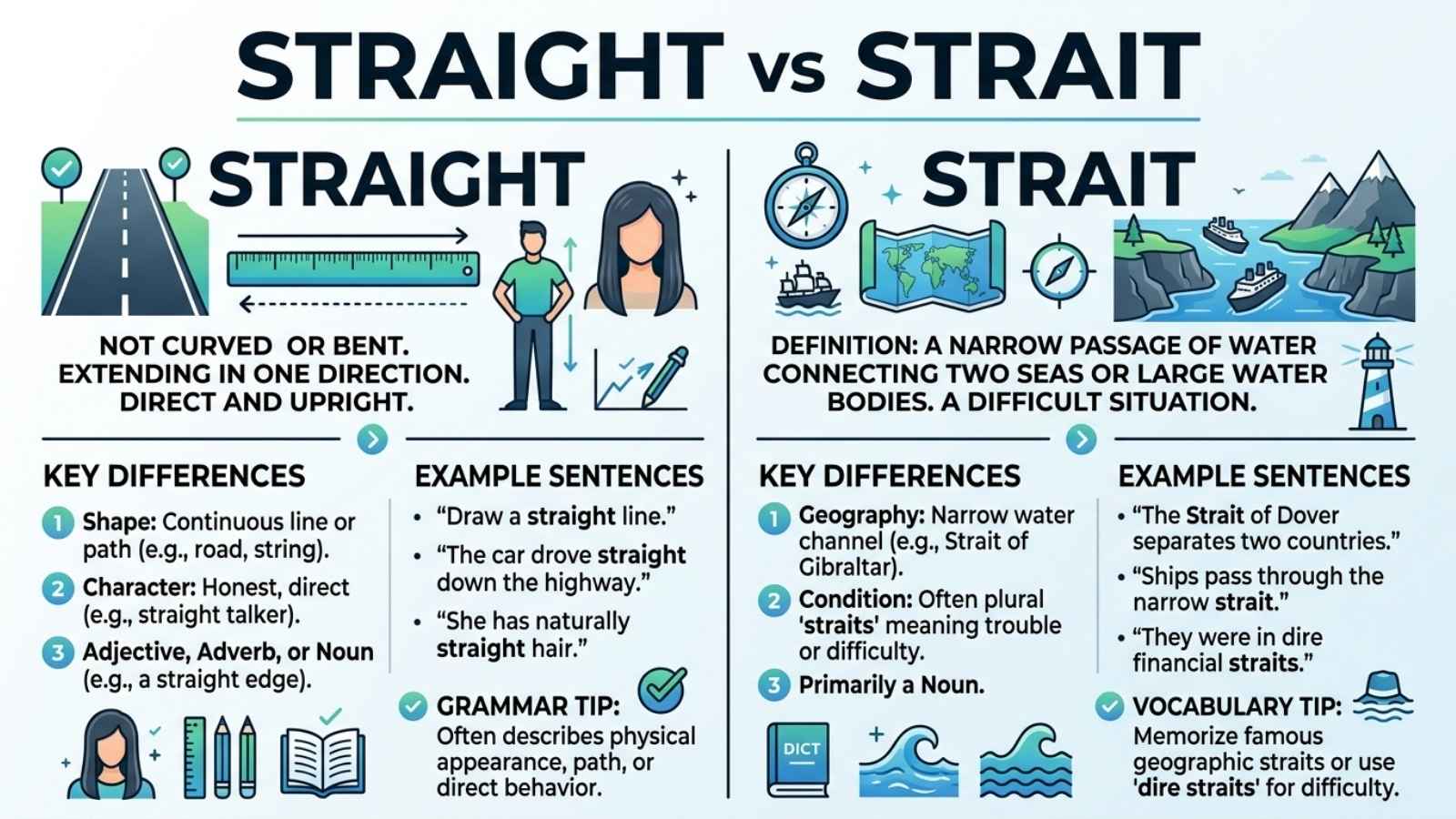
- Straight = not bent, going right ahead, or telling the truth. It can describe a line, a road, hair, or someone being honest.
- Strait = a thin strip of water joining two bigger areas of water. It can also mean a hard or tight spot in life, like “dire straits.”
Simple examples:
- “Walk straight down this road and you’ll reach the shop.” ✅
- “The two lands are split by a thin strait.” ✅
- “She has smooth, straight hair.” ✅
- “The company was in tough straits after a bad year.” ✅
In short: “straight” means not bent, or honest. “Strait” means a thin strip of water, or a hard time.
Where Do These Words Come From?
Straight comes from an old English word that meant “to stretch out.” Something straight is stretched out evenly, with no bends. Over time, this also came to mean being honest, like giving someone a “straight answer.”
Strait comes from a very different word. It comes from an old Latin word that meant “tight” or “narrow.” This word moved through French and into English, and it kept its idea of being narrow. It came to mean a thin strip of water between two bigger areas of land, since this kind of water path looks tight when you compare it to the wide, open sea near it. This same idea explains why “dire straits” means a hard, tight spot in life. Something “strait” is narrow and tight, whether that is water or a rough time.
So even though these two words sound just alike, they come from two different roots with two different meanings. One is about being stretched out straight. One is about being narrow or tight.
British English vs American English Spelling
Here is something important to know. Straight and strait are not a British vs. American spelling case, like “colour” and “color.” Both words are spelled the same way in every country. There is no spelling change here at all.
| Feature | American English | British English |
| Spelling of “straight” | Same | Same |
| Spelling of “strait” | Same | Same |
| Meaning of “straight” | Not bent, honest | Not bent, honest |
| Meaning of “strait” | Thin water path, hard time | Thin water path, hard time |
| Spelling change by country | None | None |
So there is no spelling rule to learn here, like “colour” and “color.” Both words are correct everywhere. The real job is picking the right meaning, since the words sound the same when spoken.
Which Word Should You Use?
Since spelling stays the same in every place, the right word depends on what you mean.
- Talking about something not bent, or being honest? Use “straight.” Example: “He gave me a straight answer, no excuses.”
- Talking about a thin water path between two bigger areas? Use “strait.” Example: “Ships pass through the strait to reach the open sea.”
- Talking about a hard or tight time in life? Use “strait,” often in the phrase “dire straits.” Example: “The family was in dire straits after losing their jobs.”
- Talking about hair, roads, lines, or how you stand? Use “straight.” Example: “Stand up straight and keep your back straight too.”
If you are ever stuck, ask yourself this: am I talking about something not bent or about being honest, or am I talking about a thin water path or a hard time? That question will help you pick the right word almost every time.
Common Mistakes with Straight and Strait
Mistakes
1: Writing “straight” when you mean a thin water path
- ❌ “Ships must go through the straight between the two islands.”
- ✅ “Ships must go through the strait between the two islands.”
2: Writing “strait” when you mean something not bent
- ❌ “She has nice, strait hair.”
- ✅ “She has nice, straight hair.”
3: Getting the phrase “dire straits” wrong Many people spell this phrase the wrong way, since “straight” feels more common.
- ❌ “The company was in dire straights.”
- ✅ “The company was in dire straits.”
Mistake 4: Thinking both words are just two ways to spell one word Since they sound the same, some people think they are just two spellings of one word. They are not. They are two different words with two different meanings.
Straight and Strait in Everyday Examples
In an email: “Please go straight to the main office when you get here.”
In news writing: “Tension grew near the strait as two countries argued over the water.”
On social media: “Just got my hair done, love this straight, smooth look! “
Formal writing: “The report talked about the company’s hard straits after a slow year.”
In everyday talk: “Give it to me straight, doctor. How bad is it?”
Notice how “straight” shows up a lot in daily talk about roads, hair, and honesty. “Strait” mostly shows up in map talk, news, and the set phrase “dire straits.”
Straight vs Strait – Google Trends and Usage Data
Search data shows that “straight” is looked up much more than “strait,” since “straight” is used all the time in daily talk, from roads to hair to honesty. “Strait” is looked up much less, mostly linked to map names, like the Strait of Gibraltar, or the phrase “dire straits.”
By place:
- United States: “Straight” is very common in daily talk and writing. “Strait” mostly shows up in geography class, news about sea paths, or the phrase “dire straits.”
- United Kingdom and nearby countries: The same pattern is true, with “strait” showing up mostly in map talk and news.
- Around the world: Searches for “strait” go up during big news about sea paths or land disputes near narrow water areas.
Word Comparison Table
| Word | Type | Common Meaning | Example |
| Straight | Describing word | Not bent, honest | “A straight line,” “go straight ahead” |
| Strait | Naming word | Thin water path, hard time | “The Strait of Gibraltar,” “dire straits” |
| Direct | Describing word | No bends or stops in the way | “A direct road” |
| Narrow | Describing word | Not wide | “A narrow path” |
FAQs:
1. Why do “straight” and “strait” sound just alike? They are words that sound the same but are spelled in different ways and mean different things. This happens a lot in English when two old words end up sounding close.
2. What is a real example of a “strait”? The Strait of Gibraltar, between Spain and Morocco, is a well-known thin water path called a strait.
3. What does “dire straits” mean? It means a very hard or tough spot, often about money or bad luck.
4. Is there a British vs. American spelling change between these words? No. Both words are spelled and used the same way in both.
5. Can “straight” ever mean a water path? No. When talking about a thin water path, always use “strait,” not “straight.”
6. How can I remember the difference? Try this: “strait” has a small, tight feel, just like a narrow water path. “Straight” has a long, stretched-out feel, like a long, straight line.
7. Are there other common words that use “strait”? Yes. You may also see “straitjacket” (a tight jacket used to hold someone still) and “straitlaced” (very strict), both using “strait” because of its “tight” meaning.
Conclusion:
“Straight” and “strait” sound just alike, but they come from two different roots and mean two very different things. “Straight” is about being honest or not bent. “Strait” is about being narrow, whether that is a thin water path or a hard spot in life.
There is no British vs. American spelling change here. Both words are spelled the same in every place, and the real trick is knowing which spelling goes with which meaning, since your ears can’t tell them apart.
Next time you write one of these words, stop for a second and ask yourself: am I talking about something not bent, or about a thin water path or hard time? That one small question, plus a little practice, will help you spell both words the right way every time.

Emily Carter is an English grammar writer based in Portland, Oregon, with 7+ years of experience turning tricky grammar rules into simple, easy lessons.










