You are writing a text to a friend. You want to say “it doesn’t matter” or “let’s move on.” You type a word. Then you stop. Is it one word, “anyway”? Or is it two words, “any way”? They look close. They sound the same too. But they do not do the same job in a sentence.
This mix-up happens a lot. Both forms show up in texts, emails, and daily talk. Since they sound just alike when you say them, many people are not sure when to use one word and when to use two.
People look up “anyway vs any way” because they want their writing to look clean and correct. This small mistake shows up a lot in fast texts and casual writing. Once you learn the easy rule, you will never mix them up again.
This guide gives you a fast answer first. Then it shows you where the rule comes from, gives you real examples, and points out common mistakes. By the end, you will always know which one to use.
Anyway vs Any Way – Quick Answer
Here is the simple rule:
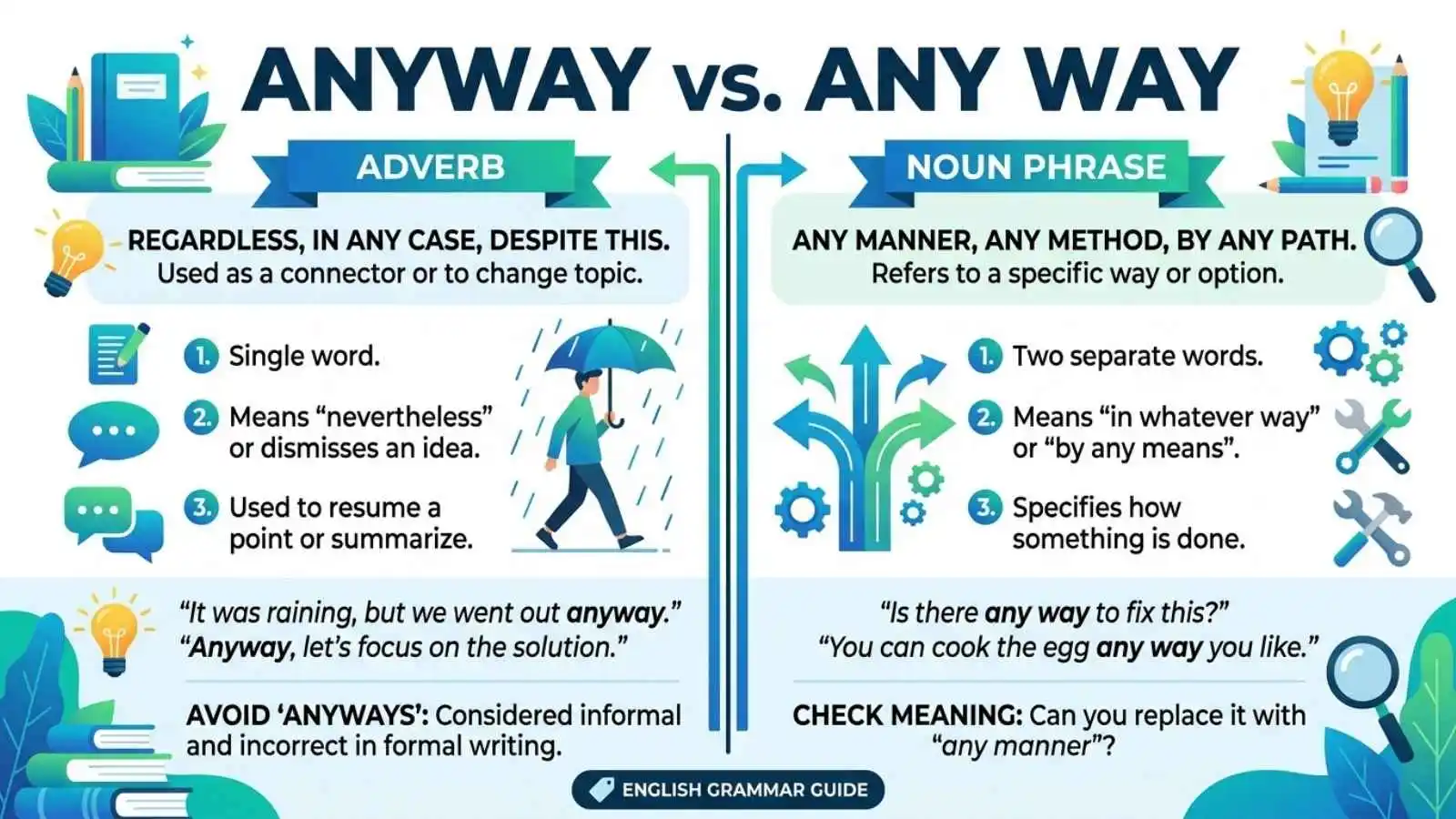
Anyway (one word) = a word used to mean “regardless,” “in any case,” or to change the subject.
Any way (two words) = means “any method” or “any manner” of doing something.
Simple examples:
- “I didn’t want to go, but I went anyway.” ✅ (one word, means “regardless”)
- “Is there any way to fix this problem?” ✅ (two words, means “any method”)
- “Anyway, let’s talk about something else.” ✅ (one word, changes the subject)
- “I can help you in any way you need.” ✅ (two words, means “any manner”)
Easy way to remember it: if you can swap the word for “regardless” or “anyhow,” use one word: “anyway.” If you can swap it for “any method” or “any manner,” use two words: “any way.”
Where Does This Rule Come From?
This is not really about old word history. It is about how English builds words from smaller parts.
“Any” and “way” are two small, simple words on their own. “Any” means “no matter which one,” and “way” means “a path, method, or manner of doing something.” When you keep them as two separate words, “any way” simply means “any method” or “any manner,” just like “any road” would mean “any road you pick.”
Over time, English speakers often joined “any” and “way” together into one word, “anyway,” when talking about something happening no matter what else is true. This joined form grew its own special job: showing that something is true or will happen, regardless of other facts. It also became a handy word for changing the subject in conversation.
This is a common pattern in English. Many one-word and two-word pairs work this way, such as “everyday” (one word, meaning “common” or “usual”) and “every day” (two words, meaning “each day”). “Anyway” and “any way” follow the very same kind of pattern.
British English vs American English Spelling
This is an important point to clear up. Anyway and any way are not a British versus American spelling case, like “colour” and “color.” Both forms are used the same way in every English-speaking country. There is no regional spelling split here.
| Feature | American English | British English |
| One word, meaning “regardless” | Anyway | Anyway |
| Two words, meaning “any method” | Any way | Any way |
| Rule for choosing | Same | Same |
| Regional spelling difference | None | None |
So there is no spelling rule to learn based on country. This is a grammar rule about word meaning, and it works the same way everywhere.
Which One Should You Use?
Since the rule stays the same everywhere, the real question is about what you are trying to say.
- Trying to say something happens “regardless” or “no matter what”? Use “anyway,” one word. Example: “It was raining, but we went to the park anyway.”
- Trying to change the subject in conversation or writing? Use “anyway,” one word. Example: “Anyway, back to what I was saying earlier.”
- Trying to say “any method” or “any manner” of doing something? Use “any way,” two words. Example: “Is there any way I can make this easier for you?”
- Not sure which one fits? Try swapping in “any method.” If that makes sense, use two words. If it sounds odd, use one word instead.
If you are ever stuck, ask yourself: am I talking about “no matter what,” or am I talking about “a method or manner”? That question will guide you to the right form every time.
Common Mistakes with Anyway and Any Way
Mistakes
1: Writing “any way” when you mean “regardless”
- ❌ “I don’t like the plan, but I’ll go any way.”
- ✅ “I don’t like the plan, but I’ll go anyway.”
2: Writing “anyway” when you mean “any method”
- ❌ “Is there anyway to get this done faster?”
- ✅ “Is there any way to get this done faster?”
3: Adding an extra “s” to make “anyways” Some people say “anyways” in casual talk, but it is not considered correct in formal writing.
- ❌ “Anyways, let’s move on to the next topic.”
- ✅ “Anyway, let’s move on to the next topic.”
4: Mixing up the two forms in the same sentence This can confuse the reader and change the meaning of the sentence.
- ❌ “I need any way to finish this, anyway I can.”
- ✅ “I need any way to finish this, however I can.”
Anyway and Any Way in Everyday Examples
In an email: “We couldn’t confirm the exact date, but we’re planning the event anyway.”
In news writing: “Officials said there was no easy way to stop the flooding, but they tried anyway.”
On social media: “Anyway, that’s my update for today! Hope everyone has a great weekend. “
In formal writing: “The team is looking for any way to reduce costs without affecting quality.”
Notice how “anyway” fits into casual talk, changing the subject, or saying something happens no matter what. “Any way” fits into talk about methods, options, or possible solutions.
Anyway vs Any Way – Google Trends and Usage Data
Search data shows that people often search for this rule because both forms sound the same but do different jobs. This is a common question among students, English learners, and anyone who wants their writing to look clean and correct.
By region:
- United States: “Anyway” is extremely common in casual writing, texting, and everyday talk.
- United Kingdom and Commonwealth countries: The same rule applies, and “anyway” is just as common in daily conversation and writing.
- Global English learners: Many people learning English search for this rule, since one-word and two-word pairs like this one can be tricky at first.
Word Comparison Table
| Form | Meaning | Example |
| Anyway | Regardless, in any case, or to change topic | “I was tired, but I stayed up anyway.” |
| Any way | Any method or manner | “Is there any way to solve this?” |
| Anyways | Casual, not standard in formal writing | Avoid in formal writing |
| Anyhow | Similar to “anyway,” slightly more casual | “Anyhow, let’s get started.” |
FAQs:
1. Is “anyway” one word or two words? “Anyway” is one word when it means “regardless” or is used to change the subject.
2. When should I use “any way” as two words? Use two words when you mean “any method” or “any manner” of doing something.
3. Is “anyways” correct? “Anyways” is common in casual speech, but it is not considered correct in formal writing. Use “anyway” instead.
4. Is this a British versus American English rule? No. Both British and American English follow the same rule for “anyway” and “any way.”
5. How can I remember the difference? Try swapping in “any method.” If it fits, use two words. If it sounds odd, use the one-word form, “anyway.”
6. Can “anyway” be used to start a sentence? Yes. “Anyway” is often used at the start of a sentence to change the subject or return to an earlier point.
7. Is there a difference between “anyway” and “anyhow”? They are close in meaning, but “anyhow” often sounds a bit more casual. “Anyway” is more common in everyday and formal writing alike.
Conclusion:
“Anyway” and “any way” sound exactly the same, but they do different jobs in a sentence. “Anyway,” as one word, means “regardless” or is used to change the subject. “Any way,” as two words, means “any method” or “any manner” of doing something.
There is no British versus American difference here. Both forms are used the same way everywhere, and the real key is asking yourself what you mean: “no matter what,” or “a method or manner.”
Next time you are not sure which form to use, try swapping in “any method.” If it fits, use two words. If it does not, stick with the single word, “anyway.” That simple trick will help you get it right every time.

Emily Carter is an English grammar writer based in Portland, Oregon, with 7+ years of experience turning tricky grammar rules into simple, easy lessons.