You are writing about something that came in the mail. Or maybe something small you got at the shop. You type a word. Then you stop. Should it be “package”? Or should it be “packet”? They look close. Both hold things inside. But they are not the same size, and they are not used the same way.
This mix-up happens a lot. Both words mean something wrapped or held inside. But one is usually big, and the other is usually small. Also, some countries use one word more than the other, even for things that are close in size.
People look up “package vs packet” because they want to say things the right way, whether they are talking about mail, a snack, or some papers. Using the wrong word can make a sentence feel a bit off, even if people still get what you mean.
This guide gives you a fast answer first. Then it shows you where each word comes from, how people use them in different places, and how to pick the right one every time.
Package vs Packet – Quick Answer
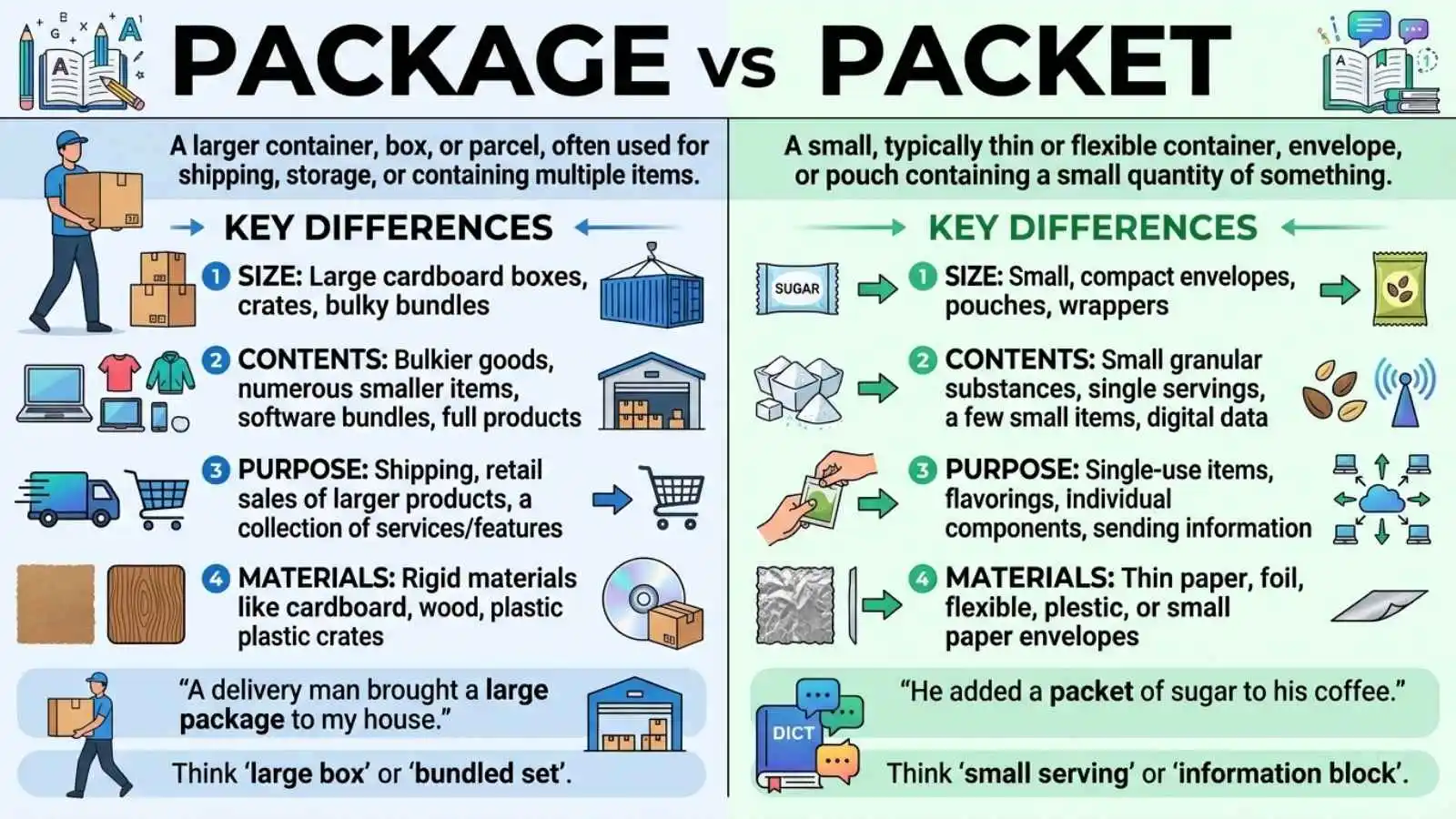
Both words mean something wrapped up or held inside. But they are not the same size.
- Package = a bigger item, often in a box, usually sent by mail. It can also mean a group of things sold or offered together, like a “package deal.”
- Packet = a small, often flat or light item, like a small bag of seeds, sugar, chips, or papers.
Simple examples:
- “The mailman brought a package to our door.” ✅
- “I picked up a packet of chips for the trip.” ✅
- “She signed for a big package from the delivery man.” ✅
- “He opened a packet of sugar for his coffee.” ✅
In short: “package” is usually the bigger item, like a box. “Packet” is usually the smaller item, like a small bag.
Where Do These Words Come From?
Package comes from the word “pack,” an old word that meant to bundle things together. Over time, English added “-age” to the end, an ending often used for a group of things, like in “baggage” or “storage.” So “package” came to mean a bundled item, usually made ready for mailing or carrying.
Packet also comes from “pack,” but it took a different path. English added “-et” to the end instead. This ending often shows something small, just like “book” becomes “booklet.” That is why “packet” grew to mean a small pack, much smaller than a full “package.”
So both words come from the same idea of “packing” something. But the endings pushed them toward two different sizes over time.
British English vs American English Spelling
Here is something important to know. Package and packet are not a spelling difference, like “colour” and “color.” Both words are spelled the same in every country. But there is a real difference in how often each word is used, based on where you are.
| Feature | American English | British English |
| Spelling of “package” | Same | Same |
| Spelling of “packet” | Same | Same |
| Word for mail | Package | Parcel (packet is less used here) |
| Word for small snack bags | Bag or pack | Packet |
| Word for seeds, sugar, tea | Packet or pack | Packet |
In American English, “package” is the main word for almost anything sent by mail. “Packet” is mostly used for small things, like seed packets or sugar packets. In British English, “packet” is used a lot for small daily items, like a packet of chips or a packet of biscuits. But for mail, British English often uses “parcel” instead of “package.”
Which Word Should You Use?
Since there is no spelling rule here, the right word depends on size, and sometimes on where you live.
- Talking about something mailed in the US? Use “package.” Example: “I’m waiting for a package from the store.”
- Talking about something mailed in the UK? “Parcel” feels more natural, though “package” is still understood. Example: “The parcel came a day early.”
- Talking about a small item like chips, seeds, or sugar, anywhere? Use “packet.” Example: “Can you grab a packet of chips from the shop?”
- Talking about a group of things sold together, like a phone plan? Use “package.” Example: “This phone package includes three plans in one.”
If you are stuck, think about size first. Big items usually need “package.” Small, light items usually need “packet.”
Common Mistakes with Package and Packet
Mistakes
1: Using “packet” for something big
- ❌ “I got a big packet in the mail with three books inside.”
- ✅ “I got a big package in the mail with three books inside.”
2: Using “package” for something small and simple
- ❌ “Can you hand me that package of gum?”
- ✅ “Can you hand me that packet of gum?”
3: Forgetting how each country uses these words Writers sometimes use “package” everywhere, but British readers may expect “parcel” for mail.
- In the UK: “The parcel came late this week.” (feels more natural)
- In the US: “The package came late this week.” (also correct and normal)
4: Mixing up “packet” with “package deal” A “package deal” means a group of things sold together, not a small item. This use of “package” has nothing to do with size.
- Example: “We got a good package deal for our trip, with flights and a hotel included.”
Package and Packet in Everyday Examples
In an email: “Your package has shipped and should arrive in five days.”
In news writing: “Police stopped a strange package at the airport this morning.”
On social media: “Just opened my care package from home, so many snacks! “
In formal writing: “The job offer includes a full pay package with health care and a yearly bonus.”
everyday talk: “Grab a packet of tea bags while you’re at the shop.”
Notice how “package” shows up a lot in mail and business deals. “Packet” shows up a lot in small, daily items like food or seeds.
Package vs Packet – Google Trends and Usage Data
Search data shows that “package” is looked up much more overall, mostly because it covers so many things in the US, from mail to phone plans to work deals. “Packet” is looked up less, but it stays steady in the UK, where it is the normal word for small snack bags and small daily items.
By place:
- United States: “Package” is the top word, used for shipping, deliveries, and deals like a “vacation package” or “job package.”
- United Kingdom and nearby countries: “Packet” is common for small items like chips, biscuits, and seeds. “Parcel” takes over for bigger mailed items.
- Around the world: “Package” is used a lot everywhere in work and business writing, especially for plans or deals with many parts.
Word Comparison Table
| Word | Size | Common Use | Where It’s Common |
| Package | Bigger | Mail, deals, groups of things | Common everywhere, most of all in the US |
| Packet | Smaller | Snacks, seeds, sugar, small items | Very common in the UK |
| Parcel | Bigger | More common in the UK than “package” | |
| Pack | Changes | A general word for a group of items | Common everywhere |
FAQs:
1. Is “packet” ever used for big items? No, not really. “Packet” almost always means something small, like a small bag.
2. Is “package” the same as “parcel”? They are close in meaning. “Package” is more common in American English for mail. “Parcel” is more common in British English for the same thing.
3. Is there a spelling change between British and American English for these words? No. Both words are spelled the same in every country. The real change is in how often each word is used, and for what size.
4. What is a “package deal”? It means a group of things sold together, like a trip that comes with flights, a hotel, and meals all in one price.
5. Which word should I use for a bag of chips? Use “packet,” especially in British English. In American English, “bag” or “pack” is also common.
Conclusion:
“Package” and “packet” both come from the idea of “packing” something, but they grew into two different meanings over time. “Package” is usually the item, like a mailed box or a group of services sold together. “Packet” is usually the smaller item, like a bag of chips or a packet of seeds.
There is no spelling change between British and American English here. People use these words differently, especially for mail, because British English often uses “parcel” instead of “package.”
Next time you are picking between these words, think about size first, then think about your reader. Big items and deals call for “package.” Small, light items call for “packet.” Keep this easy rule in mind, and you will always pick the right word.