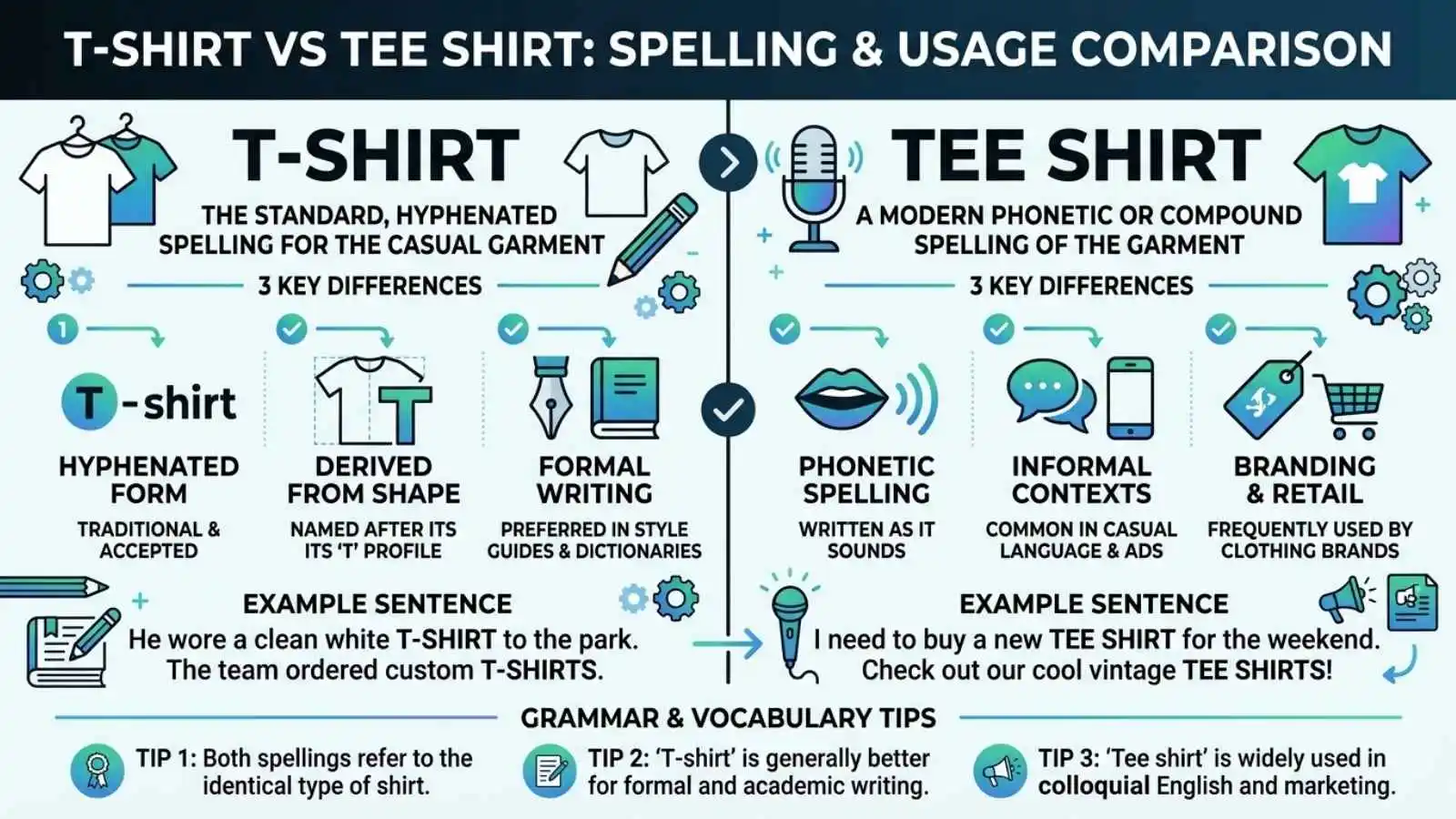
You are writing about a plain, comfy shirt with short sleeves. You type the word. Then you stop. Is it “t-shirt”? Or is it “tee shirt”? Maybe even “teeshirt,” all as one word? You have seen it written in more than one way, and now you are not sure which one is right.
This mix-up happens a lot. The word shows up on shopping sites, in ads, and in daily talk. Since people see it spelled in different ways online, they are not always sure which form to use in their own writing.
Here is the simple truth. Both “t-shirt” and “tee shirt” are used and understood. But one form is far more common today, especially in stores, ads, and everyday writing.
In this guide, you will get a fast answer first. Then you will learn where the word comes from, why it is spelled in more than one way, and which form to use so your writing looks clean and normal.
T-Shirt vs Tee Shirt – Quick Answer
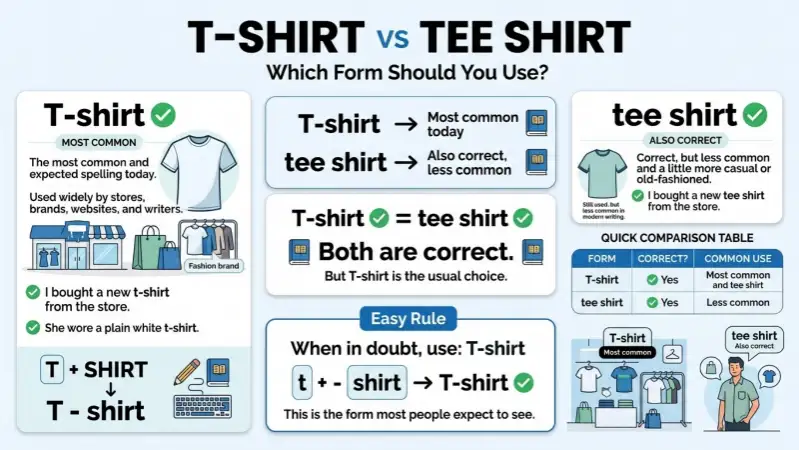
T-shirt is the most common and most expected spelling today. Most stores, brands, and writers use this form.
Tee shirt is also correct and still used, but it feels older or a bit more casual. It shows up less often in modern writing.
Simple examples:
- “I bought a new t-shirt from the store.” ✅ (most common)
- “I bought a new tee shirt from the store.” ✅ (also correct, less common)
- “She wore a plain white t-shirt.” ✅ (best choice for most writing)
Easy rule: when in doubt, use “t-shirt,” with a small letter “t,” a dash, and the word “shirt.” This is the form most people expect to see.
Where Does This Word Come From?
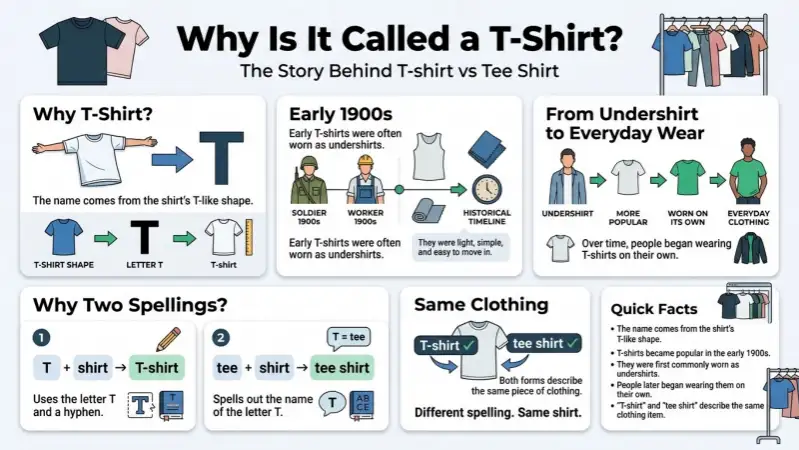
The word “t-shirt” gets its name from its shape. When you lay the shirt flat, with the arms spread out, it looks like the letter “T.” This simple, visual idea is the whole reason behind the name.
The shirt itself became popular in the early 1900s. At first, it was worn as an undershirt, often by soldiers and workers, since it was light, simple, and easy to move in. Over time, people began wearing it on its own, as a regular piece of clothing, not just something worn underneath other clothes.
As the shirt became more popular, writers needed a simple way to describe it in print. Some writers picked “T-shirt,” using the letter “T” plus a dash, since that matched the shape idea closely. Others wrote it out fully as “tee shirt,” spelling out the letter name “tee” instead of using the single letter “T.”
Both forms describe the exact same piece of clothing. The difference is only in how the word is written, not in what the shirt actually is.
British English vs American English Spelling
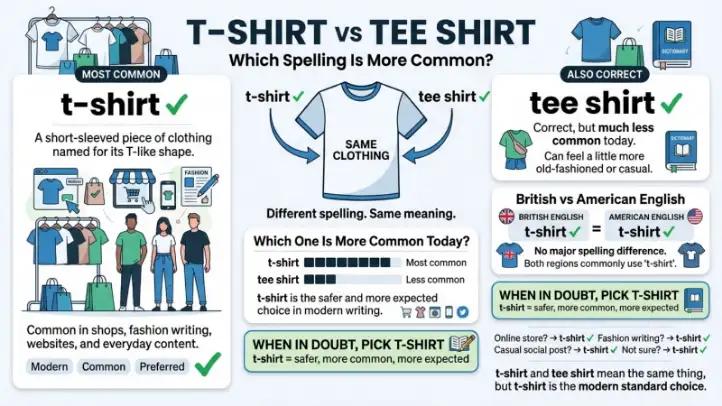
This is an important point to clear up. T-shirt and tee shirt are not a British versus American spelling case, like “colour” and “color.” Both forms are used and understood in every English-speaking country. There is no clear rule where one country always uses one spelling and another country always uses the other.
| Feature | American English | British English |
| Common spelling | T-shirt | T-shirt |
| Less common spelling | Tee shirt | Tee shirt |
| Regional rule? | No clear rule | No clear rule |
| Used in stores and ads | Very often | Very often |
| Used in casual writing | Sometimes | Sometimes |
So if you were hoping for a simple country-based rule, there isn’t one here. “T-shirt” is simply the stronger, more common choice almost everywhere in the English-speaking world, no matter the country.
Which Spelling Should You Use?
Since there is no country rule, the choice becomes very simple.
- Writing for American readers? Use “t-shirt.” It is the clear, expected choice.
- Writing for British or Commonwealth readers? Use “t-shirt” too. It is just as common there.
- Writing for a global audience, like an online store? “T-shirt” is still the safest pick. It is the spelling most readers expect and recognize right away.
- Writing something casual, like a personal blog or a text message? “Tee shirt” is still fine here, and some people even shorten it further to just “tee,” as in “I love this tee.”
In almost every case, one simple rule works: pick t-shirt. It looks clean, modern, and matches what most stores and writers use today.
Common Mistakes with T-Shirt and Tee Shirt
Here are the mistakes people make most often, and how to fix them.
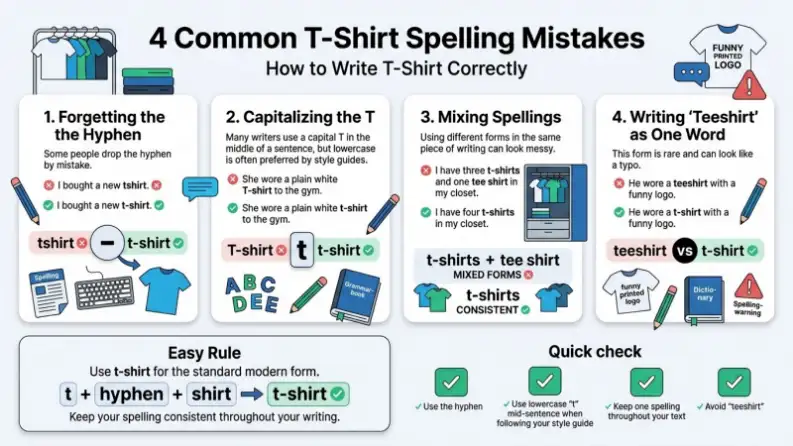
1: Forgetting the dash in “t-shirt” Some people drop the dash by mistake.
- ❌ “I bought a new tshirt.”
- ✅ “I bought a new t-shirt.”
2: Capitalizing the “t” in the middle of a sentence Since the letter “T” refers to the shape, some writers capitalize it out of habit, even in the middle of a sentence.
- ❌ “She wore a plain white T-shirt to the gym.” (capital “T” is often used, but many style guides prefer lowercase mid-sentence)
- ✅ “She wore a plain white t-shirt to the gym.”
3: Mixing spellings in the same piece of writing This can look messy to the reader.
- ❌ “I have three t-shirts and one tee shirt in my closet.”
- ✅ “I have four t-shirts in my closet.”
4: Writing “teeshirt” as one solid word This form is rare and can look like a typo.
- ❌ “He wore a teeshirt with a funny logo.”
- ✅ “He wore a t-shirt with a funny logo.”
T-Shirt in Everyday Examples
In an email: “Please confirm the size and color for the t-shirt order before we ship it.”
In news writing: “The band released a limited run of t-shirts for their world tour.”
On social media: “Just designed my own t-shirt for the summer, so excited to wear it! “
In formal writing: “Employees are required to wear a plain t-shirt under the uniform jacket.”
Notice how “t-shirt” fits smoothly into shopping, fashion, and everyday talk. It works the same way in casual posts and more formal writing.
T-Shirt vs Tee Shirt – Google Trends and Usage Data
Search data shows that “t-shirt” is searched far more often than “tee shirt” all over the world. Shopping sites, clothing brands, and fashion blogs almost always use “t-shirt” in their writing and product names.
Searches for “tee shirt” still happen, but in smaller numbers. Many of these searches come from people checking spelling, or from older or more casual writing styles that stuck with the fuller “tee” spelling.
By region:
- United States: “T-shirt” is the clear standard in stores, ads, and everyday writing.
- United Kingdom and Commonwealth countries: “T-shirt” is just as common, showing up the same way in shops and fashion writing.
- Global online shopping: “T-shirt” dominates product listings and search results almost everywhere, making it the safer choice for online stores and global brands.
Word Comparison Table
| Spelling | Correct? | How Common | Best Use |
| T-shirt | Yes | Very common | Shopping, fashion, everyday writing |
| Tee shirt | Yes | Less common | Casual or older-style writing |
| Teeshirt | Yes (rare) | Rare | Not recommended, looks like a typo |
| Tee | Yes | Common (short form) | Casual talk, like “I love this tee” |
FAQs:
1. Is “tee shirt” a real, correct spelling? Yes. It is a real, correct spelling. It is just less common today than “t-shirt.”
2. What does “t-shirt” mean? It is a simple, short-sleeved shirt, named after its “T” shape when laid flat.
3. Is “t-shirt” a British or American spelling? Neither. Both British and American English mostly use “t-shirt.” There is no clear split by country.
4. Can I use “t-shirt” and “tee shirt” in the same piece of writing? It is better not to. Pick one spelling and stay with it throughout your writing.
5. Why do some people just say “tee”? “Tee” is a short, casual way to refer to a t-shirt, often used in fashion talk or casual conversation, like “I bought a cool graphic tee.”
6. Which spelling should I use for a business or store? Use “t-shirt.” It is the modern, expected spelling in shopping and product listings.
7. Does the dash in “t-shirt” ever get left out? Sometimes, especially in casual writing or logos, people write “tshirt” without a dash. This is common in branding but is not the standard spelling for formal writing.
Conclusion:
“T-shirt” and “tee shirt” both describe the same simple, short-sleeved piece of clothing, named for its flat, “T” shape. But they are not equally common today. “T-shirt” is the spelling used in shops, fashion writing, and everyday content around the world. “Tee shirt” still exists and is not wrong, but it shows up far less often and can feel a bit more old-fashioned or casual.
This is not a British versus American spelling question. Both regions lean toward the same spelling: t-shirt. The real difference comes down to habit and modern use, not location.
If you ever feel stuck between the two, just remember this simple rule: pick t-shirt. It is the safer, more expected spelling in nearly every kind of writing, from online stores to casual social posts. Once you know this small fact, you will never have to pause and guess again.

Welcome to the official author page of Clara Wordsmith, grammar writer at Wordnomic. Clara specializes in explaining confusing English words, grammar rules, spelling differences, and vocabulary topics with clear examples and beginner-friendly explanations.