You are writing a report. They want to connect two ideas, showing that one thing led to another. You type a word. Then you stop. Should it be “therefore”? Or should it be “thereby”? They look close. They both start with “there.” But they do not do the same job in a sentence.
This mix-up happens a lot, mostly in formal writing like reports, essays, and work emails. Both words connect ideas and show a link between them. But one word points to a result, and the other word points to a method or a way something happened. Because they look and sound so close, people often use one when they mean the other.
People look up “therefore vs thereby” because they want their writing to sound clear and correct. Formal writing often uses these words, so picking the wrong one can make a sentence confusing, even if the reader can still guess your meaning.
This guide gives you a fast answer first. Then it shows you where both words come from, how to use each one, and simple tricks to keep them apart for good.
Therefore vs Thereby – Quick Answer
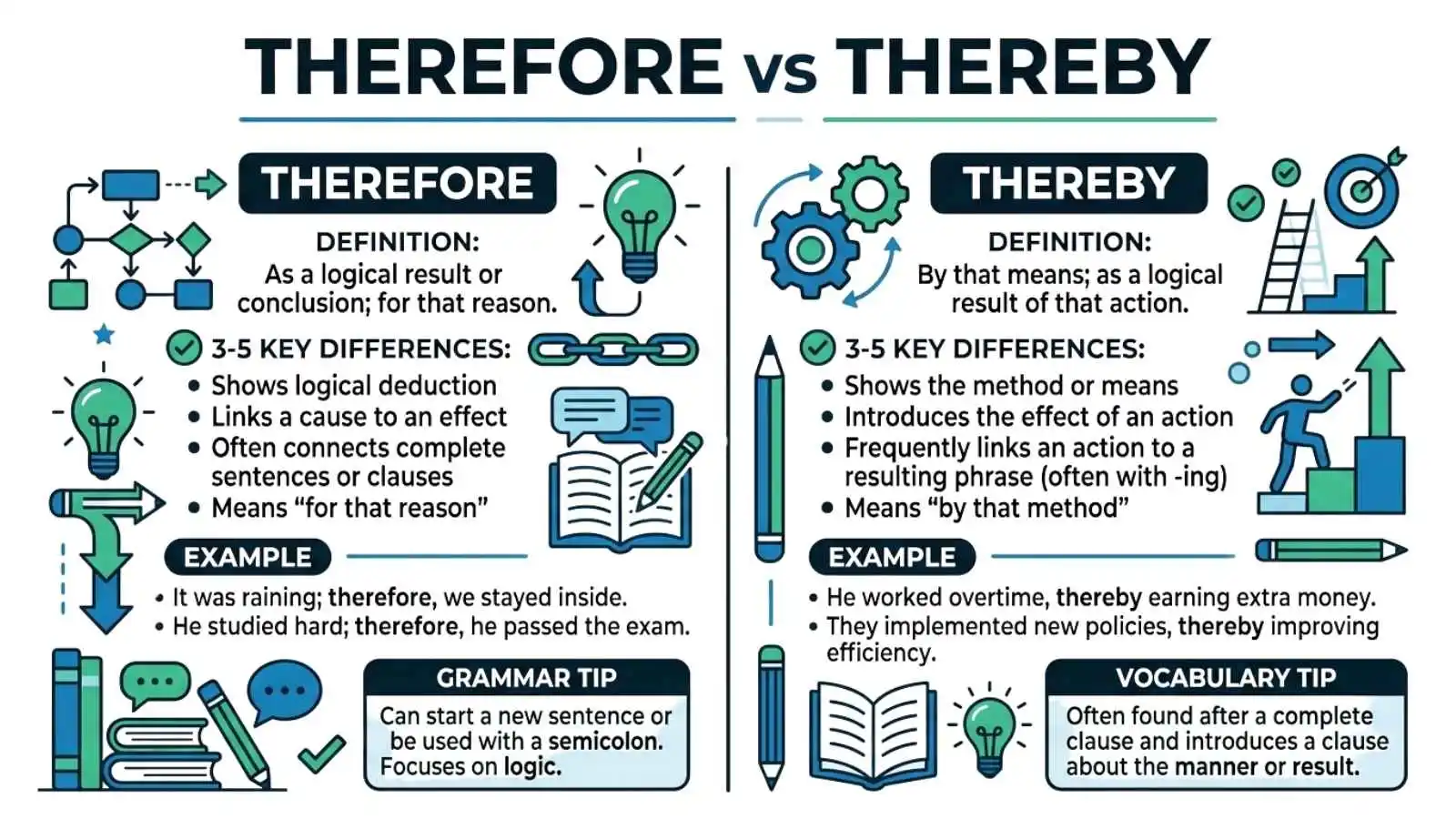
Both words connect ideas, but they point in two different directions.
- Therefore = as a result, so, or because of this. It shows a result or a conclusion.
- Thereby = by that action, or through that means. It shows how something happened, not the result of it.
Simple examples:
- “The store was closed. Therefore, we went home.” ✅ (shows a result)
- “She signed the form, thereby agreeing to the new rules.” ✅ (shows the method or way)
- “He studied hard and therefore passed the test.” ✅ (shows a result)
- “The company cut costs, thereby saving money.” ✅ (shows how something happened)
In short: “therefore” shows a result. “Thereby” shows the method or action that made something happen.
Where Do These Words Come From?
Both words come from Old English, built from the small word “there” plus another small word added to the end. Over time, English speakers combined “there” with different endings to build a whole group of formal connecting words, like “thereby,” “therefore,” “thereafter,” and “therein.”
Therefore comes from “there” plus “fore,” an old form of “for,” meaning “because of” or “on account of.” So “therefore” originally meant something close to “for that reason.” Over time, it settled into its modern job: showing that one thing is the direct result of another.
Thereby comes from “there” plus “by,” where “by” carries the old sense of “through” or “by means of.” So “thereby” originally meant something close to “by that way” or “through that action.” It kept this meaning over time, and today it still points to the method or action that caused something to happen, not just the result.
So both words are built the same way, from “there” plus a small added word. But the small added part, “fore” or “by,” pushed each word toward a different job: one toward showing a result, and one toward showing a method.
British English vs American English Spelling
This is an important point to clear up. Therefore and thereby are not a British versus American spelling pair, like “colour” and “color.” Both words are spelled the exact same way in every English-speaking country. There is no regional spelling split here.
| Feature | American English | British English |
| Spelling of “therefore” | Same | Same |
| Spelling of “thereby” | Same | Same |
| Meaning of “therefore” | Shows a result | Shows a result |
| Meaning of “thereby” | Shows a method or action | Shows a method or action |
| Regional spelling difference | None | None |
So there is no spelling rule to learn here, like “colour” and “color.” Both words are correct everywhere. The real task is knowing which meaning fits your sentence.
Which Word Should You Use?
Since spelling stays the same everywhere, the right word depends on what you want to say.
- Showing a result or conclusion? Use “therefore.” Example: “The bridge is closed. Therefore, take the other route.”
- Showing how something happened, or the method behind it? Use “thereby.” Example: “She finished the course early, thereby earning a bonus.”
- Writing a formal report, essay, or business document? Both words fit well in this kind of writing, as long as you pick the one that matches your meaning.
- Writing something casual, like a text or a quick note? Simpler words like “so” or “that way” often feel more natural than either “therefore” or “thereby” in casual talk.
If you are ever unsure, ask yourself this: am I showing a result, or am I showing the action or method that caused something? That question will guide you to the right word almost every time.
Common Mistakes with Therefore and Thereby
Mistakes
1: Using “therefore” when you mean a method
- ❌ “She worked extra hours, therefore finishing the project early.”
- ✅ “She worked extra hours, thereby finishing the project early.”
2: Using “thereby” when you mean a result
- ❌ “It started raining, thereby we stayed inside.”
- ✅ “It started raining, therefore we stayed inside.”
3: Overusing either word in casual writing Both words feel formal. Using them too much in a casual email or text can sound stiff or unnatural.
- Instead of: “I finished my homework, therefore I can watch TV now.”
- Try: “I finished my homework, so I can watch TV now.”
Mistake 4: Placing “thereby” incorrectly in a sentence “Thereby” usually comes right before the action it explains, often paired with an “-ing” word.
- ❌ “Thereby, she saved a lot of money by shopping early.”
- ✅ “She shopped early, thereby saving a lot of money.”
Therefore and Thereby in Everyday Examples
In an email: “The system was updated last week and therefore should now run faster.”
In news writing: “The company merged with its rival, thereby creating one of the largest firms in the industry.”
On social media: “Studied all weekend, therefore feeling ready for the exam tomorrow! “
In formal writing: “The court found the contract invalid, thereby releasing both parties from their obligations.”
Notice how “therefore” often shows up when explaining a result or a next step. “Thereby” often shows up when explaining exactly how something was achieved or caused.
Therefore vs Thereby – Google Trends and Usage Data
Search data shows that “therefore” is searched and used far more often than “thereby.” This makes sense, since showing a result is something people need to do constantly in daily writing, from emails to essays to news articles. “Thereby” is used less often, mostly in formal writing, legal documents, and academic papers, where explaining an exact method or action matters more.
By region:
- United States: “Therefore” appears constantly in business writing, emails, and everyday explanations. “Thereby” shows up mostly in formal or legal writing.
- United Kingdom and Commonwealth countries: The same pattern holds, with “therefore” common in daily writing and “thereby” reserved for more formal or academic contexts.
- Global academic and legal writing: “Thereby” remains a steady, useful word in contracts, research papers, and official documents worldwide.
Word Comparison Table
| Word | Type | Common Meaning | Example |
| Therefore | Connecting word | Shows a result or conclusion | “It rained, therefore we stayed home.” |
| Thereby | Connecting word | Shows a method or action | “She saved money, thereby reaching her goal.” |
| So | Connecting word | Casual version of “therefore” | “It rained, so we stayed home.” |
| By doing so | Phrase | Casual version of “thereby” | “She saved money, and by doing so, reached her goal.” |
FAQs
1. Can “therefore” and “thereby” be used in the same sentence? Yes, though it is not common. Each word does a different job, so using both together should only happen if both a result and a method are being shown clearly.
2. Which word is more common in everyday writing? “Therefore” is far more common, since showing a result comes up constantly in daily writing and speech.
3. Is there a British versus American spelling difference between these words? No. Both words are spelled and used the same way in British and American English.
4. Can I use “so” instead of “therefore”? Yes. “So” is a simpler, more casual way to say the same thing as “therefore,” and it works well in everyday writing and speech.
5. What is a simple way to remember the difference? Think of “therefore” as pointing to “the result,” and “thereby” as pointing to “the way” something happened.
6. Is “thereby” only used in formal writing? It is most common in formal, legal, and academic writing, but it can also appear in careful everyday writing when explaining a method clearly.
7. Can “thereby” start a sentence? It is possible, but it is far more natural to place “thereby” later in the sentence, right before the action it explains.
Conclusion:
“Therefore” and “thereby” both come from “there” plus a small added word, but they grew into two different jobs in a sentence. “Therefore” shows a result, a conclusion, or a “because of this” idea. “Thereby” shows the method or action that caused something to happen.
There is no British versus American spelling difference here. Both words are spelled the same everywhere, and the real key is knowing which meaning fits your sentence: a result, or a method.
Next time you are choosing between these two words, ask yourself one simple question: am I showing what happened as a result, or am I showing how it happened? That question will help you pick the right word with confidence every time.

Welcome to the official author page of Clara Wordsmith, grammar writer at Wordnomic. Clara specializes in explaining confusing English words, grammar rules, spelling differences, and vocabulary topics with clear examples and beginner-friendly explanations.










